![[BlueTrend Mini Classroom] Beautiful Predators — A Shark Field Guide](/_images/7141367938f1-1440w.webp)
the Editor says: Sharks — treasured sightings for divers worldwide — first appeared on Earth approximately 420 million years ago and have since evolved into more than 500 distinct species. From the Whale Shark, as large as a truck, to the dwarf lanternshark at just 30 cm, the range in size is extraordinary. Yet most divers know surprisingly little about shark behavior. Reading Beautiful Predators — A Shark Field Guide is sure to open the door to the mysterious world of sharks!

Beautiful Predators — A Shark Field Guide
Most people's impressions of sharks are shaped by movies — from the 1975 American blockbuster Jaws to the more recent The Meg — in which directors portray sharks as the ultimate symbol of terror. As divers, however, we feel an inexplicable longing for them. Many people spend small fortunes traveling abroad just to swim alongside Hammerhead Sharks. But out of the 500-plus shark species in the world, how many do you actually know?
In fact, there is a remarkable variety of sharks — not just the terrifying great white from Jaws, but also the largest fish in the sea, the Whale Shark (Rhincodon typus); the epaulette shark (Hemiscyllium ocellatum), which uses its pectoral and pelvic fins to "walk"; the banded houndshark (Heterodontus japonicus), commonly seen in aquariums; the cloudy catshark (Cephaloscyllium umbratile), whose embryos can be seen right through the egg case; and the scalloped Hammerhead Shark (Sphyrna lewini), with a head shaped like a bell striker — among more than 500 species worldwide.
Beautiful Predators — A Shark Field Guide opens with an extensive introduction to 66 relatively common shark species — including the Whale Shark, Hammerhead Shark, great white, and silvertip shark — using photographs and text to explain the unique behaviors of each species (habitat, diet, hunting strategies, and more), as well as whether that particular shark is likely to bite humans. For readers eager to learn about sharks, this book is essentially a definitive shark field guide.
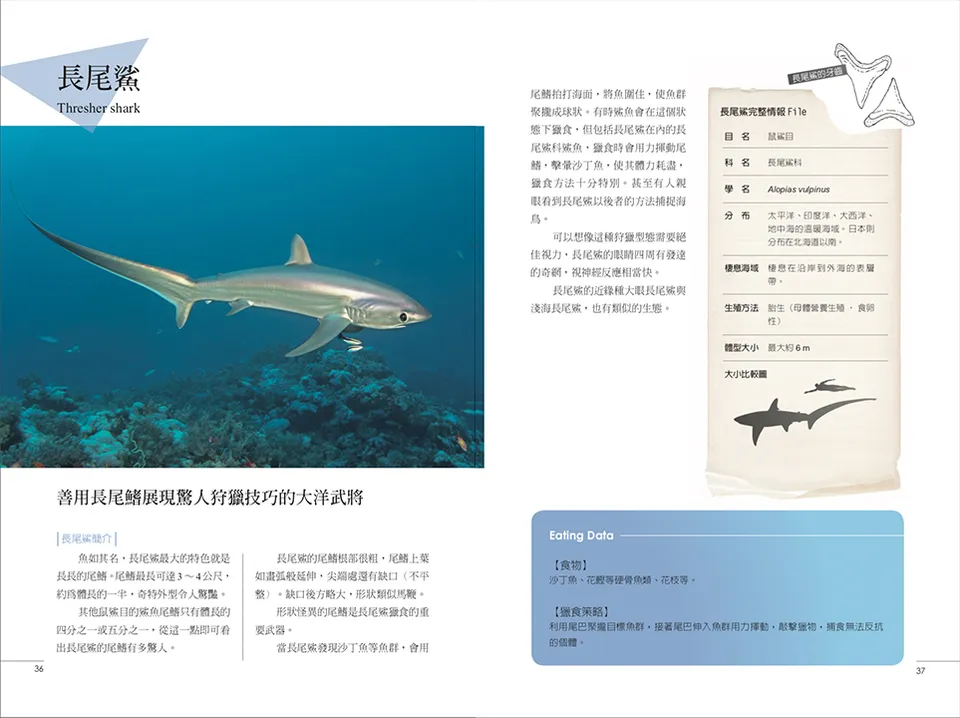
How are sharks classified? What anatomical structures make up a shark's body? In what geological era did sharks first appear? These are the kinds of foundational questions that help us understand shark taxonomy and evolutionary relationships. To explore shark ecology further, the book also covers diet, movement, habitat, natural predators, reproduction, and lifespan. As apex predators in the food chain, sharks prey on organisms lower in the hierarchy — typically the weakest individuals within a given population. The law of the jungle governs nature: even the fearsome great white shark is but a small part of the grand picture, yet it is one of the most critical links in maintaining the balance of marine ecosystems.
After the shark profiles, the author thoughtfully shares 21 Japanese aquariums where visitors can observe sharks up close. The book also devotes considerable space to the history of sharks in cinema and to how Japanese people have incorporated sharks into their crafts and daily lives throughout history — making it a book that goes beyond shark biology to explore the long-running relationship between sharks and human civilization.
In some countries, fishermen take only the fins and discard the rest of the shark's body back into the sea, resulting in severe resource waste. According to the 2015 IUCN Red List of Threatened Species published by the International Union for Conservation of Nature, as many as ten shark species are classified as Critically Endangered (CR) — meaning they face an extremely high risk of extinction in the near future (equivalent to Japan's Ministry of the Environment Category IA). An additional fourteen shark species are listed as Endangered (EN) — at high risk of extinction in the near future (equivalent to Japan's Ministry of the Environment Category IB). Put simply, sharks occupy the top of the ecological pyramid: a stable and diverse shark population in a given sea area is, to a significant degree, an indicator of a healthy marine environment. (It is hard not to feel a pang of sadness when we consider that sharks have largely disappeared from most dive sites in Taiwan.)
Humans tend to wildly exaggerate the threat sharks pose. According to U.S. statistics, only 26 people died from shark attacks between 1959 and 2010 — an average of just 0.5 deaths per year. By contrast, obesity claims approximately 150,000 lives per year — an average of more than 25,000 annually. The odds of being killed by a shark are, comparatively, extremely low.


What Should You Do If You Encounter a Shark?
The book does share some self-defense tips in case you are unlucky enough to be targeted by a shark:
-
Stay calm and get out of the water or onto a boat immediately.
-
Keep your eyes on the shark and do not swim away with your back turned. You can use a stick to intimidate it or create air bubbles to scare it off.
-
If the shark actually attacks, strike its eyes or gills to frighten it.
-
If you successfully fend off the shark, don't let your guard down — keep watching to make sure it doesn't come back for another pass!
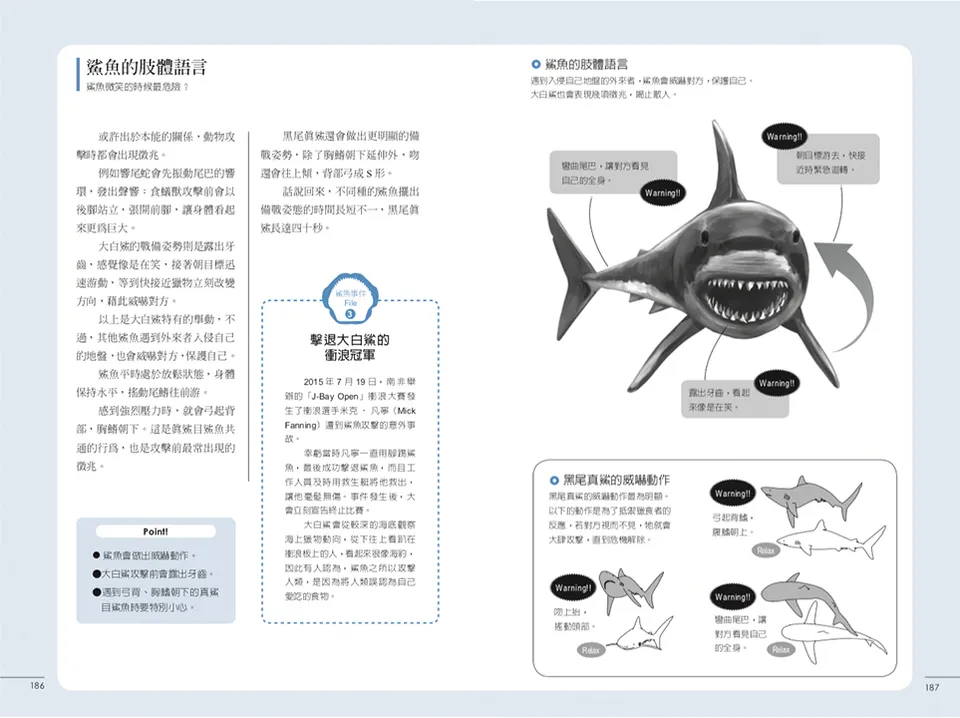
Finally, the book also covers various shark behavioral patterns, including hunting habits and the reproductive process. Perhaps most fascinating of all is the chapter on shark body language — it turns out that sharks, much like cats, have a full set of behavioral cues they display before launching an attack!
If you're a shark chaser like the Editor, this is one book we highly recommend adding to your collection — a deep dive into one of the ocean's most ancient and mysterious species!
(Excerpted from 《Beautiful Predators — A Shark Field Guide》, published by 晨星出版社. Lead image source: Pxhere, CC licensed.)

![[Ocean Reads] Give Yourself a Chance to Rediscover the Ocean — *Ocean Taiwan: A Record of the Great Blue Territory*](https://pub-7117f6d00fe54a2fb80f641ab6cb850d.r2.dev/posts/2021-01-21-ocean-taiwan/images/7東沙島小瀉湖口是台灣少數能輕易看到鯊魚、魟魚的重要海域,常見檸檬鯊幼鯊,但東沙島航道疏濬計畫,引發鯊魚棲地危機。(攝影/Zola-Chen).jpg)