Contents(10)
- Shell Classification: Tun Shells, Frog Shells, Tritons & Helmet Shells
- A. Tun Shells (Tonnidae):
- B. Frog Shells & Tritons (Bursidae & Ranellidae):
- C. Helmet Shells (Cassidae):
- Shell Classification: Murex Snails
- Shell Classification: Buccinum Whelks, Latirus Spindles & Fusus
- A. Whelks (Buccinidae):
- B. Latirus Spindles (Fasciolariidae):
- C. Fusus (Melongenidae):
- Shell Classification: Olive Shells, Miter Shells, Vase Shells & Volutes
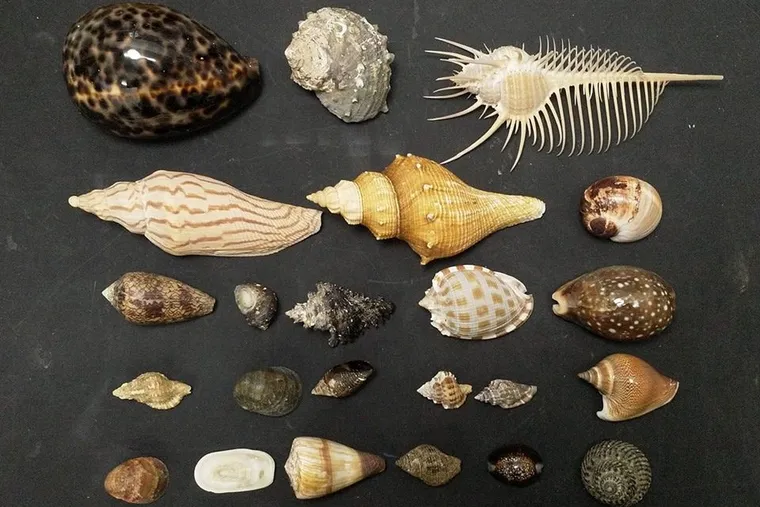
Shells carry more than just the ocean breeze and sea spray — they hold our memories of the sea.
After hundreds of millions of years of evolution, shells have taken on forms that far exceed the imagination of most people.
Like magnificent flowers in full bloom, or the solemn ziggurat towers of ancient Babylon.
Like Celtic spears, or industrial-age screws.
Like ore from the earth's core, or glistening morning dewdrops.
Embrace the ocean, and you're sure to encounter these remarkable creatures!
-
Recapping the previous installment, we covered:
1. Abalones, limpets, slit shells (flat shells)
2. Trochus, turban snails, crown-of-thorns (tower-shaped shells)
3. Cowries, ovulids, cyphoma (oval shells)
4. Cone snails, conchs, ficus shells (narrow, elongated apertures)
5. Nerites, moon snails (semicircular apertures)
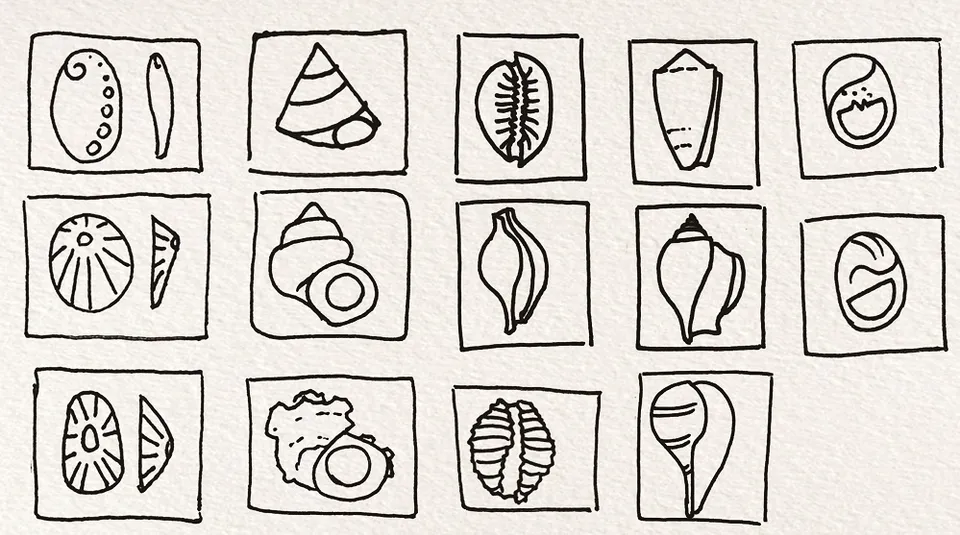
14 shell families
The 14 families and their examples may seem a little overwhelming at first.
Feel free to choose whichever family interests you most and start there.
According to informal surveys, the families most popular with the general public tend to be:
cowries, murex snails, cone snails, and conchs.
So rather than trying to learn many families at once, focusing your energy on just a few is a perfectly valid approach!
This time, we'll take a brief look at:
1. Tun shells, frog shells, tritons, and helmet shells
2. Murex snails
3. Buccinum whelks, latirus spindles, and fusus
4. Olive shells, miter shells, vase shells, and volutes
The difficulty level will gradually increase. If you haven't yet looked up the search keywords from last time,
try searching for related example images — it really helps!
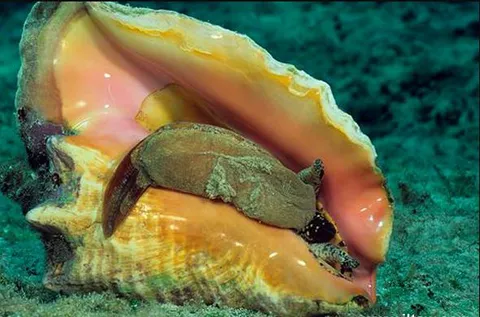
The Queen Conch, a CITES-listed species (Image source: 每日頭條)
-
Shell Classification: Tun Shells, Frog Shells, Tritons & Helmet Shells
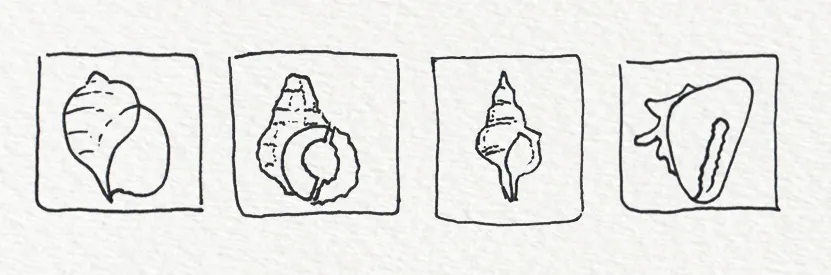
All belonging to the superfamily Tonnoidea, we can break identification into three parts based on appearance.
A. Tun Shells (Tonnidae):
The shell is thin with a plastic-like texture. Sizes commonly exceed 10 cm. The flesh is plentiful and easy to obtain, and it is often stir-fried as a drinking snack. You can compare it with the harp shell (not covered in this installment).
-
Family Tonnidae: Chinese tun Tonna chinensis (Dillwyn, 1817)
-
Family Harpidae: Giant harp Harpa major (Röding, 1798)
※ The "plastic-like" feel is something easier to notice when you actually hold the shell in your hands.
B. Frog Shells & Tritons (Bursidae & Ranellidae):
At first glance, the two can look somewhat similar, but frog shells have a shorter posterior siphonal canal (the notch along the lower edge of the aperture) and more prominent tubercles, while tritons have a longer posterior canal and more distinct axial ribs.
-
Family Bursidae: Gold-mouthed frog shell Tutufa rubeta (Linnaeus, 1758)
-
Family Ranellidae: Nicobar triton Monoplex nicobaricus (Röding, 1798)
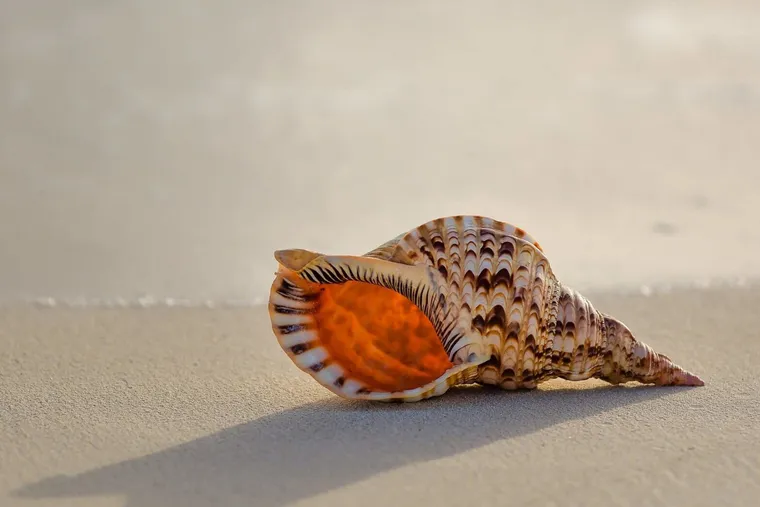
※ The much-talked-about "Giant Triton" has been moved from the family Ranellidae (formerly known as Cymatiidae) to Charoniidae (Powell, 1933).
※ The common fishing-port shell known as the "White Triton" and the multi-country protected species "Giant Triton" can be distinguished by the black lines on the inner lip.
※ The "Indian chank" used as a religious instrument, and the massive "Australian trumpet" that can be used as a horn, do not belong to the family Ranellidae.
C. Helmet Shells (Cassidae):
The most famous among them, the Cassis cornuta, takes its Chinese name ("Tang Crown Shell") from its resemblance to the official headgear of Tang Dynasty officials. Its large size makes it an easy target for collectors, and wild Taiwanese specimens have become increasingly rare in recent years. Under the family Cassidae, there are also various other groups such as Phalium, Galeodea, and Cypraecassis.
- Family Cassidae: Horned helmet Cassis cornuta (Linnaeus, 1758)
※ The horned helmet is one of the classic materials used in shell carving.
※ The well-known "Cypraecassis rufa" (bull-mouth helmet) also belongs to the Cassidae family; once processed, it becomes "bull-mouth helmet beads," which have been fraudulently sold as "blood clam pearls."
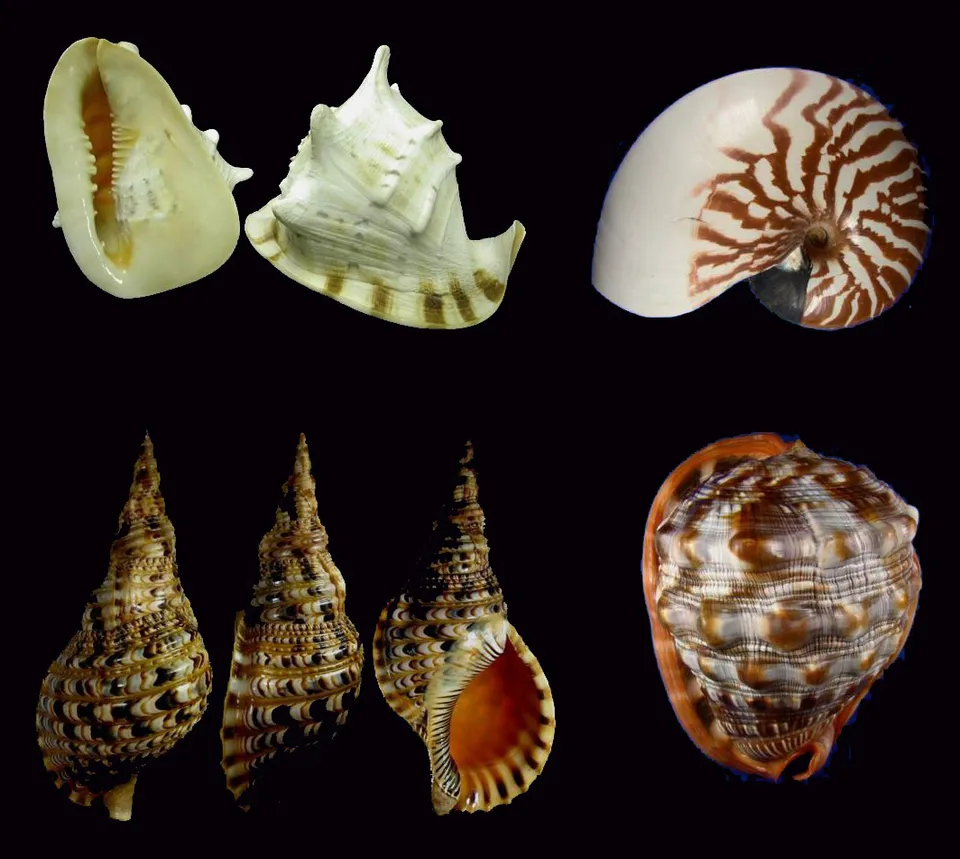
Commonly called the "Four Great Shells," they are fast becoming the "Four Great Tourist Shells" as their populations dwindle. Please refuse to catch or buy them. (Image source: 3d圖庫網)
-


Shell Classification: Murex Snails

Murex Snails
There is a reason murex snails deserve their own dedicated category. The variation in shell shape is so vast, and the classification system so complex,
that we could almost subdivide them into several families of their own. However, following the taxonomy of the well-known biological database WoRMS,
the superfamily Muricoidea currently contains only the family Muricidae, followed by several subfamilies, and a rich and diverse array of genera beneath them.
※ The classification hierarchy can be imagined as: (large box > box > small box > individual pouch > shell) corresponding to (superfamily > family > subfamily > genus > species).
As a popular and varied group, murex snails go by many colorful common names:
thousand-hand murex, coral murex, fairy murex, onion murex, banana murex, ginkgo murex, olive murex, latiaxis, knobbed murex, rock shell…
Fascinating, isn't it! So the next time you encounter an unfamiliar shell (especially a spiny one), your first guess should be: murex snail.
-
Family Muricidae: Taiwan fairy murex Babelomurex spinosus (Hirase, 1908)
-
Family Muricidae: Venus comb murex Murex pecten (Lightfoot, 1786)
-
Family Muricidae: Adusta murex Chicoreus brunneus (Link, 1807)
-
Family Muricidae: Contracted cantharus Ergalatax contracta (Reeve, 1846)
※ Readers interested in shell lore are encouraged to search for the keyword "dye murex" (Murex brandaris).
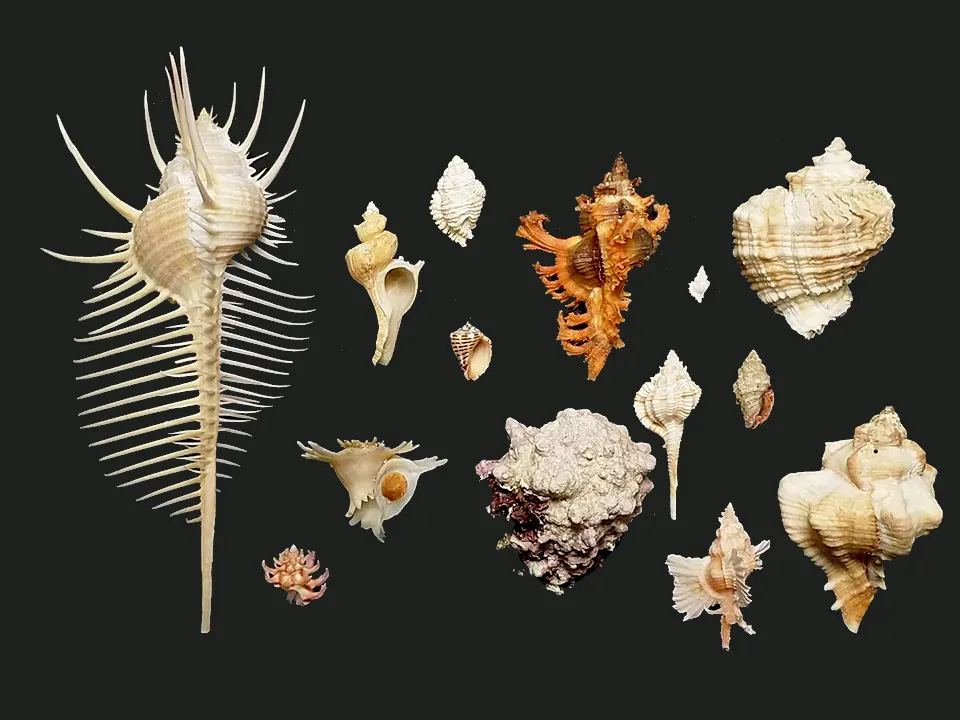
From left to right: murex, murex, murex… murex! If you missed that, we can introduce them again.
Shell Classification: Buccinum Whelks, Latirus Spindles & Fusus
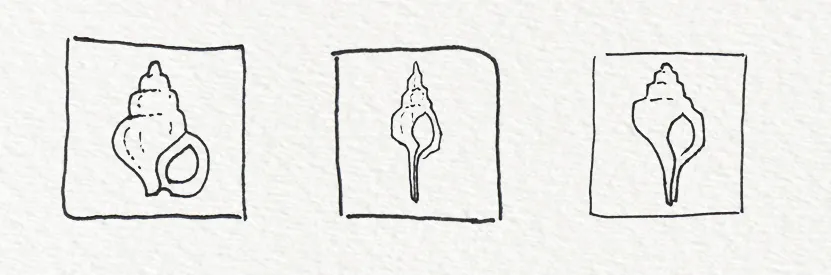
Buccinum whelks, latirus spindles, and fusus
All belonging to the superfamily Buccinoidea, we introduce the three groups separately:
A. Whelks (Buccinidae):
Although they lack the visual diversity of murex snails, they are equally complex and difficult to identify. They are considered close relatives of strombid conchs (or strombids may be classified as a genus within Buccinidae). At night markets or tourist areas, you may occasionally come across ivory conch (commonly called "wind shell," often a mix of different species) or the European whelk (commonly called "jade shell").
- Family Buccinidae: Banded whelk Pollia undosa (Linnaeus, 1758)
※ Zebra whelk, true zebra whelk, small zebra whelk, and fine small zebra whelk are four distinct species — and have been reclassified into the family Pisaniidae.
※ The "rose whelk," originally in Buccinidae, has been reclassified into the family Nassariidae (not covered in this installment).
※ Nassariidae was originally split from Buccinidae; similarities in appearance, habitat, diet, and radula offer a glimpse into their shared origins.
B. Latirus Spindles (Fasciolariidae):
Relatively easier to identify than the previous group. Basically, if a shell has a tall spire and a long siphonal canal, and it isn't a turrid (not covered in this installment), then there is a 70–80% chance it's a fasciolariid spindle. Although the two look similar, there is one small detail to check: examine the outer lip notch for comparison.
-
Family Fasciolariidae: Polygon latirus Latirus polygonus (Gmelin, 1791)
-
Family Turridae: Java turrid Turricula javana (Linnaeus, 1767)
C. Fusus (Melongenidae):
Like the ivory conch and the crystal conch, this group has high economic value and is commonly found at fish markets, stir-fry restaurants, and fishing harbors, where it is colloquially known as "響螺" (resonance shell).
- Family Melongenidae: Ternate melon conch Brunneifusus ternatanus (Gmelin, 1791)
※ The frequently mentioned "left-handed fusus" belongs to the family Buccinidae, not Melongenidae.
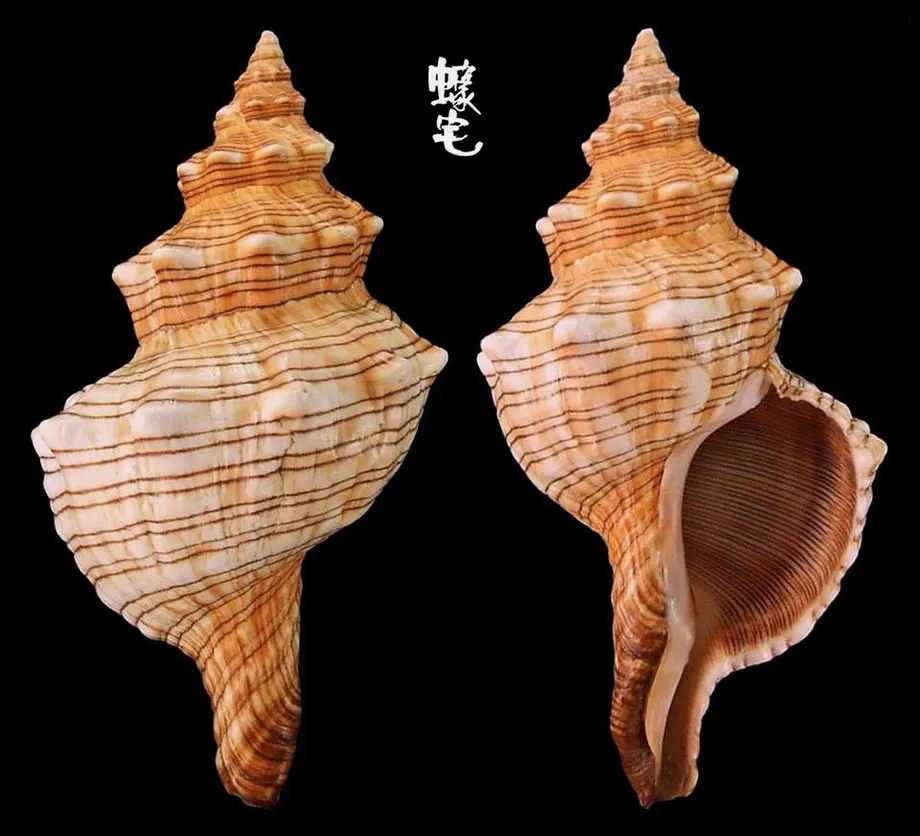
The angular latirus — a spindle shell occasionally found at the shore or in tourist souvenir shops (Image source: 蠔宅貝殼工作室)
-
Shell Classification: Olive Shells, Miter Shells, Vase Shells & Volutes
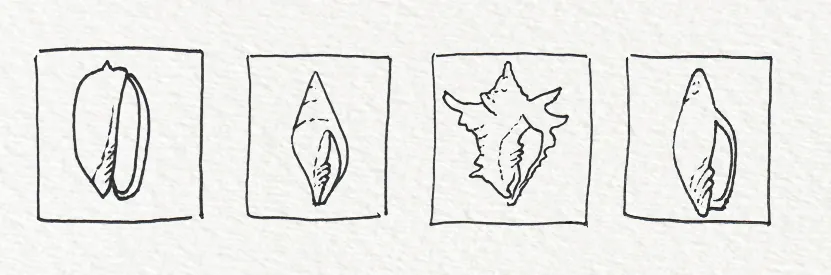
Olive shells, miter shells, vase shells, and volutes
These four types of shells frequently display columellar folds or similar features.
Simply put, along the left side of the aperture, you will often find several raised parallel folds (distinct from the folds seen on tritons).
Similar features can also be found on rice shells (not covered in this installment) and some nutmeg shells (not covered in this installment), though exceptions exist —
such as the bullet olive series within Olividae and the long flute volute series within Volutidae, which have very few or no such folds at all.
For beginners, however, using these folds as a guide to narrow down the identification to these four families is perfectly practical,
and it's a good habit for training your eye to observe shell characteristics.
For those just starting out, the cylindrical shape of olive shells can usually be spotted at first glance.
Shells with coarse spines or an especially long siphonal canal should be looked up under Vasidae (vase shells).
Shells with columellar folds and a rough, bullet-like surface point to miter shells (nearly no folds and a smooth surface point to olive-miters, family Olividae).
Large or medium-sized shells with beautiful patterning can be looked up under Volutidae (volutes).
-
Family Olividae: Red-mouthed olive Oliva miniacea (Röding, 1798)
-
Family Mitridae: Pontifical miter Mitra stictica (Link, 1807)
-
Family Vasidae: Turban vase Vasum turbinellus (Linnaeus, 1758)
-
Family Volutidae: Baler shell Melo melo (Lightfoot, 1786)
※ The "Indian chank," believed in religious traditions to possess magical powers, belongs to the family Vasidae — not Ranellidae!
※ Small flame miter, large flame miter, patterned flame miter, fine flame miter, and short flame miter are five distinct miter species.
※ The term "miter shell" can broadly refer to Mitridae, Costellariidae, and Volutomitridae — three complex and specialized families that we'll simply group together as the "miter shell complex" for now.
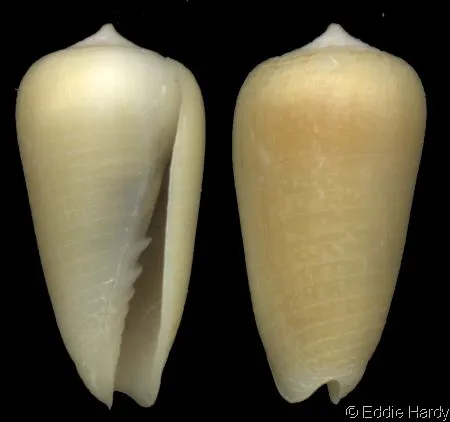
Imbricaria punctata — looks a lot like a cone snail, doesn't it! Take a close look at the columellar folds. (Image source: Eddie Hardy)
-
The 26 families introduced above offer only a broad overview and can only provide a basic framework for classification.
The ocean is vast and species are many — there will always be shells that are difficult to place using the categories above.
But with a basic understanding in hand, we now hold a key to the world of shells.
What that key unlocks is the ability to "look things up in a field guide."
After three installments of introductions, we hope you can pick up a shell book and not just flip through it blindly anymore.
At the very least, having a rough sense of the family in mind allows you to filter out 80% of unrelated shells.
For the remaining 20% of uncertainty, here are two particularly useful tips to share:
"Search by locality," and this point cannot be stressed enough.
You know that moment when you find a shell in the intertidal zone, but the field guide tells your eyes it's a rare deep-sea species?
(The purple-mouth cowrie vs. the black base cowrie is a classic example — like feeling under the weather and Googling your symptoms only to be told you have cancer.)
If you diligently record the locality information of your finds (location, depth, environment, time),
you can avoid the awkward situation of finding an ovulid in Taiwan and convincing yourself it might be an Australian porcelain cowrie.
(Even if they look alike, different species differ in size! Paying attention to measurements is also a useful aid for identification.)
"Preserve specimens in their original condition." It is essential to keep specimens intact. Inadvertently damaging shells is one of the most common pitfalls for beginners.
Common practices seen in tourist shells — such as wear and abrasion, acid washing, waxing, trimming, polishing, and mixing in opercula — can all damage the specimen.
Not only can these mislead identification, they strip the specimen of its scientific meaning and value.
It is far better to collect a single complete specimen for species documentation and comparative study than to take ten thousand shells and polish them into tourist decorations.
Only after learning to tell natural wear (from wave action and erosion) apart from man-made processing
can we begin to assess the condition of a shell and proceed with species identification.
The author will try to update a dedicated article on this topic as soon as possible.
-
Typing it all out and attaching images is still somewhat limited when it comes to actual identification.
The next installment will feature a selection of more varied shell types,
and we'll run through the 26-family framework from these three installments in a methodical, step-by-step classification exercise.
If you have unidentified shells at home, take them out and give it a try!
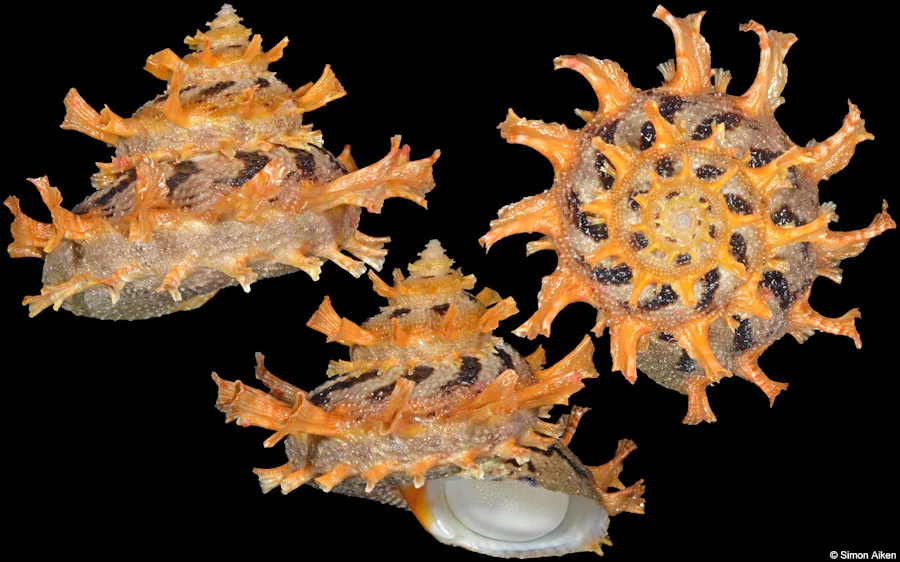
(Cover image: Stellaria solaris, the sunburst carrier shell — a highly popular shell among collectors.) (Image source: Jacksonvilleshells)
Related links: