Contents(5)
Plastic is the double-edged sword of modern life. It gives us instant access to a wide variety of beverages, keeps our food packaging safe — yet it has quietly crept onto our dinner tables, into our drinking water, and into the very air we breathe, becoming a largely invisible health threat. As the world turns its attention to the Global Plastics Treaty, searching for consensus on limiting plastic production and improving recycling at the source, the straw lodged in a sea turtle's nostril, the plastic bag draped over a coral reef, and the whale with a belly full of rubbish all remind us: plastic is not merely pollution — it is an urgent health and environmental crisis.
Living on this island, we do have a choice. From using fewer single-use utensils to choosing everyday products made from recycled plastic, every small change reduces the harm that plastic inflicts on the ocean and on us.
Since 2017, the Small and Medium Enterprise and Startup Administration (SMESA) under the Ministry of Economic Affairs has run the "Social Innovation Products and Services Procurement Incentive Mechanism," bringing together nearly a thousand social innovation organizations (hereinafter "social enterprises") that develop their business models around the United Nations Sustainable Development Goals (SDGs).
To encourage the public to respond to SDG 12 "Responsible Consumption and Production," SMESA launched the "Responsible Commerce" curated brand, selecting 80 products annually and promoting sustainable goods and services to consumers through the "Social Innovation Selection Catalog." Among these selections are social enterprises advancing sustainable action under SDG 14 "Life Below Water." This series of reports will share, from multiple perspectives — from daily shopping to local experiences — how the products and services of social enterprises can support marine conservation.
This article introduces 4 social enterprises using creativity and action to advocate plastic reduction, and shows how we can work toward a healthier living environment for ourselves and the ocean in our everyday lives.
Making Less Plastic the Norm — Reducing Plastic Is Easier Than You Think: Renzhou Zero Plastic
You've thought about switching to reusable containers to replace single-use items, but reality keeps getting in the way — lunch boxes are big and bulky, glass is heavy and breakable, and you end up back in the arms of disposable plastic. Renzhou Zero Plastic gets your frustration.
Their star product, the SilSeal food storage box, is made from 100% food-grade silicone — the same material as a baby's pacifier. It's soft and flexible enough to fold flat and save space, and it can transform from a lunch box into a plate. With a heat resistance range of -40°C to 200°C, it handles freezing, refrigeration, microwaving, oven use, rice cookers, and dishwashers with no problem. The one-piece, seamless design eliminates the gasket grooves where mould and grime tend to accumulate, saving you the annual cost of replacing seals. If odours or staining build up over time, simply soak with fresh lemon slices or use boiling water with sodium percarbonate to restore it — then keep on reducing plastic in your daily life.
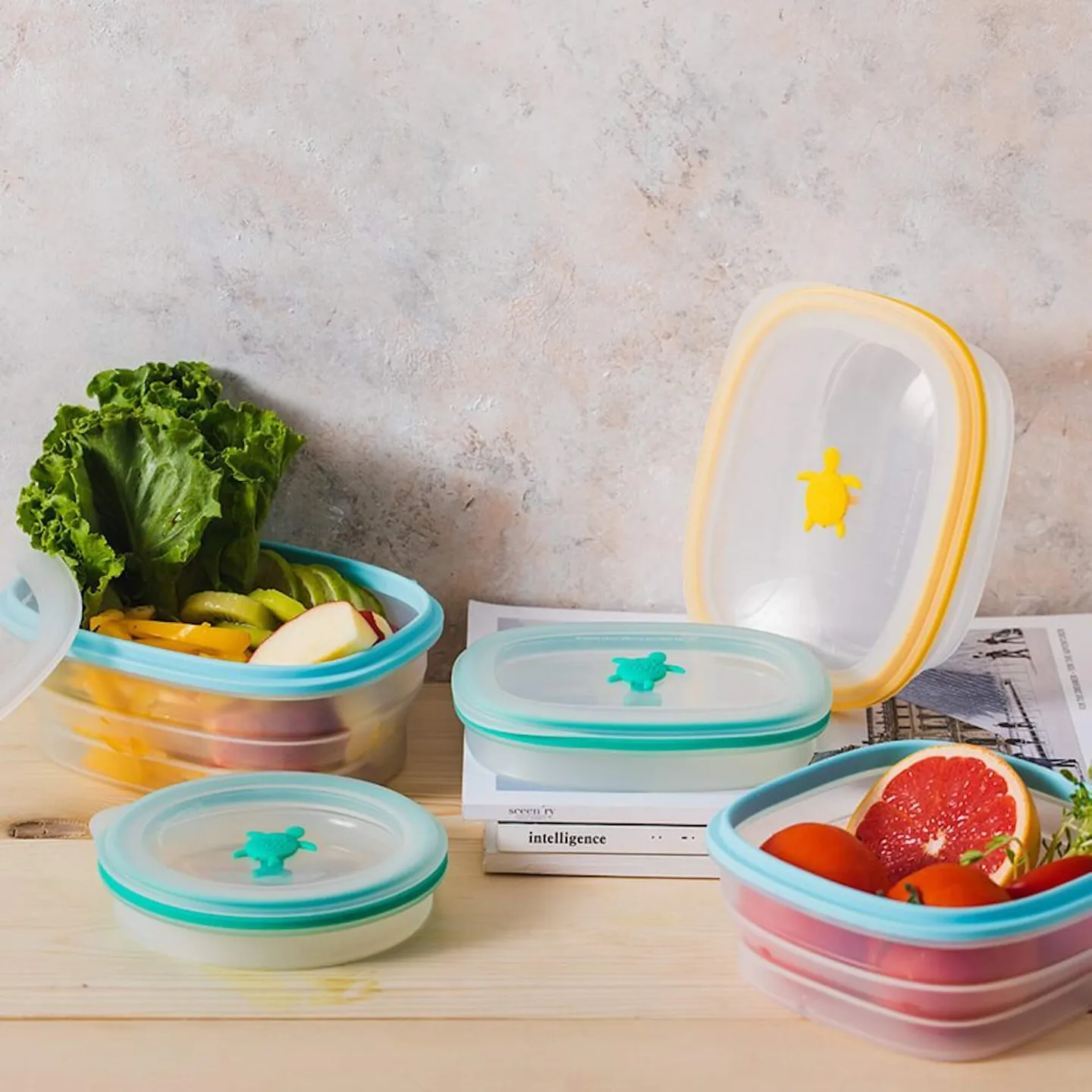
The SilSeal food storage box is Renzhou Zero Plastic's flagship product, featuring an adorable little sea turtle valve plug on top. Image source: Renzhou Zero Plastic
For an even more flexible carrying option, Renzhou also offers the "Cloud Silicone Bag" — a pouch-style design that opens up more plastic-free possibilities for storing food, whether you're keeping it fresh or eating straight from the bag. And here's an unexpected bonus: the silicone bag doubles as a waterproof pouch for your personal belongings at the beach, making it the ultimate multi-tasker of the plastic-reduction world.
If you love bubble tea but feel guilty about all that single-use waste, the Roll-Up Silicone Bottle 3.0 might just be your saviour. Made from food-grade silicone, the bottle rolls up after use to reduce its volume by two-thirds. It comes with a wide silicone straw for drinks with toppings, and the strap-equipped body lets you eliminate five pieces of rubbish in one go: paper cup, sealing film, straw, straw wrapper, and plastic bag.
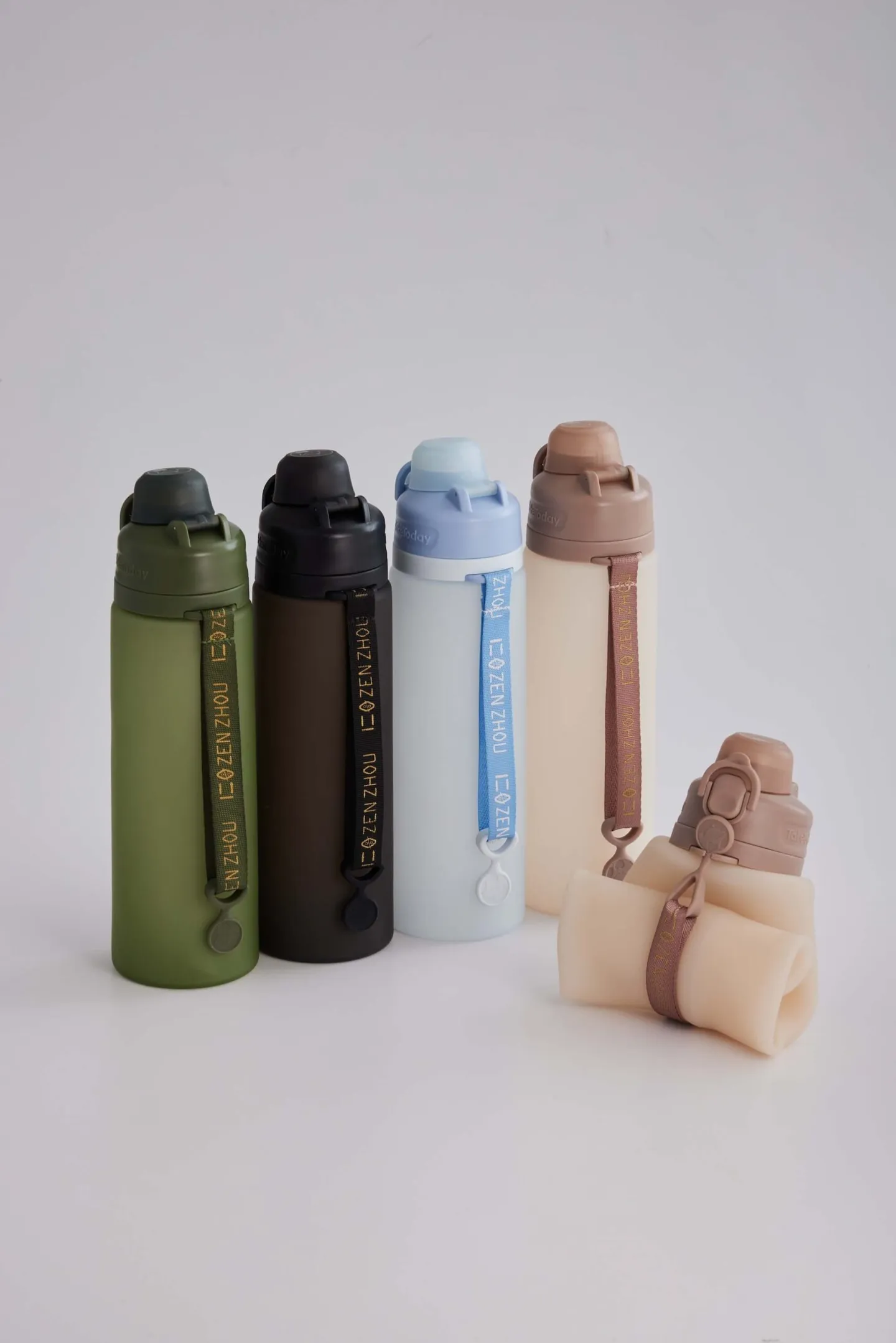
The Roll-Up Silicone Bottle is now in its third generation. Image source: Renzhou Zero Plastic
For other everyday plastic items, Renzhou has alternatives sorted: beeswax wraps to replace cling film, a silicone travel-size bottle set that passes airline carry-on rules, and the stylishly practical Xifuton cotton net bag — so you can find attractive, lightweight plastic-free alternatives for every scene of daily life.


A Little Less Plastic, A Lot More Clean Living: CHEF CLEAN
People scrutinise the ingredients in their skincare — but what about cleaning products? That question was the starting point for CHEF CLEAN. In under a decade, the brand became a popular name on the market. The clean, eye-catching "CHEF CLEAN" label on its bottles belies the sophistication inside. Committed to easily biodegradable, plant-based formulas, its products clean effectively without irritating skin or harming the environment. Since launching its vegetable and dishwashing cleaners in 2015, the product line has expanded continuously across kitchen, bathroom, and laundry categories; this year, marking the brand's 10th anniversary, new dishwasher tablet and rinse-aid products have been introduced.
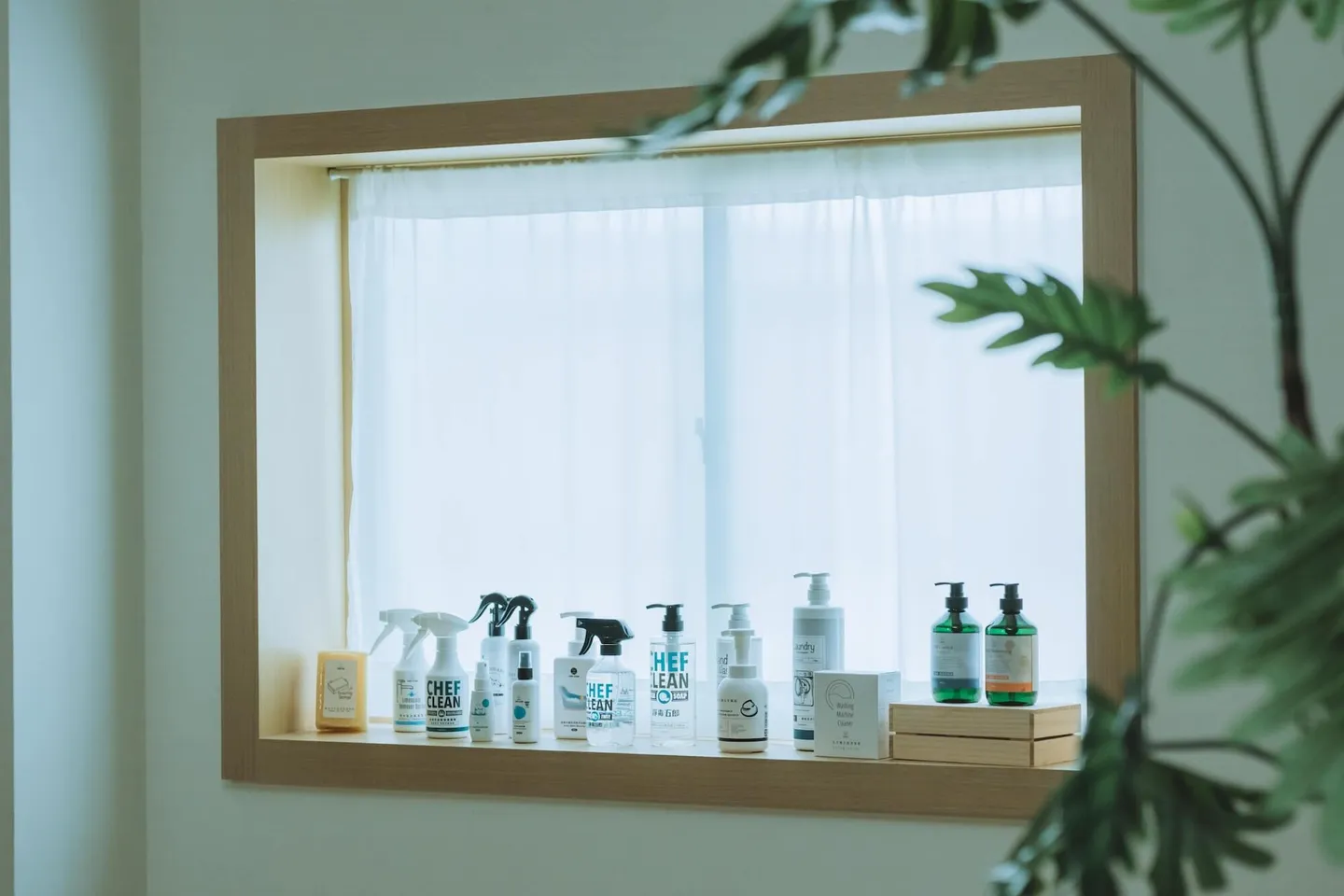
From the vegetable and dish cleaners of its first year, CHEF CLEAN's product range has grown increasingly diverse. Image source: CHEF CLEAN
Starting in 2019, founder Zheng Yiling set her sights on greater corporate social responsibility for the brand. The company switched to bottles made from 100% recycled plastic and began partnering with packaging-free stores across Taiwan to promote the idea of buying cleaning products unpackaged. To date, more than 82% of CHEF CLEAN's product bottles are made from 100% recycled plastic as part of its commitment to reducing plastic at the source; its partner packaging-free stores now number nearly 30 locations across Taiwan. CHEF CLEAN stays focused on eco-friendly plastic reduction, bottle reuse, and zero-packaging refills — walking steadily down the path of sustainability within its means, and building a clean circular platform.
In 2022, the brand launched the "R-Clean Clean Cycle Programme," taking its zero-packaging refill model a step further by advocating plastic reduction within corporate supply chains. The 10 kg refillable drum of cleaning product cuts plastic use by 93%, making it ideal for high-volume users such as businesses, schools, community buildings, restaurants, laundries, and more. After use, the empty drums are collected, cleaned, and disinfected before re-entering the circulation system. Of course, individual consumers are also welcome to group-buy with their neighbours.
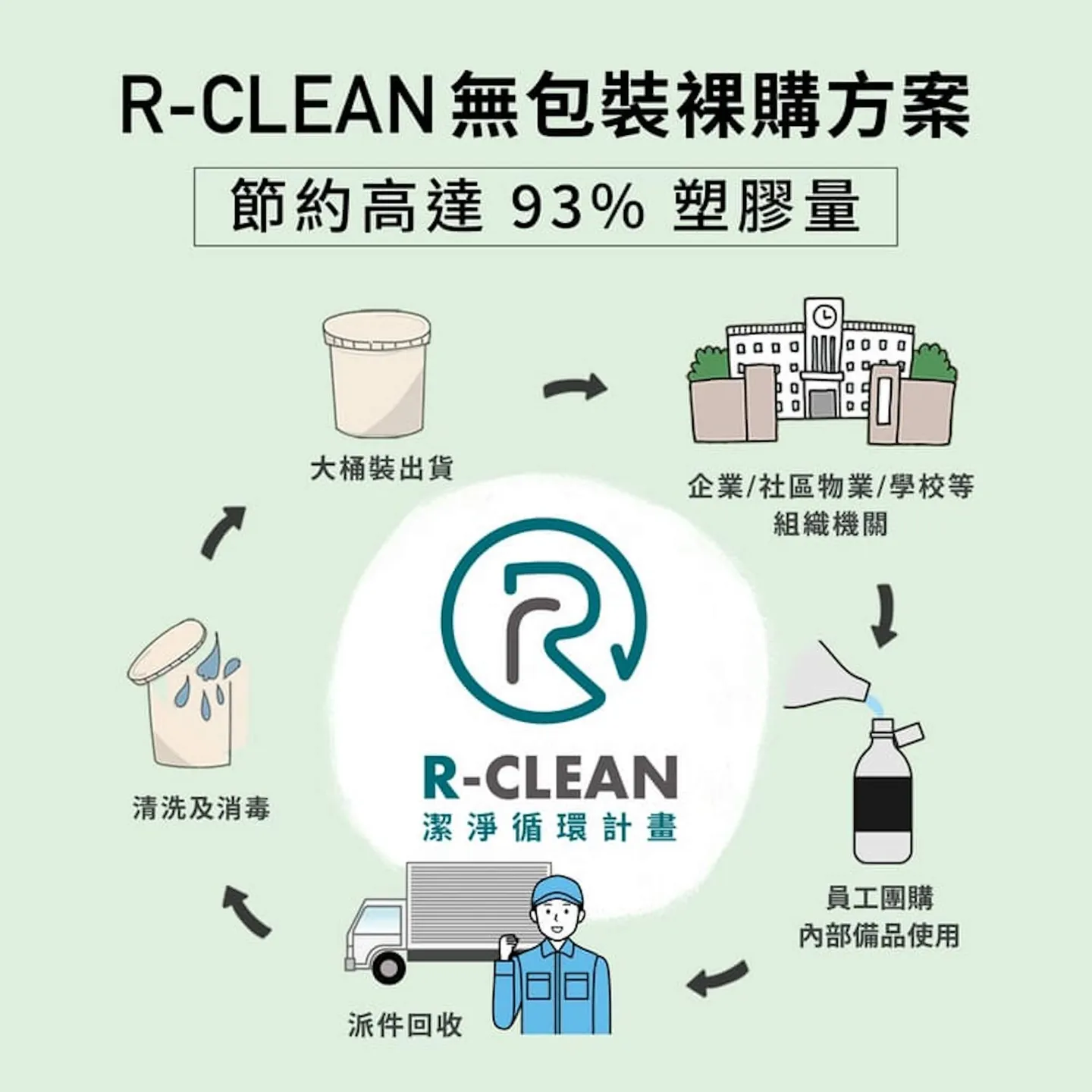
The R-Clean Clean Cycle Programme aims to create a friendly loop between people and the environment; the unpackaged refill price is approximately 60% of the standard retail price. Image source: CHEF CLEAN
Less for Your Skin, More for the Planet: Greenvines
Greenvines is built around the philosophy of "subtractive skincare." Riding the wave of Clean Beauty, the brand's commitment to ingredient transparency — and its pledge to exclude more than 3,200 unnecessary ingredients — has become increasingly well known. The belief in "people first, planet first" is not only reflected in product development but also extends to the brand's long-term environmental commitments.
Since current regulations prohibit selling skincare products without packaging, Greenvines began switching to recycled plastic and recycled glass for its packaging materials to reduce the environmental impact of its products — and has now achieved a 100% adoption rate for recycled materials. All plastic bottles have been converted to 100% recycled plastic. In 2022, the brand earned the Marine Debris Recycled Product Label, and its packaging makes it the first locally made shampoo in Taiwan to use marine debris-derived recycled material — as well as the shampoo with the highest proportion of recycled marine debris in the country.
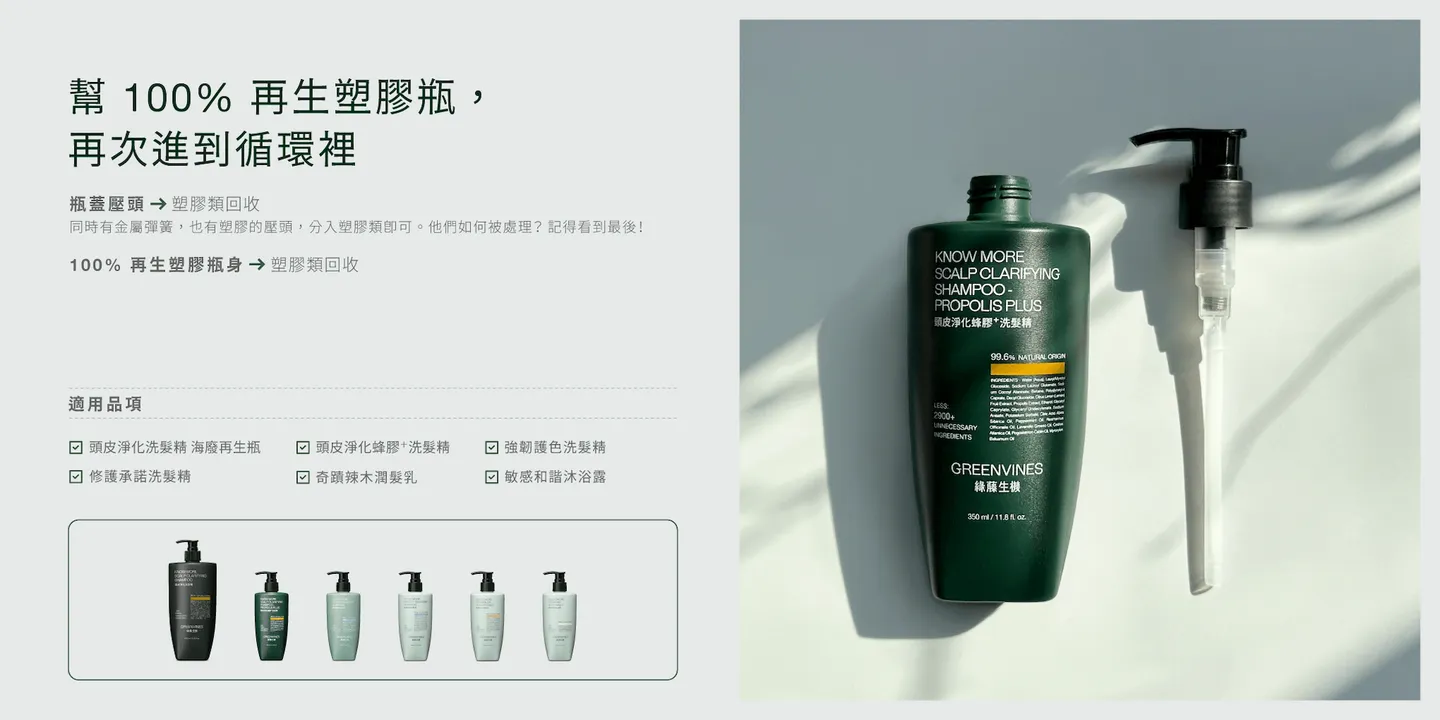
Bottles made from 100% recycled plastic, when properly recycled, have the opportunity to enter the cycle again. Image source: Greenvines
Since 2017, Greenvines has been running its "Empty Bottle Recycling Programme," encouraging customers to return empty bottles to any of its stores for recycling in exchange for a purchase discount. By 2024, the programme had collected more than 500,000 bottles and containers.
If bringing empty bottles to a store is not convenient, no worries — the brand updates its "Empty Bottle Recycling Guide" on its official website every year, telling you exactly how to recycle each product correctly. Even more thoughtfully, the brand designs recyclability into the products from the start: containers are intentionally built with detachable components so that the bottle body, cap, pump head, and other parts made from different materials can each enter the appropriate recycling stream, ensuring no part of the product becomes a recycling dead end.
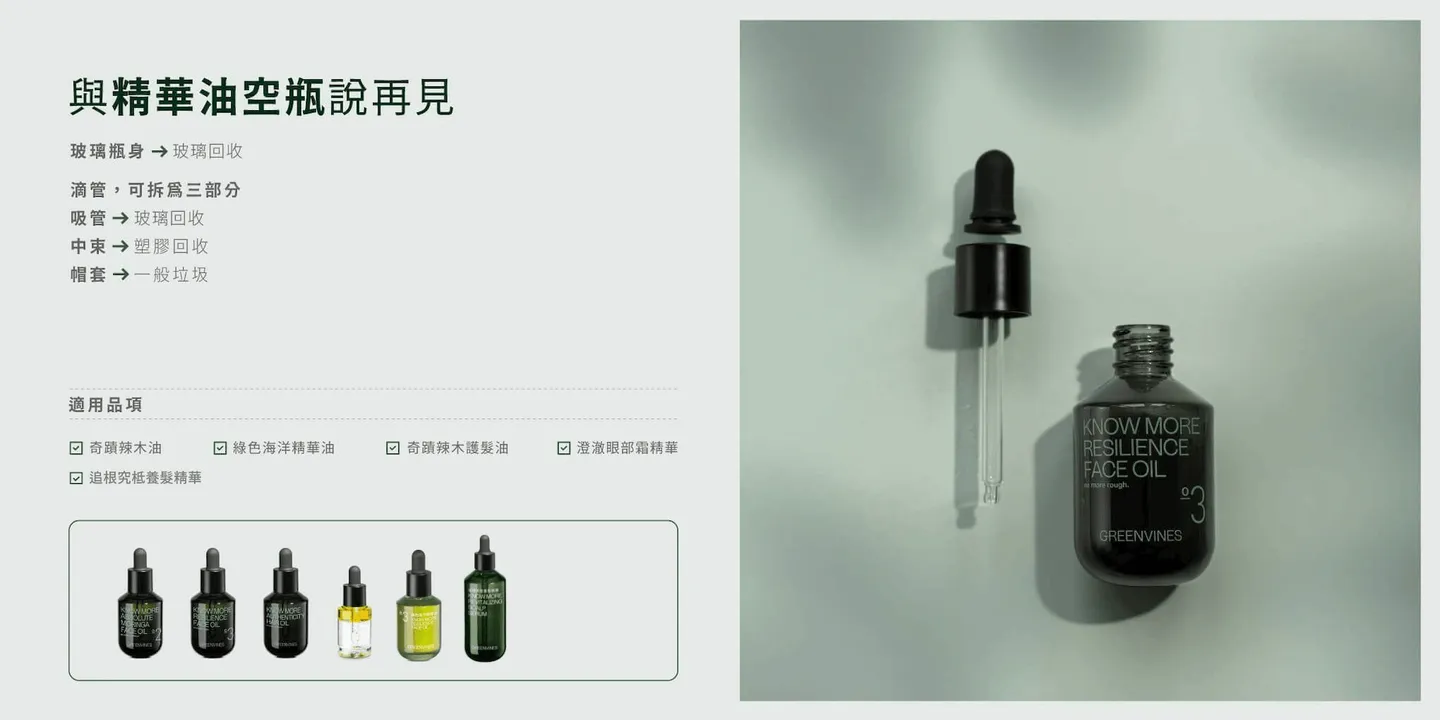
Greenvines improves recycling rates through a disassembly-friendly packaging design. Image source: Greenvines
Waste Not — Giving Plastic a Second Life: Yun Workshop
Yun Workshop is a social enterprise that combines sustainable materials, educational translation, and social impact, with a focus on giving waste new value and putting the principles of the circular economy into practice. The recycled materials it works with include plastic, oyster shells, coffee grounds, substandard diapers, recycled paper, and plant fibre. Its plastic waste stream encompasses fishing buoys, polystyrene foam, PET bottles, and other hard-to-handle waste common in everyday life and industry — giving resources that would otherwise end up in landfill or the ocean a new lease on life.
Among its offerings, PCR (post-consumer recycled) circular plastic lumber is one of the core products of Yun Workshop's plastic reuse line. Crafted to mimic the look of wood, it is waterproof, corrosion-resistant, and lightweight, and at the end of its service life it can be 100% recycled back into building materials, achieving true circular use. Thanks to its combination of durability and eco-friendliness, circular plastic lumber has been used in exhibition setups, event stages, outdoor structures, and public art installations, establishing itself as a sustainable alternative to conventional timber.
Beyond materials research and development, Yun Workshop is also committed to bringing the circular concept into hands-on public experiences. Using circular plastic lumber and other recycled materials, the team has designed a variety of DIY projects — such as a moon lamp made from oyster shells mounted on a plastic-lumber stand, a memo clip that is both stylish and functional, and a succulent-themed candle that blends a warm atmosphere with a sustainable spirit. Participants not only get to create with their own hands but also come to understand the origin of the materials, how they are transformed, and the environmental significance behind them. For those unable to attend in person, material kits are also available for purchase to DIY at home.
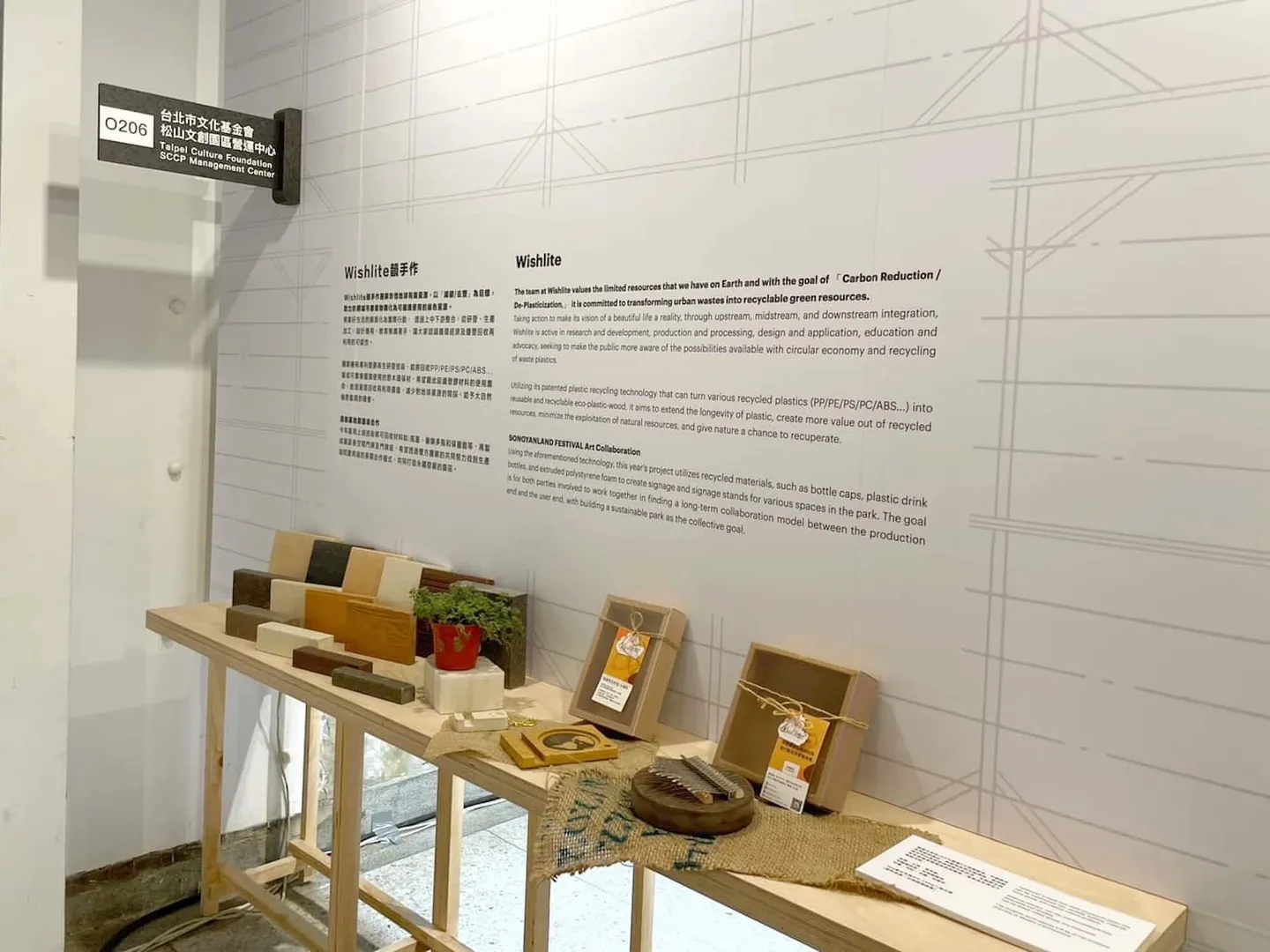
The signage update at Songshan Cultural and Creative Park two years ago was made using circular plastic lumber. Image source: Yun Workshop
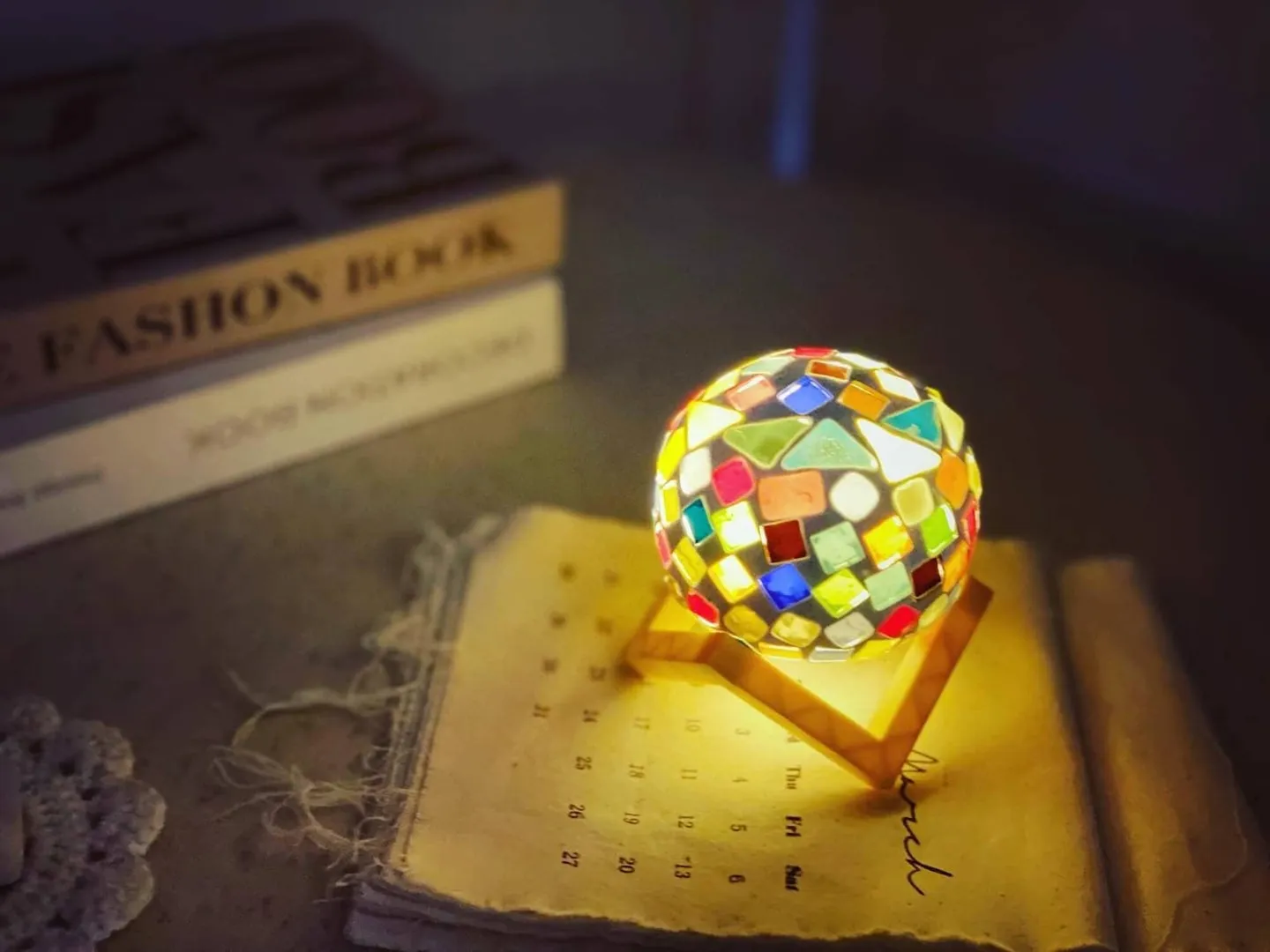
The mosaic moon lamp is as eco-friendly as it is beautiful. Image source: Yun Workshop
Through creative making, materials innovation, and the promotion of modular educational programmes, Yun Workshop hopes to restore value to waste, extend the life cycle of resources, and weave sustainable awareness into the fabric of everyday life. Make art, Live eco!
Every purchase, every choice, is a vote for the future of our environment. "Reducing plastic" is not just a slogan — it is something we can all carry forward in our daily lives. A damaged environment will not recover overnight, but every plastic bag avoided, every recycled product chosen, is an opportunity to slow the tide of pollution and give life a little more room to breathe.
Further Reading