Contents(5)
- Sunset Dives Are Where the Real Excitement Begins! Experience the Thrill of Fish Behaving Very Differently from Daytime
- To Witness the Spawning of the Splendid Dottyback, Find the Suspicious-Looking Male First!
- Is Caressing a Tactic? The Captivating World of Reproductive Behavior!
- Reproductive Behavior Changes with the Seasons
- Related Links
The Editor says: Did you know that many creatures of the deep only emerge at dusk to feed and move about? After the sun dips below the horizon, the once-dark underwater world comes alive with a whole new cast of characters — spawning, mating, foraging, all unfolding in the fading light. Next time you head out diving, why not give night diving a try! Full article translated from: スミレヤッコの繁殖行動を追え!いま、サンセットダイビングがアツイわけ
Why do you dive ? If someone asked you that, how would you answer? Is it the underwater terrain that draws you in? The thrill of encountering large marine life? The enchanting calm of nudibranchs? Or are you simply the kind of person who's happy and at peace just by being underwater?

The ocean has a certain magic to it — simply slipping beneath the surface is enough to bring a sense of profound peace.
For me, tracking the reproductive behavior of fish is the most fascinating thing of all. I believe one of the greatest joys of diving is observing marine creatures in this extraordinary underwater environment — close enough, almost, to reach out and touch them.
This series is brought to you by Shota Ishino, a dive guide based in Okinawa, who will introduce some rather cheeky and amusing fish behaviors. We're not sure how long the series will run, but we hope you'll stick with us until we run out of material!
Sunset Dives Are Where the Real Excitement Begins! Experience the Thrill of Fish Behaving Very Differently from Daytime
Up until now, I suspect most divers have structured their dive trips around the post-dive drinks session. But since the pandemic, even gathering in groups became difficult. After finally making it out for a trip, many of us ended up alone in our hotel rooms, flipping through the day's photos and having a quiet solo drink — a little lonely, if we're honest.
In that kind of situation, why not delay that drink and instead plunge into the sea at dusk? In the seemingly tranquil ocean after most divers have surfaced for the day, you can catch fish behaving in ways that are subtly yet fascinatingly different from their daytime selves.

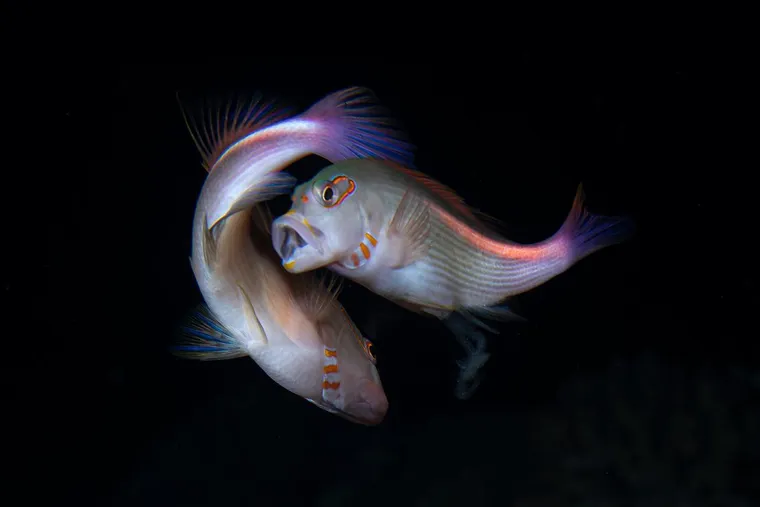
The Goatfish, so often overlooked during the day, puts on a breathtaking display of color change during courtship.
Males pursue females with full-throttle enthusiasm, while females focus intently, readying themselves to receive their suitors. The entire ocean hums with a restless, electric energy.
Of course, some species do carry out their reproductive behaviors in the bright light of day. But what you witness at dusk carries with it a particular edge — the thrill of diving when almost no one else is in the water, combined with the creeping urgency of the light slowly dying. It's an incredibly exciting experience.
Sunset diving is especially recommended for marine life enthusiasts. Even if you're skeptical at first, give it a shot — you just might find yourself never again thinking "beer the moment I surface."

As the sky blazes crimson at sunset, dive into a world of excitement and wonder with a twilight dive!


To Witness the Spawning of the Splendid Dottyback, Find the Suspicious-Looking Male First!
The target for the first installment of "Heart-Fluttering Twilight Moments" is the spawning behavior of the Splendid Dottyback (Macolor niger) — or more precisely, the fish known in Japan as Sumire Yakko (Centropyge venusta), a small, brilliantly colored angelfish with striking blue and yellow markings.
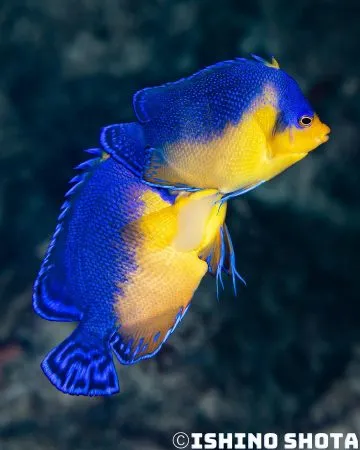
The spawning behavior of Centropyge venusta
In Japan, this small angelfish (family Pomacanthidae) is known for its vivid blue and yellow coloration, and is found primarily along the Pacific-facing southern coast of Japan and throughout the Ryukyu Islands. In Okinawa, it is commonly spotted in the shadows of steep drop-offs — hiding in crevices or lurking beneath overhanging rock formations.
This species is inherently shy. To get a close look during the day, you need to approach with extreme care. Flash even a bright light in their direction and they'll vanish instantly into the reef. Despite their stunning colors, they're not particularly popular among divers — perhaps because they're so difficult to observe?
At dusk, however, Centropyge venusta can be spotted quite easily, cruising along the base of the reef. If you notice a larger individual roaming over a wide area, that's your male!
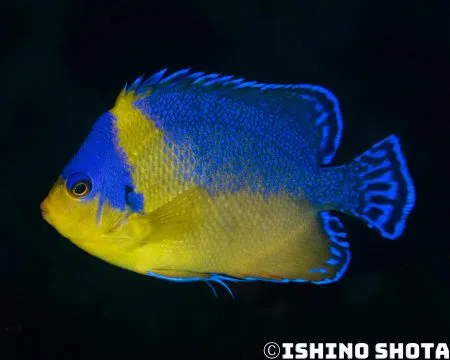
The male Centropyge venusta has a more extensive yellow area on its body and brighter blue lines on its fins compared to the female.
In the world of Centropyge venusta, a harem social system prevails. A single male typically holds a territory containing 3 to 4 resident females. As the sun begins to set, the male becomes noticeably more active, patrolling his territory and checking in on each of his females.
If you want to witness the spawning of Centropyge venusta, locating the male is absolutely critical. After that, all you need to do is shadow him until each female is ready. With a bit of luck, you can witness multiple spawning events in a single dive.
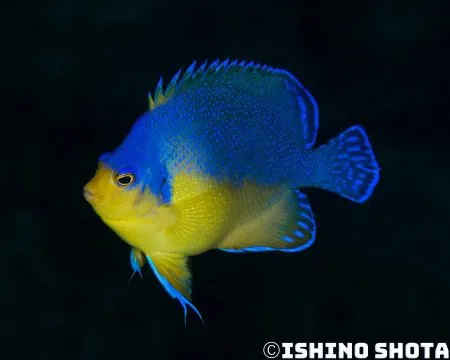
A female Centropyge venusta just before spawning — her belly is absolutely full of eggs!
Is Caressing a Tactic? The Captivating World of Reproductive Behavior!
Centropyge venusta reproduces via external fertilization, with the pair ascending together to release their gametes. As the two fish rise in unison, the female releases her buoyant eggs while the male simultaneously releases sperm over them. The whole process is over in an instant — after releasing their eggs and milt, both fish dart back into the reef, and the fertilized eggs disperse rapidly. If you're not familiar with the behavior, you might not even realize what just happened. Full concentration is required.
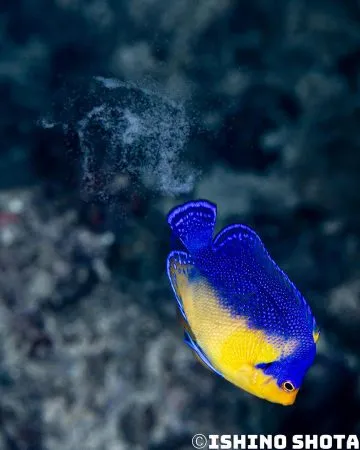
The fertilized eggs disperse rapidly into the water column.
For me, the most remarkable part of this entire reproductive sequence is what's known as the "belly nudge" — a behavior the male performs to encourage the female to spawn, often described as the male "gently prodding the female's abdomen." When this behavior appears, it signals that spawning is imminent, and it's the single best moment to capture a great shot.
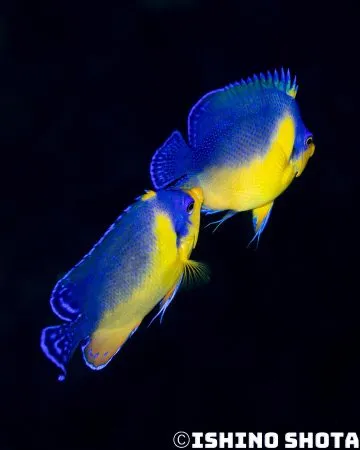
The belly nudge — the male gently prods the female's "abdomen" as they ascend together.
Although it's a little hard to say out loud, this behavior strikes me as remarkably like a male caressing a female — which is precisely why witnessing the spawning of angelfish gets me so excited. I'd love for you to see the belly nudge with your own eyes, but this is hardly the only highlight of fish reproductive behavior.
The interactions between male and female before spawning are equally fascinating. As with many fish species, the female holds the ultimate veto in Centropyge venusta reproduction. No matter how hard the male courts, if the female isn't ready, he simply has to keep waiting.
The timid female often loses her nerve mid-ascent and dives back into hiding. Even so, the male must press on — he cannot give up. You're so close to witnessing a spawn at that point! In my observations, I've seen countless near-misses. It's only once the female finally commits that the male gets his chance. There's a certain agony to watching this struggle that resonates deeply with observers — particularly the male ones. That spirit of perseverance in the face of rejection makes this little fish both brave and endearing.
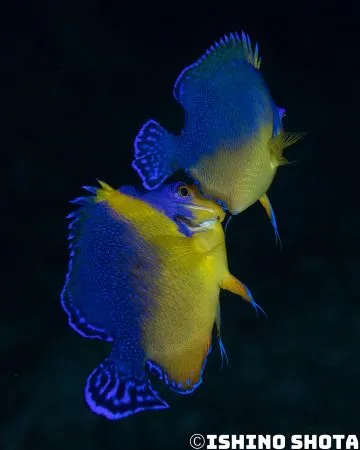
Just before spawning, the female's belly is so full of eggs they look ready to spill out. Even in this state, she can still turn tail and abort at any moment.
At first glance it might seem like the female holds all the power in the mating process — but the reality is more nuanced than that. The harem contains multiple females, and as night falls, Centropyge venusta retreat into reef crevices to sleep. This means the male must race against the clock to complete spawning with every female in his harem before darkness sets in. If he devotes all his time to one reluctant female, he simply won't have time to get to the others. If a female becomes too troublesome, the male may lose patience and move on to the next one; if that one isn't cooperating either, he moves on to the one after that. If none of them pan out, he circles back to the beginning and starts the courtship all over again. The male runs to a strict timetable, and sometimes you'll see a female chasing after him as if to say, "Wait! I'll be ready next time, I promise!" — but if the male has already decided to move on, he won't look back. It's an intricate game of push-and-pull played out against the ticking clock.
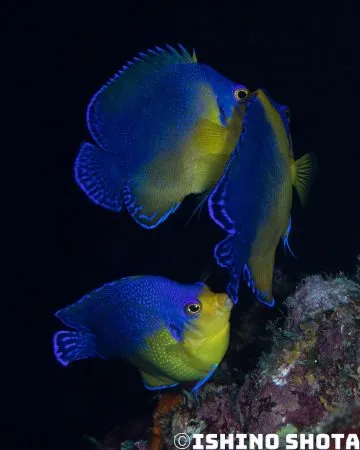
A strong male commands a territory with multiple females.
Each female spawns only once per day, so the moment one female has finished, the male immediately moves on to the next. Once every female in the territory has spawned, the male — previously so full of energy — suddenly deflates and vanishes in an instant. That, I suppose, is what you might call his "sage mode." He retreats, looking thoroughly satisfied, and goes off to sleep.
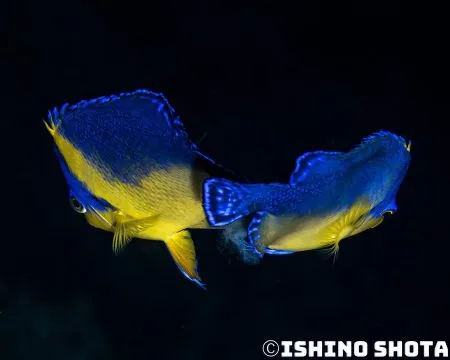
After releasing their gametes, the pair immediately separates. The male loses no time in courting his next female.
Reproductive Behavior Changes with the Seasons
I have always believed that continuously observing the same subjects in a stretch of sea you can call your home turf makes diving far more rewarding. As for fish reproductive behavior, if you think snapping one great photo and calling it done gives you the full picture, I'd argue you haven't even scratched the surface. It's only when you can feel the shifts that come with the changing seasons that you can truly say you've experienced the full richness of observing reproductive behavior.
For instance, at the start of the spawning season in spring, young females are still unaccustomed to spawning and remain highly skittish. They may respond to the male's advances, but you'll often see these nervous females suddenly abort their ascent partway through — much to the male's exasperation.
Here's a true story: I was watching what looked like an imminent release — "Oh, here it comes!" — when another fish happened to pass by nearby. The female immediately froze and stopped. The male, however, was too far gone to stop himself, and released his milt regardless — then scrambled around in a panic chasing the female, as if mortified. "Oh no, how embarrassing!"
It's remarkable, really — as remote work and workation lifestyles continue to reshape the way we work and live, it's becoming increasingly easy to slip in a sunset dive after hours or squeeze one in during a week-long work trip. That said, I know this kind of flexibility is still out of reach for many people. My hope is that through this humble series of mine — however modest it may be — I can bring a little of the wonder of fish reproductive behavior into your lives. That would make me very happy indeed.
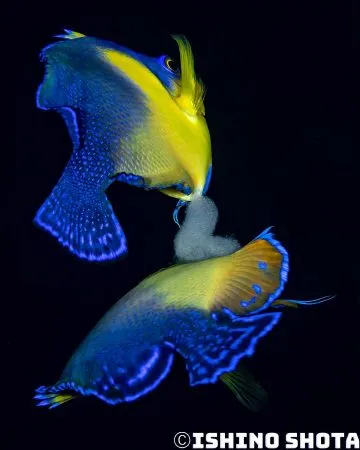
These heart-shaped fruits of love will set off on a long journey, carried away by the currents.
Related Links
Frequently Asked Questions
How is a BlueTrend dive trip different from an unknown, no-name dive group?
Choosing us means full peace-of-mind protection and a smooth experience from start to finish. Every trip we run holds to three things.
First, full legal protection and a professional dive leader: we strictly follow Taiwan's travel regulations and provide complete travel-agency liability insurance, travel insurance, trip-inconvenience insurance and dive insurance. Every group is accompanied by a certified, foreign-language dive leader who joins you on both the dives and the land itinerary, liaising seamlessly with local dive shops and operators on your behalf to keep things running smoothly — the person our travellers trust most.
Second, fully licensed with secure payments: every payment goes into a licensed travel agency's account, with multiple safe payment channels (bank transfer, credit card and more) and a legal collect-and-remit receipt, so every transaction is open, transparent and protected, avoiding the fraud and dispute risks of transferring money privately to an individual.
Third, hand-picked quality we vet in person: every trip, dive site and partner shop is scouted on the ground by our own team, from the guides' professionalism and safety standards to the food, lodging, environment and service details on land, all vetted by us so you don't get caught out.
I want to sign up for a dive trip. Are there certification-level or logged-dive requirements?
Each dive site is different, so the entry bar varies. 'Bali Tulamben', for instance, is relatively beginner-friendly. 'Malapascua in the Philippines' is also beginner-friendly, but since thresher sharks tend to cruise between 20 and 30 metres, we recommend AOW certification with 20+ logged dives to enjoy this trip comfortably. For 'the Maldives' or 'Palau', we suggest AOW with 50+ logged dives for a more relaxed experience. If you're not sure whether your experience fits the trip you want, message us and our dive editors will assess it and help you find the trip you'll feel safest on.
Can I join if I'm signing up alone? How are rooms arranged?
Plenty of our travellers sign up solo! For rooms and beds, we prioritise pairing you with a same-gender traveller, and if you'd rather have your own space you can pay the difference to upgrade to a single room. For the diving, our professional leader will pair you with a suitable buddy, and with the happy vibe on our trips you'll quickly make a great group of dive friends. Many people sign up alone, make new friends, and end up organising the next trip together!
Does the trip fee include dive insurance, gear rental, taxes and instructor tips?
It depends on the trip, the destination's regulations and the local operators. Every BlueTrend dive trip has a detailed web page with a clear 'included / not included' list, transparent and with no hidden charges. All payments are collected by a licensed travel agency, with a standard-form contract for your protection.
I'm a new diver / haven't dived in a long time — will I fall behind the group?
Before you complete your booking, our team assesses a suitable trip based on your certification level and experience. Before departure, we strongly recommend taking time to refresh in Taiwan with an instructor, or a fun dive to get your feel back. On the trip itself, our professional dive leader groups and pairs everyone by experience, keeps a close eye underwater on travellers who need extra care, and steps in to help right away.
Will the photos and videos taken during the trip be shared with us?
During the dives, 'safety' is always the leader's top priority, so whenever it's suitable and safe the leader will capture great shots and record the best moments. During or after the trip, we compile a cloud album for all travellers to download, so you go home loaded with memories!
Besides your scheduled trips, can you arrange a private group charter or independent travel for me and my friends?
Absolutely! Besides group trips, we also arrange private group charters and independent travel. We can communicate, enquire and coordinate services with local operators based on your needs, saving you time and effort and taking the language barrier off your plate, to tailor the smoothest, most reassuring dive trip just for you. Contact our LINE support and our editors will arrange it for you!