



Taiwan is surrounded by ocean on all sides, which would naturally make it an ideal place for water sports. Yet for a variety of reasons, many Taiwanese people remain surprisingly unfamiliar with the sea. That is precisely why BlueTrend was founded — to help Taiwanese rediscover the ocean and, ultimately, fall in love with it. So let's start by exploring what diving destinations this island nation actually has to offer.
If you'd like to read more about Taiwan's diving environments, check out the Overview of Taiwan's Diving Environments – Southern Region and the Overview of Taiwan's Diving Environments – Outlying Islands.
Taiwan Diving Environments – Northern Region
Taiwan's northern diving zone broadly covers the coastline from Keelung to the ports north of Toucheng in Yilan. Situated along the Northeast Coast, this area is heavily affected by the northeast monsoon in winter. After October, water temperatures drop sharply, and the powerful rogue waves that frequently crash along the shore make entries and exits considerably more dangerous. If diving is absolutely necessary during this period, a drysuit is strongly recommended to guard against hypothermia. In summer, however, the area is only about an hour's drive from Taipei, making it far more accessible than other diving regions in Taiwan. Several well-known dive sites feature sheltered bay topography that remains calm and gentle in summer — perfect for beginner training and instruction, and a top choice for experienced divers looking to sharpen their underwater photography skills.
The Northeast Coast diving area can be broadly divided into the following locations:
Wanghaixiang Bay, Keelung:
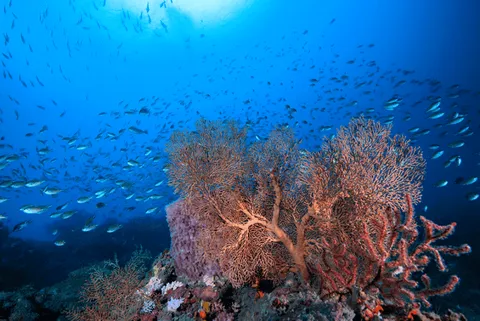
A landmark of Wanghaixiang Bay: the massive gorgonian / sea fan colony. Photo Credit Owen Yeh
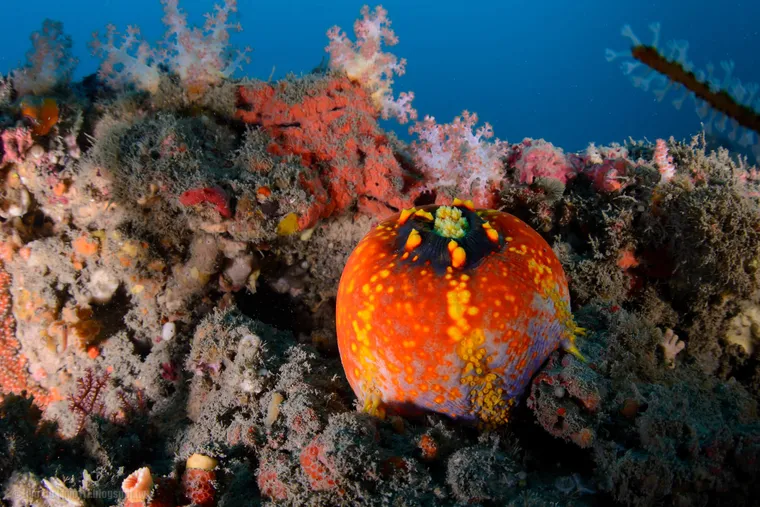
Wanghaixiang Bay is located between Badouzi Cape and Fan Zai Ao Cape, accessible by turning left off Highway 62. Since 1999, the Keelung City Government has designated this area as the Wanghaixiang Artificial Reef No-Fishing Zone, and in 2016 it further established the Wanghaixiang Chaojing Bay Resource Conservation Area, with the aim of creating a marine life sanctuary while boosting local tourism. Thanks to the currents and depth conditions, the seabed here is blanketed with soft corals of many colours and species — a diversity rarely seen elsewhere. These soft corals feed primarily by filter-feeding, so they only fully expand when conditions are right; at other times they contract and rest to avoid the current, meaning the same spot can look quite different depending on when you visit. Gorgonians / sea fans, sea trees, and sponges — all filter feeders — are also abundant here. The Secret Garden shore dive site is particularly notable for offering a close-up view of enormous sea fans. Thanks to the large-scale deployment of artificial reefs by fisheries authorities and the efforts of conservationists, the bay becomes a nursery for juvenile fish each early spring, attracting migratory species inshore. Various coral reef fish are present as well, though aside from damselfish and grunts, most are small in both number and size due to past harvesting activity. Macro photographers who take the time to search carefully will always find unusual creatures hidden among the corals.
Popular dive sites: Chaojing Park, Secret Garden, Front Garden, Flower Wall, Steel Reef, Haijian Wreck, Crystal Palace, and more.
Ruifang Section:
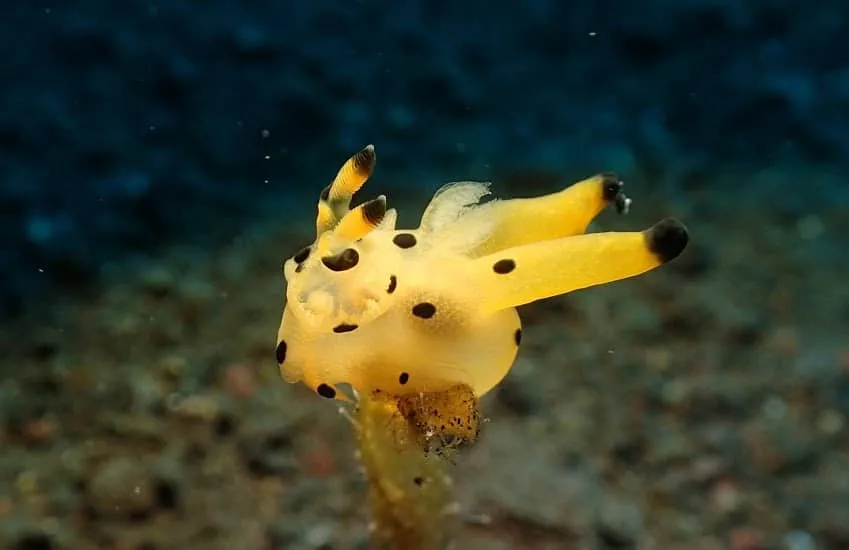
A slightly more advanced dive, but a paradise for macro enthusiasts. Photo Credit 林佑平
Along the Ruifang coastal area, beyond Bat Cave and between Nanya and Bitou, several dive sites are tucked away — including 82-5k, renowned as the North's macro photography paradise, the breathtaking canyon terrain of 83k, and the beginner-friendly Bitou Park. 82-5k in particular draws enormous crowds on summer weekends. It is worth noting that the underwater terrain here is an extension of the coastal headlands: tidal longshore currents running perpendicular to the topography can generate strong surges, and depths beyond the outer edge exceed 40 metres. It is strongly recommended to dive with a guide who is familiar with the local conditions. This area falls within the New Taipei City Ruifang District's prohibition on drift gillnets within three nautical miles. If you spot a fishing vessel or members of the public setting nets along the shore, please report it immediately to the Coast Guard at 118.
Popular dive sites: Bat Cave Park, 82.5k, 83k, Bitou Cape Park
Longdong:
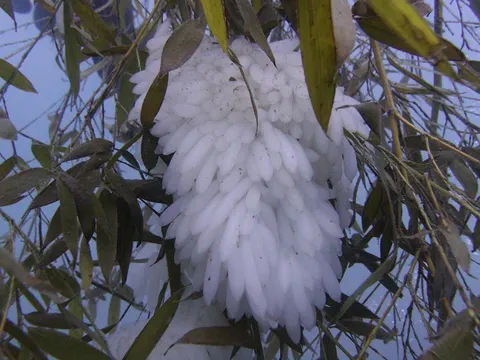
Cuttlefish egg clusters are a signature sight at Longdong in summer. Photo Credit 林佑平
Longdong Bay sits between Bitou Cape and Longdong Cape, forming a natural northeast-to-southwest fjord. It is easily reached via Provincial Highway 2 just past the Bitou Tunnel. This area is the primary diving hub in northern Taiwan, with a stretch of dive shops lining the roadside at a density unmatched anywhere else in the country. Longdong Bay Park, operated by local businesses under a lease from the Tourism Bureau, has been designated an ecological conservation zone where harvesting is prohibited; it also offers well-maintained facilities and a range of water activities. Nestled within the fjord, the bay is almost entirely shielded from strong currents, and in summer the southwest monsoon is blocked by the surrounding hills, leaving the water calm and conditions ideal for diving. In addition to resident coral reef fish, the bay becomes a nursery for juvenile fish each early spring, drawing migratory species inshore. Note that the Gongliao District of New Taipei City has not yet implemented a three-nautical-mile drift gillnet ban, so divers should carry a dive knife at all times for safety.
Popular dive sites: Longdong Ocean Park, Longdong 1.5, Longdong No. 2, Longdong No. 3, Longdong No. 4 (Hemei Elementary School).
Gongliao – Lailai Section:
The Gongliao District of New Taipei City stretches from Longdong all the way to Lailai. Due to the local topography and ocean currents, water clarity improves noticeably beyond the Longdong Tunnel. The coastline here alternates between rocky reef and sandy bottom, with generally shallow depths and no strong currents. Many of the rocky shores were illegally developed into nine-hole abalone ponds in earlier years, altering the original coastline — but this has inadvertently made water entries and exits more convenient for divers. While the coastal land is state-owned and has been encroached upon, please mind your manners when passing through privately operated abalone pond areas.
Popular dive sites: Sijivan Bay, Wenzi Pit, 92k, Meiyan Mountain, Pillbox, Yingge Rock, Gui'an (Chang'an Diving).
Yilan:
Yilan's coastline is one of Taiwan's lesser-known diving destinations, but some dive shops offer specialised dive trips here that are well worth joining. Unique dive sites include the sea fan forest at Shicheng, the Wan'an warship wreck off Shicheng, the Juyong warship wreck off Dong'ao, and the submarine volcano off Turtle Island (Guishan Island). As most of these sites are accessed by boat dive and require more advanced skills, they are best suited to divers with at least an Advanced Open Water Diver (PADI cert) certification or equivalent.
Popular dive sites: Fenniaoling, Juyong Warship, Turtle Island Submarine Volcano, Wan'an Warship.
Frequently Asked Questions
How is a BlueTrend dive trip different from an unknown, no-name dive group?
Choosing us means full peace-of-mind protection and a smooth experience from start to finish. Every trip we run holds to three things.
First, full legal protection and a professional dive leader: we strictly follow Taiwan's travel regulations and provide complete travel-agency liability insurance, travel insurance, trip-inconvenience insurance and dive insurance. Every group is accompanied by a certified, foreign-language dive leader who joins you on both the dives and the land itinerary, liaising seamlessly with local dive shops and operators on your behalf to keep things running smoothly — the person our travellers trust most.
Second, fully licensed with secure payments: every payment goes into a licensed travel agency's account, with multiple safe payment channels (bank transfer, credit card and more) and a legal collect-and-remit receipt, so every transaction is open, transparent and protected, avoiding the fraud and dispute risks of transferring money privately to an individual.
Third, hand-picked quality we vet in person: every trip, dive site and partner shop is scouted on the ground by our own team, from the guides' professionalism and safety standards to the food, lodging, environment and service details on land, all vetted by us so you don't get caught out.
I want to sign up for a dive trip. Are there certification-level or logged-dive requirements?
Each dive site is different, so the entry bar varies. 'Bali Tulamben', for instance, is relatively beginner-friendly. 'Malapascua in the Philippines' is also beginner-friendly, but since thresher sharks tend to cruise between 20 and 30 metres, we recommend AOW certification with 20+ logged dives to enjoy this trip comfortably. For 'the Maldives' or 'Palau', we suggest AOW with 50+ logged dives for a more relaxed experience. If you're not sure whether your experience fits the trip you want, message us and our dive editors will assess it and help you find the trip you'll feel safest on.
Can I join if I'm signing up alone? How are rooms arranged?
Plenty of our travellers sign up solo! For rooms and beds, we prioritise pairing you with a same-gender traveller, and if you'd rather have your own space you can pay the difference to upgrade to a single room. For the diving, our professional leader will pair you with a suitable buddy, and with the happy vibe on our trips you'll quickly make a great group of dive friends. Many people sign up alone, make new friends, and end up organising the next trip together!
Does the trip fee include dive insurance, gear rental, taxes and instructor tips?
It depends on the trip, the destination's regulations and the local operators. Every BlueTrend dive trip has a detailed web page with a clear 'included / not included' list, transparent and with no hidden charges. All payments are collected by a licensed travel agency, with a standard-form contract for your protection.
I'm a new diver / haven't dived in a long time — will I fall behind the group?
Before you complete your booking, our team assesses a suitable trip based on your certification level and experience. Before departure, we strongly recommend taking time to refresh in Taiwan with an instructor, or a fun dive to get your feel back. On the trip itself, our professional dive leader groups and pairs everyone by experience, keeps a close eye underwater on travellers who need extra care, and steps in to help right away.
Will the photos and videos taken during the trip be shared with us?
During the dives, 'safety' is always the leader's top priority, so whenever it's suitable and safe the leader will capture great shots and record the best moments. During or after the trip, we compile a cloud album for all travellers to download, so you go home loaded with memories!
Besides your scheduled trips, can you arrange a private group charter or independent travel for me and my friends?
Absolutely! Besides group trips, we also arrange private group charters and independent travel. We can communicate, enquire and coordinate services with local operators based on your needs, saving you time and effort and taking the language barrier off your plate, to tailor the smoothest, most reassuring dive trip just for you. Contact our LINE support and our editors will arrange it for you!

![[Taiwan · Keelung Chaojing] Dive Site Guide – North Taiwan's Ecologically Rich Secret Garden](/_astro/%E6%BD%AE%E5%A2%83_Z1lB1ql.webp)