![[Taiwan Northeast Coast 82.5K] Dive Site Introduction – The Macro Paradise Along the Coastal Highway](/_images/d2945136fd93-480w.webp)
Contents(3)
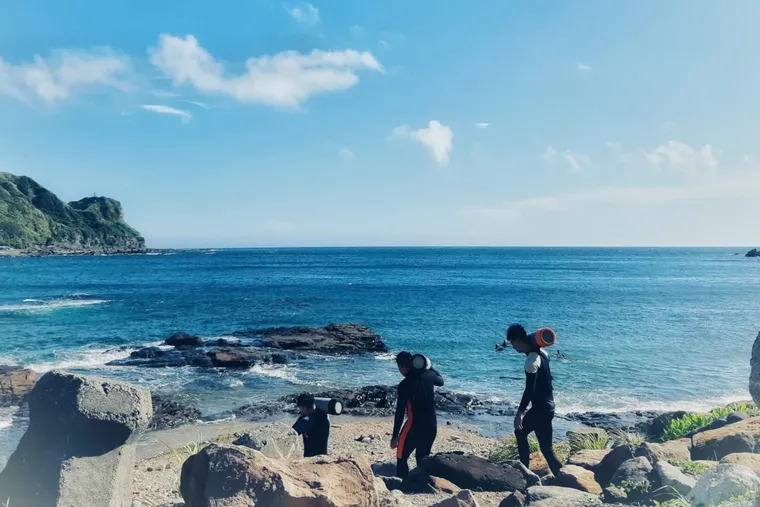
Named after the 82.5 K marker on the Northeast Coast highway, this dive site is an underwater extension of a land headland that can exceed 25 meters in depth offshore. However, due to tidal patterns, longshore currents, and the rugged topography, strong currents are common — when the current picks up, divers may even find themselves crawling back along the seabed by hand. On top of that, entering and exiting at 82.5 K requires climbing a nearly 70-degree handrail ladder in full gear, and the shoreline terrain is rough, so extra care is needed on foot. Despite these minor inconveniences, parking at 82.5 K is still nearly impossible to find on weekends, with underwater photographers arriving in an endless stream — because this is the most celebrated macro paradise on the Northeast Coast.
Underwater Photographer: Robin
Robin has received numerous domestic and international awards for his underwater photography. He generously shares stunning seascape images and rare marine creature behaviors through his lens, and many of his works were created right here at 82.5 K.
When Robin first took up macro photography, he heard there were many subjects to photograph at 82.5 K. He came to explore it with his dive buddy, and it has been one of his favorite dive sites ever since.

Underwater Photographer: Robin
Robin recommends entering from the entry point noted in the dive site reference materials, then heading out at 330 degrees by compass. You will quickly encounter a cliff face / major fault wall; searching along this cliff between roughly 16 – 24 meters depth, you can find many subjects ideal for macro photography.
Near the sea fans, look carefully for the Solenostomus paradoxus (commonly called the ornate ghost pipefish, nicknamed "cross ghost dragon" locally); along the cliff face, following thread-like macroalgae may reveal the photogenic skeleton shrimp; scanning the gorgonians may turn up a rhinopias scorpionfish or a variety of commensal small shrimp and crabs.
If you want to find the charming Cuthona nudibranchs — the so-called "Pikachu family" — head toward the rocky reef base at around 20 meters depth and search for tiny branching bryozoans; you stand a good chance of spotting them feeding there.
When you reach the far end of the cliff at about 26 – 28 meters, remember to turn back along the same route and refrain from venturing further offshore to avoid getting lost.
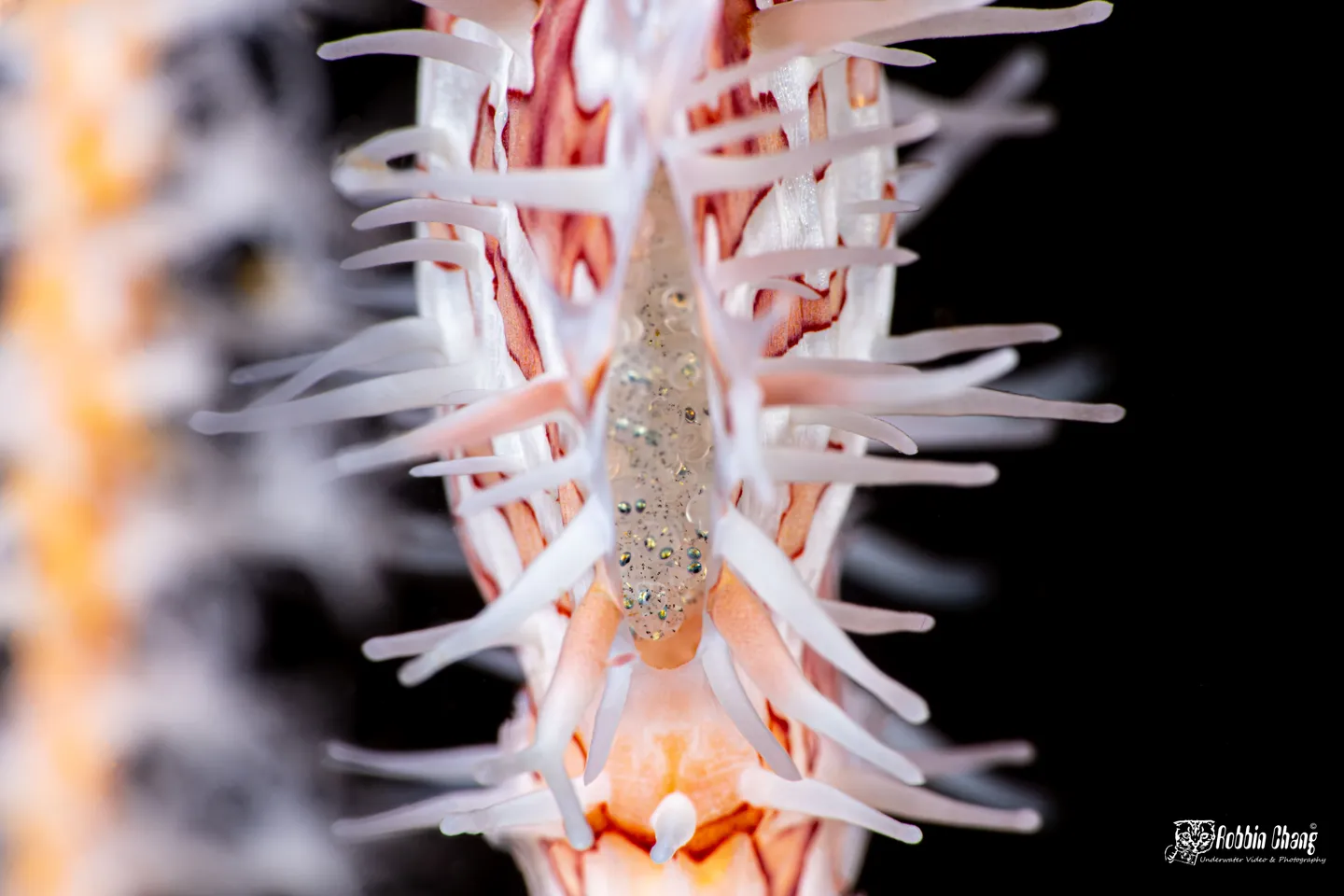
A rare photo of an ornate ghost pipefish brooding eggs, captured at 82.5 K in 2020. photo credit: Robin


The Macro Paradise Is Right Here
Venturing further out, divers encounter what locals call the "Three Reef Blocks," surrounded by an expanse of open sand. Not only are there no reference points for navigation, but 82.5 K's tendency to generate sudden currents can stir up sand and silt, causing visibility to plummet in an instant — sometimes to near-zero.
Without the cliff to buffer the current, the force can be so strong that even if it doesn't sweep you away entirely, just kicking back to the cliff is an extreme test of leg strength. So even if you genuinely want to photograph on the sandy bottom, it is strongly recommended that the moment a current begins, you do not hesitate — turn around immediately and head back to stay safe!
Speaking of the return journey: during your 3-minute safety stop at 5 meters, take a moment to look around carefully and you may spot chaenopsid blennies and Neoclinus nudus hiding in coral crevices. Both species tend to tuck themselves inside, peering out with just their heads exposed to observe the world outside — utterly charming. In the shallows during summer, it is also common to see various species of damselfish guarding their eggs.
Just as timing matters for spotting damselfish eggs, the creatures at 82.5 K follow distinct seasonal patterns:
- April to May is the peak season for swan nudibranchs such as Melibe species
- May to July is a great time to observe cardinalfish mouthbrooding eggs
- July to August is when the adorable "Pikachu family" makes its appearance
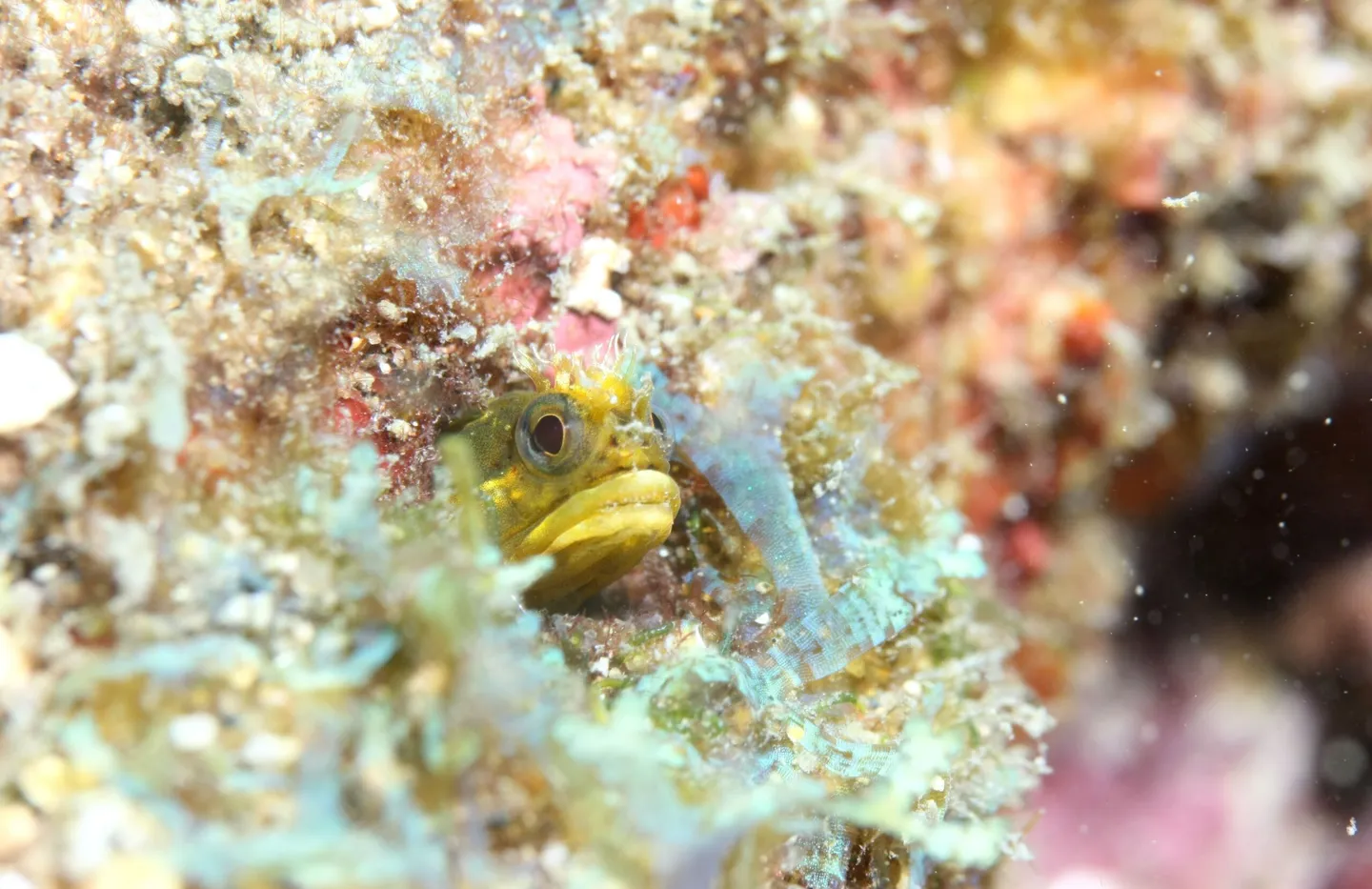
Chaenopsid blennies & Neoclinus nudus are nicknamed "Britney" by local divers. photo credit: Wox Lee
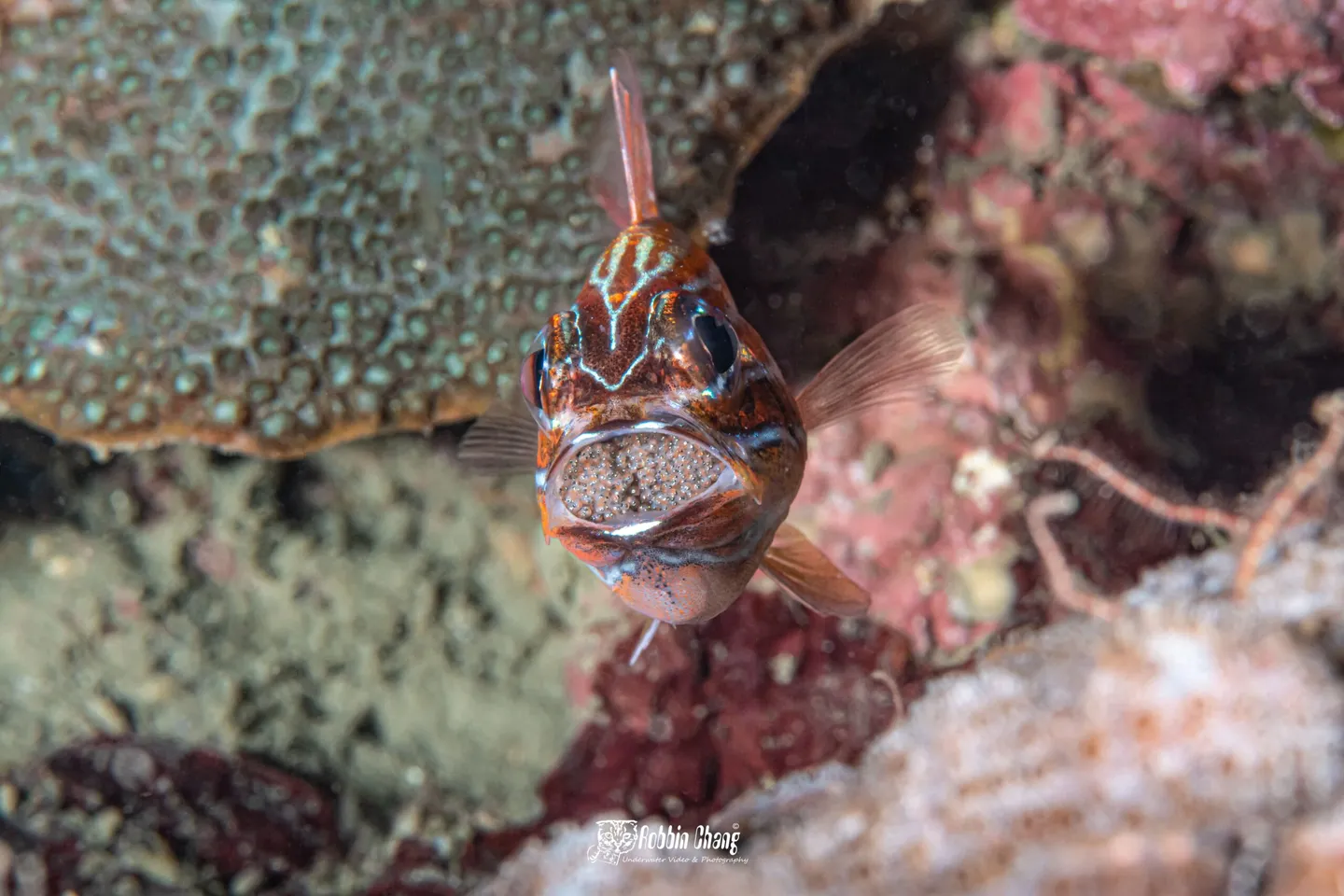
A cardinalfish mouthbrooding its eggs. photo credit: Robin
Robin explains that what makes 82.5 K a macro paradise for underwater photographers is that within just over 100 meters from shore, there is an abundance of rare marine life to photograph. Rhinopias scorpionfish — seldom seen at places like Green Island or Xiaoliuqiu — were found here five times last year, in shades of purple, yellow, and pink alike.
Compared to other Northeast Coast dive sites, the marine ecosystem here is also far richer. Photographers can use sea fans, coral, and other natural backdrops to make their subjects stand out more vividly and uniquely — all of which are reasons why underwater photographers simply cannot get enough of this place.
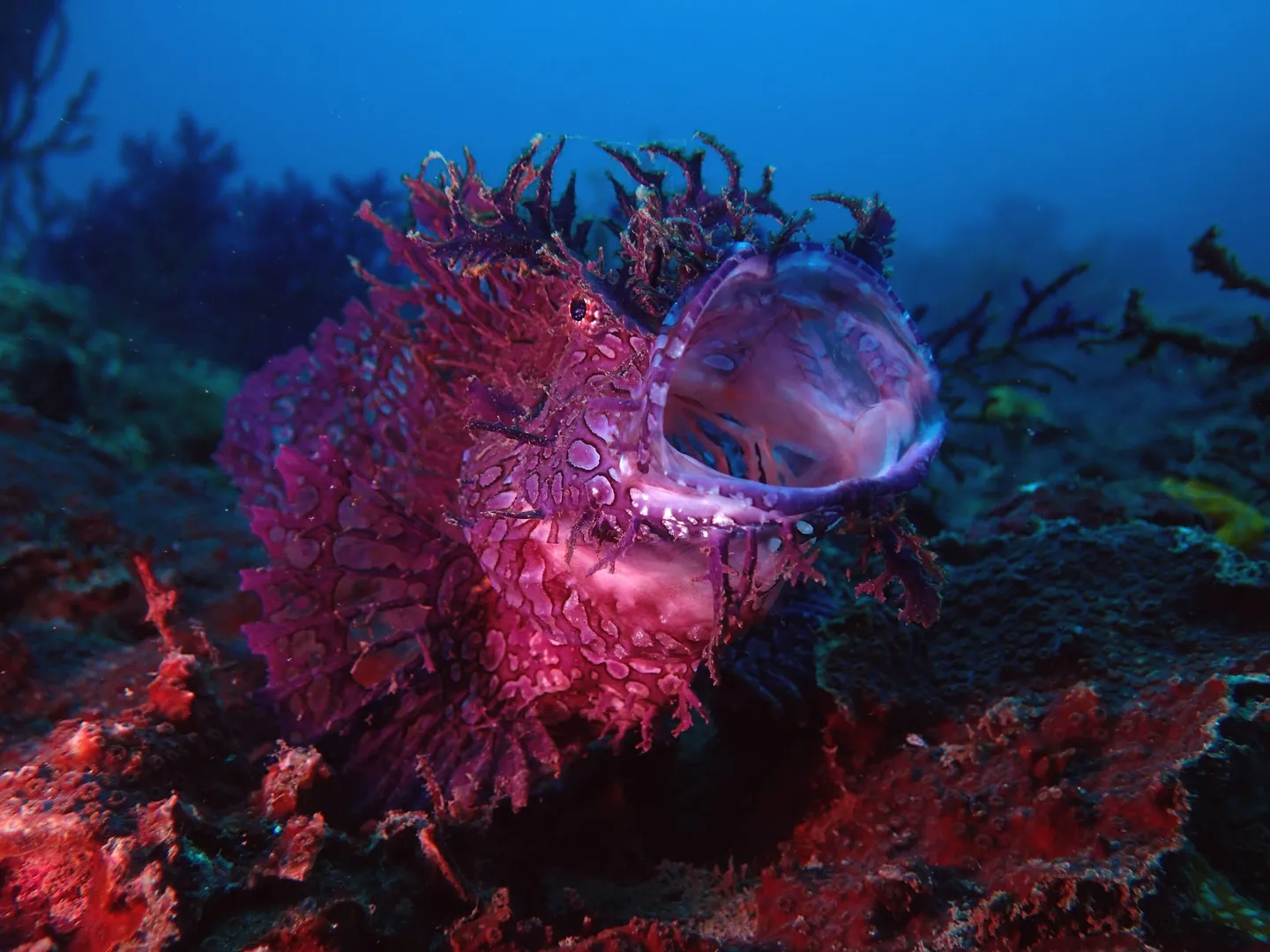
A purple rhinopias scorpionfish — a rare and prized sighting at 82.5 K. photo credit: 陳致維
Because the site is popular, there will often already be someone photographing a subject by the time you arrive. Robin's advice is to wait at a distance of about 3 – 5 meters, observing how the other photographer works while thinking through your own approach. This will produce far better results than rushing in the moment you spot a creature.
82.5 K is a wonderful photography dive site — as long as you dive safely. It is best to come knowing how to use a compass, always dive with a suitable dive guide or dive buddy, and turn back immediately when a current picks up. Do all of this, and you are sure to have a great time and come away with shots you are proud of!
Recommended Species to Look For
Species recommended by Wox Lee:
- Cuthona nudibranchs: The most popular members of the Northeast Coast's nudibranch community — the "Pikachu family" — have a particular fondness for bryozoans. This group encompasses many species and is a favorite photographic "collection" target for many divers.
- Chaenopsid blennies & Neoclinus nudus: These fish love to make use of holes left behind by sea urchins or bivalves, hiding within coral and typically poking only their heads out to survey their surroundings — incredibly cute.
- Rhinopias scorpionfish: An oddly shaped scorpionfish that mimics algae. It sways along the seafloor, imitating seaweed drifting in the current, waiting for prey to pass by. There are two species found in Taiwan.
Special thanks to the biological consultant for this article — Wox Lee
Editor: Jenny Tsai
References:
- Marine Natural History of Northern Taiwan (Li Cheng-Lu & Zhao Jian-Shun, 2020)
- Taiwan Reef Coast Map (Zhao Shi-Min, 2003)
- Tourism Bureau, Ministry of Transportation and Communications Official Website
- Northeast Coast and Yilan Coast National Scenic Area Official Website
- National Museum of Marine Science and Technology Official Website
- 82.5K Dive Site Map
- 【Kyotaro Column】Learn to Shoot Macro with TG6 and Adjust the Aperture in 6 Minutes!
- 【Kyotaro Column】Black Background Underwater Macro Photography — Learn It Easily in Just Five Minutes!

![[Diving with Da-Tou Shi] How to Organize a Safe Ocean Cleanup Dive](/_astro/%E8%9E%A2%E5%B9%95%E5%BF%AB%E7%85%A7-2019-08-04-%E4%B8%8B%E5%8D%889.24.17-e1564925237369_Z2mHAub.webp)