Contents(3)
When audiences watch stunning underwater footage on screen, they naturally picture a behind-the-scenes team of directors, cinematographers, and actors. But there is one more crucial role that often goes unnoticed — the underwater safety diver, whose job is to protect the director and cast throughout the shoot and to serve as the vital link coordinating the entire underwater crew.
The variables in an underwater filming environment are far greater than those on land, and the range of uncontrollable factors is much wider. Unlike on land, direct verbal communication during a shoot is impossible, so the work of the underwater safety diver goes well beyond simple surveillance and protection. Most people instinctively equate underwater safety divers with lifeguards and do not regard them as core crew members, leading productions to recruit ordinary divers for the role — a practice that invisibly raises both shooting risks and communication costs. Director Yuan Xu-hu (hereafter "Director Hu"), the driving force behind "海人制作" (Taiwan Underwater Production) — Taiwan's only professional underwater cinematography team — drew on years of production experience to share with us just how important the underwater safety diver truly is.
Behind-the-scenes footage of Director Yuan Xu-hu and the team's underwater safety diving work during an underwater shoot
Underwater Safety Divers Are Not Lifeguards — They Are the Glue That Holds the Entire Crew Together
Director Hu requires that the safety divers in the "海人制作" team be involved in production planning from the very start. They must know every detail of the shooting schedule and crew configuration, and be able to track the status of the talent they are responsible for during scene transitions. This stands in fundamental contrast to productions that simply hire any available diver — or even a lifeguard — to fill the safety role. Safety divers fall into two categories: scuba safety divers, who primarily cover the underwater cinematographers, and freediving safety divers, who primarily cover the actors being filmed.


The Scuba Safety Diver Is the Underwater Cinematographer's Powerful Co-Pilot
During a shoot, an underwater cinematographer may become so absorbed in capturing the perfect frame that they lose awareness of their immediate surroundings — for example, getting stung by a sea urchin or bumping into a reef while moving the camera. The safety diver must remain vigilant at all times and eliminate hazards before they become a problem.
When an underwater cinematographer is hand-holding a camera rig weighing roughly 20–40 kg, their neutral buoyancy can easily shift, making it difficult to hold the ideal depth. Beyond adding risk, this also prevents them from achieving the desired composition and camera position. In these moments, the safety diver becomes the cinematographer's underwater stabiliser, helping them adjust back to neutral buoyancy at the right depth.
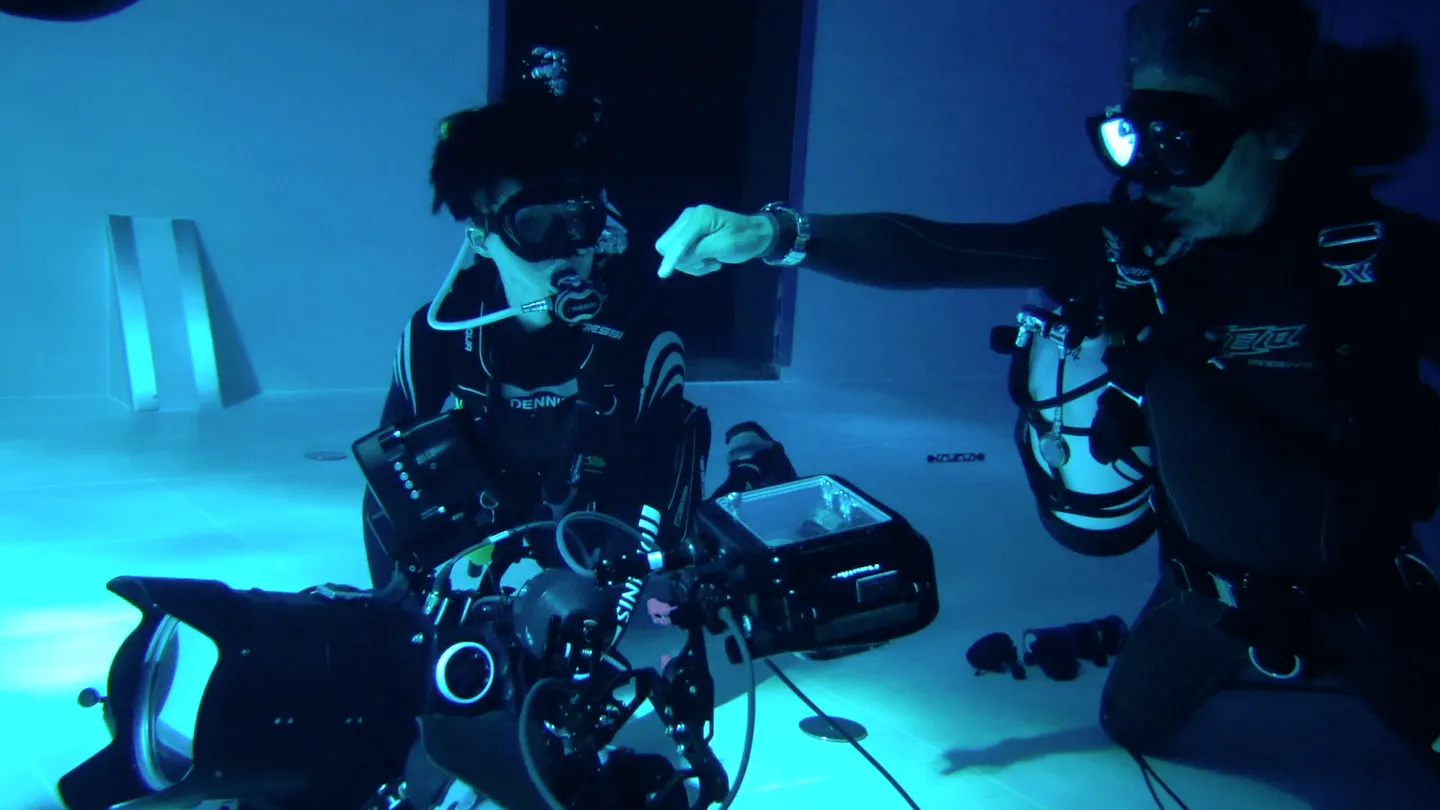
The scuba safety diver must constantly anticipate the underwater cinematographer's needs and provide immediate support
Director Hu recalled a dive near Penghu's Nanya Four Islands National Park to the wreck of the Lingyun, where the team missed the entry point and suddenly encountered a current shift. The underwater cinematographer, fighting enormous water resistance while holding the camera, was unable to reach the filming location. In that situation, the safety diver had to push hard against the current alongside the cinematographer to reach the rendezvous point.
Sometimes, due to weather conditions at the filming location or the need to capture a specific moment — such as the underwater rays of a setting sun — the cinematographer chooses sidemount with multiple cylinders to extend bottom time, making decompression stops inevitable. The safety diver may then surface to fetch decompression cylinders for the cinematographer underwater, or directly assist by carrying those cylinders (on one occasion a single safety diver carried five cylinders), making the cinematographer's underwater work considerably more manageable.
At the "May Your Soul Possess the Spirit of the Sea" special exhibition, Coach Wei-zhe — who primarily works as a scuba safety diver — shared that his main task is to stay with the cinematographer at all times: checking the surrounding environment, monitoring the cinematographer's equipment and pressure gauge (SPG), reading what the cinematographer needs, and upholding the team's cardinal rule of safety first — never taking unnecessary high-risk chances.
The Freediving Safety Diver Is the Actor's Eyes and Feet
Coach Zheng-feng explained that the freediving safety diver's role is to serve as the actor's eyes and feet. Because most actors film without a mask, even if they open their eyes underwater, the different refractive index of water makes it impossible to focus. The freediving safety diver must therefore communicate with the actor on the surface beforehand, conveying the planned camera angle and the expression required for the dive, then guide the actor to the precise filming position once they descend. This means the freediving safety diver must have the script, storyboard, and every camera angle memorised to ensure the shoot flows smoothly.
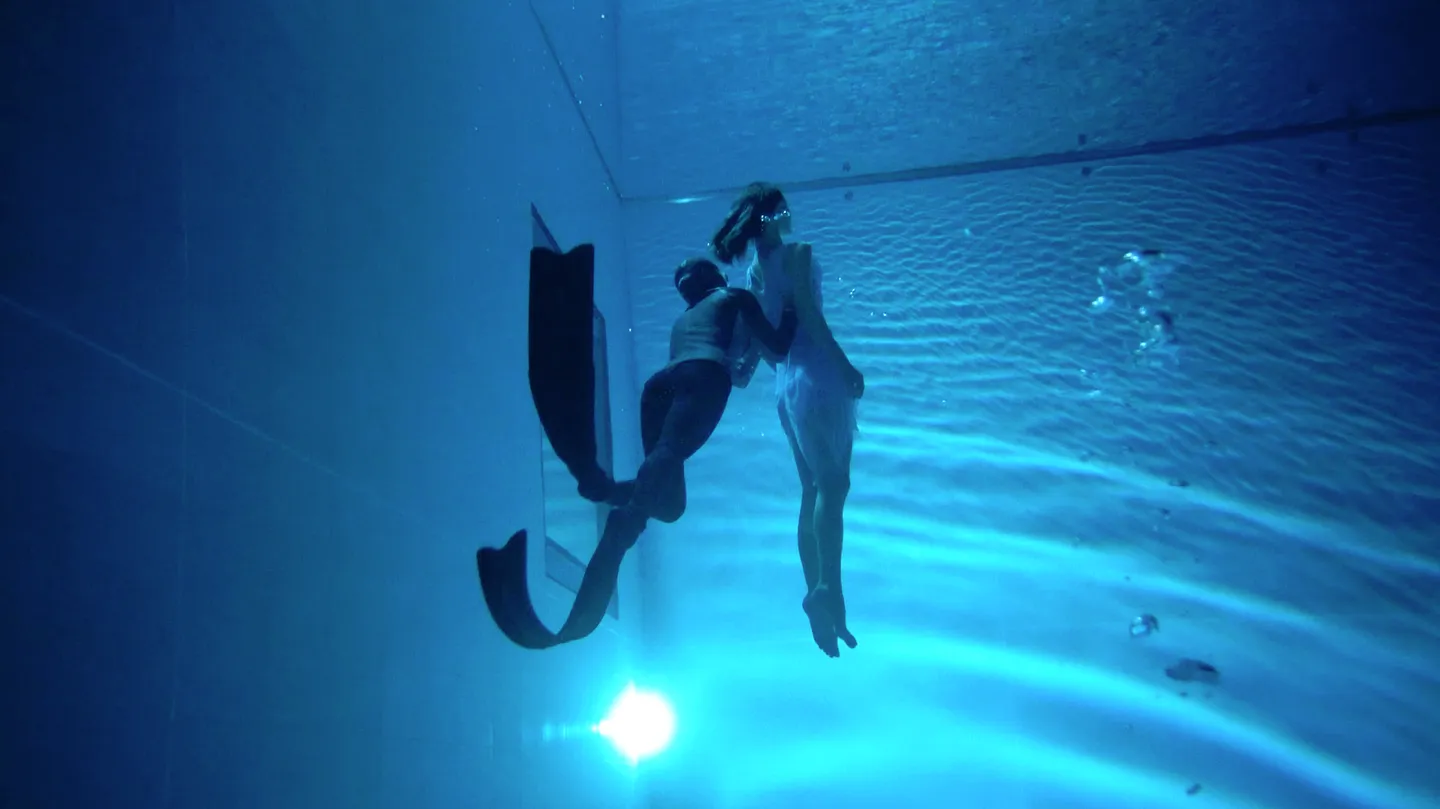
The freediving safety diver must guide the actor into the correct position
Beyond that, a professional freediving safety diver must monitor the actor's condition in real time throughout each take. As the shoot progresses and dive frequency increases, the actor's physical reserves diminish and breath-hold times shorten. The safety diver needs to read these signs and communicate them to the crew so the actor is given appropriate rest at the right moment.
Of course, freediving and scuba safety divers also work in tandem. For instance, if a particular shot calls for the actor to swim toward the camera, the scuba safety diver will position ahead to provide lighting, while the freediving safety diver briefs the actor on the surface, then guides them underwater to the designated spot to move toward the light source and complete the shot.
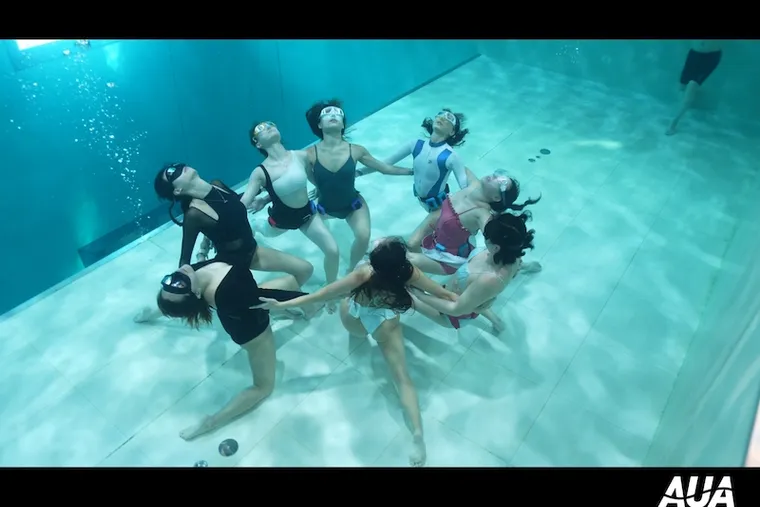
Underwater filming, like any land production, demands extensive pre-shoot discussion of every storyboard panel and blocking detail. All of that communication then happens silently underwater through hand signals. Director, cinematographer, actor, and safety diver — each plays their distinct role beneath the surface, and the entire crew performs their concerto with the precision of a symphony orchestra, delivering the finished work to audiences above.
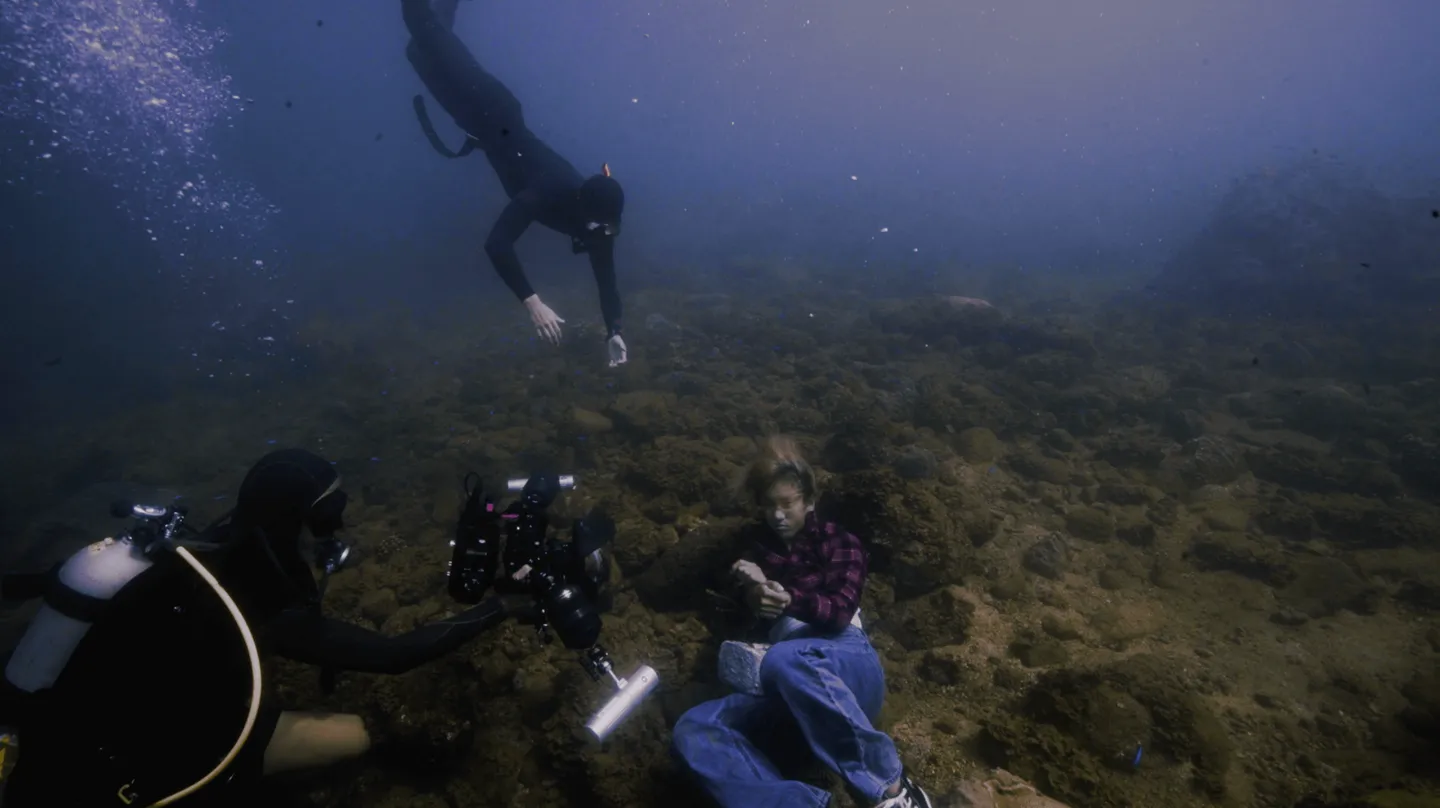
Underwater cinematography is a perfect symphony of different roles working in harmony with one another
Yuan Xu-hu: A great underwater safety diver must not only possess exceptional diving skills but also a heightened awareness of everything happening around them.
The minimum standard for a safety diver within the "海人制作" team is a dive instructor with teaching experience. An instructor-level certification provides the foundational professional diving ability and safety awareness the role demands. Instructors with teaching experience are also better equipped to intuitively understand what a cinematographer or actor needs underwater. When verbal communication is impossible during a shoot, the ability to read an actor's facial expression and eyes — gauging their physical condition, reacting to changes in the environment, and coordinating with the crew to make the safest and most efficient on-the-fly adjustments — represents the safety diver's irreplaceable and often unseen contribution.
"海人制作" is Taiwan's first and only professional underwater cinematography production team. We look forward to the day when their lens brings us even more underwater film and video works created by Taiwan's finest professional team!
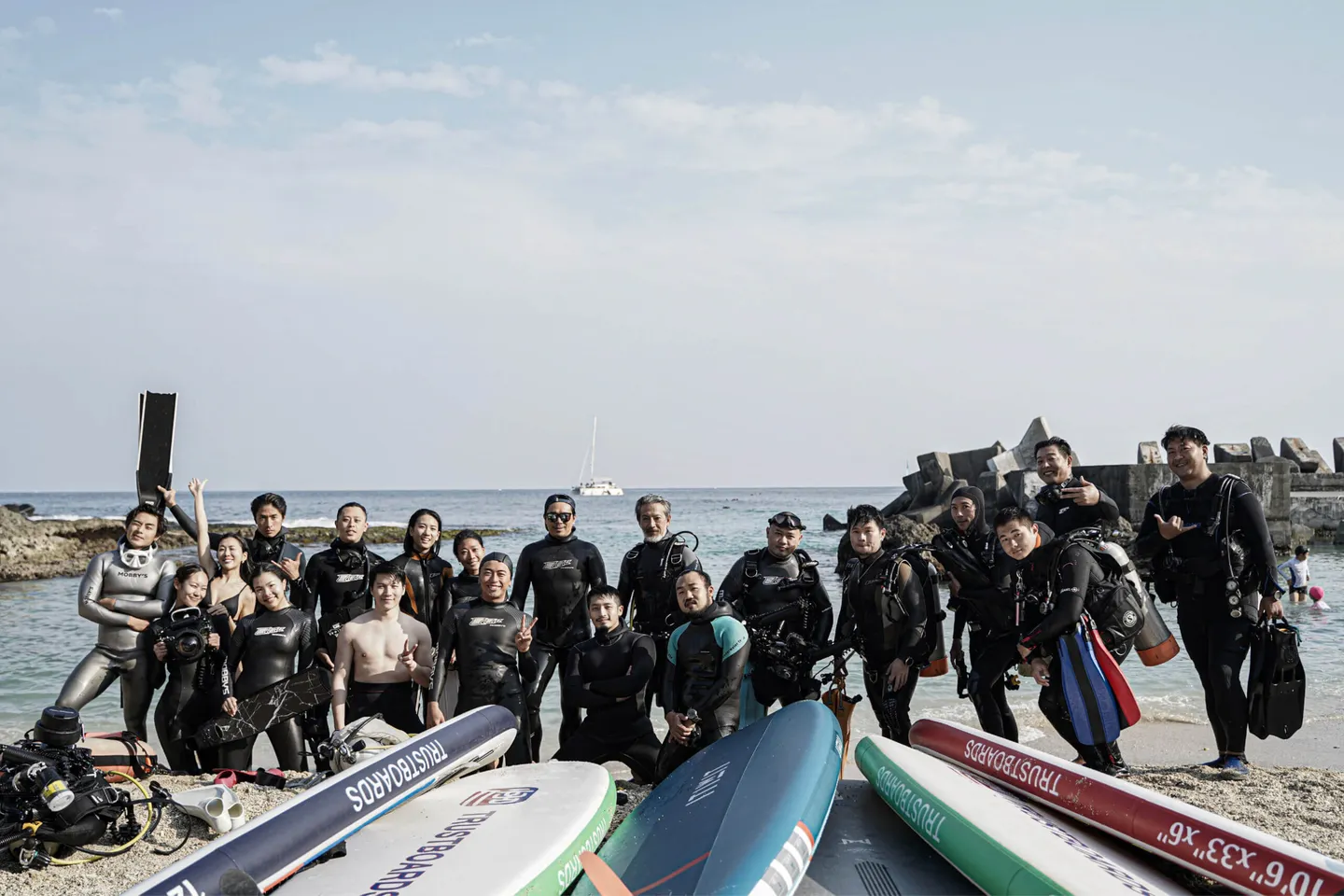
"海人制作" team's 2022 Xiaoliuqiu winter training camp
Related links: