Contents(4)
the Editor says: In the very first lesson of learning scuba diving, the instructor will always ask everyone to put the second stage regulator in their mouth and breathe in and out with big, full breaths. But truly mastering the correct breathing technique for diving usually takes a fair number of tank dives — plus a little natural talent — before it finally clicks. Before that "aha" moment arrives, the new-diver experience is often defined by breathless, exhausting dives and the up-and-down "elevator diving" that comes with it. As the saying goes, a great instructor takes you to heaven — and after reading this article, you'll quickly learn how to breathe correctly underwater! This article is reprinted in full from the personal Facebook page of dive instructor 黃彥勛.
3 Super Practical Breathing Tips for Scuba Divers!
I believe the most important thing in scuba diving is breathing. You might be thinking: it's just breathing — how hard can it be? Go ahead and ask your friends who have already earned their Open Water Diver (PADI/SSI cert) certification. I'm sure they'll have some very profound thoughts on the subject of "breathing."
So what does it actually mean to breathe correctly underwater? Below I've listed a few of the problems that I think beginners are most likely to run into.


1. Instructor, I Can't Get Enough Air!
I often have try-dive participants or students who are just starting their course come to me and say, "Instructor, why does it feel harder and harder to breathe?"
The reason is actually quite simple: your breathing pattern is either exhale nothing or barely exhale. In other words, you take a breath in, but you only breathe out about 30% of that air. This means your next breath has only that 30% of space to work with, which is why breathing feels like such an effort.
The fix is straightforward: breathe out the rest of that air completely. You'll find that breathing becomes much smoother right away.
2. Instructor, Why Can't I Sink?
Assuming your weights are properly adjusted and all the air has been fully vented from your BCD, why are you still not descending? At this point, take a close look at your breathing — are you taking one very large breath in a short amount of time?
Think about it this way: imagine trying to pull a balloon down underwater — that's quite the challenge, isn't it? The human lungs work just like a balloon. If you keep taking big gulps of air continuously, how do you expect to descend into the water?
The solution here is to adjust your breathing pattern. Breathe slowly and deeply, and you'll gradually start to sink.
3. Instructor, I Keep Going Up and Down — Why Can't I Control My Neutral Buoyancy? (Your Instructor Is Already Exhausted)
First, let's set aside those moments when you suddenly remember you're supposed to have neutral buoyancy only when you happen to glance at an EKG-looking depth trace — actually, let's assume your depth is fixed and you've already achieved neutral buoyancy. At this point, the one factor that will affect your buoyancy is breathing.
Why the up-and-down movement? If you're still inhaling while you're rising, your buoyancy naturally increases along with the extra air in your lungs, and you'll float higher and higher until you turn into a human sky lantern (?). Conversely, if you're still exhaling while sinking, your buoyancy decreases further and you'll sink straight to the bottom.
So: when you're rising, remember to start exhaling slowly; when you're sinking, start inhaling slowly. The more comfortable you get with controlling your breathing, the sooner you'll shed the title of "EKG diver" — and before long you'll be the one calling someone else an "EKG diver" (hey, that's not what I meant!) — which means you're ready to move on to the next level.
-
If you finished this article and realised you're not great at breathing, take a moment to consider whether you might need an instructor in your life to teach you how to breathe. (Wait, what?)
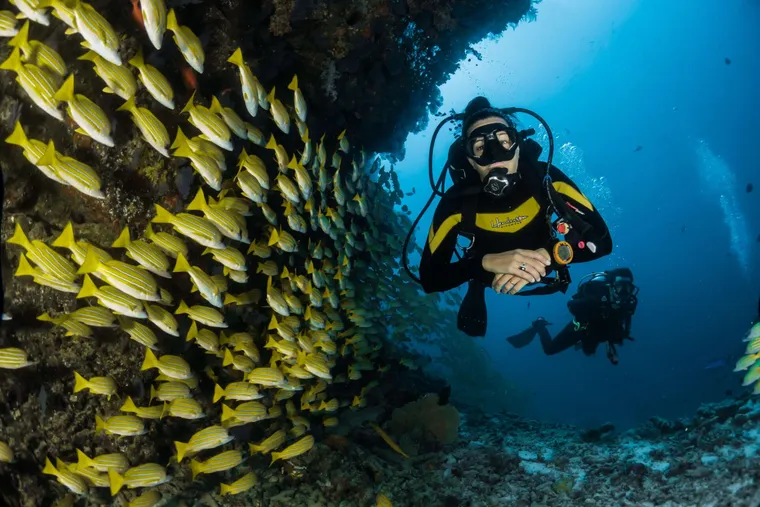
Cover photo: Photo by James Thornton on Unsplash
Further reading:
-
Dive instructor 黃彥勛's personal Facebook page