Contents(5)
The Editor says: Did you know that coral bleaching does not actually mean coral death? However, when this condition persists, corals will begin to die one after another. This past March, Australia's Great Barrier Reef was confirmed to be undergoing its fifth mass bleaching event, with over half of the world's coral reefs now in crisis. <Full article reprinted from: Environmental Information Center; translated by 吳凱西; reviewed by 陳文姿 and 林大利>
Ocean temperatures are sounding the alarm, with bleaching reports emerging from locations around the world. The U.S. National Oceanic and Atmospheric Administration (NOAA) announced on the 15th that the world is experiencing its fourth global mass coral bleaching event — the second such event in the past decade.
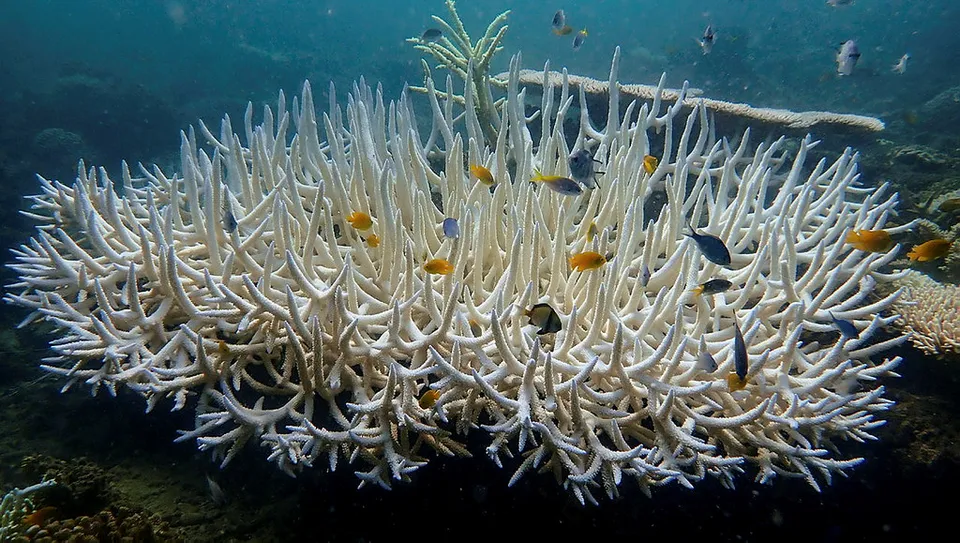
Coral bleaching at Martin Reef in northern Australia's Great Barrier Reef, March 2024. Photography: Veronique Mocellin. Image source: Australian Institute of Marine Science
Coral Bleaching Crisis Spreads Globally — Over Half of Reefs Threatened
According to Reuters, global warming has caused sea surface temperatures to rise. NOAA noted that from February 2023 to the present, coral bleaching has been confirmed in more than 54 countries and territories worldwide.
NOAA has long monitored global sea surface temperatures via satellite, and provides a coral bleaching early warning system using tools such as in-situ measurements and model analyses. According to NOAA, over the past 365 days, coral bleaching has spread across the Atlantic, Pacific, and Indian Oceans.
Derek Manzello, coordinator of NOAA's Coral Reef Watch program, stated that more than 54% of the world's coral reefs are currently experiencing heat stress severe enough to trigger bleaching.
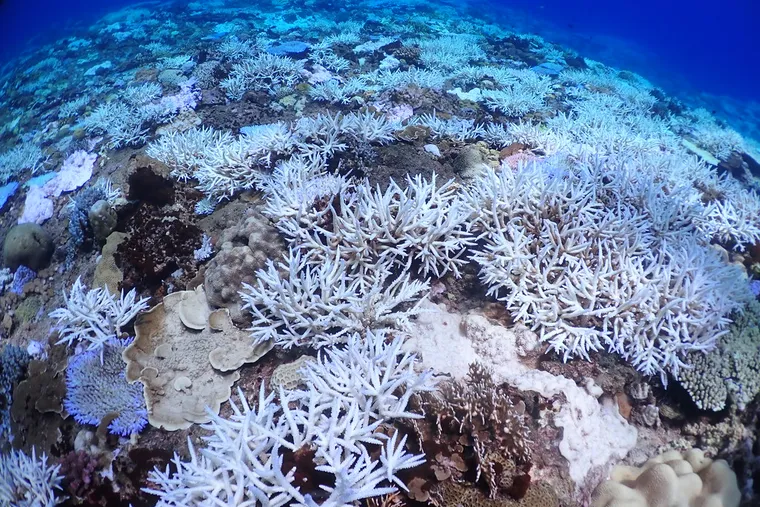
Coral bleaching is a physiological response of the coral-symbiotic algae partnership (the coral holobiont) to environmental stress, and does not in itself equate to coral death. However, when the stress persists — such as prolonged exposure to high temperatures and intense light — the holobiont exceeds its physiological limits, and corals begin to die.
Marine scientists are deeply troubled and even angered by the severity of the coral bleaching. BBC notes that the first warning sign came from the Caribbean, where swimmers off the coast of Florida in the United States noticed unusually warm waters in 2023. This was followed by marine heatwaves in the Southern Hemisphere, affecting Australia's Great Barrier Reef, Tanzania, Mauritius, Brazil, Pacific island nations, and regions as far as the Red Sea and the Persian Gulf.
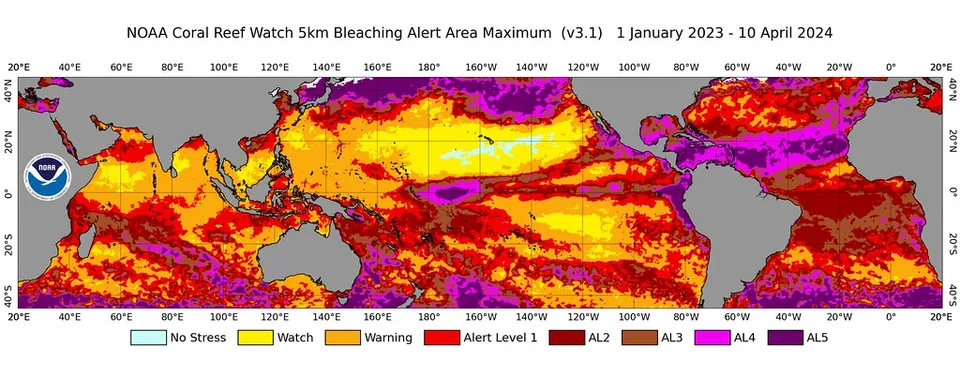
NOAA's Coral Reef Watch displaying coral bleaching alert levels from January 1, 2023 to April 10, 2024. (Image source: NOAA)


Great Barrier Reef Undergoing Its Fifth Mass Bleaching Event
Australia, in the Southern Hemisphere, entered summer at the end of last year, with sea temperatures continuing to climb. The Great Barrier Reef Marine Park Authority (GBRMPA) confirmed in March that the Great Barrier Reef is experiencing a mass bleaching event — the fifth bleaching crisis in eight years. Aerial survey results revealed severe coral bleaching in shallow-water areas, with underwater surveys now underway to assess the severity and extent of the bleaching.
The Australian Marine Conservation Society stated in April that aerial surveys show coral bleaching has been observed across 75% of the Great Barrier Reef.
"I feel devastated," said Selina Ward, former academic director of the Heron Island Research Station at the University of Queensland and a coral reef expert, who surveyed 16 areas in the southern Great Barrier Reef. She said it was the worst she had seen in 30 years.
The GBRMPA further confirmed on the 17th that the bleaching impact is extremely widespread, with nearly 46% of corals across the Great Barrier Reef exposed to record-level heat stress. Approximately 60% of corals may have bleached as a result of significant heat stress exposure; detailed underwater surveys are still ongoing and more time is needed to fully understand the scale of the impact.
According to The Guardian, Terry Hughes, emeritus professor at James Cook University in Australia and a leading coral bleaching expert, noted that since 1998, coral bleaching events have occurred in every coral reef ecosystem, with some locations having experienced bleaching three to four times. This cumulative toll progressively weakens the resilience of coral reefs.
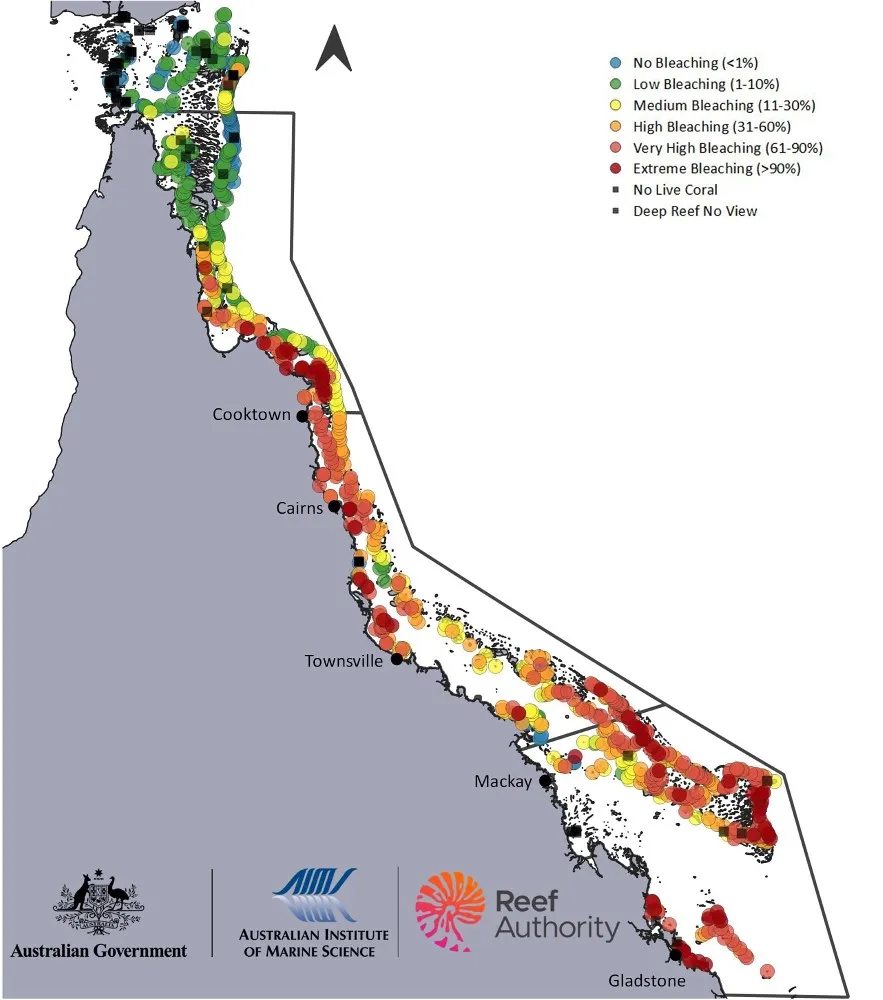
Results of the Great Barrier Reef Marine Park Authority's (GBRMPA) 2024 aerial survey of bleaching rates in shallow-water coral reef communities of the Great Barrier Reef. Image source: Great Barrier Reef Marine Park Authority (GBRMPA)
References
- BBC (15 April 2024), Coral bleaching: Fourth global mass stress episode underway - US scientists
- NOAA (15 April 2024), NOAA confirms 4th global coral bleaching event
- AP (15 April 2024), Scientists say coral reefs around the world are experiencing mass bleaching in warming oceans
- Great Barrier Reef Marine Park Authority (17 April 2024), REEF HEALTH UPDATES
- Australian Marine Conservation Society (11 April 2024), 'Worst I've seen': new footage shows Reef bleaching in deeper waters from record marine heatwave
- The Guardian (11 April 2024), Great Barrier Reef suffering 'most severe' coral bleaching on record as footage shows damage 18 metres down
Related Links
- Environmental Information Center Official Website
- Original article: NOAA Confirms 4th Global Mass Coral Bleaching Event — Over Half of the World's Reefs at Risk
Further Reading