Contents(10)
- Okinawa's Diving Environment
- Okinawa Dive Sites
- The Northern Ie Island Wreck (0–40 m)
- The Blue Cave in the Onna Area (0–18 m)
- The Central Sunabe Area (0–30 m)
- The Southern Itoman Golden Triangle (0–60 m)
- The Kerama Islands and Beyond (0–50 m)
- A Special — and Shameful — Bonus: The Whale Shark Captive Dive Site
- Summary: Diving in Okinawa
- The Story Behind Starting a Business Here
The Editor says: This year, BlueTrend has featured a wealth of Okinawa diving articles and travel information — and for good reason. Okinawa is incredibly close to Taiwan; a quick budget-airline flight and you're there. Japan's unique cultural charm makes it a wonderful complement to any dive trip, and the legendary wagyu beef alone is worth the journey. We are deeply grateful to Ken, instructor at 沖繩海潛 UMI DIVE, for generously sharing his many years of invaluable experience living and diving in Okinawa. His insights make for the perfect planning guide for an Okinawa dive adventure — so gather your crew and let's go!
I'm Ken (that's what everyone calls me). I relocated to Japan for work four years ago and currently run a dive shop in Okinawa. I promised some time ago to write an introduction to diving in Okinawa, so here it is! I'll try to break it into several sections so fellow divers can get as complete a picture as possible.
Okinawa's Diving Environment
Water-based activities are completely open throughout Okinawa Prefecture. As of last year, 1,986 registered water-activity operators were on record for the entire prefecture. Scuba diving is naturally among them — in fact, it is one of the leading tourism activities (with more than 550 operators). In Onna Village alone (home of the Blue Cave), there are at least close to 200 dive shops, not counting independent instructors.
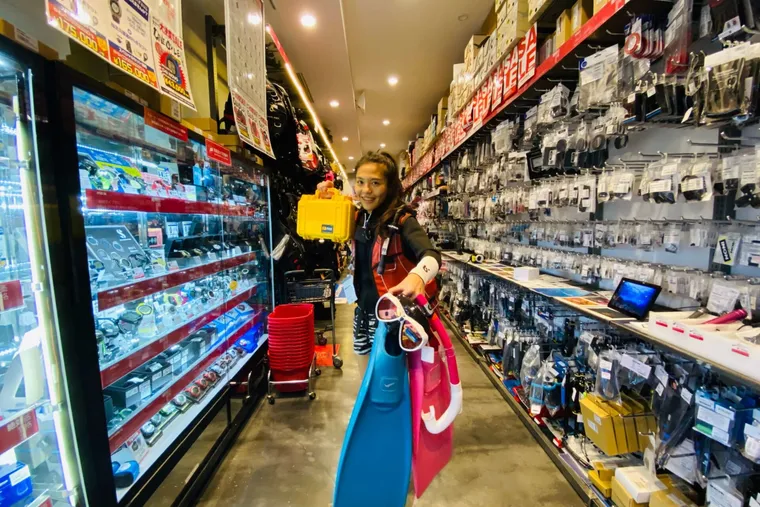
The Okinawa prefectural government has also developed a number of facilities so divers can train in comfortable environments. In Ginowan, there is a pool managed by a commissioned operator at an industry center. It features a 4-meter pool — deep enough, though a little on the small side — and is well suited for Open Water Diver (PADI/SSI cert), drysuit, and freediving courses. On the second floor is an HID dive gear shop selling mostly budget-friendly products; about one-third of the inventory comes from Taiwan. Other major international brands available in Taiwan can also be found here. The primary customer base is operators and fishermen from the fishing cooperative. Discounts on scuba equipment are not substantial (the Japanese don't tend to discount much), but if you bring your passport you can look for specialty brands not manufactured in Taiwan. Everything else can be purchased at dive shops or online in Taiwan.
If you'd prefer not to head straight to open water for a certification course, you can bring students to Mihama Port Marine and Air Park next to Naminoue Shrine. This is a facility built by Okinawa Prefecture and managed by a contracted operator. It includes a calm-water zone specially designed for dive training, where courses can be conducted very safely. Paid shower and changing facilities are available on land.
Since everyone has their own preferences when it comes to dive sites, I'll try to be as objective as possible:


Okinawa Dive Sites
The main island of Okinawa is roughly the length of the Taoyuan–Hsinchu–Miaoli corridor. Within that stretch, there are approximately 150+ dive sites spread across the north, south, east, and west. Depending on weather conditions and divers' skill levels, operators will either drive you to the site or arrange to meet you there, taking you to conquer a variety of spots.
The Northern Ie Island Wreck (0–40 m)
I haven't had the chance to dive the Ie Island wreck myself yet. The boats heading there are quite small, so it's best to go only when the weather is excellent.
The Blue Cave in the Onna Area (0–18 m)
This dive site was developed about eight years ago. My take: it's worth visiting… once. Think of it as a pilgrimage — the way foreign visitors always go to see the changing of the guard at Chiang Kai-shek Memorial Hall at least once. That's the vibe here. It's best visited outside peak season (June–September, when you'd want to be diving elsewhere anyway). It's especially good for a try dive (no certification required) and is great for bringing the whole family for an introductory dive or snorkeling experience.
There are two ways to dive the Blue Cave: shore diving and boat diving (stating the obvious, I know). Those with good fitness and budget-conscious travelers can opt for shore diving — consider it leg-day training. That said, hauling full gear up and down 200 steps is still easier than the old cross-country trail at Chaoching Park in Taiwan, so Taiwanese divers will definitely manage. The boat dive is more relaxed. The boats in this area are fishing vessels (和船) from the local fishing cooperative that convert to dive-transfer boats in summer. It's about a 5-minute ride to the surface in front of the cave, then it's queue to enter the water, queue to enter the cave, queue for photos, queue to board the boat — the whole dive activity wraps up in about 25 minutes. It really is an ideal site for try dives.
There are many operators here, and Chinese-speaking operators are not in short supply. Those looking to save a little money can seek out Japanese-run dive shops. 黑潮潛水 was an early player, and 青潛 has also been doing great work recently — both are worth considering.
My conclusion: the Blue Cave is genuinely well-suited for try dives and absolutely worth experiencing at least once.
The Central Sunabe Area (0–30 m)
Next, let me introduce the dive sites near my shop — the Miyagi Coast (Sunabe). This is a well-known shore dive site and a favorite among local Japanese and American divers alike. Sunabe could be called the ancestral home of Okinawa diving. It has excellent coral coverage, and when I got my Open Water Diver (PADI/SSI cert) in Okinawa back in 2004, the instructional video shown at the shop featured Sunabe. In recent years, the Sunabe coastline has been nicely rehabilitated, drawing even more visitors. The Sunabe area stretches roughly one kilometer along the shore and can be divided into three main dive sites:
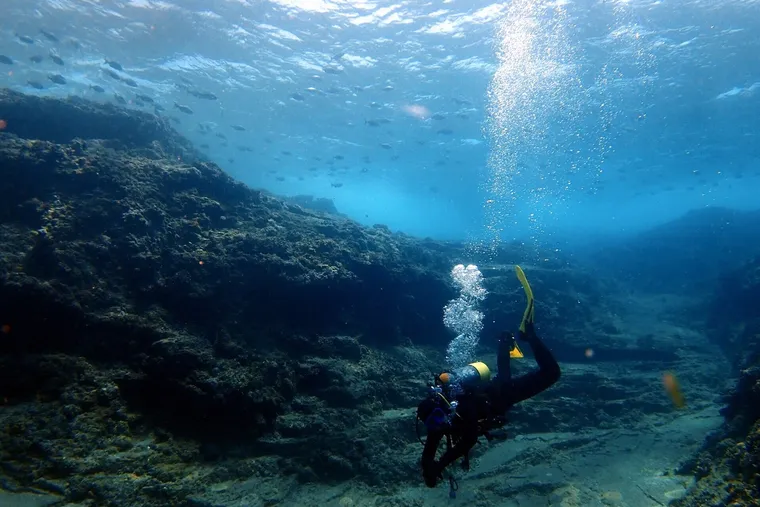
- Small Blue Cave vs. Underwater Wall
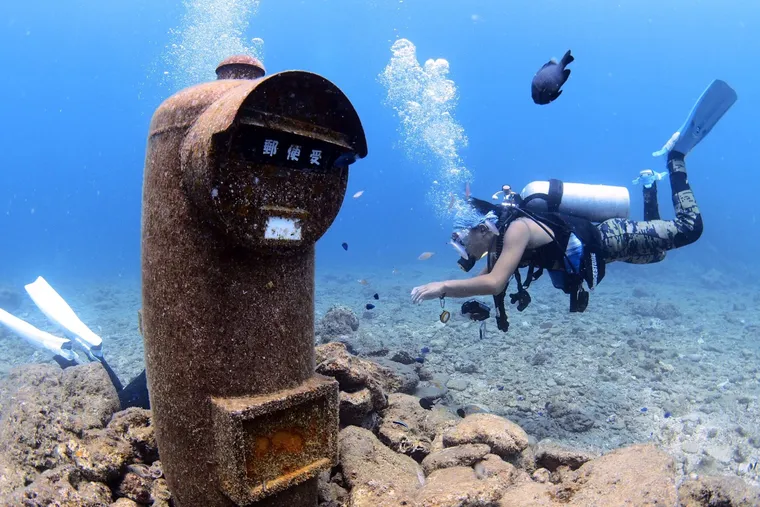
- Underwater Mailbox vs. Underwater Wall
- UFO vs. The Bird Cage (artificial steel reef)
Sunabe is suitable for try dives, instruction, advanced diving, and night diving. In my personal view, this site is ideal for travelers whose primary purpose is diving. Spend the first day here doing two tank dives for gear adjustment and a skills review. On the first tank, head to the Small Blue Cave — it's not as large as the main Blue Cave, but the upside is no queuing with other divers for photos. The soft coral along the way is rarely seen in Taiwan; I personally love diving this route just to unwind. On the way back, swing by the underwater mailbox before completing your safety stop and surfacing.
For the second tank, ask your dive shop to take you to the Bird Cage and UFO to see the yellowtail barracuda schools. This site is also along the Sunabe coastline, about 200 meters away on foot. Afterward, head ashore for a bowl of 浜屋そば (Hamaya Soba) — one of Okinawa's most celebrated noodle shops.
To sum up, Sunabe is ideal for three dives. From there, the planning is up to you — you can map out dive sites across Okinawa at your leisure.
Two Chinese-speaking operators currently run the Sunabe area: 沖潛, which opened before us, and our own 海潛 (UMI DIVE). Both have excellent and enthusiastic instructors — feel free to check either of us out!
The Southern Itoman Golden Triangle (0–60 m)
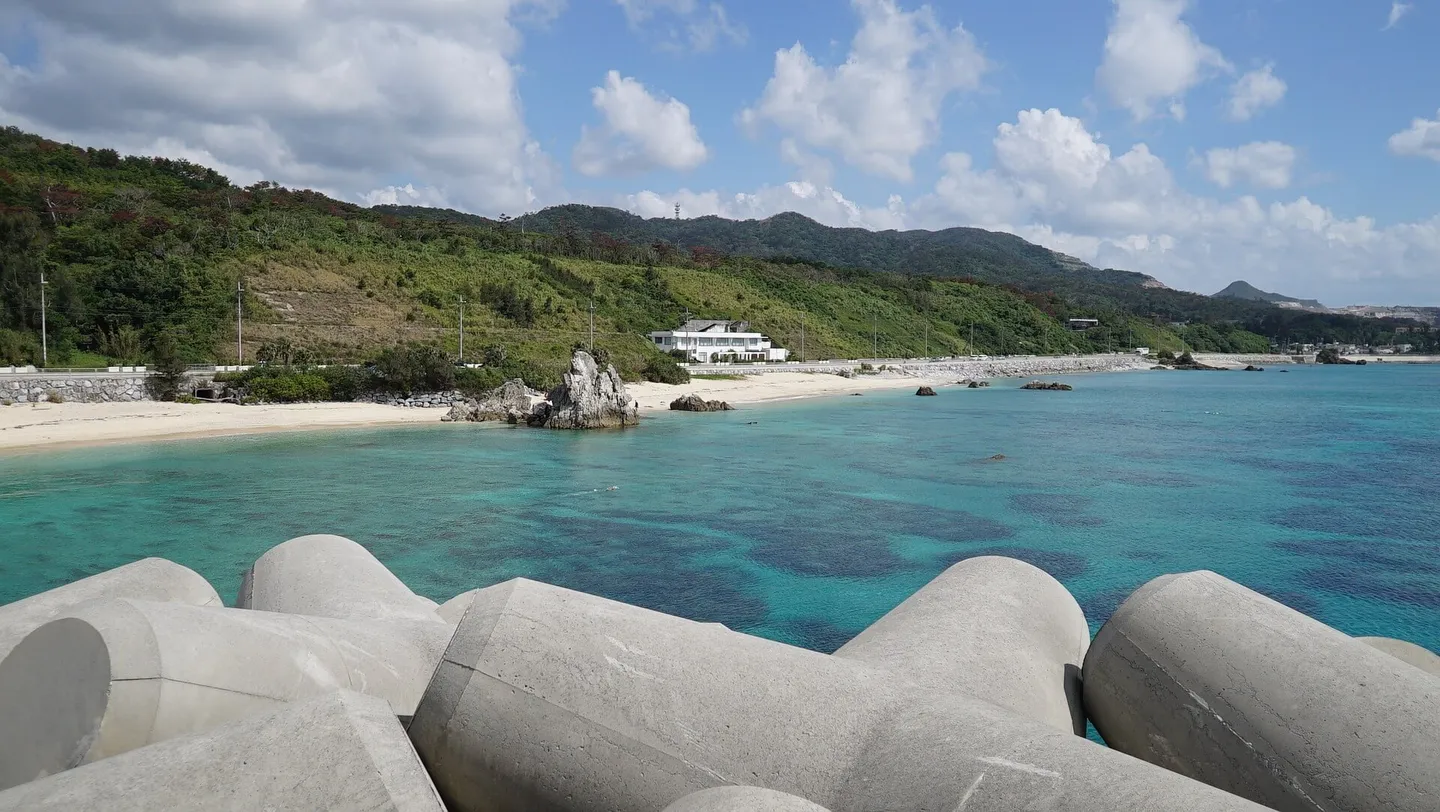
Itoman is better suited to boat diving. Shore diving there is mostly done by locals — getting to the entry point is quite an effort, roughly a combination of the old Chaoching and Hejie routes in Taiwan: gear up, descend a near-vertical rock face, then walk along a stretch of coastline to reach the entry point, and do the same in reverse on the way back. As a boat dive, however, Itoman is a lot of fun. It's best suited for advanced-level divers and above, with good neutral buoyancy control.
The famous Golden Triangle has some spots that exceed the recreational diving maximum depth of 40 m. Divers who love this site often use enriched air nitrox (EANx) to push slightly past the line to around 50 m, where you can encounter schools of Whitetip Reef Sharks, tuna, and giant trevally (GT). Near the Golden Triangle there is also a spot where you might chance upon Stingrays on their migratory path — timing it with the tides is a bit of a gamble. I've been several times and only spotted them once, but the boat operators communicate with one another about Stingray sightings, so it's a site well worth anticipating.
The Kerama Islands and Beyond (0–50 m)
This is a destination you could dive for years and still not exhaust. It's better suited to certified recreational divers looking for a proper dive trip. The only way to dive the Kerama Islands is by boat, departing mainly from Mihama Port in Naha or from Kōkawa Fishing Port near American Village. Heading west from Naha, about twenty minutes by boat brings you into the waters of Kerama National Park.
There are roughly 400+ dive sites here, spread across more than 100 islands of varying sizes in all four directions. Boat operators choose entry points based on wave and current conditions, always aiming to bring divers to the calmest possible entries. A day of Kerama diving typically includes three dives. Divers should bring their own lunch or ask the shop to arrange it. Usually, a longer surface interval is scheduled after the second dive — we eat on the boat before heading to the third site. The third dive is generally completed by 2:30 p.m., with arrival back at Naha port around 3:30 p.m., leaving plenty of time to arrange land-based activities. Divers can plan a group dinner in the city — wagyu yakiniku, Okinawan cuisine, and live folk-music performances are all excellent choices.
A Special — and Shameful — Bonus: The Whale Shark Captive Dive Site
This site was originally presented as a holding area to give the Whale Sharks from the aquarium an occasional "breath of fresh air." The version told to customers, however, is that the Whale Sharks were rescued from the open ocean. Yet after a typhoon last year during which the Whale Sharks actually escaped the enclosure net, one mysteriously "appeared" (was "rescued") again shortly afterward. Strip away the branding and this is simply commercial diving dressed up under the banner of conservation.
Someone will always ask, and where there's demand there's a market — I won't pretend otherwise, and I'm mentioning it here so everyone is informed. Interested divers can ask around; there are operators running it as a straight business.
Update from a reader, 7 May 2019: The Whale Shark at Yomitan Village's Toda Fishing Port is the property of the aquarium, entrusted to the Toda Fishing Cooperative for management, with the cooperative in turn delegating care to affiliated dive operators. The new Whale Shark this year was transferred from the aquarium in March — it was not caught at sea. Health checks, including monthly blood draws and stool samples, are conducted by the aquarium, which also serves as a regular fish-supply center for the port. — Clarification provided by Instructor Wang of 沖繩縱橫四海 (topmarine.com.tw).
Summary: Diving in Okinawa
To wrap up — compared to diving in Southeast Asia, diving in Japan is generally on the pricier side. My usual recommendation for dive-trip friends is to plan a five-day itinerary and either rent out an entire guesthouse or find a budget hotel. Renting a whole place works out to roughly ¥3,500–¥4,500 per person per night on average, and you have the added bonus of being able to hang your gear and wet clothes outside to dry.
The downside is that living together gets a little too lively — just remember not to drink too much alcohol the night before a dive day. Hotels and guesthouses offer more personal privacy, though rooms tend to be on the small side in general. Spend the first three days diving hard — you can realistically fit in eight to nine dives.
For transport, spend a little to have the dive shop or hotel shuttle you to and from the port. Spend your evenings enjoying great food near your accommodation. You really don't need to rent a car for those first three days. Save the car rental for the last two days of land sightseeing and enjoy the Japanese self-drive experience. Renting an American-style convertible sports car here is surprisingly affordable, and renting a Japanese hybrid is even cheaper!
Diving in Okinawa — setting aside the captive Whale Shark site mentioned above — really comes down to luck when it comes to spotting big animals. But I can say this: they're all out there, living their lives in these waters. Every dive brings a different surprise, and Japanese divers take whatever they happen to see very much in stride.
The Story Behind Starting a Business Here
Starting a business in a foreign country as a Taiwanese person is genuinely harder than it is for locals. We have to offer employees more — accommodation, transportation — costs that Japanese operators simply don't bear. We provide Chinese-language service, which eliminates a lot of potential misunderstandings and communication issues. If you speak fluent Japanese and have budget considerations, looking up Japanese-run dive shops through their websites is also a perfectly good option.
Finally, I want to sincerely ask all fellow divers: once you have made a booking with any dive shop, please do not cancel at the last minute the day before. Okinawa boat operators run on a reservation system, and if an activity is cancelled the day before, the dive shop still has to pay the boat operator. Let's all work together to uphold the reputation of Taiwanese divers!
Budget airline flights to the Okinawa main island — many under just one hour — make it extremely worthwhile to come and dive. I hope this guide helps with your planning!
Wishing all fellow divers —
Dive safe.
Related links:
-
Okinawa Diving Is More Than Just the Blue Cave! 5 Okinawa Diving Secrets You Need to Know
-
Cave Diving, Sharks, Beautiful Coral Reefs — Unlocking Okinawa's Hidden Dive Sites: Cape Manzamo
Cover image: Image by mutomasataka from Pixabay
Frequently Asked Questions
How is a BlueTrend dive trip different from an unknown, no-name dive group?
Choosing us means full peace-of-mind protection and a smooth experience from start to finish. Every trip we run holds to three things.
First, full legal protection and a professional dive leader: we strictly follow Taiwan's travel regulations and provide complete travel-agency liability insurance, travel insurance, trip-inconvenience insurance and dive insurance. Every group is accompanied by a certified, foreign-language dive leader who joins you on both the dives and the land itinerary, liaising seamlessly with local dive shops and operators on your behalf to keep things running smoothly — the person our travellers trust most.
Second, fully licensed with secure payments: every payment goes into a licensed travel agency's account, with multiple safe payment channels (bank transfer, credit card and more) and a legal collect-and-remit receipt, so every transaction is open, transparent and protected, avoiding the fraud and dispute risks of transferring money privately to an individual.
Third, hand-picked quality we vet in person: every trip, dive site and partner shop is scouted on the ground by our own team, from the guides' professionalism and safety standards to the food, lodging, environment and service details on land, all vetted by us so you don't get caught out.
I want to sign up for a dive trip. Are there certification-level or logged-dive requirements?
Each dive site is different, so the entry bar varies. 'Bali Tulamben', for instance, is relatively beginner-friendly. 'Malapascua in the Philippines' is also beginner-friendly, but since thresher sharks tend to cruise between 20 and 30 metres, we recommend AOW certification with 20+ logged dives to enjoy this trip comfortably. For 'the Maldives' or 'Palau', we suggest AOW with 50+ logged dives for a more relaxed experience. If you're not sure whether your experience fits the trip you want, message us and our dive editors will assess it and help you find the trip you'll feel safest on.
Can I join if I'm signing up alone? How are rooms arranged?
Plenty of our travellers sign up solo! For rooms and beds, we prioritise pairing you with a same-gender traveller, and if you'd rather have your own space you can pay the difference to upgrade to a single room. For the diving, our professional leader will pair you with a suitable buddy, and with the happy vibe on our trips you'll quickly make a great group of dive friends. Many people sign up alone, make new friends, and end up organising the next trip together!
Does the trip fee include dive insurance, gear rental, taxes and instructor tips?
It depends on the trip, the destination's regulations and the local operators. Every BlueTrend dive trip has a detailed web page with a clear 'included / not included' list, transparent and with no hidden charges. All payments are collected by a licensed travel agency, with a standard-form contract for your protection.
I'm a new diver / haven't dived in a long time — will I fall behind the group?
Before you complete your booking, our team assesses a suitable trip based on your certification level and experience. Before departure, we strongly recommend taking time to refresh in Taiwan with an instructor, or a fun dive to get your feel back. On the trip itself, our professional dive leader groups and pairs everyone by experience, keeps a close eye underwater on travellers who need extra care, and steps in to help right away.
Will the photos and videos taken during the trip be shared with us?
During the dives, 'safety' is always the leader's top priority, so whenever it's suitable and safe the leader will capture great shots and record the best moments. During or after the trip, we compile a cloud album for all travellers to download, so you go home loaded with memories!
Besides your scheduled trips, can you arrange a private group charter or independent travel for me and my friends?
Absolutely! Besides group trips, we also arrange private group charters and independent travel. We can communicate, enquire and coordinate services with local operators based on your needs, saving you time and effort and taking the language barrier off your plate, to tailor the smoothest, most reassuring dive trip just for you. Contact our LINE support and our editors will arrange it for you!