Contents(4)
The ecology and scenery of Taiwan's waters have always been a mystery that divers are eager to explore.
The Push for a Database That Sparked a Conference
For many divers, it has been a stroke of good fortune to encounter BlueTrend's growing marine life database and marine natural history collection, which let us understand our ocean in the most accessible way possible. Last year's Marine Citizen Scientist training course went even further, teaching everyone how to identify marine life using scientific methods and record the species they photograph — contributions that, through the database, help researchers and government agencies analyze marine ecosystems. It was precisely because of that training course that the 2022 Species Classification Conference was held on January 7, 2023, giving course participants, ocean enthusiasts, and divers the chance to interact and exchange ideas with biologists.
Every participant on-site worked diligently on classification, contributing their part to the database.


Every Photo Holds a Story You Never Knew
As the event opened, BlueTrend founder Spark shared how the phrase "The ocean changes because I dive" had profoundly influenced him — inspiring him to establish BlueTrend and the marine life database, with the hope of laying a foundation for marine ecological research in Taiwan. He also shared that in 2022, the marine database recorded the first-ever sightings of the Japanese Butterfly Ray Gymnura japonica and the Orectolobus leptolineatus in the Chaojing Conservation Area. Both species are apex predators that can only survive in waters rich with biodiversity. Their appearance demonstrates that the designation of a marine protected area can effectively boost the abundance of life within its waters — a finding that has helped Taiwan's academic community recognize the importance of marine protected areas (MPAs).
First recorded appearance in the Chaojing Conservation Area — Orectolobus leptolineatus. photo credit:Jialing
In addition, a citizen scientist also documented a sponge crab Dromia dormia in Chaojing cutting a gorgonian / sea fan to use as camouflage — a revelation that prompted those present to reconsider whether the 2022 incident of a large sea fan breaking apart in Chaojing was caused by human activity, or rather by natural animal behavior shaping the environment. It was a valuable lesson for everyone in attendance. The subsequent Wide-Angle Award, Rarity Award, and Best Marine Life Photo Award presented for the marine life database further showcased the beauty of Taiwan's waters, the rarity of the creatures within them, and some truly extraordinary animal behaviors.
Sponge crab Dromia dormia cutting a gorgonian / sea fan to use as camouflage. photo credit:簡晨宇
Reviewing these records allowed participants to see just how important it is to document marine ecosystems. Spark also announced that the marine life database had undergone major improvements to its user interface, and invited everyone to try it out on the spot. The species conference quickly turned into a lively gathering of like-minded enthusiasts, with people comparing the creatures they had photographed and sharing dive site locations, filling the venue with enthusiastic discussion.
New Records Can Be Found Even Among Common Species
Wox Lee, who presided over the event, was like a living marine encyclopedia, sharing ocean knowledge with everyone. For instance, one member brought a nudibranch photo to Wox Lee, only to discover it was actually a Coriocella nigra. Another member shared a photo of what they believed to be a Banded pipefish Doryrhamphus dactyliophorus, and after Wox Lee's explanation, it turned out to be a new species record — the Naia's pipefish Dunckerocampus naia. The difference lies in the tail: the common banded pipefish has concentric white rings all the way around, while Dunckerocampus naia has a red tail with white only on the upper and lower edges. This left everyone amazed that new species records could be found even among seemingly familiar species — and because the location and depth of the sighting were logged in the database, it provides a valuable lead for anyone else hoping to document it.
Living encyclopedia Wox Lee sharing and exchanging knowledge with fellow participants.
While practicing use of the marine life database, participants also discovered several particularly clever features. Beyond quickly searching for photos by species classification, users can also see which species within a given group have yet to be recorded — like a bounty board for new species records, motivating people to become the first to document them. Clicking on a photo within a species category simultaneously shows all records and locations where that creature has been photographed; some entries even display the most frequently reported locations (or "hotspots"), allowing marine citizen scientists to observe a species from multiple angles to improve their ability to identify it, while also learning where it is most likely to be found.
Good change is built together, by you and me — to be continued…
The Ocean Changes Because I Dive
In addition, the updated marine life database now supports multiple photo upload methods, including via Facebook and Google Drive, with Line integration planned for the future — significantly increasing convenience for users. From now on, anyone can use the database to help identify species together, turning it into the Wikipedia of the marine world, and helping those of us living on this island nation to love and understand our ocean more deeply.
Finally, Spark announced that to encourage more people to upload photos, contributors can not only enter prize draws but also accumulate points based on the number of uploads, redeemable for prizes in the future. This year, several initiatives will also be spun off from the marine life database, including a Giant Grouper Tracking Project — open to all divers willing to photograph and log sightings of Giant Grouper — and an advanced-level Marine Citizen Scientist course, among others. These plans stirred a sense of eager anticipation among conference attendees, as if echoing the founder Spark's opening words: "The ocean changes because I dive." It is our hope that in 2023, we can collectively leave behind even more precious biological records of Taiwan's waters, and together witness good change as it continues to unfold.
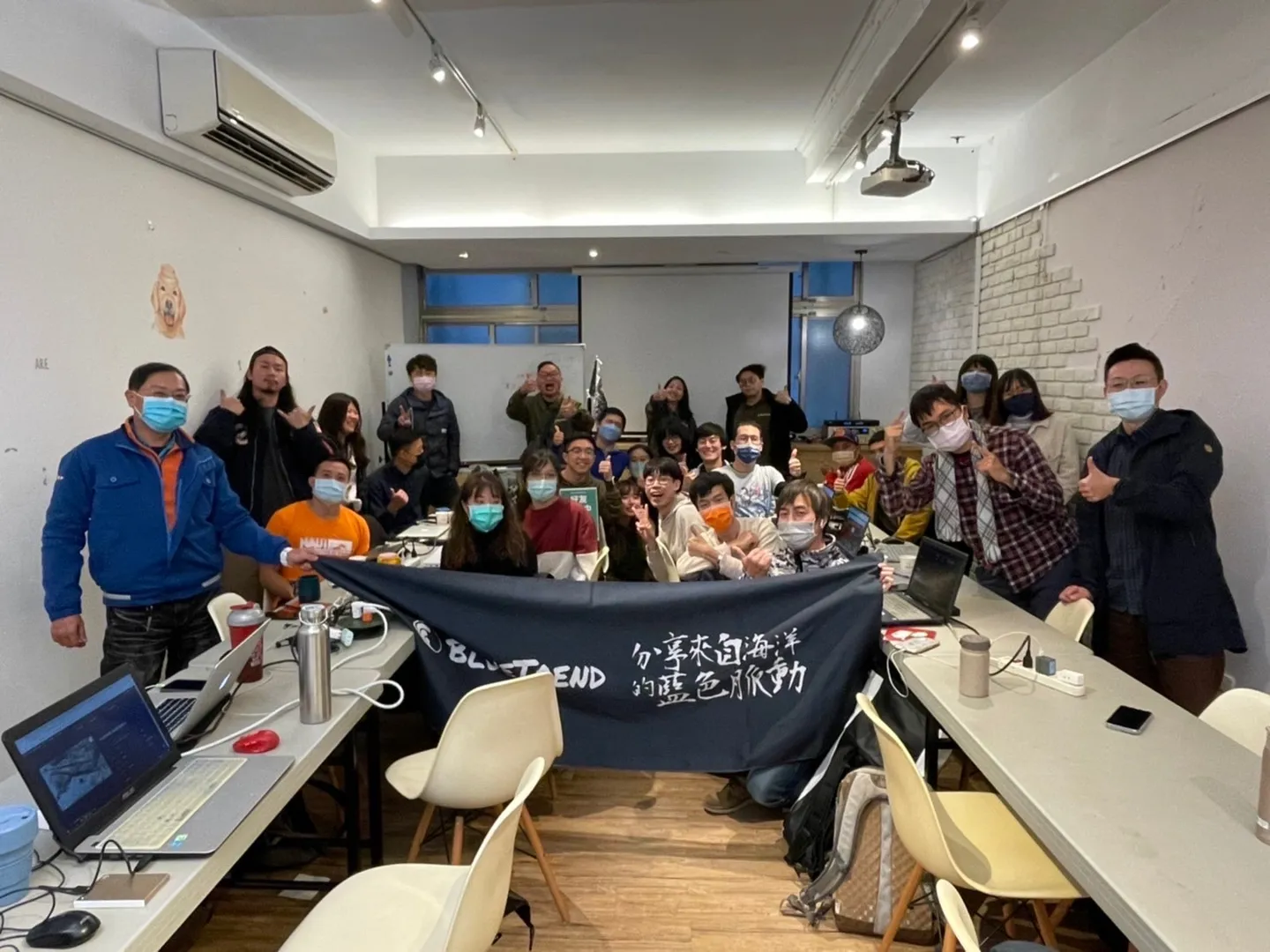
Let's all do our part for the database!
Group photo of all attendees at the 2023 Annual Species Classification Conference.
Further Reading:
- Marine Citizen Scientists Using Underwater Photography to Support Marine Conservation and Fundamental Research
- The First Lesson for Marine Citizen Scientists — How to Take Identification Photos of Underwater Marine Life
- The Chaojing Underwater Photography Competition Award Ceremony — Behind the Lens
- Award-Winning Works from "Marine Life Database — Upload and Be a Lucky Winner"