Contents(9)
- The Past of Marine Debris
- A Common Marine Debris Item — The Lighter
- The Smallest Marine Debris — Microbeads
- The Deeper Harm of Ocean Plastic
- How Can Ocean Plastic Be Recycled and Reused?
- Too Many Types of Plastic, Making Waste Sorting Extremely Difficult
- Marine Organisms and Substances Attached to Waste Make Cleaning Extremely Difficult
- Recycling Does Not Achieve Economies of Scale
- While We Wait, What Can We Do?
Marine debris plastics — commonly referred to as "ocean plastic" — are both a systemic environmental crisis and a transboundary problem, yet they remain an enormously difficult challenge to solve. "Plastic" is a catch-all term: two simple words attempting to define, under the banner of waste, tens of millions of different polymers. Almost everything we see and touch the moment we open our eyes each morning is made of plastic. As the plastics industry has evolved, it has produced materials that mimic leather, grass, and foliage; materials that retain warmth or have memory; materials that are glossy, matte, or thin as silk — all of them permeating every corner of our lives.
The Past of Marine Debris
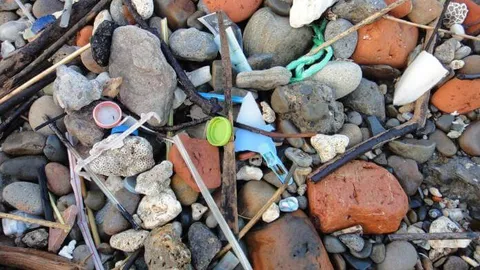
During World War II, the U.S. military promoted plastics as replacements for metals such as aluminum and brass, giving rise to the polyethylene, nylon, acrylic, and polystyrene foam we know today. From that point on, plastics began flooding our lives in enormous quantities. Global plastic production surged from the 1940s onward, reaching an annual consumption of some 270 billion kilograms today — a figure that continues to climb. On average, statistics show that each of us consumes approximately 136 kilograms of plastic per year. After these plastic products are discarded, they are hauled away by garbage trucks to incinerators — or they quietly slip into the ocean, and ultimately find their way back into our own bodies.
Image source: Hands-On Love Taiwan / Chen Xin-Zhu


A Common Marine Debris Item — The Lighter
Before World War II, people used metal lighters that needed to be refilled with fuel after use. Once the U.S. military developed the plastic disposable lighter during the war, annual lighter production skyrocketed — and so did the chances of spotting them on beaches. Beyond being an eyesore when washed ashore, plastic lighters floating at sea create another serious problem. The Black-footed Albatrosses of Midway Atoll have been among the most tragic victims of this plastic revolution. Adult birds skim the ocean surface to collect squid or fish eggs to feed their chicks — but since the 1960s, researchers have documented adults routinely picking up plastic fragments by mistake and feeding them to their young, significantly increasing chick mortality rates.
Research and surveys estimate that as much as 725,700,000 kilograms of marine debris end up in the ocean every year. These plastic wastes not only kill albatrosses, sea turtles, and whales — they will inevitably work their way up the food chain and into the human body.
Image source: NOAA
The Smallest Marine Debris — Microbeads
For decades, consumer industries have flourished, with some companies developing microbead-based products. Originally formulated using sugar, fine sand, or plant-derived granules, the raw materials for microbeads were gradually replaced — largely due to cost considerations — with plastics, including PE (Polyethylene), PP (Polypropylene), PET (Polyethylene terephthalate, the material used in plastic bottles), PMMA (Polymethyl methacrylate, the material used in acrylic), and Nylon. These substances do not break down over time. Because the particles are so tiny, they are extremely difficult to manage, and they ultimately drift into the ocean. Many people assume the vastness of the sea can absorb anything — but what they do not realize is that these particles have already entered the human body through the food chain.
The Taiwan Watch Institute has collaborated with the Dutch organization Beat the Microbead to conduct a survey of products containing plastic microparticles available in Taiwan (link), hoping to empower consumers to boycott products that are harmful to the environment. When shopping, you can also use an app to scan product barcodes and check whether they contain microplastics (app download).
The Deeper Harm of Ocean Plastic
In the broadest sense, ocean plastic includes PET bottles, discarded fishing nets, plastic bags, polystyrene foam, and all manner of plastic products. Beyond causing marine life to ingest them by mistake, plastics are extremely resistant to degradation. As waves batter them against the shore, they gradually fragment into smaller and smaller pieces. Their lipophilic (oil-attracting) nature means these fragments absorb human-made hazardous substances known as POPs (persistent organic pollutants), including polychlorinated biphenyls (PCBs) and DDT (Dichloro-Diphenyl-Trichloroethane) — all of which are proven highly dangerous carcinogens. As these fragmented plastic particles move up the food chain and accumulate in the human body layer by layer, they can trigger endocrine disruption. Commonly associated conditions include infertility, developmental delays in children, breast cancer, and prostate cancer — modern-day diseases that will slowly but profoundly affect future generations.
How Can Ocean Plastic Be Recycled and Reused?
Take a walk along any beach, or join a beach cleanup, and you will be immediately struck by just how much plastic litter lines the shore. Whether this beach plastic can be given a second life is a question that environmental groups are urgently trying to answer — yet preliminary inquiries with dozens of Taiwanese recycling facilities paint a deeply worrying picture. Ocean plastic recycling faces three major obstacles that must be overcome:
Too Many Types of Plastic, Making Waste Sorting Extremely Difficult
As noted above, "plastic" encompasses many different polymers, but only a small subset have recyclable value. A common example is the PET bottle, made from Polyethylene Terephthalate. However, once plastics are broken into fragments by ocean waves, they become a mixture of many different polymer types — making sorting the very first challenge recyclers must face.
Marine Organisms and Substances Attached to Waste Make Cleaning Extremely Difficult
Recycling requires multiple complex processing steps before ocean waste can be converted into usable raw materials. A PET bottle, for instance, can be processed into PET yarn and then remade into clothing or other products. However, existing processing equipment cannot handle the salt content of seawater or the marine organisms that attach to recovered items. As a result, everything retrieved from the sea must first go through a laborious cleaning process to remove contaminants.
Recycling Does Not Achieve Economies of Scale
After the two steps above have eliminated the majority of ocean plastic waste, what remains may still not be enough. Taking a single PET yarn production line as an example, a minimum of 10 metric tons of material is required to achieve economies of scale. Even though the volume of plastic collected at a single beach cleanup can be staggering — Hands-On Love Taiwan typically collects around 1 metric ton of plastic per cleanup — after sorting and elimination, the portion with actual recyclable value may amount to only a few hundred kilograms, which most recycling facilities deem not worth sending a truck to collect.
Image source: Hands-On Love Taiwan / Chen Xin-Zhu
Despite these three obstacles, companies around the world — including in Taiwan — are investing in research and development on plastic regeneration, from turning fishing nets into clothing to using waste plastic as road-paving material. It is hoped that in the not-too-distant future, research teams from multiple countries will find a workable solution to tackle the persistent problem of ocean plastic waste.
While We Wait, What Can We Do?
Since 2016, beyond the issues surrounding the dragon king statue at Green Island, the giant sea fan at Orchid Island, and the giant clam controversy in Penghu, marine conservation has been drawing increasing public attention. In addition to established beach cleanup groups that have long been active, many organizations and institutions are now holding their own beach cleanup and ocean cleanup events. Although the marine debris collected today can only be reported to local environmental protection agencies for incineration, engaging in these activities is itself an act of communicating the message of marine conservation to a wider audience — and it is hoped that, in time, this effort will bear more mature fruit.
Ocean cleanup event at Wanghai Lane. Image source: Dive Buddies Club
RE-THINK beach cleanup event. Image source: Chen Xin-Zhu
Here are a few beach cleanup and ocean cleanup groups we recommend — please show your support! (If you know of other groups, please share them too!)
- EVP Group Official Website
- Dive Buddies Club (ocean cleanup)
- Xiaoliuqiu Ocean Volunteer Team (ocean cleanup)
- Hands-On Love Taiwan (beach cleanup)
- RE-THINK (beach cleanup)
- Formosa County Beauty (beach cleanup)
References:
- Plastic: A Toxic Love Story, Susan Freinkel
- Applications and Societal Benefits
- Ocean "microplastics" damage reproductive capacity — humans and birds both at risk. Environmental Information Center


![[NCCU Diving Club] Reflections on a Beach Cleanup: A Little Inconvenience for Us, Infinite Opportunities for the Ocean](/_astro/94387669_2786902881408514_3988714893476888576_o_mQFSh.webp)