Contents(5)
the Editor says: Every summer, many people flock to the beach — and accidents increase along with the crowds. Rip currents are one of the most common causes of those accidents. Even regular beachgoers like us can't always spot a rip current right away. Follow along as we use five images to understand rip currents and what to do if you ever get caught in one. <Full article reprinted from Hong Caiyang's Facebook post>
How Waves Form
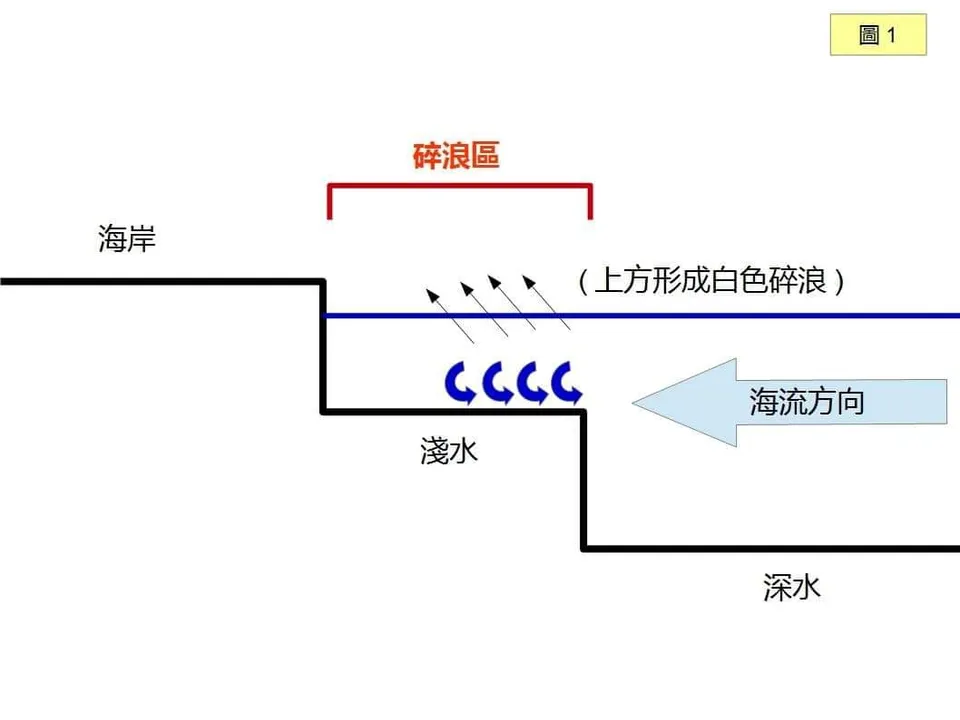
When seawater moves toward shore due to wind, gravity, the Coriolis force from the Earth's rotation, ocean currents, seafloor friction, and many other factors, the combined forces cause the water to travel toward the coastline in a circular motion. In deeper water, wave amplitude is small. But when the seafloor rises or suddenly becomes shallower, large volumes of water surge upward — the crests of the upper water move faster than the troughs below — causing the waves to break and producing the white foam you see (as shown in Image 1).


The Uneven Coastline
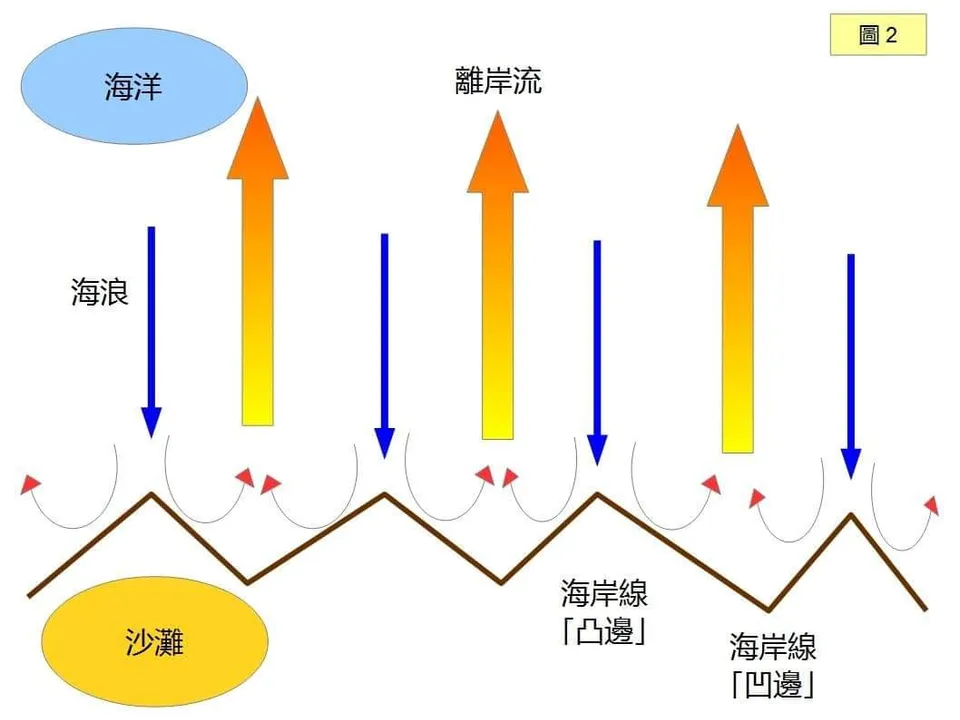
In general, coastlines are never perfectly straight. "Protruding" sections of coastline tend to have relatively shallower seafloors just offshore (because those areas are more resistant to erosion) and are more likely to produce breaking waves. Conversely, areas along the shore where you notice fewer breaking waves tend to have deeper water.
When large volumes of seawater wash ashore, that water must eventually flow back out to sea. The "protruding" sections of coastline are continuously fed by breaking waves, so the water tends to drain back through the deeper "receding" sections — and this is how a rip current forms (as shown in Image 2).
What Is a Rip Current?
A rip current is an extremely powerful stream of water. When combined with tidal forces or areas where the depth changes dramatically, even a strong swimmer will find it nearly impossible to fight against. As you can see in Image 3 below, these dangerous rip currents tend to appear in spots that at first glance look calm — "no waves, seems safe."

What to Do If You Get Caught in a Rip Current?
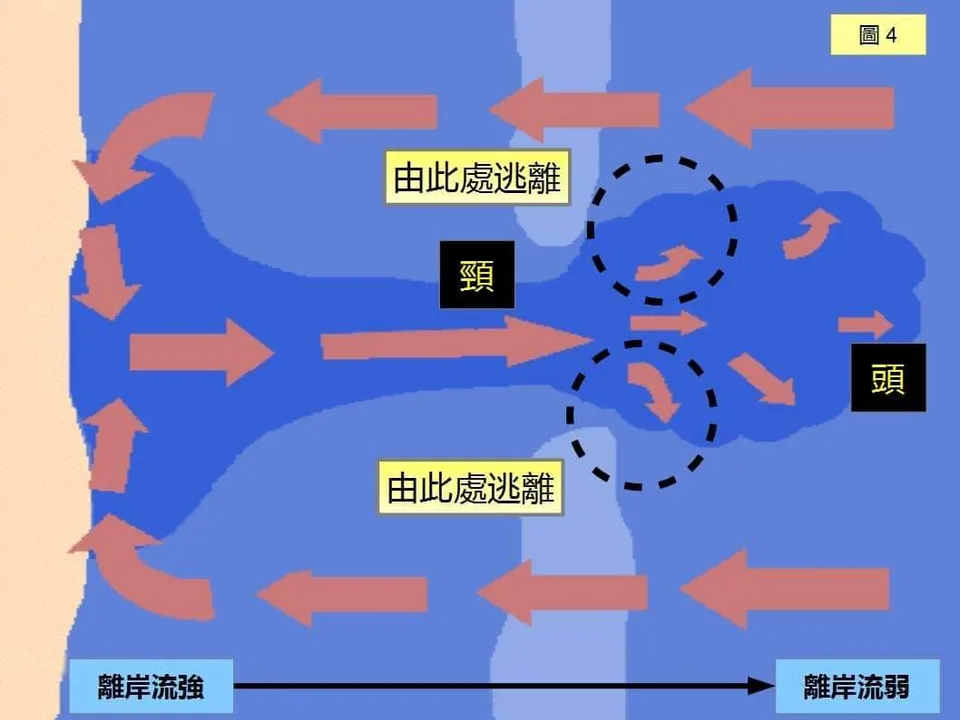
If you are pulled into a rip current, do not panic — and do not try to fight it. The farther the rip current travels from shore, the weaker it becomes. Refer to Image 4 below, which is a simplified diagram of a rip current and the longshore current. After traveling some distance from shore, the rip current is compressed and converged by the longshore current, forming a flow structure that resembles a "neck" and a "head." The area outlined in black dashed lines by the crocodile illustration marks the position of the "neck." Swim sideways out of the current at that point, and you can escape the rip current.
If the water is clear and you happen to be on a sandy beach, take a look at the seafloor and you will see ripple patterns in the sand (refer to Image 5 below). Due to inertia and the circular motion of waves, these ripple lines run parallel to the shoreline. Remember what we mentioned earlier: the "protruding" sections of the coastline tend to have breaking waves pushing water ashore, while the "receding" sections tend to generate rip currents that pull people out to sea.
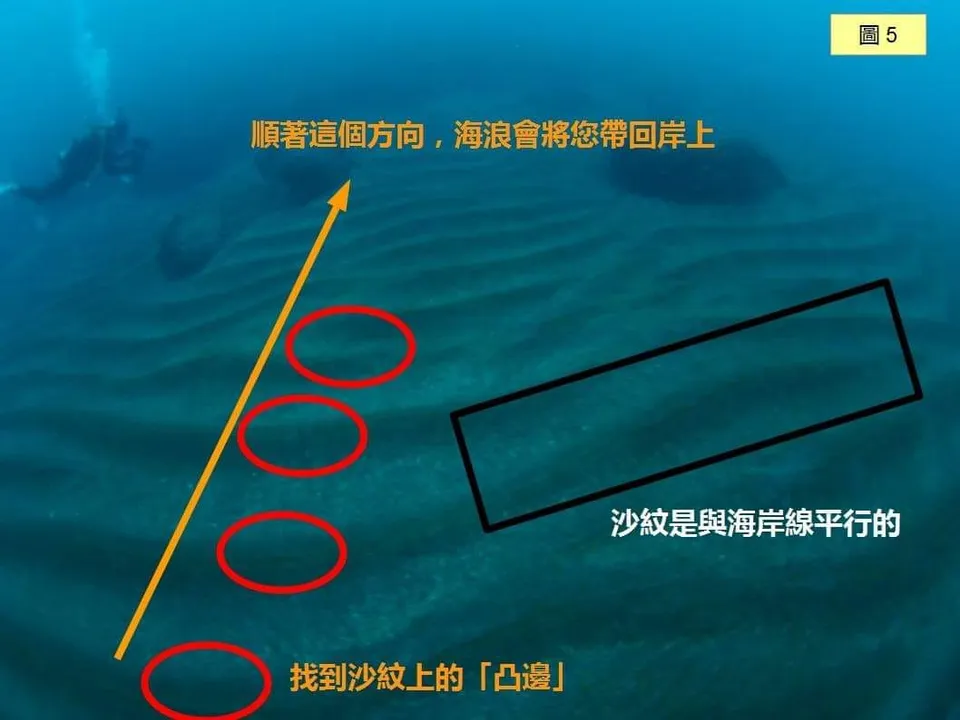
So when you can see the seafloor, calmly locate the line connecting the peaks of these ripple patterns and try to swim toward the nearest such line — whether you are at the "neck" or "head" of the rip current. The breaking waves pushing toward shore will then carry you back to the beach, without you having to struggle and swim against the current on your own.
You might ask: how do you know whether you are at the neck or the head of the rip current? Simple — the neck is roughly at the same depth as the longshore current, meaning it is around the depth where you can see waves just beginning to form white foam on the surface.
Once you escape the rip current by swimming at a 45- to 90-degree angle across or perpendicular to its flow, the breaking waves will carry you back to shore and you will be safe.
Conclusion
- Before entering the water, observe the shape of the coastline. The more irregular the coastline — with frequent protrusions and indentations — the greater the chance of rip currents forming along the receding sections.
- Before getting in, take a moment to observe the current direction and wave patterns. Deep water does not produce white breaking waves. In particular, any area with a straight, calm strip of water that produces no foam — like the one in Image 3 — is somewhere you should avoid swimming near.
- If you are unfortunately pulled into a rip current, relax your body. Do not struggle or resist. Wait for the current to carry you out to the depth where waves are just beginning to break, then try to swim parallel to the shoreline, moving sideways.
- The head of a rip current is typically only 10 to a few hundred metres wide (and often just ten or so metres). If you relax and float outward, escaping is actually not that difficult — there is no need to panic.
- If you can see the sand ripples on the seafloor, quickly find the line connecting the peaks of a ripple pattern, swim in that direction, and the current will help carry you back to shore.
Finally, three quick reminders:
- Always try to swim at beaches staffed by lifeguards. No matter how confident you are in your swimming ability, if something goes wrong and no one around you knows you are in trouble, the consequences can be dire.
- Summer vacation offers plenty of lifesaving and swimming courses. You don't need to learn how to rescue others — but Taiwan is surrounded by rivers and ocean, so you should at least learn enough to keep yourself safe and stay calm in the water.
- If any dangerous situation arises in the water, your first priority is to call out loudly for help and draw the attention of those around you. Then follow the principles of self-rescue to protect yourself.
Further Reading:
- Downwelling, washing-machine currents, and deadly flows — staying calm is the only way to handle strong currents!
- 【Freediving】Someone Almost Died in the Ocean
- Are You an Underwater Panic Diver? How to Avoid 10 Causes of Underwater Panic!
- Outdoor Enthusiasts Must Read Before Entering the Water! 3 Key Concepts for Water Activities