The Editor says: Heading to the beach for water activities in summer is a seasonal staple for many, but in all the excitement we often overlook the dangers lurking beneath the surface. The Editor often points out that the scariest things underwater aren't sharks (sharks are honestly adorable) — it's the seemingly harmless creatures lying quietly off to the side, doing nothing at all. We're sharing this article from someone who learned the hard way, in the hope that everyone heading out for ocean recreation will stay alert, and know what to do if the worst happens — so they can address the situation quickly and avoid more serious injury. Reprinted in full from Yu-Chen Kyle Wu's personal Facebook page.
Following the previous episode of the "sea urchin superhero," I've once again been struck down by an unidentified marine creature. If getting attacked by an animal turns you into that animal's superhero counterpart, I wonder what I'll become this time — let's wait and see...
How It All Happened
On June 13, I joined an experienced diver on a night dive straight to the prime Rhinopias spot, and got all the shots I could have hoped for. So on Sunday I went back to the same site in a purely sightseeing-and-sharing frame of mind (the veteran diver casually set out with nothing but a torch in hand — that selfless spirit of his left me utterly in awe... or rather on my knees in admiration).
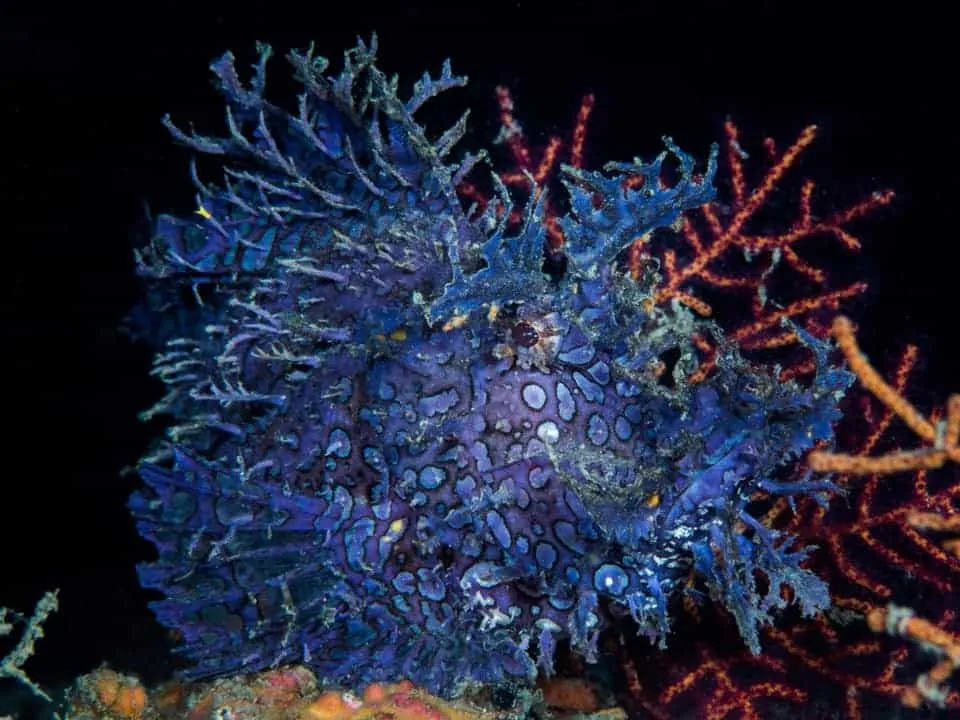
Purple Rhinopias (scorpionfish)
It happened on June 14, during the 7th and final dive of the weekend at the Northeast Coast 825 dive site. Early that Sunday morning, Zhong-ge had reported spotting two purple Rhinopias — one large and one small — so our goal was to find the second one so that friends who hadn't seen it yet could get their photos, rather than everyone queuing up like a human centipede in front of the first one. So the whole tank was spent wandering around the first purple gorgonian / sea fan area, playing a game of "Where's Rhinopias?" Just as the veteran diver was circling in the water signaling the return, I spotted a clump of purple something swaying its head in an unnatural way. I looked more carefully — it was the second, smaller Rhinopias!
At that point everyone had received the turn-back signal. The veteran diver and Gary were fairly far ahead, and Wesley was slowly drifting toward me. Bursting with excitement, I started frantically gesturing — pointing furiously at the Rhinopias. Since I was a bit of a distance away, he looked at me with a puzzled expression as I hollered and gesticulated underwater. He was probably only about 15 cm from the Rhinopias, but still couldn't quite tell what I was pointing at. Driven by the spirit of "I can't be the only one who sees this — no photo, no proof," I kicked down a little more and stretched out my right hand to point directly at the Rhinopias's face.


Pain Level Skyrockets — Could I Pass Out?
What I didn't realize in that moment was that my neutral buoyancy had drifted slightly off, causing my left hand to drop too low and lightly graze the reef. I was instantly hit with a sharp, sudden pain in my hand — about a 7.5 out of 10 on the pain scale. Even underwater I could clearly see two puncture wounds on my middle finger and one on my ring finger. The blood from the wounds diffused through the water like three small smokestacks releasing wisps of smoke into the sea. The immediate, intense pain made me think the venom must be highly neurotoxic. I glanced at my dive computer — I was at 20 m, roughly 400 m from shore. I was genuinely worried I might pass out from the pain, so I ascended at the fastest acceptable rate (10 metres per minute) while simultaneously kicking forward as hard as I could. The anxiety and the all-out kicking elevated my heart rate, which could have actually caused the venom to spread through my bloodstream to my heart faster. So for the entire return journey I kept my right hand clamped tightly around the middle finger of my left hand — squeezing so hard that the hand, pale and wrinkled from soaking in seawater (yes, seawater is the only thing that can make my hands look pale), had dark purplish veins bulging out, like something out of a kung fu poison storyline. I was genuinely worried that the dark purple colour might not be veins at all but an accumulation of venom — an answer I'll perhaps never know for certain. But at the time, there was indeed a localised darkening spreading outward, like a bruise.
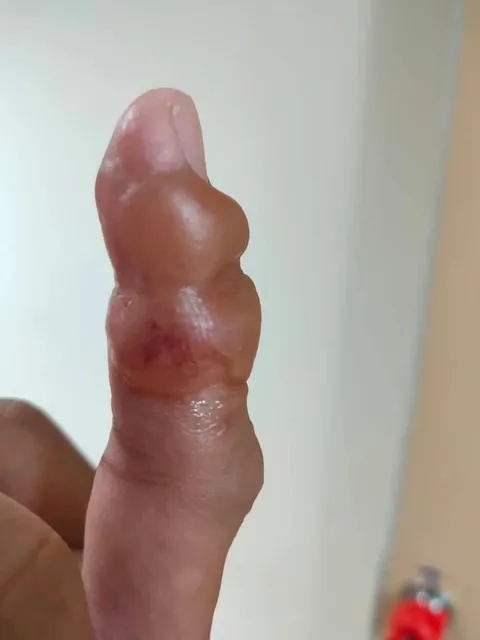
The finger that contacted the Rhinopias, visibly swollen
At that point my mind was solely focused on survival — monitoring the wound on my middle finger, the ascent rate on my dive computer, and my breathing efficiency. I wasn't paying attention to the pressure gauge because I knew I had 100 bar left for the return, which was more than enough. All I wanted was to reach 6 m as quickly as possible for my safety stop. I made it ashore — thankfully — but the pain hadn't eased at all. In the car, my hand was shaking, my body was curled up and I couldn't sit properly; every single second was a struggle. Gary made the call to speed through a few red lights to the nearest hospital in Keelung rather than going all the way to Taipei, because I genuinely couldn't have endured those extra 20–30 minutes.
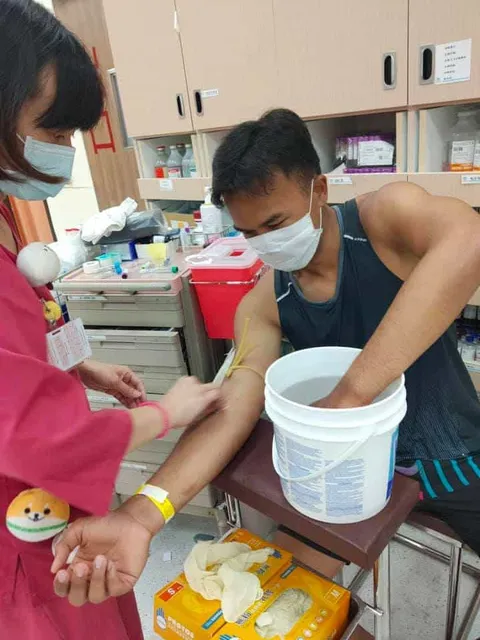
Receiving injections and soaking the wound in hot water in the emergency room
At the emergency room, the doctor administered a tetanus shot, an antibiotic injection, and a dose of painkillers, and asked me to keep soaking the wound in clean hot water. But the painkiller had virtually no effect — half an hour later I was still writhing on the bed, so they gave me another dose. That still didn't help much, so I asked for something stronger. After a final shot of a morphine-like analgesic, the pain gradually faded, though numbness in the hand remained. At least I could finally rest — I dozed off for over ten minutes and even dreamed I was diving and happily photographing seahorses. I genuinely think morphine is a wonderful thing. A doctor friend later confirmed that the last dose they gave me was indeed quite potent.
Takeaways
-
Whatever happens underwater, don't get overly excited. Too much emotional reaction at best wrecks your breathing efficiency, and at worst turns joy into disaster.
-
If you are unfortunately injured, try to look back and identify what creature caused it — this is a crucial piece of information for subsequent medical treatment. The same applies to snakebites: knowing the species allows the right antivenom to be administered.
-
For stings and bites, soak the affected area in warm water immediately. If warm water isn't available, rinse with clean water — avoid using tap water directly.
June 14 update: No more pain today. Just localised numbness in the middle finger, disgustingly large blisters, and an ongoing course of antibiotics while under hospital observation.
The Editor's Notes
Marine life is mesmerizing and extraordinary, but the creatures most likely to cause harm are often the ones that look unassuming and just sit there doing nothing. Here's a quick rundown of some commonly encountered hazardous creatures and basic first-aid responses:
-
Cone snail: Considered the most dangerous creature of the intertidal zone, its beautiful shell lies quietly on the seafloor and can often be spotted during tidal pool explorations — but don't be fooled by how slow it is and pick it up to play with! Cone snails can extend a venomous dart from inside the shell to paralyze prey; the venom is a type of protein toxin that can affect the human nervous system, muscles, and heart. There is currently no antivenom available. If stung, quickly wrap a bandage around the affected area to restrict blood flow and seek medical attention immediately.
-
Stonefish, rabbitfish, Lionfish, sea urchin, Stingray: All of these creatures carry protein-based toxins. If you come into contact with one, get out of the water immediately and soak the affected area in hot water for at least 30 minutes to reduce protein activity. The author of this article is believed to have contacted a stonefish. These creatures are very common along Taiwan's nearshore waters — always maintain good neutral buoyancy during scuba diving to avoid accidentally touching them. If basic first aid doesn't effectively relieve the pain, seek medical attention promptly.
-
Jellyfish: Every early summer, the waters of northern Taiwan fill with swarms of jellyfish (in southern Taiwan, they tend to appear in autumn and winter). Jellyfish come in many species with varying levels of toxicity, and individual reactions to jellyfish nematocysts also differ. Most people experience redness, swelling, and inflammation; more severe reactions can include vomiting, fever, and even cardiac shock — this should not be taken lightly. If stung by a jellyfish, once ashore first use seawater or dry sand to remove tentacles — do not use bare hands or fresh water to remove them (alcohol and urine are strictly off-limits), to minimize secondary discharge of nematocysts. Then apply or soak the area in cooking vinegar to reduce nematocyst activity. Applying an ice pack can also help limit the spread of the reaction and reduce discomfort. If symptoms persist after a while, seek medical attention as soon as possible.
In truth, the most important rule when engaging in water activities near the ocean is: don't touch marine life. Beyond building good neutral buoyancy in scuba diving, when exploring tidal pools, don't casually touch creatures you don't recognize — it's a matter of respecting marine life and protecting yourself. If you are stung by a marine creature, deal with it promptly and, critically, try to identify what it was so you don't apply the wrong first-aid method and make things worse.
Related links:

![[Diving Safety] Headache After Diving? Nosebleed After Diving? Ear Pain After Diving? 8 Physical Symptoms That May Occur During a Dive](/_astro/sea-79606_1920-2_1kBv47.webp)