Yen-Yi Lee (Facebook: Yen-Yi Lee), known to everyone as "Little Brother Lee," is an underwater photographer who has a deep passion for diving and the shutter. Since 2010 he has won numerous underwater photography awards, including First Place at the China Underwater Photography Competition, Gold Medal at ADEX 2015, First Place at the Raja Ampat Underwater Photography Competition (Indonesia, 2017), Champion and Gold Medal at the Asian Dive Expo (DRT 2012 & 2013), Gold Medal at China's Ocean Voice (ADEX 2017), Gold Medal at the Malaysia International Dive Expo (MIDE 2017), Gold Medal at the National Museum of Marine Science and Technology Underwater Photography Competition (2017), Gold Medal at the US International Dive Expo (2016), and Gold Medal at the world's largest underwater photography forum (Wetpixel Deep Indonesia 2016). He hopes that through his lens he can let everyone see the beauty of the ocean. The Editor is delighted to have had the chance to interview him and invite him to share his thoughts and experiences on underwater photography!
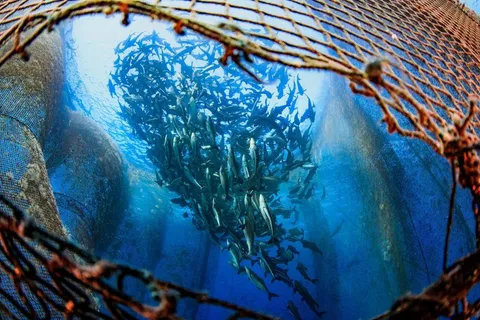
Xiaoliuqiu's distinctive cage aquaculture
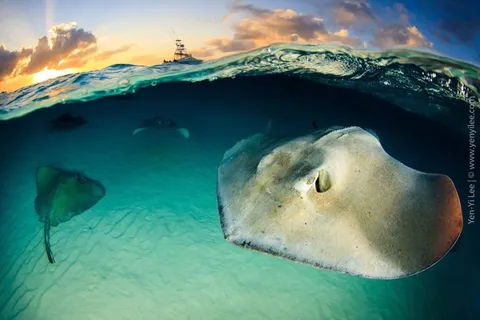
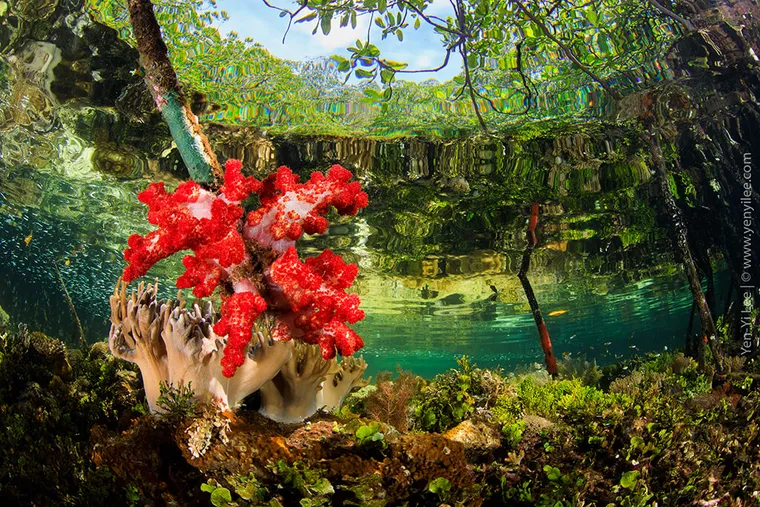
A unique split-level (over-under) shot
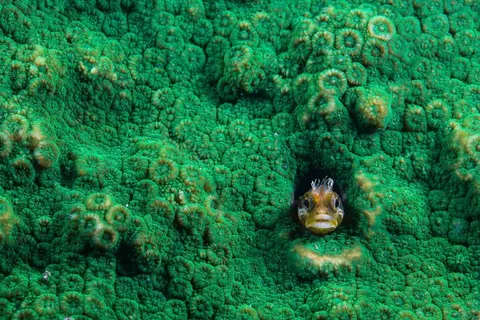
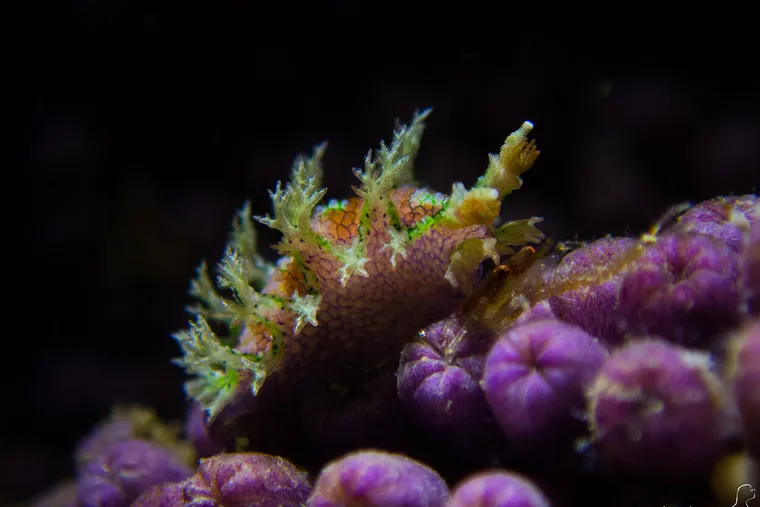
Seeing marine life from a different perspective — macro
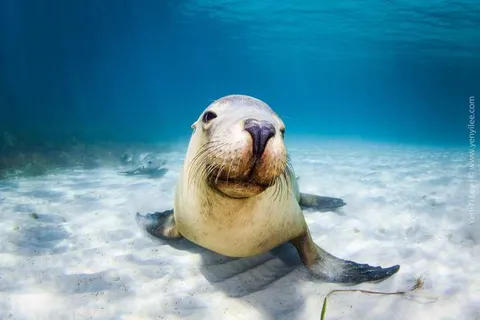
If you love it, don't harm it
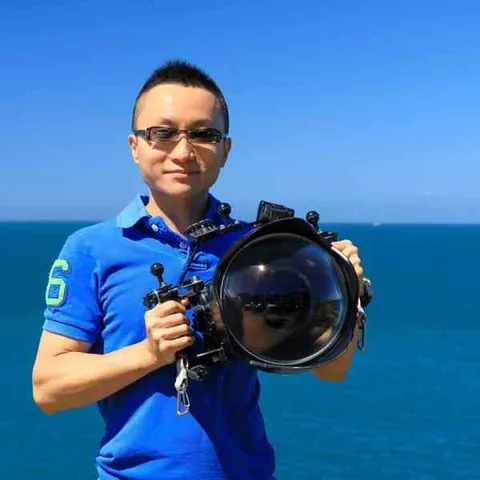
Yen-Yi Lee
The Editor: How did you first get into underwater photography?
Yen-Yi Lee: I still remember it was in 2010, during a snorkeling activity in Kenting. I discovered that the underwater scenery was absolutely beautiful — the perspective and the sense of wonder it gave me were completely different from anything on land. I immediately signed up for a diving course and that was the start of my underwater photography journey. In the beginning, before I had logged 30 scuba tanks, I was shooting with a Sony action camera, photographing everything in sight. But I soon found that the resolution and image quality weren't satisfying enough, so I began learning to take a DSLR underwater.
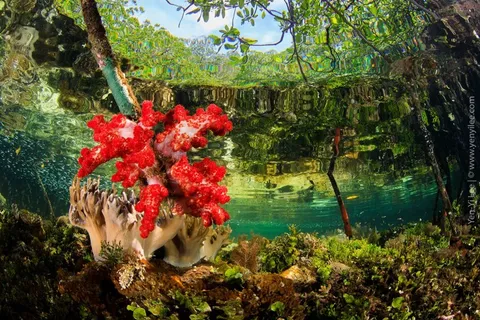
Raja Ampat mangroves
The Editor: As camera costs have dropped in recent years, more and more people have taken up underwater photography and information has become increasingly abundant. Seven years ago, however, resources must have been comparatively scarce. How did you go about improving your underwater photography skills back then?
Yen-Yi Lee: Before getting into underwater photography, I had already been shooting on land, so I had a solid grasp of camera settings — the relationship between ISO, aperture, and shutter speed — and I understood my camera's limits and its color rendering. That gave me a faster learning curve than most. But information really was scarce back then, so I went ahead and bought several English-language underwater photography books and studied them intensively, which is how I gradually picked up the techniques. Beyond the technical side of shooting, I honestly think that an aesthetics elective course I took at university helped me enormously — it had a remarkably visible impact on my wide-angle photography later on. Looking back, I consider it the most useful course I took in all four years of university (laughs).
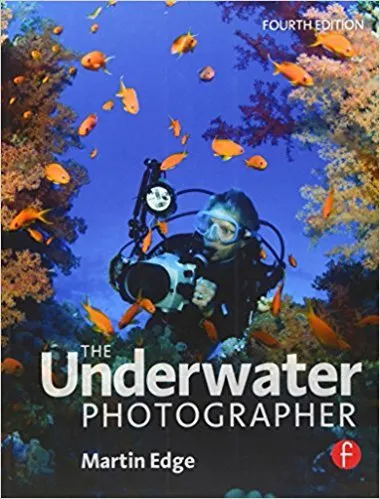
Recommended read: The Underwater Photographer
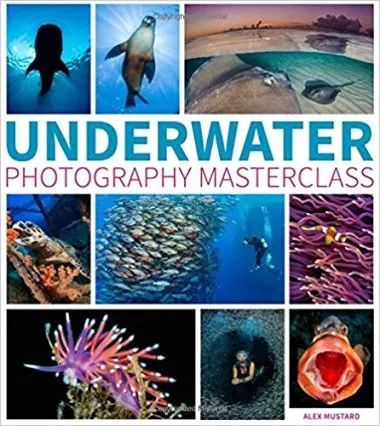
Recommended read: Underwater Photography Masterclass
The Editor: You've worked with both topside and underwater photography. What do you see as the key differences, and which do you find more difficult?
Yen-Yi Lee: Whether shooting on land or underwater, producing truly distinctive and creative images requires a great deal of experience and thoughtful planning — neither is easy. That said, I think underwater photography presents far more challenges, including the following:
- Natural conditions: The surface might be calm and sunny, yet underwater the visibility can be murky and the current extremely strong. More variable factors mean fewer opportunities to shoot.
- The medium: Air is an excellent medium, but seawater is not — it absorbs sharpness and color saturation. And that's before accounting for the additional impact of increasing distance or suspended particles, all of which directly affect the quality of an image.
- Diving skills: Controlling neutral buoyancy and managing air consumption both affect how long you can stay in position and what angles you can shoot from.
- Equipment: Underwater photography gear requires an underwater housing, which is bulky and heavy. High-end camera systems also have lens port considerations, meaning you have to decide before each dive whether you're shooting wide-angle or macro. Poor light transmission underwater also makes lighting a discipline of its own — choosing between continuous lights and strobes, and deciding on the position and technique for lighting, are often the deciding factors in whether a shot works or not.
The underwater world is a three-dimensional space — it has one more dimension of arrangement and composition than topside shooting. That means photographers have far more room to express themselves: the same dive site photographed at different depths can convey completely different moods and atmospheres, which tests every photographer's sensitivity to composition. My advice is to shoot on land as often as possible: it helps you get familiar with your camera, and more importantly, it helps you develop that crucial "photographer's eye" — the ability to find a unique composition that sets your work apart from everyone else's.
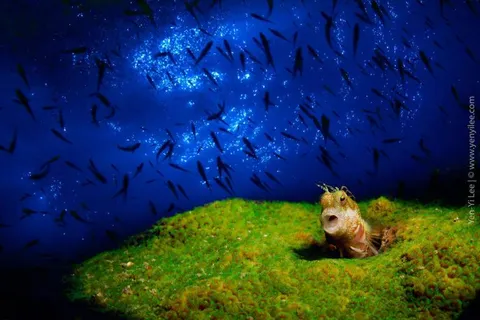
Patient waiting, plus a little luck
The Editor: Your portfolio includes both macro and wide-angle work. What does each style feel like or teach you?
Yen-Yi Lee: I have a stronger preference for wide-angle shooting — each image looks markedly different from the last, and the compositional possibilities are highly varied. I also just don't enjoy staying in one spot shooting macro after macro; I'd rather swim around, explore, and enjoy the dive itself. That said, from a purely aesthetic standpoint, macro is actually easier to produce a strong image with, because the simplicity of the concept makes the subject clear and direct. Wide-angle, by contrast, captures a large angle of view with many elements, making it harder to highlight the subject — which is exactly why composition becomes so much more critical.
The Editor: Over the years of shooting, which photograph are you most proud of? And how do you feel your approach to shooting has changed?
Yen-Yi Lee: That question is genuinely hard to answer, because your mindset at each stage of your journey is different, and there tends to be a representative work for every period. When I was just starting out, the moment I had a camera in my hands I'd shoot anything and everything. But as my experience grew, I became more selective — I learned which compositions simply wouldn't work and would move on immediately, always looking for something different. The way I shoot also shifts with time and circumstances, so I honestly believe that for a photographer, there is no such thing as a single "best" image. The one change that is most obvious is that I press the shutter far less often than before — I've gradually developed the ability to "pre-select." These days, within 20 to 50 frames I can usually find one good shot.
The Editor: You've won countless awards over the years. What mindset do you bring to your shooting, and how do you view underwater photography competitions?
Yen-Yi Lee: In the beginning you want to photograph every creature you encounter. Then, as you accumulate experience, you start craving recognition and begin entering competitions. But in later stages, you find yourself returning to the original reason you started diving — "to dive with joy and freeze a moment in time with the shutter." Every dive brings you different friends and different marine life encounters, and I genuinely relish that process now. Winning awards is certainly gratifying, but what I really hope is that diving continues to enrich my life experiences. Underwater photography competitions are a wonderful medium — they help more people appreciate the beauty of the ocean, and by looking at competition entries, we can learn new shooting approaches and incorporate them into our own future work.
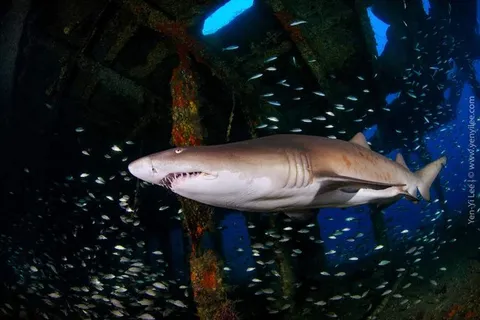
A great composition is always a matter of chance
The Editor: When shooting, do you target a specific subject and pre-visualise the frame in your mind? Or is each shoot really a matter of patient waiting combined with a little luck?
Yen-Yi Lee: If I'm going after a specific species, I'll always prepare a shooting plan in advance — though the plan and the reality on site rarely match up perfectly. When they don't, the ability to respond in the moment becomes crucial. For instance, you might want a shark to swim close to a wreck so you can get the shot you imagined, but the shark simply won't come near. You then have to adapt your composition, reposition your strobes, adjust your camera settings, and so on. The better you know your camera, the more effectively you can respond in real time. I lean toward wide-angle shooting, and I rarely wait more than 30 minutes for a particular shot — I'd rather keep moving and searching for new compositions.
The Editor: As a Taiwanese diver who has traveled to many countries to shoot, could you recommend some places or subjects you consider ideal for underwater photography, and why? Do you think Taiwan has the potential to become a must-visit destination for serious underwater photographers? What would you suggest relevant authorities could do to improve the current situation?
Yen-Yi Lee: Let me answer the second part first — I think it will be very difficult! The service standards and ecological richness of Southeast Asia are simply exceptional, and it would be extremely hard for Taiwan to develop on that scale in the short term. However, Taiwan might start by identifying a few distinctive features and then gradually develop the surrounding industry ecosystem, so that entire communities can benefit from the diving industry — the way Malapascua in the Philippines and Raja Ampat in Indonesia have done. Local governments there collect diving fees to subsidize residents or invest in environmental conservation, giving locals higher income than fishing alone, creating a win-win-win outcome. In Taiwan, the Northeast Coast's 82-5k area is well-suited to macro photography; Xiaoliuqiu's rich sea turtle ecology could attract visitors from Hong Kong, Macau, and mainland China; and the wreck in Orchid Island's Badai Bay is absolutely worth promoting strongly. But the most important issue is this: Taiwan's supporting services for diving are still lacking. We need to think carefully about whether visitors who come once will leave with a positive impression — or not — because that affects everything. There is one Taiwanese water body I'm particularly curious about: Itu Aba Island in the Spratly Islands. With so few people visiting, the marine ecosystem must be extraordinarily rich. But the priority, ultimately, is finding that point of differentiation.
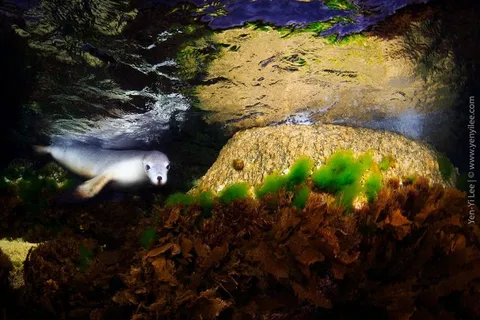
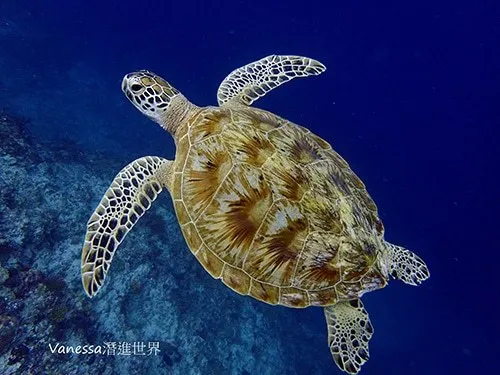
Encountering marine life is one of the great joys of underwater photography
The Editor: During your travels to shoot in many different countries, are there any experiences that stood out as particularly special — whether because of the journey, the thrill of the creature you were shooting, or anything else that happened along the way?
Yen-Yi Lee: Once, I was headed to Australia to photograph Minke whales. I'd boarded a liveaboard out of Cairns, but the airline delayed my luggage and I missed the boat's departure — the entire trip had to be cancelled. Another time, I went to Rhode Island near New York to photograph blue sharks. On the first day, we drifted at sea for seven or eight hours and got only fifteen minutes with the sharks. The second day was cancelled due to rough seas. On the third day, despite the swells still running high, we pushed out anyway — seven or eight more hours of pitching and rolling, and we came back empty-handed. And they don't refund your money if you cancel, by the way! Then there was a trip to Sri Lanka to photograph whales. For five days we could only spot them far in the distance. But on the sixth day, we witnessed more than a hundred whales spouting all around us. If the trip had only been booked for five days, none of that would have happened. That, though, is part of the joy of diving — wouldn't you say?
The Editor: They say diving will drain your wallet for life, and underwater photography will bankrupt three generations. What advice or experience can you share with beginner divers who want to enter the world of underwater photography, so they don't go down the wrong path?
Yen-Yi Lee: It really comes down to how passionate you are about underwater photography. These days, you simply cannot make money from it — ten-plus years ago, underwater images could fetch respectable prices, but now there's no way to recoup your investment. If you're certain you want to commit, then within your budget, buy the best you can afford from the start, because the cost of upgrading your equipment later will be even higher. The next consideration is what you expect from your images: if you just want to share them online, a compact camera is perfectly fine. If you're planning to exhibit prints in large format, then you'll need to consider investing in a more capable system. Everyone places different values on things — some people in Southeast Asia are astonished that what I paid for a single camera could buy a house there. But as long as what you're doing gives you fulfillment, that's enough.
Related links: