Contents(8)
- What Kind of Marine Creature Is a Barnacle?
- Do You Know What a Barnacle Is?
- Acorn Barnacles: Masters of the Intertidal Zone
- Stalked Barnacles: A Prized Ocean Delicacy
- Rhizocephala: The Cunning Parasitic Barnacle
- The Role of Barnacles in Nature
- Wanella milleporae: The Barnacle That Lives on Fire Coral
- Further Reading
This article is reprinted in full from Academia Sinica's "Research at Sinica" — "Barnacles Everywhere: The Unassuming Coral Cohabitants — and the Parasites That Puppeteer Crabs!"
What Kind of Marine Creature Is a Barnacle?
To most people, barnacles are those little volcano-shaped organisms clinging to rocks — and to some, a daring "extreme" seafood delicacy. Barnacles are ubiquitous in marine environments, found across intertidal zones, coral reefs, shallow seas, the deep ocean, and even on sea turtles and whales. But what exactly are they, and what role do they play in the ecosystem? Academia Sinica's "Research at Sinica" sat down with Distinguished Research Fellow Benny Kwok-Kan Chan, Director of the Biodiversity Research Center, to have him share his years of knowledge about these fascinating creatures.
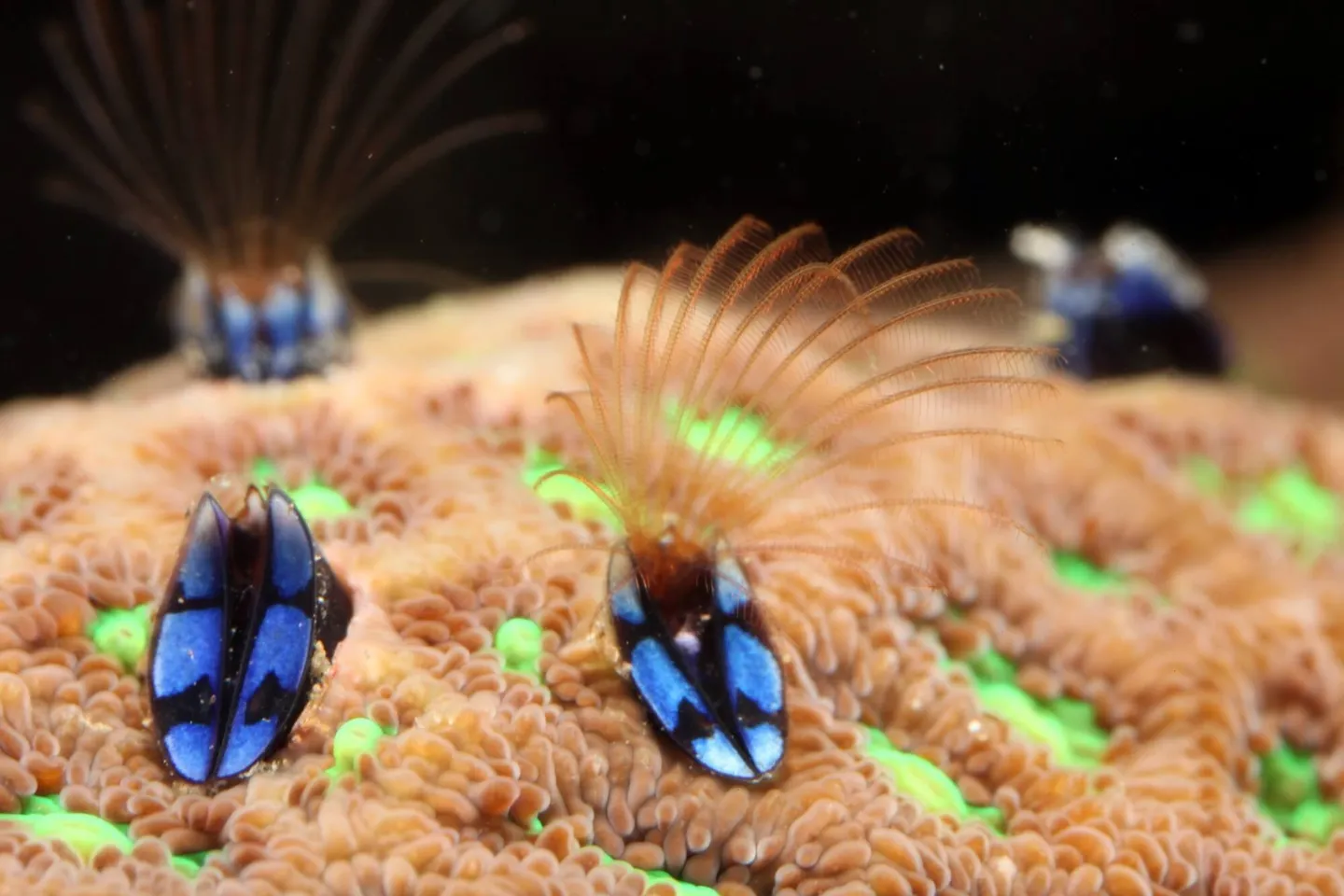
The coral-symbiotic barnacle pictured here is Berndtia purpurea — its sapphire-like coloration is strikingly beautiful, and it shares a mutualistic relationship with its coral host. Photo | Benny Kwok-Kan Chan


Do You Know What a Barnacle Is?
Barnacles are marine animals with remarkably diverse forms. Some resemble miniature volcanoes; others look like the neck of a goose. Despite their wildly different appearances, all barnacles share one thing in common: a pear-shaped nauplius larva with a pair of long lateral horns at each end. Once they mature, barnacles almost always attach firmly to rocks, ship hulls, or coral and are largely incapable of moving on their own. More than two thousand species have been identified to date. Although many barnacles have hard shells that make them look similar to molluscs, Chan points out that they are in fact crustaceans — classified under Arthropoda alongside crabs and shrimp.
Want to see barnacles up close? Head to the coast!
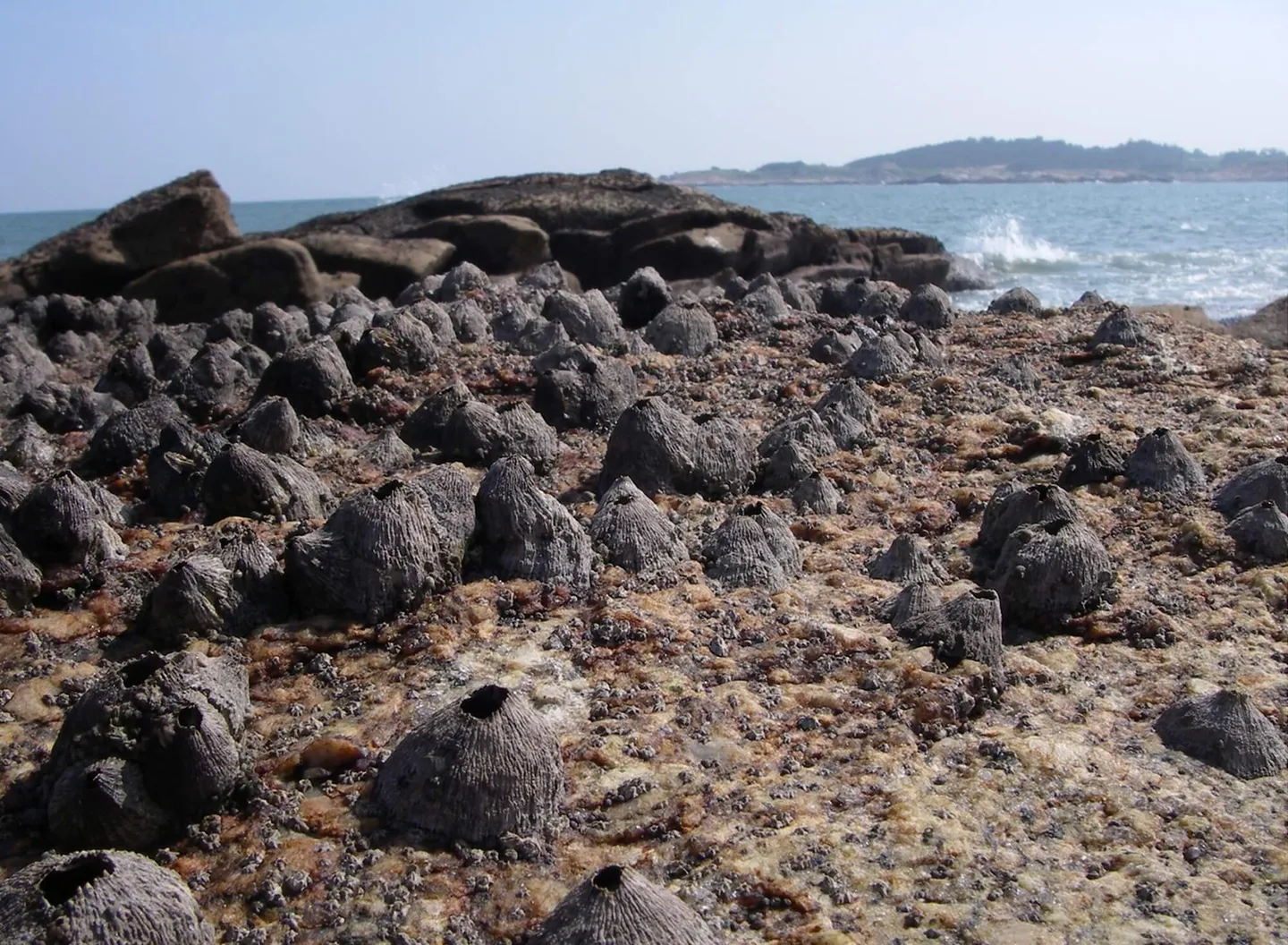
The volcano-shaped barnacle is known as an acorn barnacle. Pictured here is Tetraclita japonica. Photo | Benny Kwok-Kan Chan
Acorn Barnacles: Masters of the Intertidal Zone
Stroll along a rocky shoreline in Taiwan and you will almost certainly spot organisms shaped like conical hats or miniature volcanoes, each with a circular opening at the top, firmly cemented to the reef. These are sessile (stalkless) barnacles — as their name implies, they have no peduncle connecting them to the rock; instead, they adhere directly to the substrate and encase their soft bodies within a hard calcium carbonate shell. Along Taiwan's Northeast Coast, east coast, and Kenting shorelines, one commonly encountered species is Tetraclita kuroshioensis, recognizable by its greenish shell — a new species discovered and named by Chan in 2007.
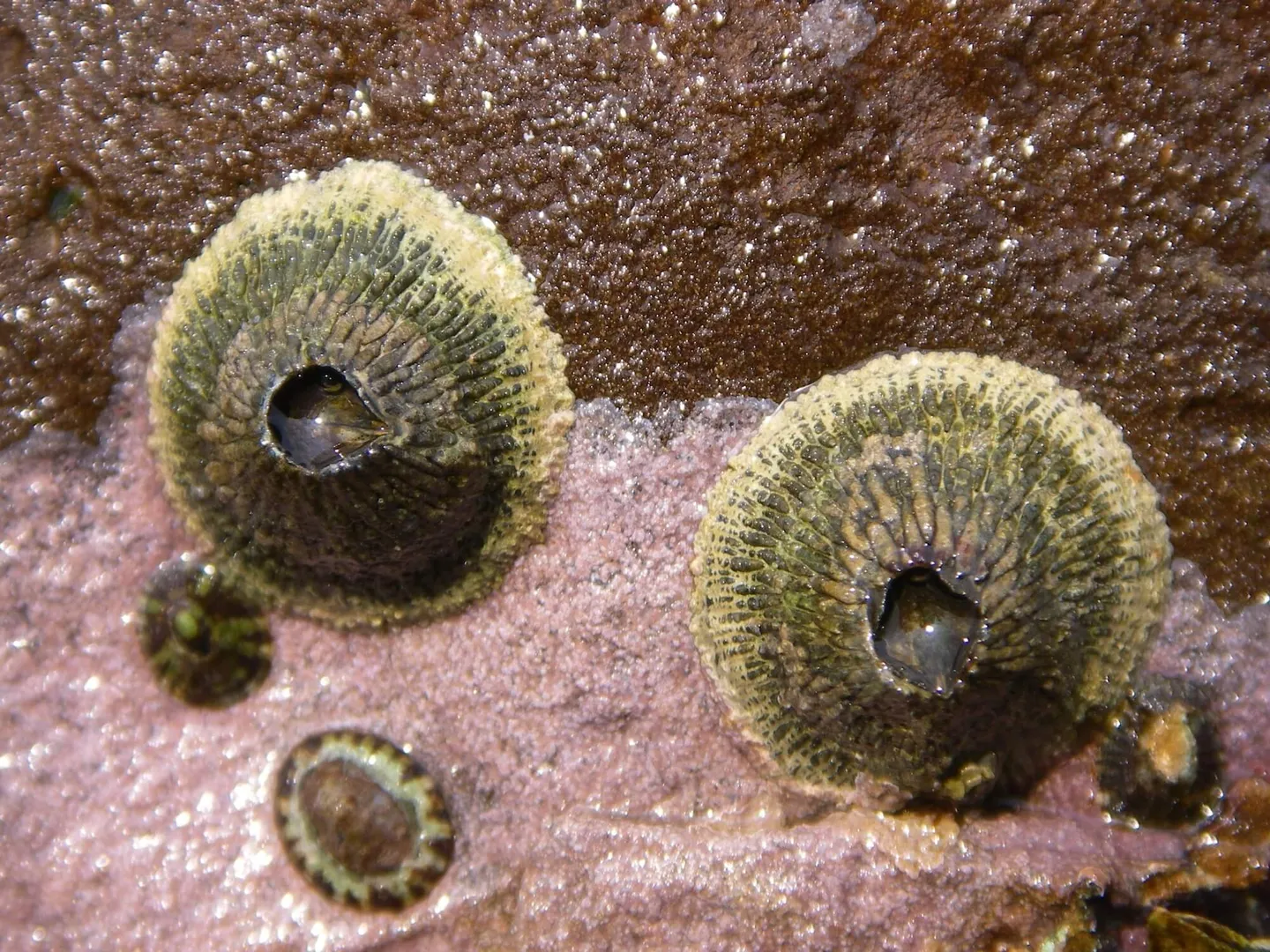
Tetraclita kuroshioensis, commonly seen on Taiwan's coastlines, is distinguished by its gray-green, volcano-shaped shell. It was discovered and named by Benny Kwok-Kan Chan in 2007. Photo | Benny Kwok-Kan Chan
The barnacle body living inside the volcanic shell possesses six pairs of appendages called cirri. Each cirrus forks into two branches that resemble feathery antennae lined with slender cilia. Three of the six pairs are longer and form a net-like "cirral fan" used to filter plankton from the water; the other three shorter, stouter pairs pass the captured food into the mouth.
The intertidal zone is subject to the ebb and flow of the tide. When the tide recedes and the reef is exposed to air, barnacles — unable to move — must clamp their paired opercular plates tightly shut to prevent desiccation from wind and sun. At low tide you will see only the volcano-like shell; once the tide returns and the barnacle is submerged again, it opens its plates and extends its slender cirri to resume filter-feeding on plankton.
The barnacle world is enormously diverse. In addition to sessile barnacles with their hard volcanic shells, there is another group: the stalked barnacles, which bear a long, neck-like peduncle.
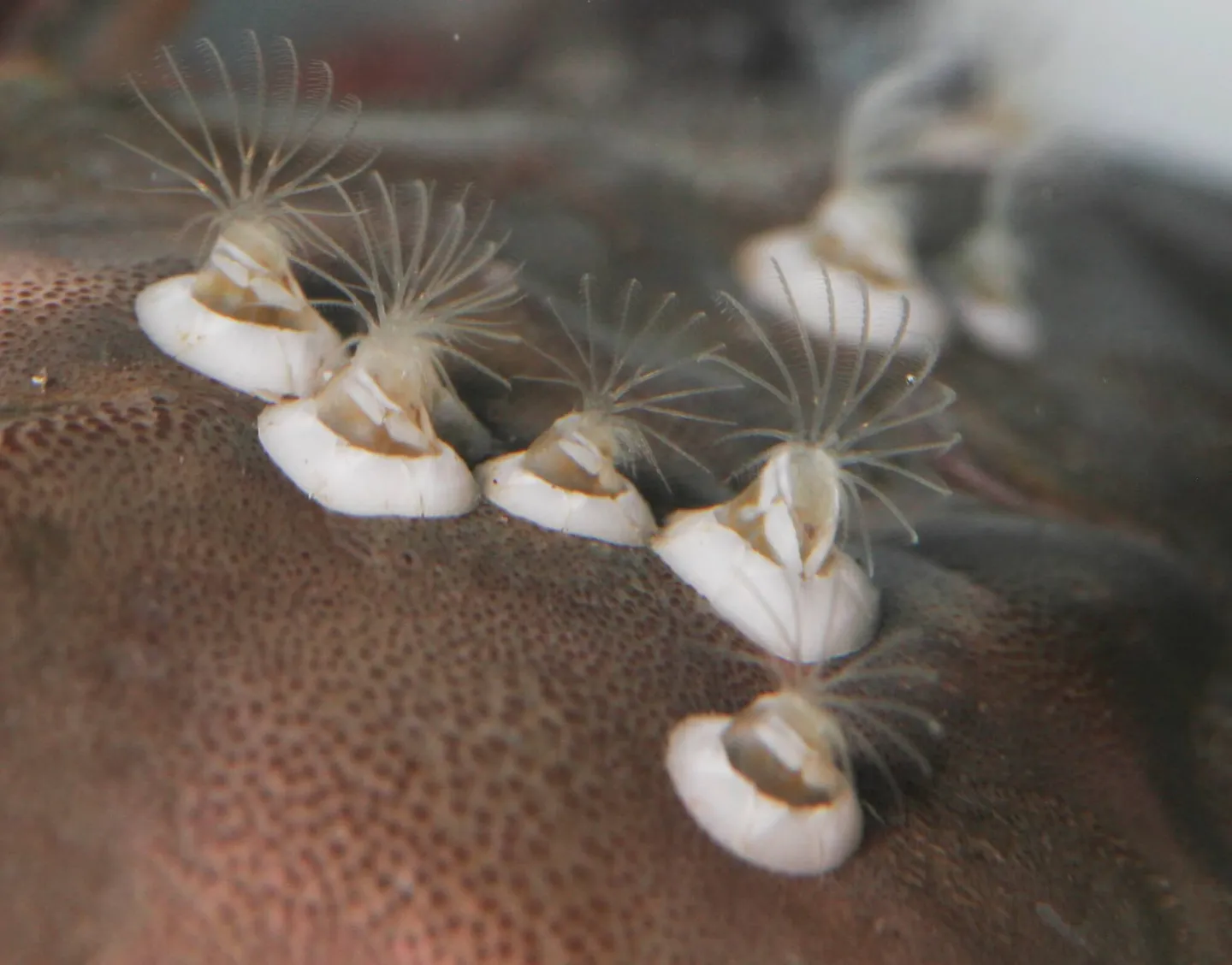
Pictured is the sessile barnacle Chelonibia testudinaria. Beneath the shell, the barnacle body bears six pairs of cirri; three of the longer pairs form a net-like "cirral fan" for filtering plankton from the water. Photo | Benny Kwok-Kan Chan
Stalked Barnacles: A Prized Ocean Delicacy
Found in the crevices of intertidal reefs on Kinmen, the Matsu archipelago, and along Taiwan's east coast is the stalked barnacle known locally as "turtle claw" (Capitulum mitella). Unlike the volcano-shaped acorn barnacle, its body is clearly divided into a capitulum (head) and a peduncle (stalk). The capitulum is composed of hard tergal and scutal plates, while the muscular peduncle is covered with many tiny scales. Because of its resemblance to a turtle's claw, a pair of clasped hands, or a brush holder, it goes by a variety of colorful names: turtle claw, turtle foot, Buddha's hand, Guanyin's hand, and brush stand, among others.
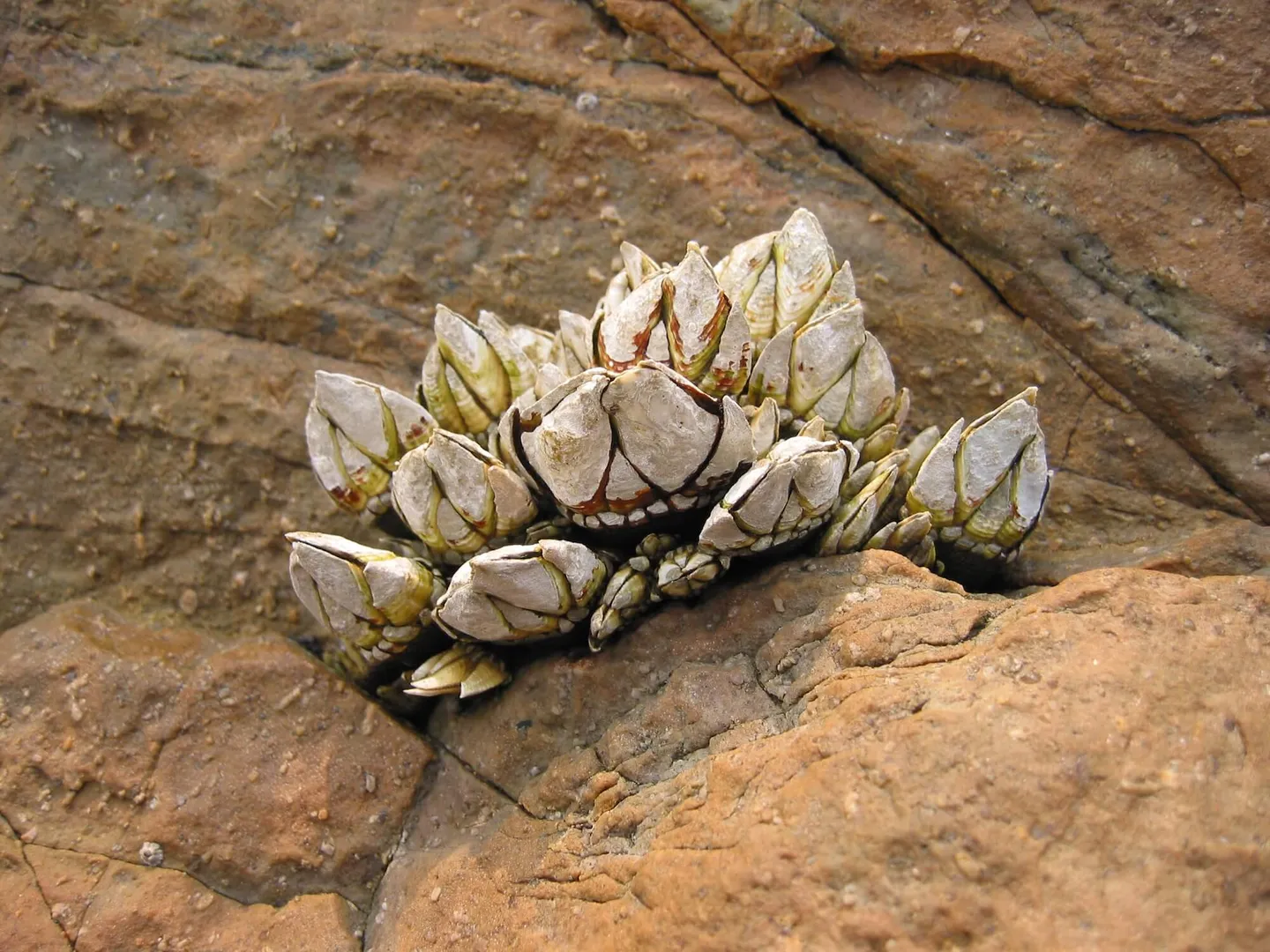
The stalked barnacle Capitulum mitella ("turtle claw") also has a shell, but its form is completely different from that of the acorn barnacle. In Kinmen and Matsu, it is prized as a delicious edible seafood. Photo | Benny Kwok-Kan Chan
In contrast to sessile barnacles and turtle-claw barnacles that adhere directly to rock, another group of stalked barnacles uses a goose-neck-like peduncle to connect the capitulum to its attachment point. These barnacles are often found on floating buoys or marine debris and are commonly known as "gooseneck barnacles," belonging to the genus Lepas. Additionally, there is Pollicipes, a stalked barnacle found along the coasts of Spain, Portugal, and nearby North Africa. Because they are scarce and difficult to harvest from the wild, Pollicipes barnacles are regarded as an exquisite and expensive seafood delicacy.
There is also an amusing historical footnote about gooseneck barnacles. "In the Middle Ages, Europeans had a monumental misunderstanding about Lepas anatifera," Chan recounts. At the time, Europeans had no idea that the Barnacle Goose was a migratory bird that breeds in the Arctic and travels to Britain and Europe only in winter to escape the cold. Every winter, Barnacle Geese would simply appear — and no one knew where they came from. Because gooseneck barnacles bore a superficial resemblance to the geese, some people actually believed that the birds hatched from inside the barnacles. Hence the Barnacle Goose got its name.
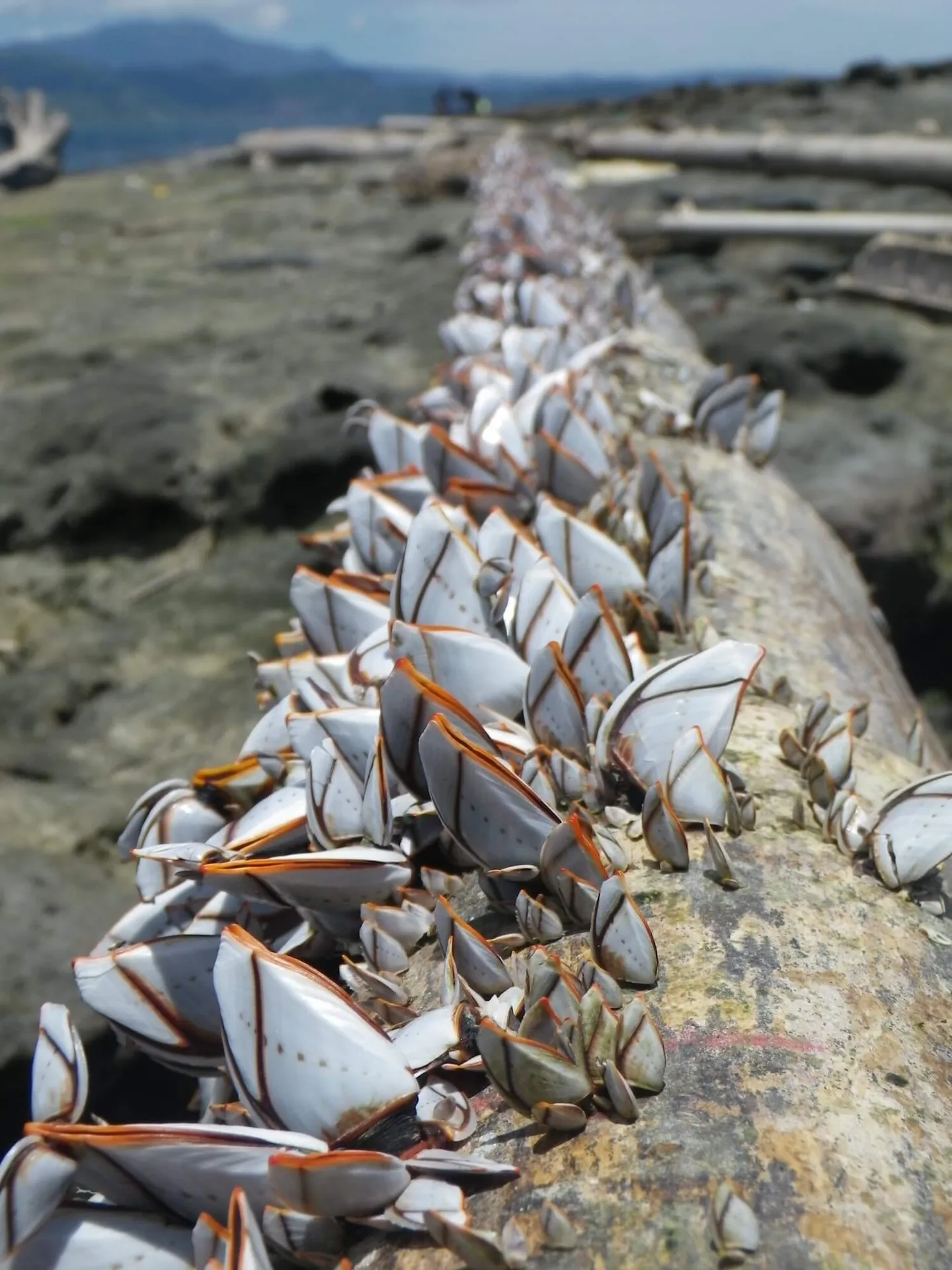
Pictured is the gooseneck barnacle Lepas anatifera, attached to a piece of driftwood. In the Middle Ages, Europeans believed that Barnacle Geese hatched from inside these barnacles — hence the bird's common name, "Barnacle Goose." Photo | Benny Kwok-Kan Chan
Rhizocephala: The Cunning Parasitic Barnacle
Sessile and stalked barnacles both make an honest living, waving their cirri through the water to catch plankton. But one group of barnacles has evolved a rather different lifestyle — living off a host and taking without giving back. Their preferred targets are mostly crabs (though other crustaceans can be hosts too), which is why they are called Rhizocephala — or in Chinese, "crab slaves" (xie nu). Classified under the superclass Rhizocephala, there are currently more than three hundred known species; they lack a recognizable body form and endoparasitize crabs, isopods, and other crustaceans.
The adult rhizocephalan consists primarily of a root-like system growing within the host's body and a sac-like reproductive organ visible on the outside of the host. The internal root filaments absorb nutrients from the host and can also manipulate the host's brain and behavior. The degree of control varies by species; in Europe, some rhizocephalan species cause the parasitized crab to stop molting and growing, and to become reproductively sterile.
In Taiwan, observations show that parasitized crabs can still move, search for food, molt, and grow — but cannot mate or reproduce. After infection, the crab loses its own sense of identity and carefully tends to the rhizocephalan instead. Male crabs undergo physiological feminization: the abdomen gradually changes from the narrow, elongated shape typical of males to the broad, rounded shape of females, and the crab is compelled to exhibit brood-care behavior toward the parasite's offspring.
The name "crab slave" (xie nu) might suggest that the parasite serves the crab — but the reality is precisely the opposite. The crab ultimately becomes the slave, entirely at the mercy of the rhizocephalan.
Rates of rhizocephalan infestation vary by region; in some parts of the Mediterranean, infestation rates among crab populations can be extremely high. So the next time you eat crab, don't get too excited if you see a yellowish protrusion on the abdomen thinking you've found a treasure trove of roe — look carefully, because it might just be the rhizocephalan's external reproductive sac (terrifying, isn't it?).
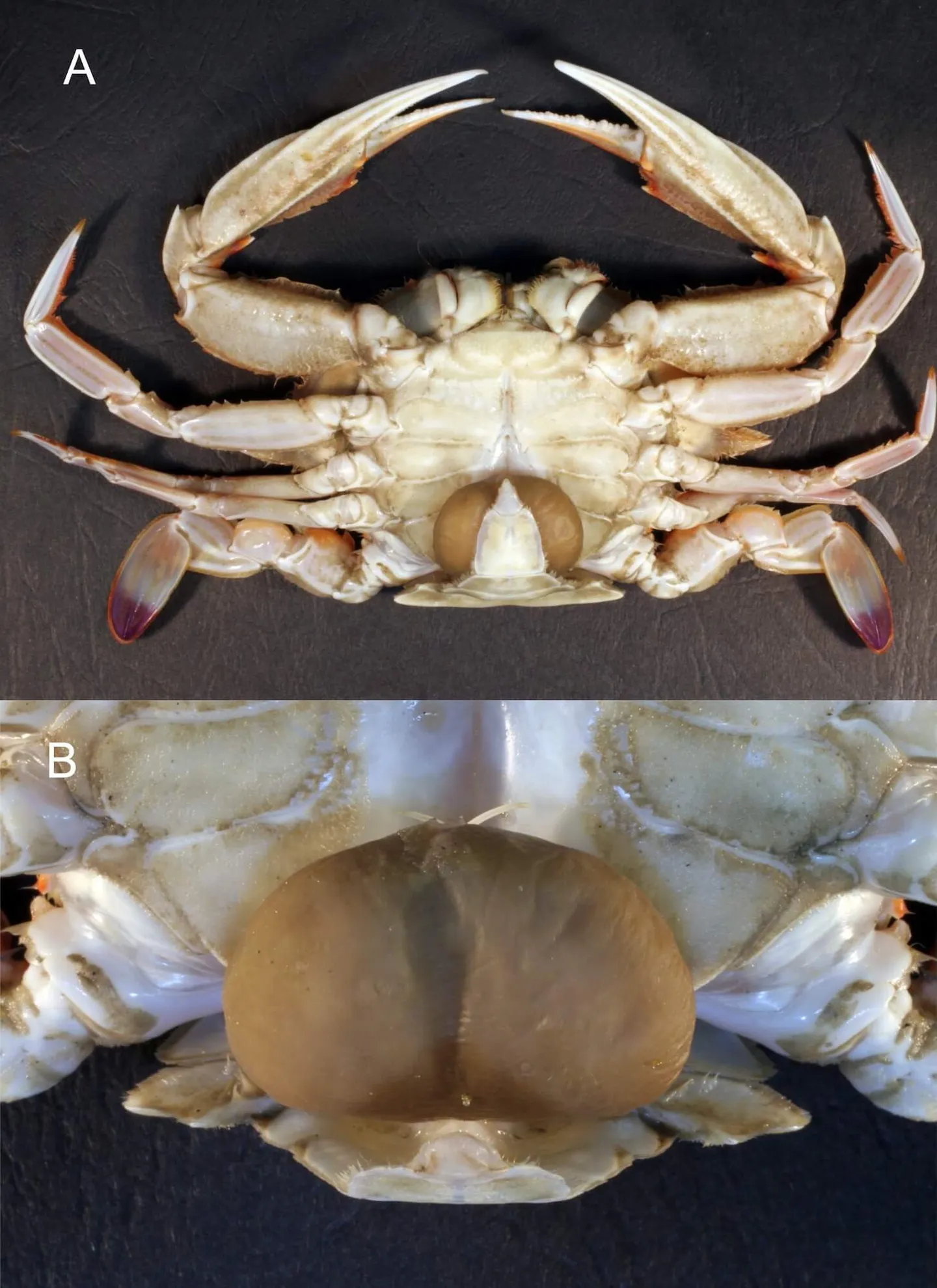
A: A swimming crab parasitized by a rhizocephalan; the dark mass in the lower center of the body is the parasite's reproductive sac. B: The sac-like reproductive organ of the rhizocephalan on the exterior of the host. Photo | Provided by Benny Kwok-Kan Chan
The Role of Barnacles in Nature
Apart from the parasitic rhizocephalans, most barnacles are filter feeders that select a settlement site after larval metamorphosis, attach permanently, and use their cirri to capture plankton — while simultaneously becoming prey for other marine life themselves. Most barnacles live unobtrusively, and precisely because their lifestyle is so sedentary, they are highly sensitive to environmental changes; their abundance and distribution significantly influence ecosystem balance.
Do barnacles really keep entirely to themselves? Other animals might beg to differ — whales and sea turtles, for instance, are frequent victims of barnacle encrustation. A single barnacle or two may cause little harm, but a dense colony is another matter entirely. Not only does it add considerable extra weight, but the rough barnacle shells dramatically increase drag during swimming, making movement genuinely laborious for whales and sea turtles.
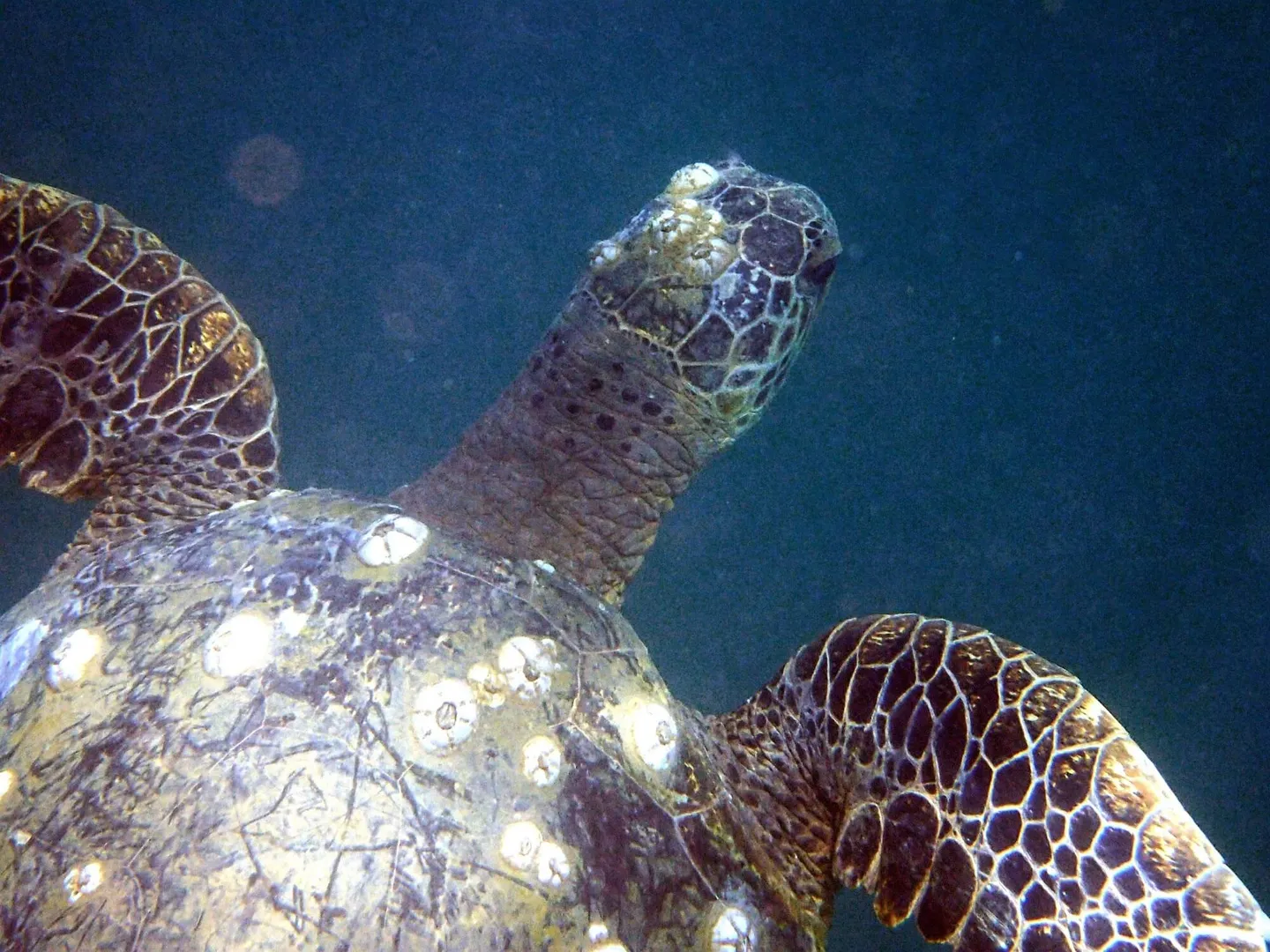
The shell and head of a sea turtle encrusted with Chelonibia testudinaria. Photo | Provided by Benny Kwok-Kan Chan; photography by Ceri Lewis
That said, we should also be alert to the surge of misleading videos circulating online — such as footage supposedly showing polar bears covered in barnacles, or people standing on whales and scraping barnacles off with shovels. Chan emphasizes that all such videos are fabricated. "First of all, polar bears cannot grow barnacles on their bodies, because polar bears do not remain submerged in seawater long enough for barnacles to settle and grow. Furthermore, whales generally do not allow humans to climb onto them — and the base of whale barnacles is deeply embedded in the whale's skin, making it impossible to scrape off with a shovel."
Barnacles can also be a burden to humans. Over time, underwater vessels and structures accumulate heavy barnacle fouling: ships must burn more fuel to generate the additional power needed to overcome the increased drag, while submerged infrastructure faces hefty maintenance and cleaning costs. For these reasons, barnacles are classified as marine biofouling organisms.
Despite the headaches they cause, Chan is quick to note that barnacles also offer some surprising benefits. Species such as Pollicipes, Capitulum mitella, and giant barnacles are prized seafood in Spain, Portugal, Japan, and Taiwan.
Furthermore, the cement proteins barnacles secrete to anchor themselves to rock have an adhesive strength unaffected by seawater — arguably the most powerful underwater glue ever known, surpassing all human-made adhesives. If this phenomenon can be better understood, it could form the basis for developing far more durable and effective underwater adhesives. Chan's latest research has revealed something even more remarkable: Chelonibia testudinaria, which grows on the shells of sea turtles, can actually dissolve its own cement protein, allowing it to reposition itself before secreting new cement to reattach.
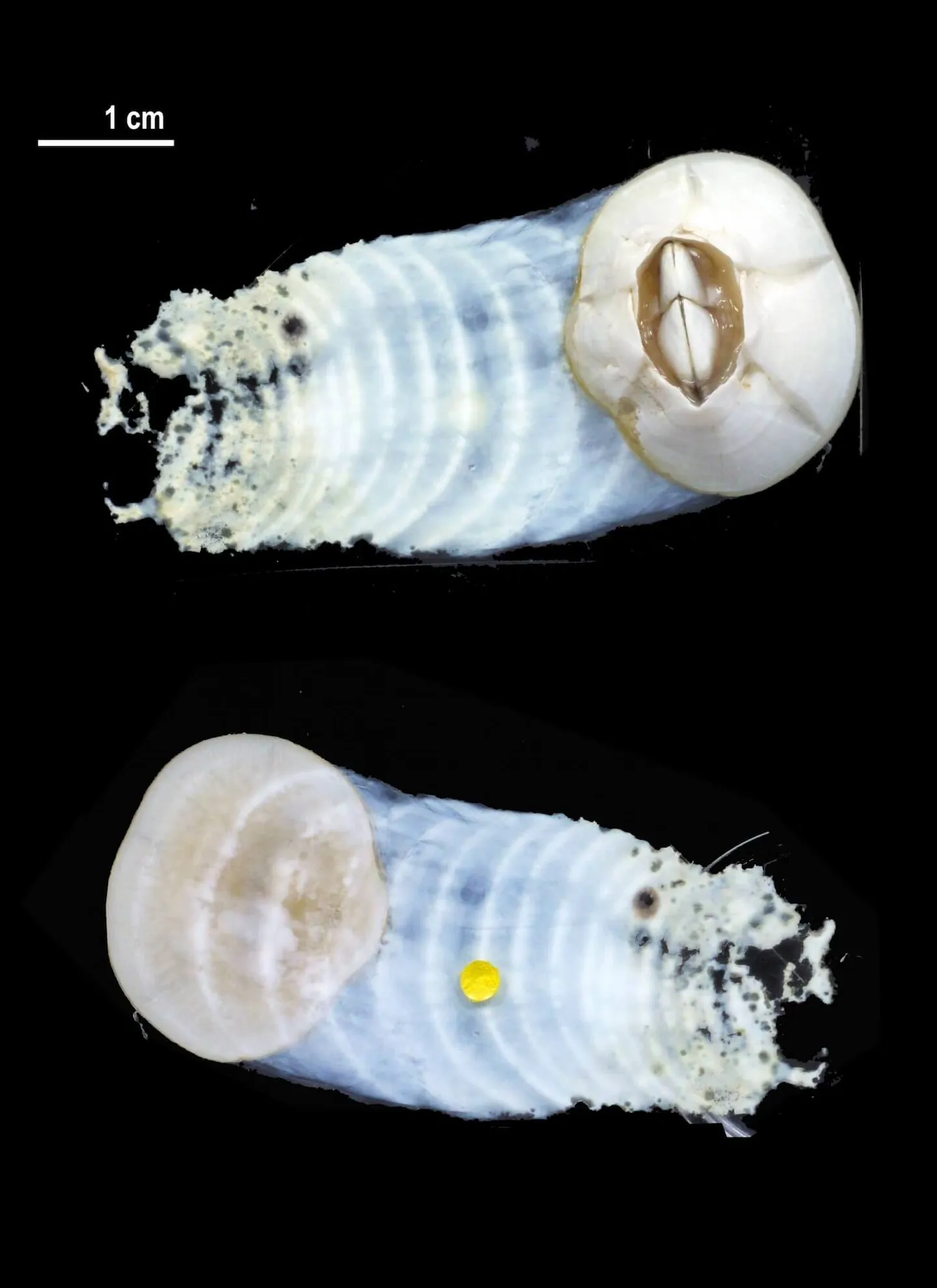
Chan's latest research has shown that Chelonibia testudinaria, which grows on sea turtle shells, can dissolve its own basal cement protein and reposition itself. Top: frontal view. Bottom: basal view. Photo | Provided by Benny Kwok-Kan Chan
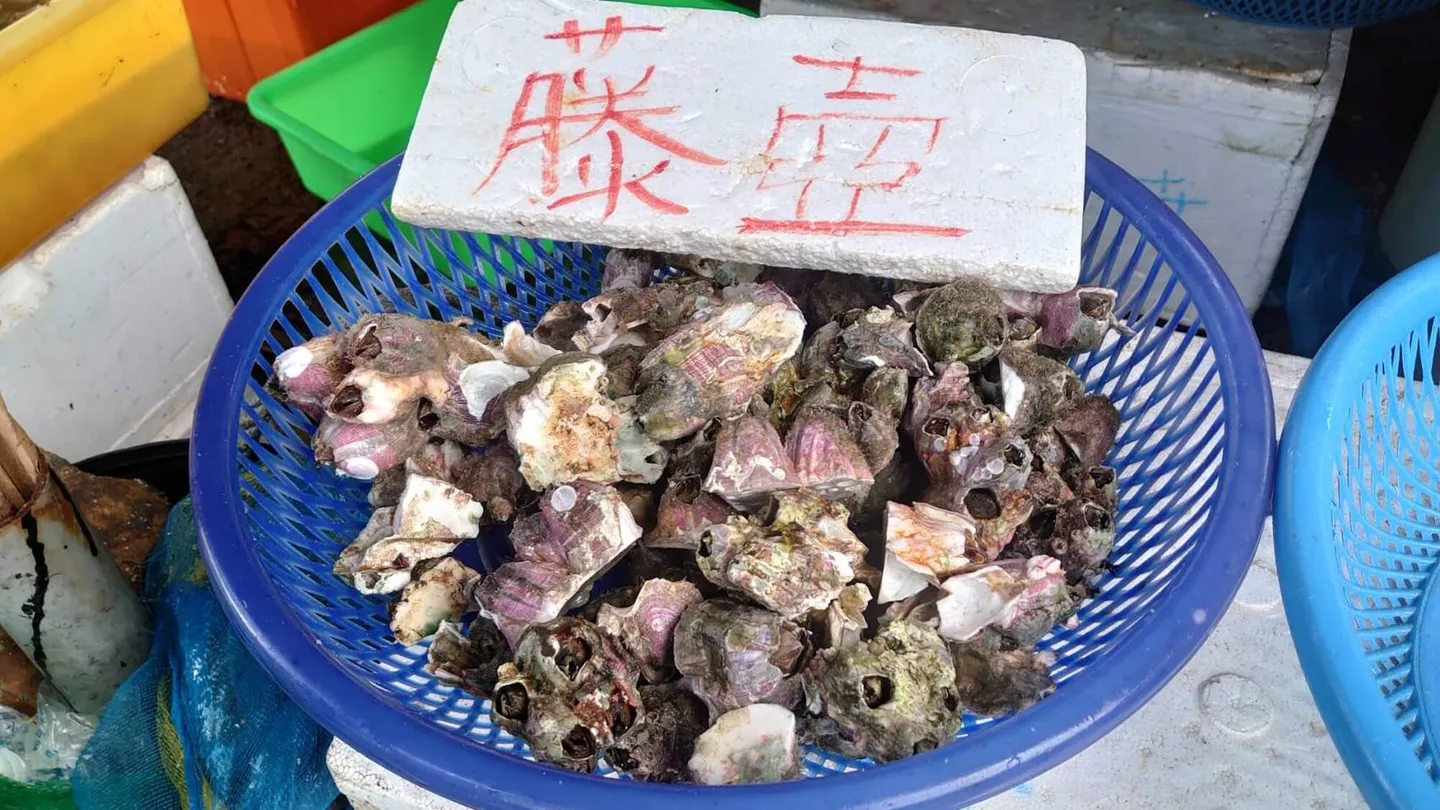
In Daxi, Yilan, giant barnacles are a local seafood and are nicknamed "underwater volcanoes." Photo | Provided by Benny Kwok-Kan Chan
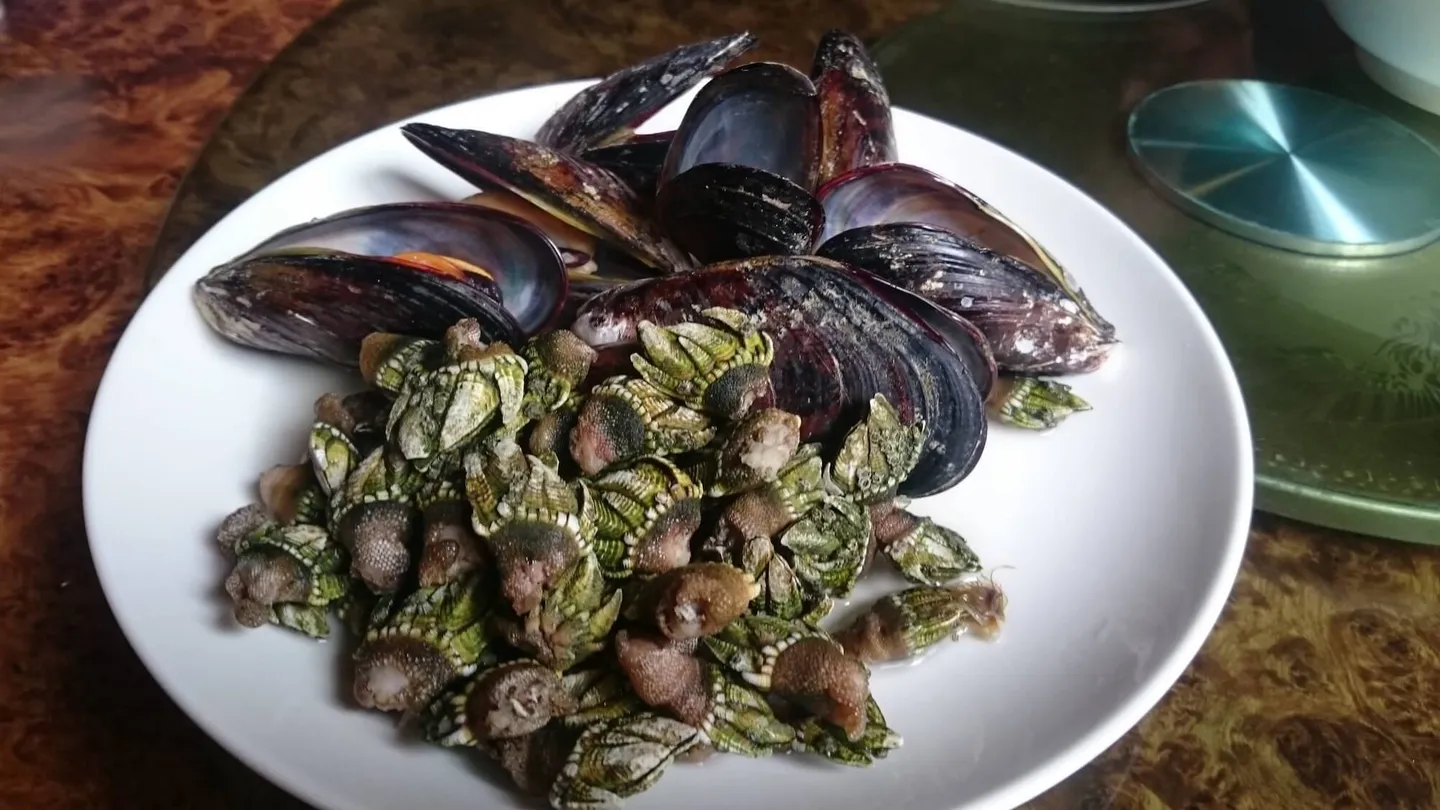
In Matsu, turtle-claw barnacles (bottom) and mussels (top) are both celebrated as delicious ocean fare. Photo | Benny Kwok-Kan Chan
Wanella milleporae: The Barnacle That Lives on Fire Coral
So far we have met barnacles that parasitize hosts, and barnacles that foul ships and animals — both somewhat problematic. But there is also a "cooperative" side to barnacles!
If you are fortunate enough to dive around a tropical island, you will be dazzled by colorful coral. Look closely at the coral surface and you may notice small, charming circular holes from which slender cirri just barely protrude — these are coral barnacles, the quiet cohabitants that share a mutualistic relationship with coral!
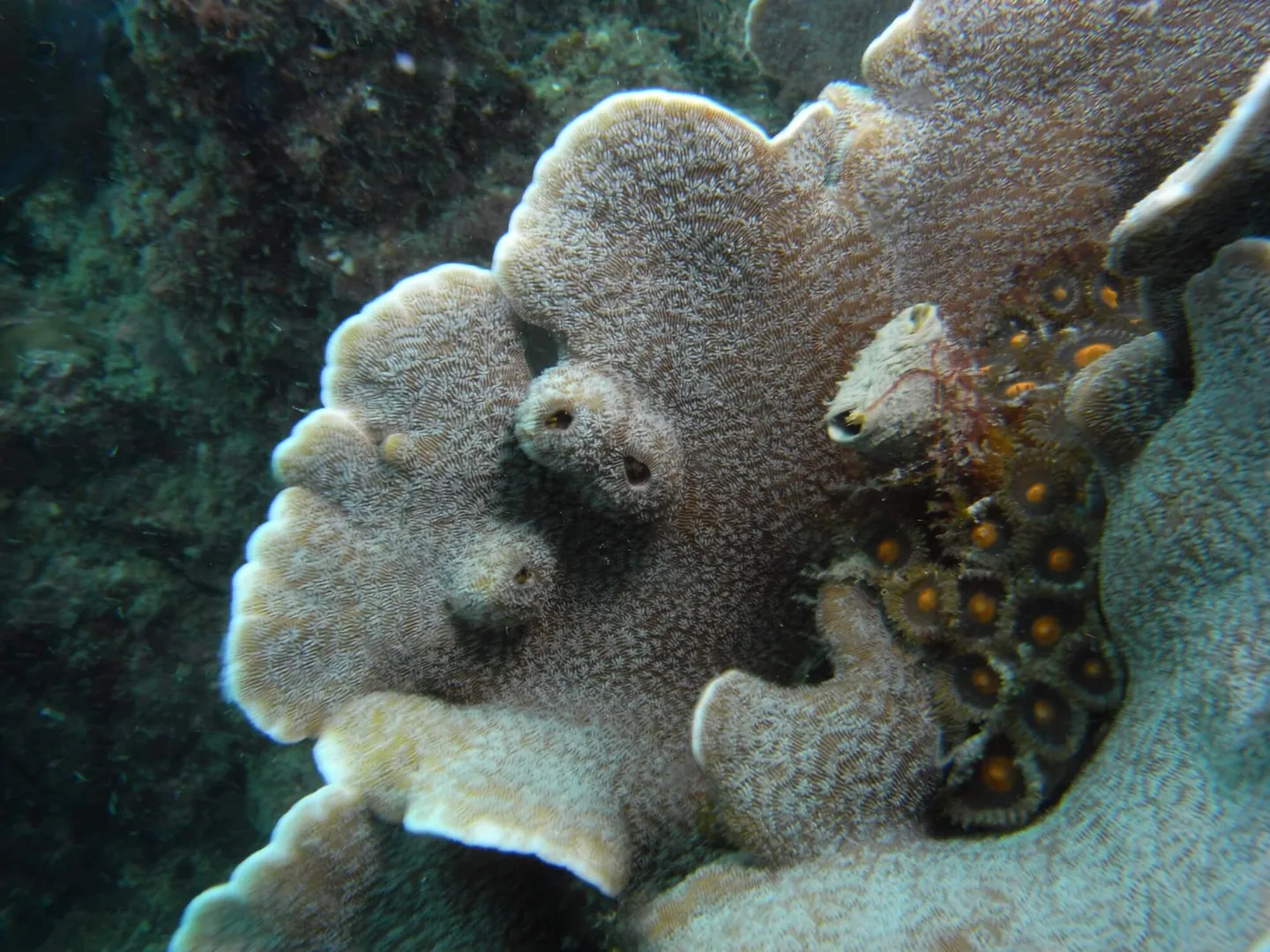
A barnacle living in symbiosis with coral. Photo | Benny Kwok-Kan Chan
The star of this research is Wanella milleporae, one of the most common symbiotic organisms found on fire coral. Is fire coral the same as regular coral? Despite the name and a superficial visual resemblance, fire coral is not a true coral.
Common corals are stony corals, built from relatively large polyps. "Fire coral belongs to the genus Millepora — compared to the polyps of stony corals, fire coral is more closely related to jellyfish and hydroids. It is made up of tiny, calcium carbonate-secreting hydroids and is therefore also called hydrocoral. The hydroids of fire coral are extremely small, and their nematocysts secrete potent toxins," Chan explains.
When diving, if bare skin makes direct contact with fire coral, the toxins released by the hydroids' thread-like tentacles cause a burning sensation at the point of contact — and in more serious cases, blistering and skin peeling. This is why Millepora is called "fire coral."
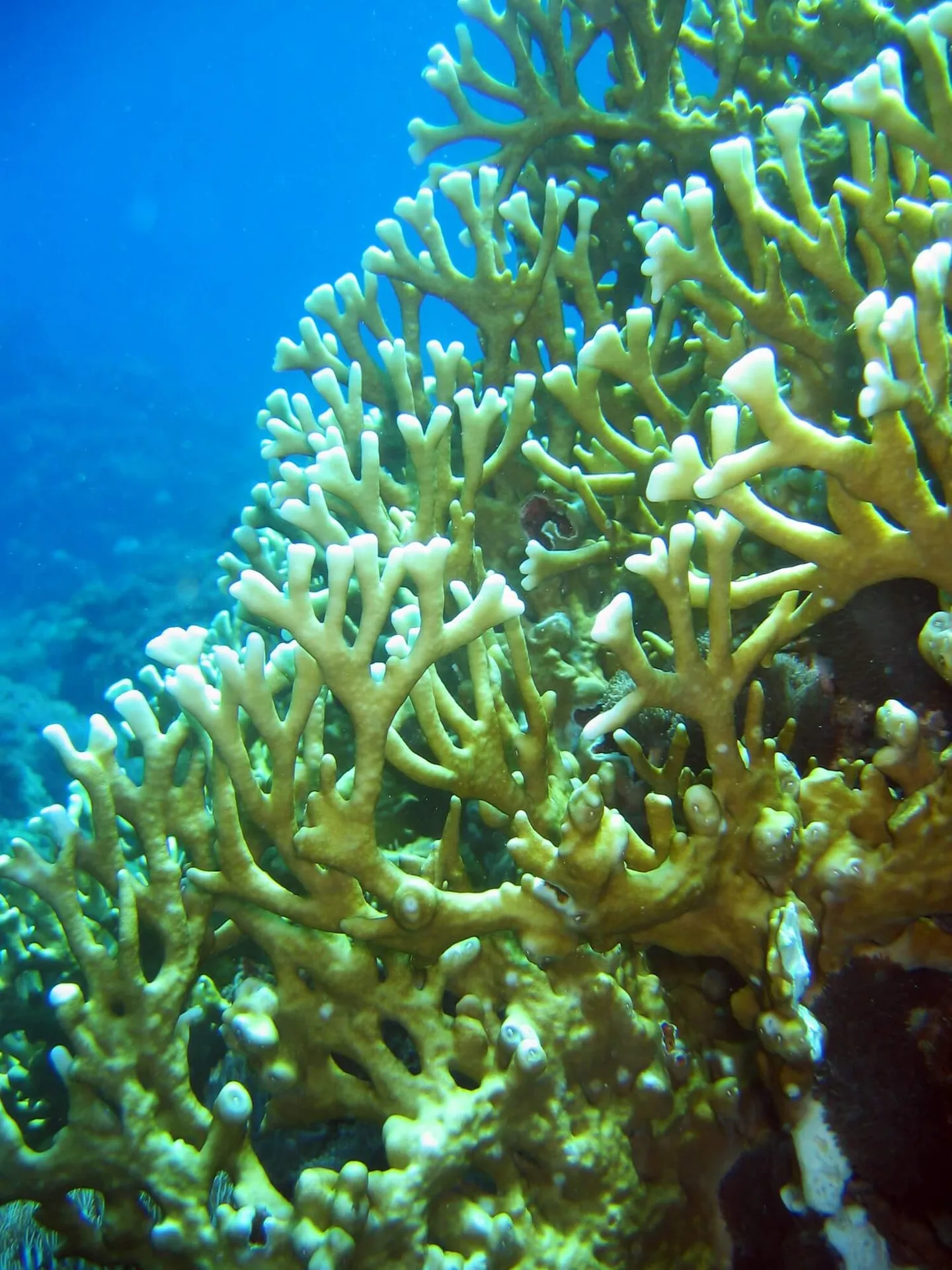
Fire coral comes in branching and massive forms. Direct skin contact while diving causes an intense burning sensation. Photo | Provided by Benny Kwok-Kan Chan
In terms of appearance, Wanella milleporae looks nothing like the volcano-shaped acorn barnacle or the stalked turtle-claw barnacle. The body of Wanella milleporae is embedded within the fire coral, with only the circular plate opening exposed; the rest is covered by the fire coral and is easy to miss unless you look carefully.
The host of Wanella milleporae — fire coral — harbors symbiotic zooxanthellae, which give it its characteristic yellow-green to yellow-brown coloration. Fire coral is distributed across tropical and subtropical seas and is commonly encountered around Kenting and Green Island.
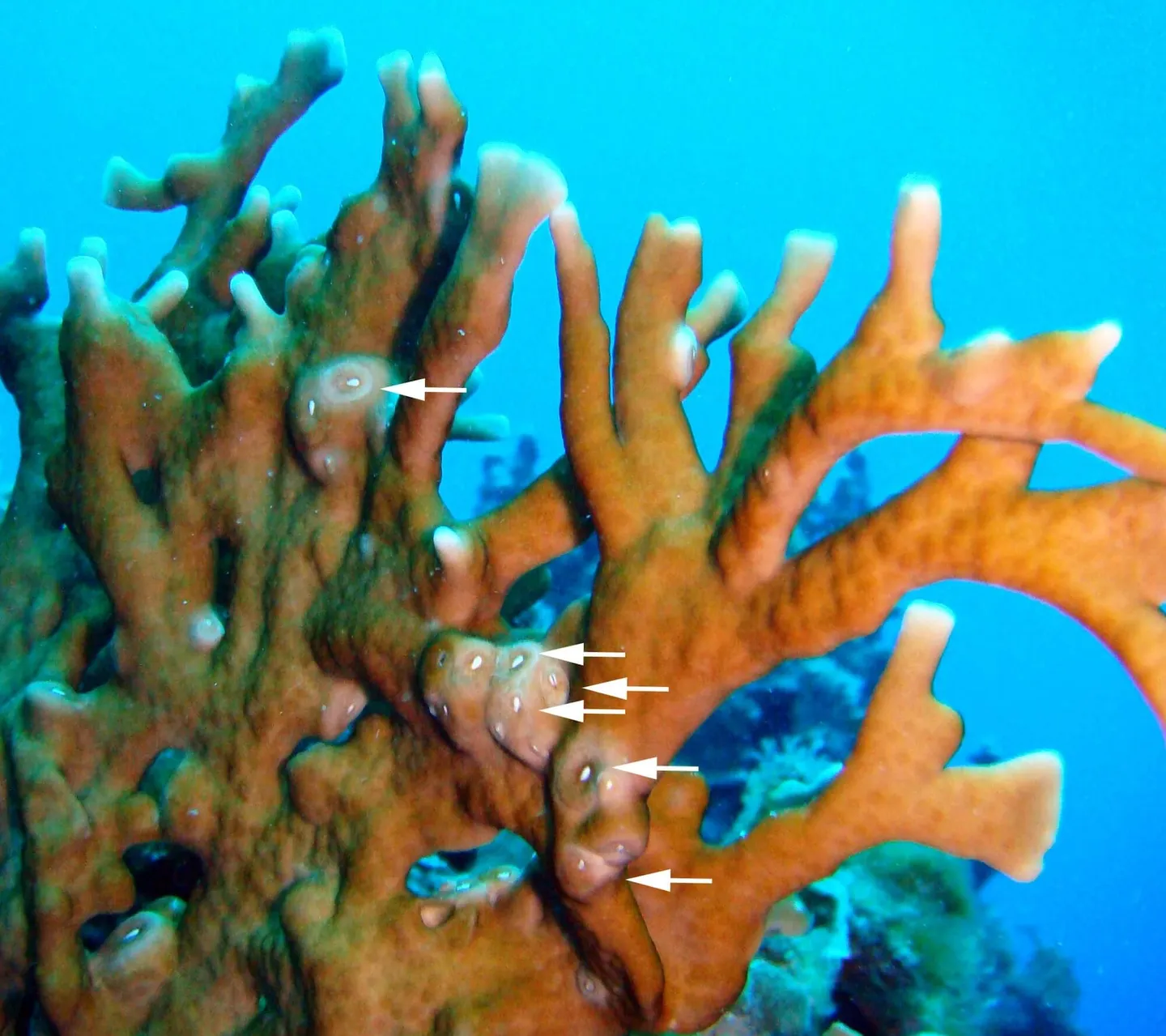
The body of Wanella milleporae is embedded within the fire coral; only the circular plate opening is exposed while the rest is covered by the coral and is easy to miss (see arrows). Photo | Benny Kwok-Kan Chan
Although fire coral possesses nematocysts for capturing plankton and secretes toxins to deter intruders, some organisms do manage to live on its surface — including amphipods, pistol shrimp, and, most abundantly, Wanella milleporae. Some researchers consider the relationship mutualistic, arguing that nutrients such as nitrogen and phosphorus produced by the barnacles support the photosynthesis of the zooxanthellae. Others are skeptical, suggesting that a high density of Wanella milleporae may damage the fire coral's skeleton, making the relationship more harmful than beneficial.
"Based on our field observations, many fire coral colonies remain structurally robust even when densely colonized by barnacles. Taking other studies into consideration, we still believe the relationship is mutualistic," says Chan. But for Chan, the more intriguing scientific question is: how exactly does Wanella milleporae manage to settle on fire coral without being attacked by its nematocysts? In the follow-up article "Living on Flames: The Secret of Wanella milleporae's Symbiosis with Fire Coral," we will uncover the answer!
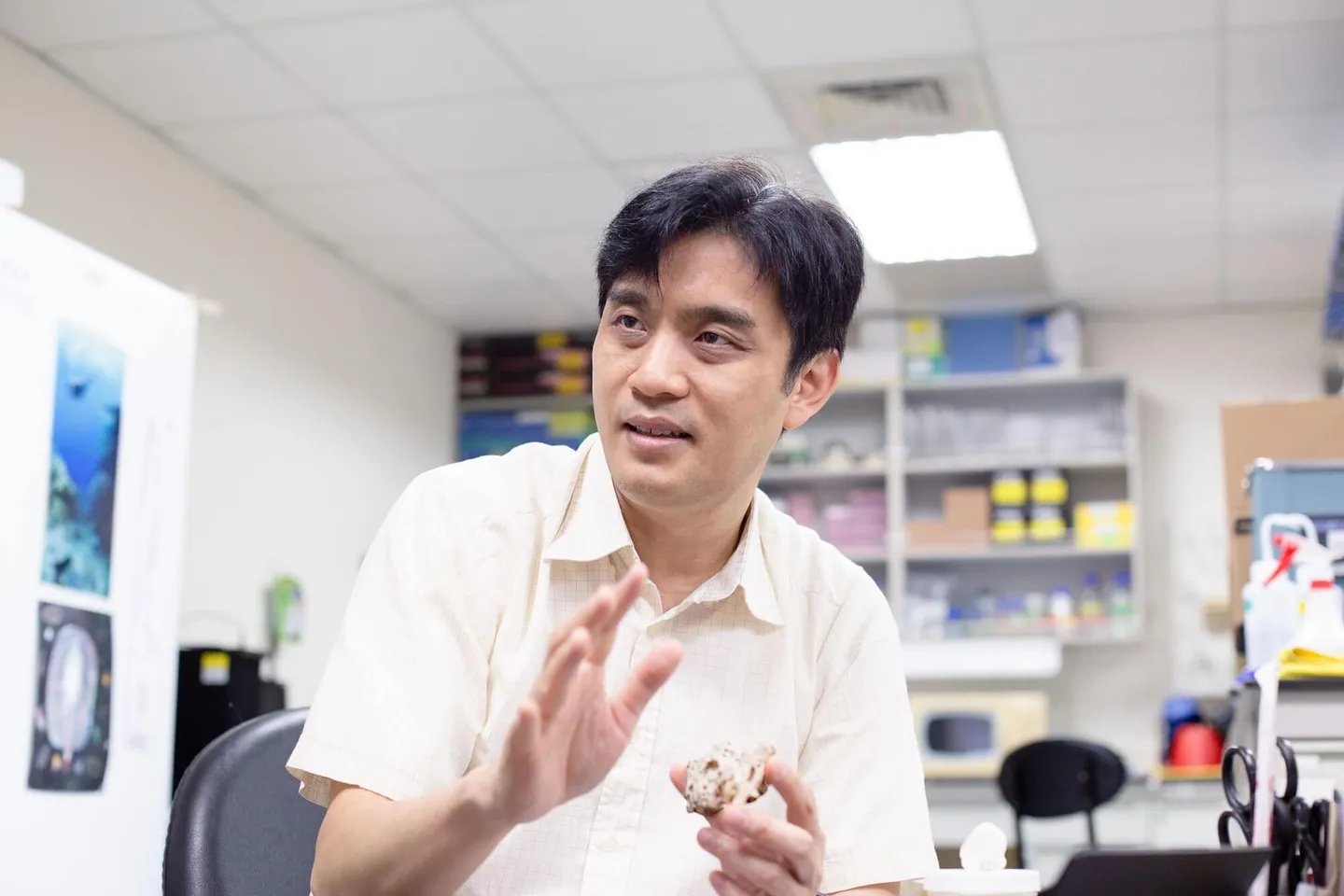
Benny Kwok-Kan Chan introducing a barnacle specimen to the "Research at Sinica" team. Photo | Research at Sinica
Reporting & Writing | Lin Cheng-Hsun
Editor | Jian Ke-Zhi
Graphic Design | Cai Wan-Jie
Further Reading
-
Original article: Barnacles Everywhere: The Unassuming Coral Cohabitants — and the Parasites That Puppeteer Crabs!
-
Wang, Y. H., Dreyer, N., Liu, H. C., Lan, Y., Chen, J. J., Sun, J., Zhang, W. P., & Chan, B. K. K. (2023). Gene co-option, duplication and divergence of cement proteins underpin the evolution of bioadhesives across barnacle life histories. Molecular Ecology, 32(18), 5071-5088.
-
Yap, F. -C., Høeg, J. T., & Chan, B. K. K. (2022). Living on fire: Deactivating fire coral polyps for larval settlement and symbiosis in the fire coral-associated barnacle Wanella milleporae (Thoracicalcarea: Wanellini). Ecology and Evolution, 12(7), e9057.
-
Chan, B. K. K., Wong, Y. H., Robinson, N. J., Lin, J.-C., Yu, S.-P., Dreyer, N., Cheng, I.-J., Høeg, J. T., & Zardus, J. D. (2021). Five hundred million years to mobility: Directed locomotion and its ecological function in a turtle barnacle. Proc. R. Soc. B, 288.
-
Lin Cheng-Hsun (2025). "Living on Flames: The Secret of Wanella milleporae's Symbiosis with Fire Coral", Research at Sinica.
Academia Sinica Press Release (2025). "Distinguished Research Fellow Benny Kwok-Kan Chan Receives Germany's Mario Markus Prize for Entertaining Science". -
Chan Kwok-Kan (2024). "Seeing the Value of Biodiversity Research", Science Monthly.
-
Academia Sinica (2024). Strolling Along the Ecological Trail II: 22 Stories of Biodiversity Research. Compiled by the Biodiversity Research Center, Academia Sinica.
-
Chan Kwok-Kan (2020). "Standing Above All Others — The Extraordinary Reproductive Organs of Barnacles", in Strolling Along the Ecological Trail — Exploring the Wonders of Biodiversity. Compiled by the Biodiversity Research Center, Academia Sinica.
-
Academia Sinica Press Release (2020). "Microplastic Harm Passed Down Through Generations! First Discovery of Microplastics Affecting Reproduction of Intertidal Marine Organisms".
-
Chan Kwok-Kan & Li Kun-Xuan (2007). Barnacles of Taiwan: Biodiversity and Ecology. Published by the National Museum of Natural Science.