

Contents(4)
It's been a while since I last wrote anything for BlueTrend. For those who have read my previous articles — a quick update: I've left Australia and returned to Taiwan, and I'll be heading abroad to study very soon. In the short term, I won't be working as a dive instructor anymore. It's not that I dislike the job; I simply reached my goal and wanted to set a new challenge for myself. That's a topic I could write a whole separate article about.
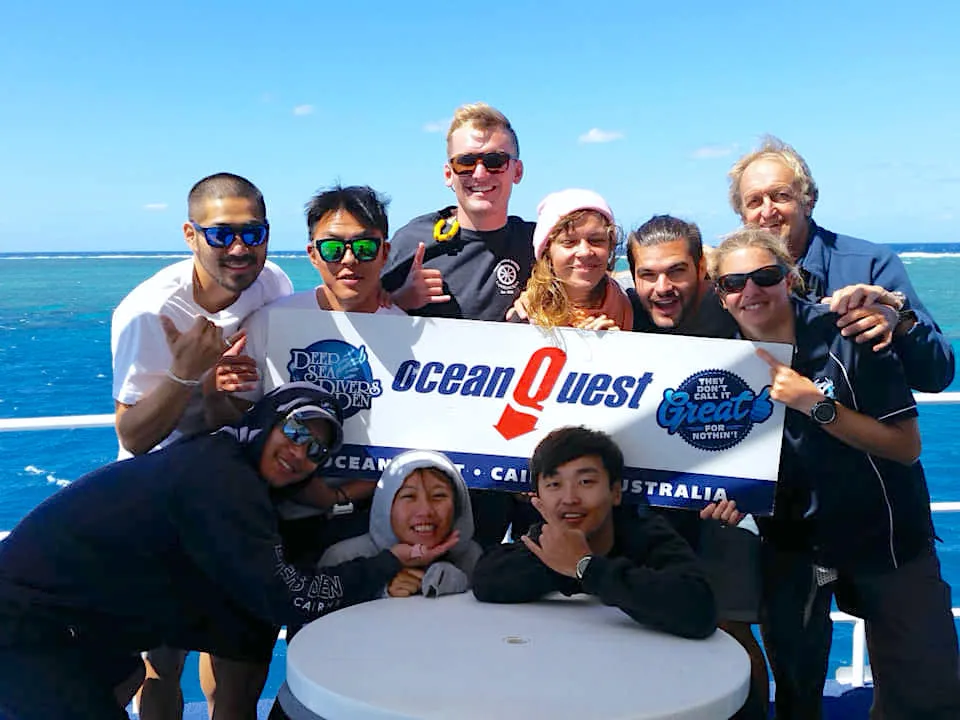
Today, a friend who is working in Australia on a working holiday sent me a private message asking about the working visa dive certification process. It's been exactly one year since my very first day working toward that certification! In that time, quite a few people have messaged me with questions, and some have even gone to work at the same dive shop I did and successfully earned their instructor licenses. I still remember my last day on Ocean Quest (the boat I worked on). On the way back, I was completely heartbroken. At the farewell party, many of the Divemasters from the company came to hug me and sincerely thanked me for my guidance — something that the younger version of me, doing her first ever scuba diving experience in Kenting, could never have imagined.
In this article, I want to talk about my personal journey from Divemaster to dive instructor.
The Weakest Divemaster, With the Hardest-Working Mindset
During the working visa certification program, I was the weakest Divemaster in my cohort. Because I had never actually worked as a Divemaster before, I found everything — from dealing with guests to simply leading a dive — a little difficult. I got scolded by a Japanese instructor, then lectured by an Australian instructor, and there was also a Korean instructor who would periodically chase me around saying "terrible."
So every day, I made a list of small things to work on: "How do I remember the corals?" "How do I lead a dive?" "How do I find the photographer?" "How do I navigate to a specific depth?" I also started observing how instructors organized their divers, how they boosted diver morale, how they encouraged divers to move faster, what I should be doing at each moment, how to give a dive briefing, how to use the compressor, how to set up divers' equipment, how to arrange the order of entries into the water.
"Oh, so that's how Mel talks to Open Water students." "Oh, Kyle is so popular — it's because he designs these fun little exercises!" "Oh, everyone loves diving with Filippo because he's funny (and a bit charming), and he always chats with the divers before they get in the water." "Oh, Tom is always so efficient because he gives a mini-briefing right before taking people down." Every single day I was watching what others did and finding ways to improve myself.
I once wrote out my entire dive briefing as a full word-for-word script. I even practiced jokes like, "If you have any problem, please tell your instructor, we will take care of your problems. However, we cannot fix your marriage" until they sounded completely natural. After a week of practice, I went to my supervisor and said I wanted to give the briefing in English — and in the end, I received very positive feedback.
The more aware you are of being the weakest, the harder you must work than everyone else.
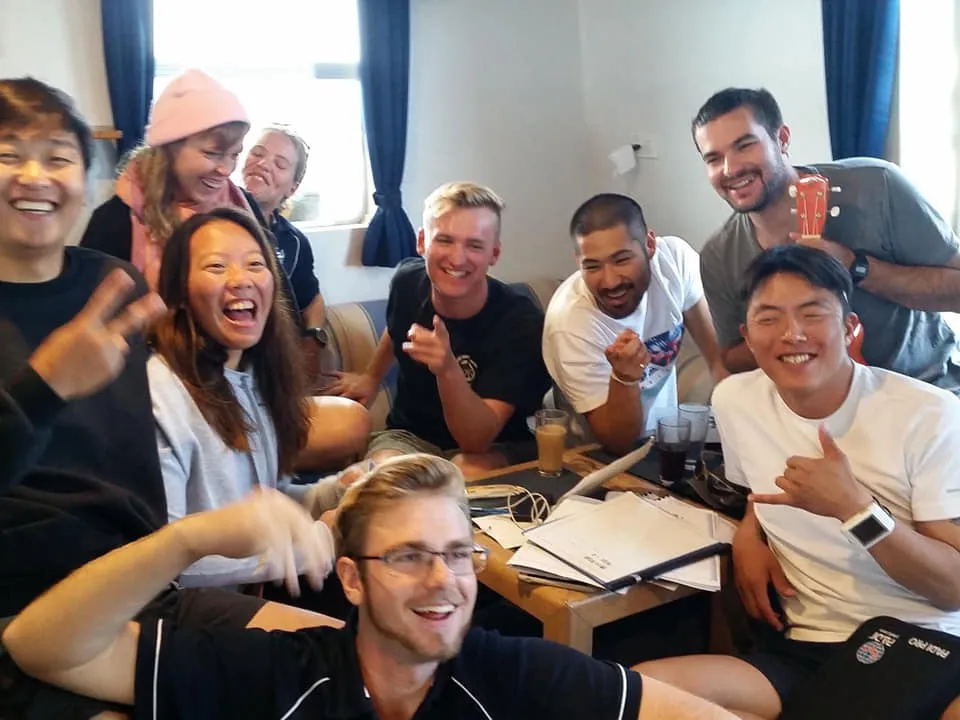
My fellow Divemasters in the same cohort


"If You Can't Think Like an Instructor, You Don't Belong Here"
The reason I suddenly felt like writing this article is because this sentence came back to me.
Before the instructor exam, we had nearly three weeks of Instructor Development Course (IDC). I spent almost every day in the pool practicing neutral buoyancy (the pool at the exam venue was very shallow — I recall the deepest point was about two meters). Among the IDC sessions, we had three days and two nights aboard a liveaboard for open-water instructor training. In addition to the Course Director, we had a Korean instructor who spoke three languages serving as our teaching assistant.
It was winter in Cairns at the time. Apart from mealtimes and sleeping, we were in the water constantly — usually staying down until someone was close to 50 bar, then surfacing just long enough to swap cylinders and go back down. On one particular dive, we were doing underwater navigation. I was playing the role of the instructor, while the other two students acted as my divers. I pointed out several errors the "students" were making: the arm holding the compass needed to be held horizontally with the elbow perpendicular, they should use the free leg to kick and count kick cycles, and they needed to turn in the correct direction.
Suddenly the Korean instructor stopped me. He looked very angry, indicating that there was a mistake I had failed to point out. Underwater in that moment, I genuinely couldn't understand what he was trying to say.
So he brought me to the surface and told me: "If you cannot think like an instructor, you are not supposed to be here." It turned out that although I had identified the textbook errors, I had completely missed the fact that one of the students had excessive vertical movement — too much bobbing up and down. In that moment, I didn't feel upset at all. It wasn't until we were back on the boat resting that another classmate — who had been toughened up through the Korean instructor's intense training — came over and said, "Jen, I know you." Only then did I involuntarily tear up. My immediate thought was: why do I still feel like I can't get it right?
"If You Can't Think Like an Instructor, You Don't Belong Here"
Those words from the Korean instructor had a profound impact on me. Because going from Divemaster to dive instructor means not just a change in responsibility — the perspective you're required to maintain is vastly different as well. Sometimes as a Divemaster you can't understand why an instructor "does this" or "doesn't do that," and it's only after you become an instructor yourself that you realize there's always a reason. That's why we often joke: "A Divemaster is someone who thinks they know everything but actually knows nothing" — because most Divemasters are still primarily spending their time with certified divers, and aren't well-equipped to guide less experienced divers using proper instructional techniques. Their judgment of situations can also be skewed from spending the majority of their time with certified divers.
That one line from the Korean instructor was truly a wake-up call. I finally understood that once you've completed the training, your responsibilities are fundamentally different. (Afterwards, the Korean instructor was called in and reprimanded by the Course Director — after all, there are huge differences between Asian and Western educational approaches, and I felt a little bad for him.)
In fact, this feeling became even stronger once I actually became an instructor and entered the professional world. The job now meant leading try-dive participants and inexperienced certification students (a side note: in Australia, one instructor typically takes four try-divers at a time; I went from barely managing two without going all over the place, to being able to handle four at once — hovering over coral watching Clownfish is both a magical experience and a real skill). Unexpected situations would arise quickly and out of nowhere. Thinking through how to keep the big picture in mind became something I needed to do before every dive. It was no longer just about worrying that I'd get lost or not find anything interesting — much more of my mental energy went toward: how do I successfully take these people out and bring them all safely back?
This kind of personal journey was truly extraordinary — it even felt like, just as I had finally climbed up to reach my goal, everything reset back to zero all over again.
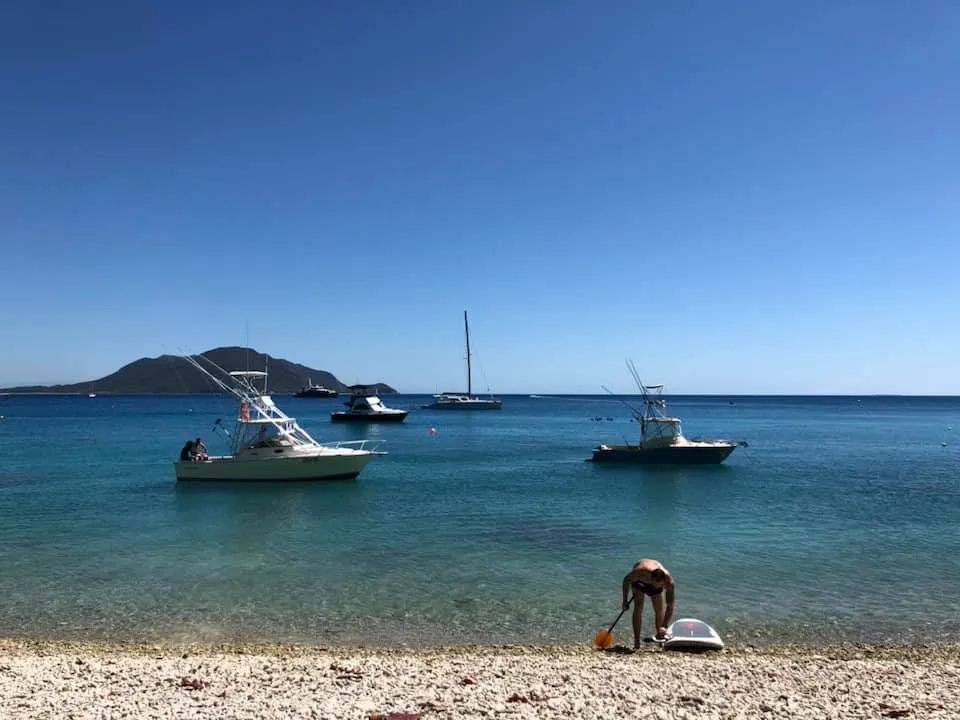
The venue for the instructor exam
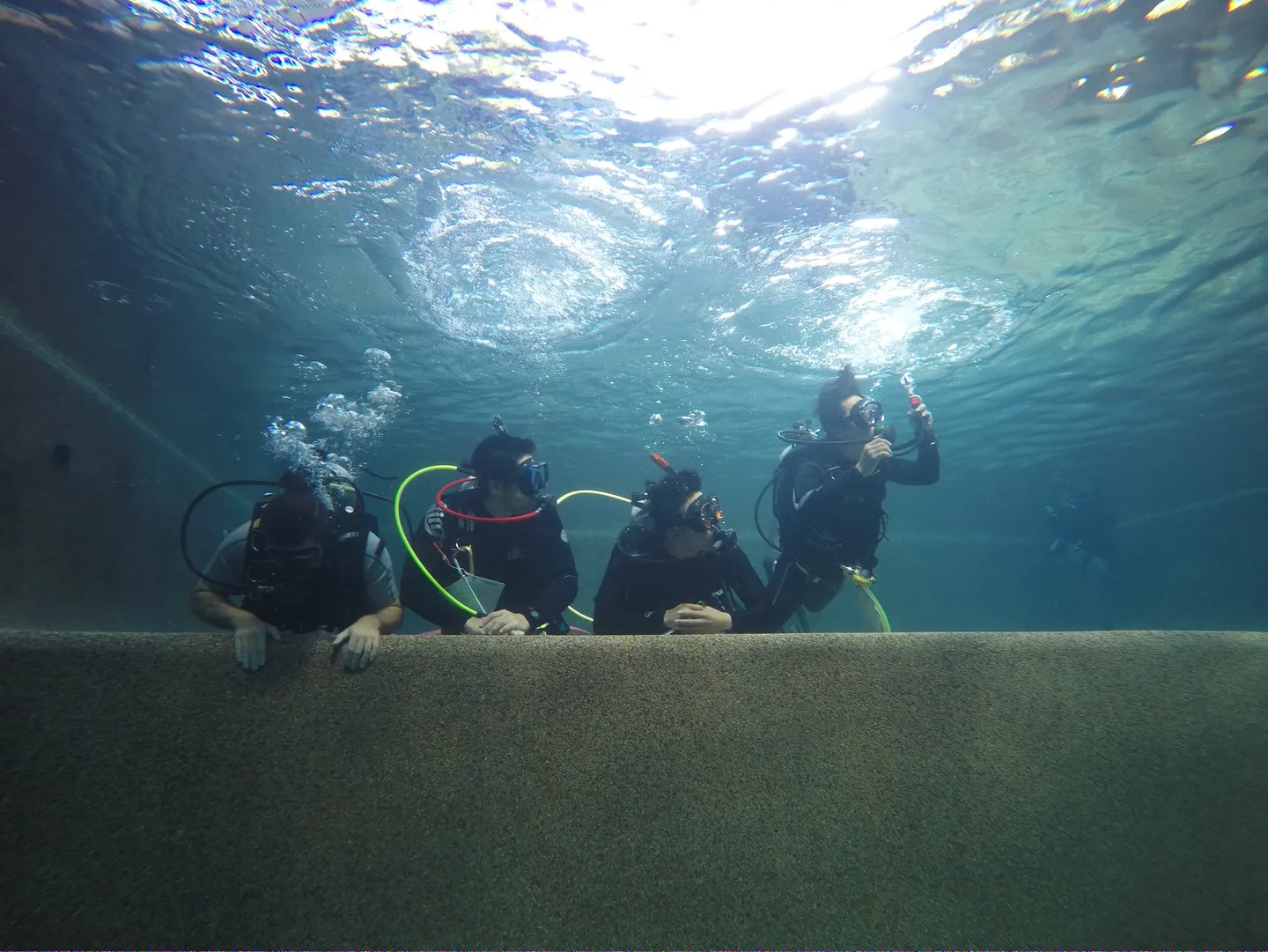
When we were still Divemasters, we used to fool around until the Course Director got annoyed
Dive Instructors and Divemasters
During my new instructor training period after becoming certified, Eunice — a Hong Kong instructor who was training me — once told me: "After you become an instructor, you can't just dump all the boat duties on the Divemasters. You still have to do them yourself." This Hong Kong instructor taught me the right attitude to have toward Divemasters: "We are all colleagues. You cannot pile things on them just because they're Divemasters, or refuse to help them out." After I became an instructor, I still went to help with door duty (when the swell is big, someone needs to stand at the gate to make sure guests don't trip and get injured — further reading: Diving Safety Is Non-Negotiable: The Diver's Guardian — The Lookout), cleaned masks alongside everyone else, sorted out wetsuits, and did the work I was being paid to do. At the same time, I gave appropriate support to the Divemasters, and I also reminded them that when they become instructors in the future, they should treat the hard-working Divemasters assisting them with the same respect. Perhaps these small details were noticed — before I left Australia, those Divemasters expressed their gratitude to me.
Compared to instructors with deeper theoretical knowledge and richer experience, I still have a lot to learn. But I believe that this small mindset, and the actions that come from it, can go a long way in earning genuine respect from those who come after you.
Whether in the medical field or the diving industry, I've come to feel how important it is to have mentors who are "willing to respect and nurture those who come after them." When you lead by example, that mindset is passed on — it brings positive energy and a virtuous cycle to the work environment. In Australia, I frequently heard supervisors and instructors praising you specifically for things you did well. You might think: doing your job properly is just expected. But those one or two words of encouragement genuinely made me work more efficiently, made me more confident in my ability to get things done — and more importantly, made me happy. When something went wrong, it was also rare to be met with irrational top-down scolding; the first priority was always solving the problem. "Let's get everything done together, have a great day, and then all go for drinks" was the shared goal of every colleague.
After returning to Taiwan, I've continued to carry this same philosophy (minus the drinks), letting this small idea spread to the junior colleagues around me in the hospital.
Further reading:
-
Diving Safety Is Non-Negotiable: The Diver's Guardian — The Lookout
-
Bored of Diving the Great Barrier Reef? Come Swim with Pipefish and Seals in Melbourne
-
Exploring Australia's Mysterious Shipwreck in Strong Currents — S.S. Yongala
-
Looking for a Purpose in Life? Come Do an Unforgettable Dive Working Holiday in Australia!
-
Encountering a Dwarf Minke Whale on the Great Barrier Reef — A Must-Do Dream Voyage in Australia

![Diving Abroad But Can't Speak Diving English? The Essential Diving English Guide Part 1 — [Nouns]](/_astro/mael-balland-hx73qL8rOOo-unsplash-2_Z1JBwHj.webp)
![Can't Speak Diving English Abroad? The Essential Diving English Guide for Divers — Part 2 [Practical Conversation Edition]](/_astro/LRG_DSC00874_7dl44.webp)
![Diving Abroad But Can't Speak Diving English? The Essential English Guide for Divers Part 3 — [Divemaster / Instructor Edition]](/_astro/mael-balland-4HGHduVeCNs-unsplash_2gDACr.webp)