

The Editor's Note: sidemount and cave diving are incredibly alluring to any diver, yet they remain a largely uncharted territory. Beyond the considerable costs involved, the level of technical skill and mental fortitude required far exceeds that of recreational diving. Online resources about cave diving and technical diving are scarce, which only adds to the mystique surrounding the technical diving world. We are grateful to 百鬼夜行 TEK Dive Team instructor Ryan Chan for sharing his insights and helping us better understand the world of cave diving.
A Personal Reflection on the Toddy Style Sidemount System!
"It doesn't matter where Turks & Caicos is. What matters is that, to me, that ocean is the end of one wish and the beginning of another story." —R.C.
In the summer of 2014, I earned my Open Water Scuba Diver certification. On the boat ride back after completing my final open-water checkout dive, I chatted with my Canadian instructor, who mentioned that he had done a single-tank dive to 52m with a friend on air. I told him that sounded far too dangerous, and that I should just stick to being a recreational diver. Later, when I started getting into decompression diving, I told my friends that things were pretty much good enough where they were — expanding my depth limits slightly beyond open water was sufficient. As for cave diving and wreck diving — too dangerous. Best to leave that to the crazy, reckless lunatics who have a death wish!
Then I went to Mexico and completed a full cave diving course with my French instructor. I sighed quietly to myself, thinking, I've come so far, and I've finally reached the finish line... And then, somehow, I ended up becoming a Hypoxic Trimix Diver and a Cave Surveying Diver. I started removing tanks to squeeze through passages so tight they were barely there. 100m became my everyday fun dive. These days, I no longer say there's any type of diving I'll absolutely never do — because you never know what fate has in store for a diver.
Toddy Style Sidemount Equipment
What I actually want to talk about today is gear selection, because the path I've walked as a diver has had its fair share of wrong turns and costly detours. Looking back now, if someone had stopped me from buying equipment I ended up barely using, I can't imagine how much time and money I could have saved — and how much faster I could have progressed. That said, having hands-on experience with so many different setups does give me a genuine basis for talking students through the pros and cons of various gear when I'm teaching — students who love diving, not just people I'm trying to drag into technical diving.
Over the years of diving, I've gotten to know a great many exceptional technical divers around the world. Because of my own passion for cave diving, a significant proportion of my friends are cave divers, cave explorers, or cave instructor trainers. Around April of this year, I had a conversation with four well-known cave instructor trainers from different regions, nationalities, and systems about a particular piece of equipment: the Toddy Style Sidemount system.
Let me give a brief, simplified introduction to Toddy Style Sidemount (TS) based on my limited knowledge. This isn't exactly a brand-new invention — OMS had made similar so-called "sandwich-style" sidemount rigs some time ago. However, it was renowned cave explorer Thorsten Waelde (Toddy) who, after completing his cave instructor training in Mexico in the late 1990s and returning to Europe, noticed that the Mexican-style sidemount setup had certain limitations in the cold-water environments of Europe, where a drysuit is necessary. So, in the 2000s, he began refining this sandwich-style sidemount concept — essentially two metal backplates sandwiching a bladder. The metal backplates serve a dual purpose: they add the extra ballast weight needed for drysuit diving, and they limit the longitudinal expansion of the bladder when inflated in confined spaces. Beyond the harness design, Thorsten Waelde also developed his own distinctive approach to hose routing — for instance, all second stage regulator hoses are 1m long and fitted with 90-degree elbow connectors. I won't go into further detail here, but if you're interested, I recommend listening to Episode 24 of Steve Davis's Speaking Sidemount podcast, which features an in-depth interview with Thorsten Waelde.
Now, back to my discussion with four cave explorer friends about the Toddy Style system. First, let's talk about its advantages. For those of us who dive sidemount in caves, switching between different gas configurations always requires some adjustments. For example, the configuration for OC S80 cylinders differs somewhat from sidemount CCR. As one of my friends told me, Toddy Style is primarily designed to work in conjunction with the T-REB sidemount CCR, and switching between OC and CC apparently doesn't require too many complex adjustments to the rig. Then there's the dual-backplate sandwich/sandwich design, which genuinely allows cold-water drysuit divers to integrate their required ballast into the main rig rather than adding weight externally.
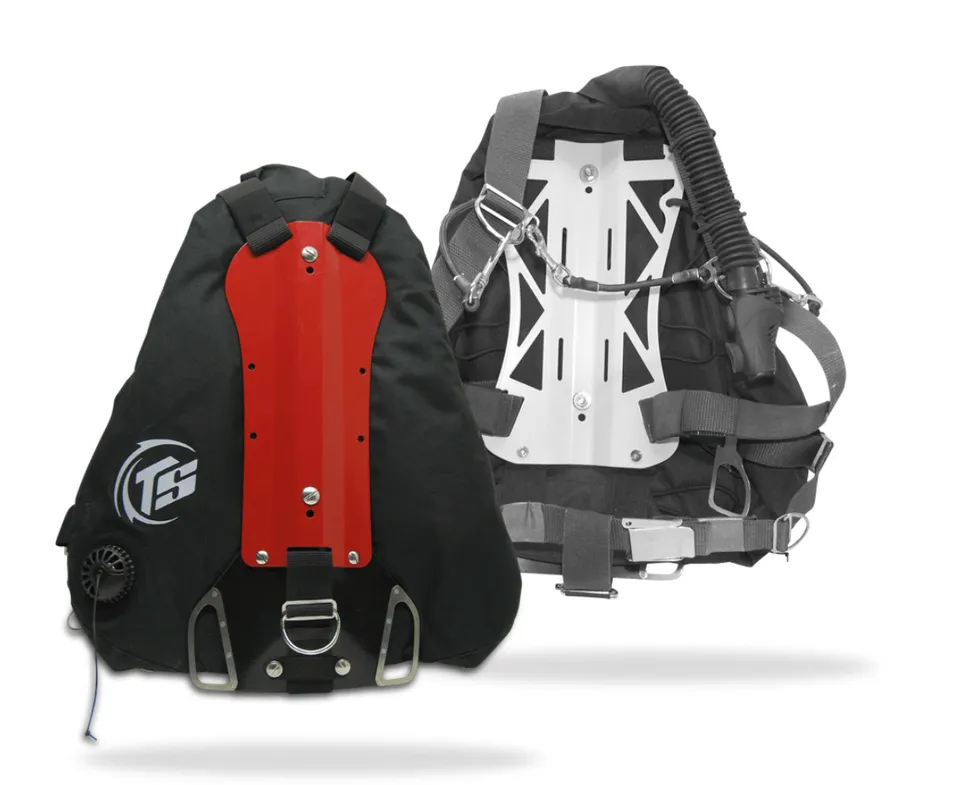
Image from the TOBBY STYLE official website
The advantages of TS sound pretty appealing on the surface — but then I started thinking more deeply. My first question: how many dives per year do I actually do in a drysuit? This might be a question worth asking yourself when choosing equipment too. If you primarily dive in a wetsuit (or don't even own a drysuit), do you really need to be carrying two metal backplates that cannot be removed underwater? And suppose your bladder malfunctions and you need to use your surface marker buoy (SMB) as a backup buoyancy device — can your SMB support the negative buoyancy of two backplates? If so, how much air would you need to put into it? In a current, how much additional drag would that create? And how much of that extra drag would drain your energy — and therefore your gas supply?
My second question: when I'm diving in spaces rated R4/R5 (Note 1 / Figure 2), the flexibility of a soft bladder to compress and expand is extremely valuable. Would hard metal backplates cause problems with getting stuck or wedged? In spaces that small, the room you have to move your limbs is already extremely limited — let alone manoeuvring yourself free if things go wrong. You might only have one hand barely free to push against the rock to inch forward; kicking your fins may not even be possible, and really shouldn't be done for fear of silting out and killing your dive buddy. Of course, Thorsten Waelde is a far more experienced and accomplished cave explorer than I am, and he stated in his interview that he has never had an issue with getting stuck. I believe him. But I'm not him. I don't have his depth of experience, and I certainly don't understand the TS system as well as he does. And what about you? If I'm diving in a roomy confined space, my first choice would be Mexican-style sidemount gear — and my second choice would be back-mount twin tanks.
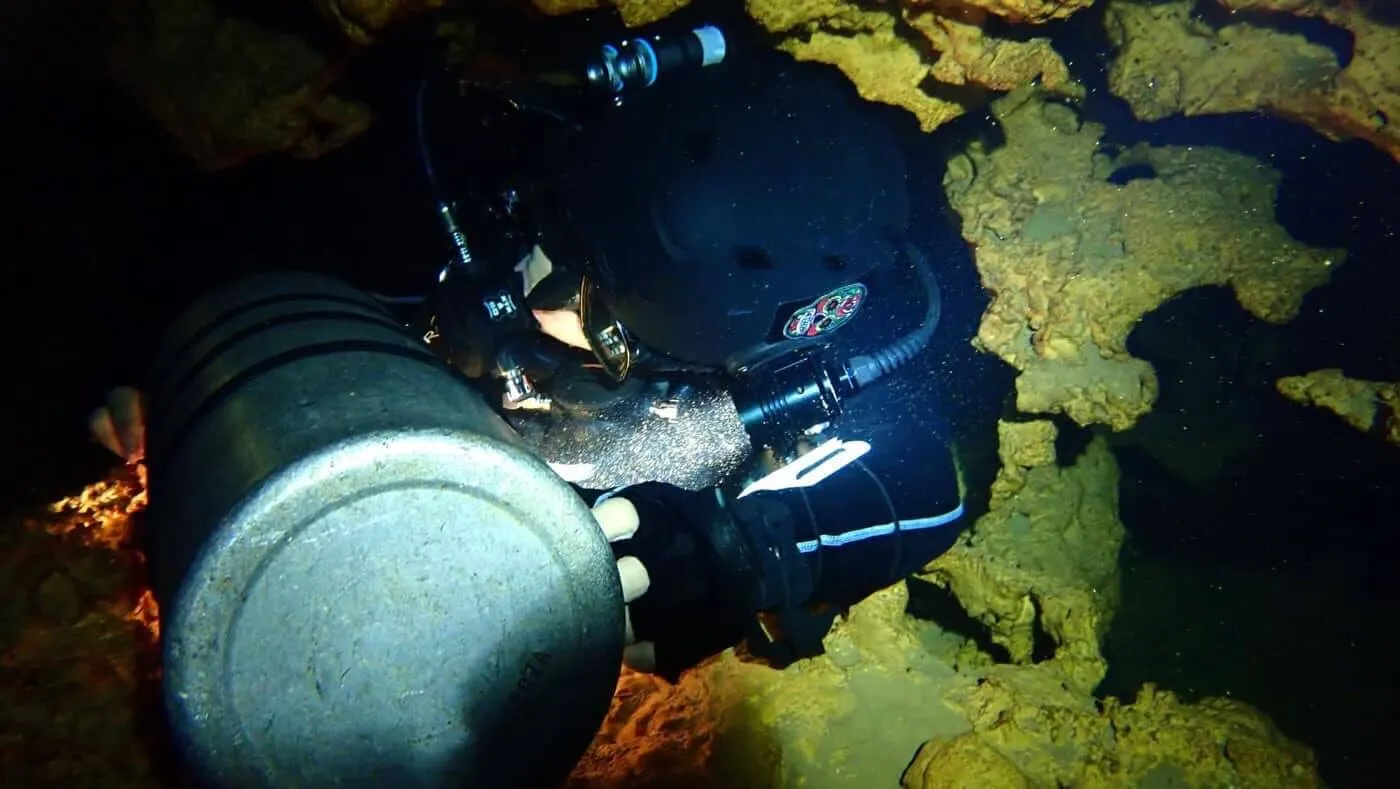
R4-rated narrow passage
Don't assume this could never be relevant to you just because you don't dive tight caves. Trust me — if you read the opening of this piece, you'll know that's exactly what I used to think too!
Speaking of experience, that brings me to my next concern: training quality. If I absolutely had to use the TS sidemount system, I would go directly to the inventor himself for instruction. At a minimum: first, I haven't seen anyone using this system in the areas where I typically dive, and even if I had the chance to dive alongside someone using it, I wouldn't understand their emergency procedures — so what would happen if I ran into trouble underwater? For the sake of my own safety, I would never seek out instruction from someone who claims to be an instructor but has insufficient experience with this particular system. Those individuals may be far more enthusiastic about selling the equipment for profit than they are knowledgeable or experienced — but I do believe the inventor himself could answer my many questions and offer informed solutions and recommendations.
One specific technical detail that caught my eye: the placement of the cylinder bungee configuration relative to the waist belt and the height of the hip D-rings. That setup would be absolutely fine with steel tanks as used in Europe or Florida — but when diving sidemount with aluminum tanks that become positively buoyant as the gas is consumed, I imagine maintaining horizontal cylinder trim would be quite a challenge. (I have official photos — feel free to message me privately if you'd like to take a look; I won't publish them here.) And in a cave or other confined space, if your technical diving instructor ever tells you that sidemount cylinder trim doesn't matter — I can say with near certainty that either they don't know how to teach it properly, they don't understand it themselves, or they're simply lying to you.
Logically speaking, TS isn't a new sidemount concept that emerged only in the past couple of years. And given the adoption rate it has achieved over the time it has been promoted, it's even less accurate to call it an emerging trend. So why haven't the vast majority of cave divers around the world chosen it? I'd encourage everyone to check out the discussions on the international Scubaboard forums regarding the TS sidemount system — opinions there are largely one-sided. Then again, perhaps it's simply that people don't yet understand its merits? I don't know the system well enough myself to offer much more of an opinion on that aspect.
On the topic of sidemount adoption rates, here's a comparative point worth making. At present, the British-style sidemount, Mexican-style sidemount, and Florida-style sidemount systems have all been extensively tested and refined through years of real-world use by a great many cave divers and explorers, across a vast range of cave diving scenarios. They have higher usage rates, more systematic training frameworks, and a larger pool of qualified instructors. In terms of after-sales support, training availability, and overall safety and convenience — which system makes more sense for me right now?
More importantly: I would advise everyone to buy gear that will last you for the long haul so you don't have to keep replacing it. Money doesn't grow on trees!
I genuinely believe that no cave diving gear inventor would design something purposeless. I'm certain the TS is capable, well-functioning equipment — and there may well be advantages to it that I haven't yet come to appreciate. But for now, whether for recreational or technical diving, I have far too many other equipment options that are more convenient, safer, and easier to understand. Perhaps one day, if the TS develops a truly groundbreaking feature that solves a critical problem no existing equipment can address, I'll consider getting to know it more seriously. Although the four cave diving explorers I spoke with from around the world are none of them using TS — and none of them are considering it — who knows? Even though TS hasn't become the choice of the majority of cave divers over the past decade-plus, what might change in the future with aggressive marketing and promotion from vendors? We'll just have to wait and see.
Note 1:
R = Restriction (confined, narrow space)
R1 = Passable — barely — by a back-mount twin-tank diver
R2 = Not passable by back-mount twin tanks; only sidemount divers can pass
R3 = A sidemount diver can barely squeeze through without removing cylinders
R4 = A sidemount diver must remove some cylinders to pass
R5 = A sidemount diver must remove all cylinders (No Mount) to pass
Related links: