Contents(3)
Full article republished from the Environmental Information Center: "Crown-of-Thorns Starfish 'Locusts of the Sea' Sweep Through Dongsha — Experts Warn: All Hard Coral Could Be Devoured Within Two and a Half Years"
The Dongsha Atoll National Park is facing a massive crown-of-thorns starfish (COTS) outbreak. Last year (2024), the Taiwan Coral Reef Society and the Marine Conservation Administration under the National Park Service assembled a team that removed nearly 14,000 COTS. This year (2025), the team has returned, removing close to 34,000 individuals within a single month. Honorary Chairman Cheng Ming-Shiou warned that wherever the starfish pass, it is like a forest fire on the seafloor — healthy hard coral is completely devoured, disrupting the habitat of coral reef fish and other organisms and triggering an ecological catastrophe. Without significantly intensified management, he estimates the coral reefs of the area could be stripped bare by these "locusts of the sea" within two years. He has called on the Executive Yuan to convene a cross-ministerial task force and commit more resources to scientific research and removal operations.
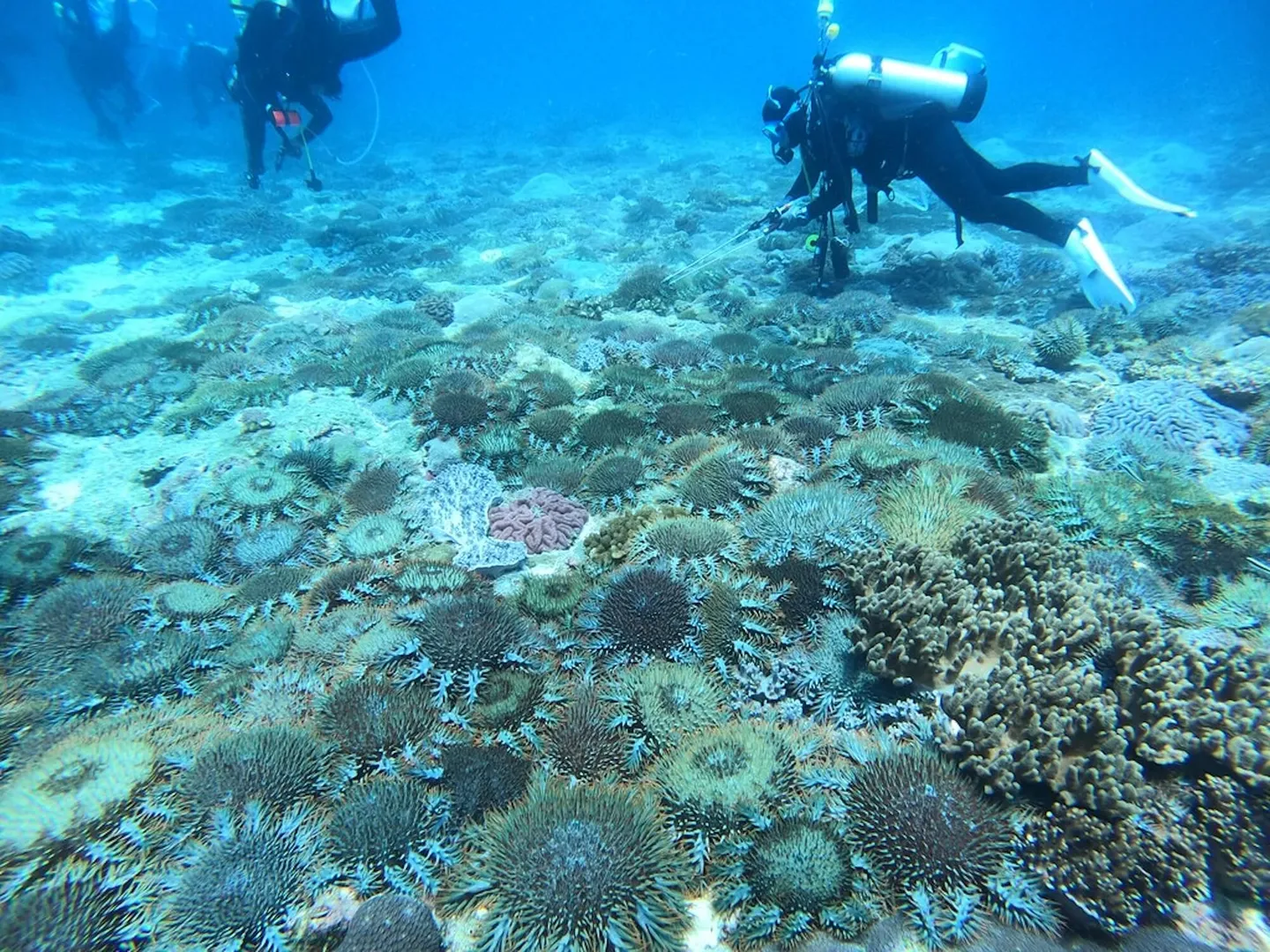
In March 2025, a massive congregation of crown-of-thorns starfish was found along approximately 1,600 m of the southeastern outer reef of Dongsha. Photo credit: Taiwan Coral Reef Society
This Year's COTS "Army" Is Lining Up Right on the Hard Coral Reefs
Crown-of-thorns starfish have almost no natural predators and can only be controlled by injecting diluted acetic acid. At a press conference held on the 8th, the Taiwan Coral Reef Society's Honorary Chairman Cheng Ming-Shiou stated that in 2024, an estimated 110,000 COTS were present in an area of approximately 62.5 hectares around the Blue Hole and eastern zone at the southwestern corner of Dongsha Atoll. Between June and October, the team removed approximately 14,000 individuals. Photographs reveal that hard coral in the southwestern corner has almost entirely died, and algae have already begun growing in the shallows.
This year, the team returned to Dongsha between March and May for further surveys, discovering that COTS had congregated and grown in number across an area of approximately 1.6 hectares extending 1.6 km east of Blue Hole No. 2 — with nearly 34,000 removed within one month. Cheng noted that during last year's removal operations, divers sometimes had to search to find COTS hiding out of sight. This year, however, the starfish are "lining up" to receive injections of acetic acid — "their entire 'army' is right down there." The densely massed COTS are mostly individuals exceeding 40 cm, "right in their prime." Although over 30,000 have already been removed in recent months, large-scale reproduction is expected to occur as summer approaches — each female starfish can release up to 300 million eggs — making it essential to intensify removal efforts in May and June.
However, the method of having divers inject diluted acetic acid has its limitations. Divers cannot descend beyond 30 m, and bottom time at 20–30 m is very limited. Conducting research and surveys on COTS at greater depths would require significantly more resources and personnel.


Dongsha Atoll's Hard Coral Could Be Gone Within Two and a Half Years
Coral reef ecosystems hold enormous economic value; abundant fish populations create a spillover effect that increases fishery yields in surrounding waters. Cheng explained that if healthy hard coral is entirely consumed and bleached, the seafloor ecosystem will be severely imbalanced, and significant economic losses will follow. The coral ecology of Dongsha Atoll is already on a countdown — if action is not accelerated, given COTS' pace of "one kilometre per month," the hard coral of Dongsha Atoll could be completely devoured within two and a half years. Calculated against international precedents for coral reef damage compensation, losses could amount to at least NT$33.5 billion.
Taiwan currently faces a shortage of personnel, vessels, and scientific research capacity to address the COTS problem. Cheng called on the government to adopt more proactive management measures, drawing on Australia's COTS management strategies, and to have an Executive Yuan policy minister convene and establish a cross-ministerial task force, with additional funding allocated for survey and removal work.
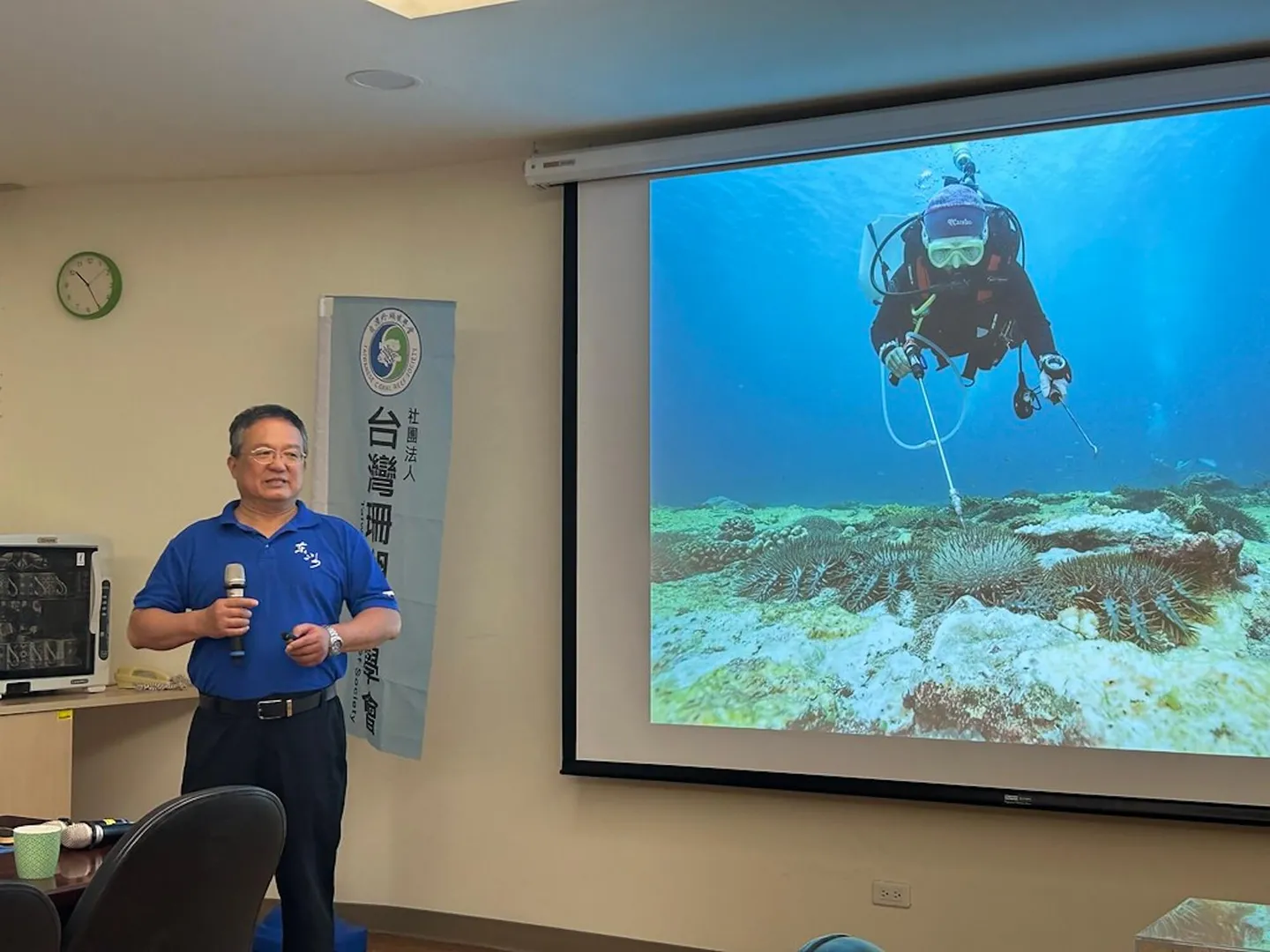
Taiwan Coral Reef Society Honorary Chairman Cheng Ming-Shiou urges that removal efforts be intensified before summer arrives. Photo: Yuan Hui-Yan
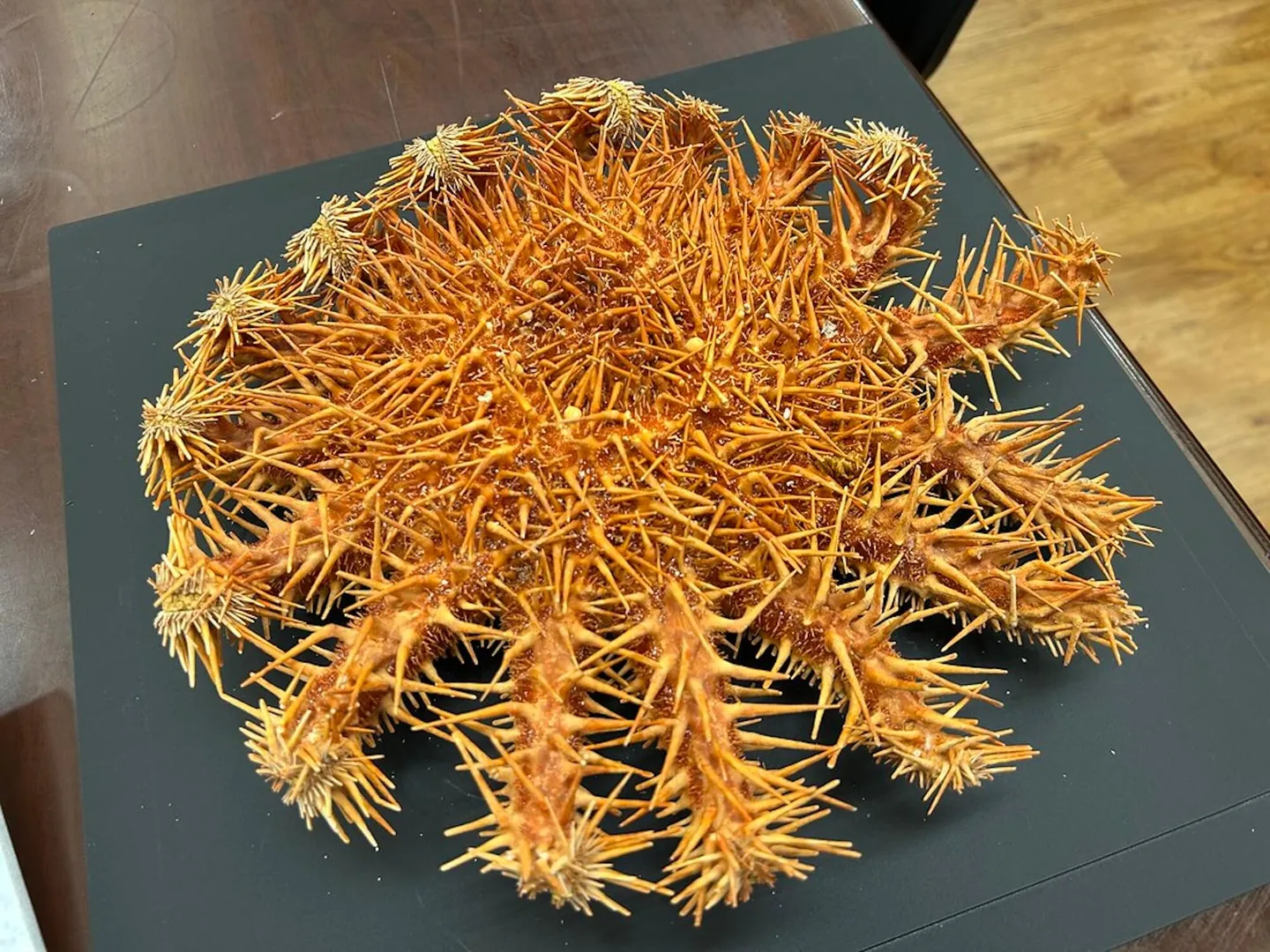
A crown-of-thorns starfish specimen. Photo: Yuan Hui-Yan
In response, the Ocean Conservation Administration (OCA) told the Environmental Information Center that it had collaborated with the National Park Service last year to remove COTS from Dongsha Atoll, sharing costs such as vessel services, and had also mobilised marine rangers, the Coral Special Diving Alliance, and OCA staff to support removal operations. Discussions with the National Park Service regarding cooperation this year are currently underway.
Beyond Dongsha, the OCA noted that in 2021 it had also responded to a COTS outbreak in the waters surrounding Itu Aba Island in the South China Sea, removing 941 individuals in collaboration with Academia Sinica. Between 2022 and 2024, the team made four visits to the island, removing 986 individuals across 82 survey zones. The OCA has urged members of the public who spot COTS around Taiwan's main island or outlying islands to report their sightings via the coral health reporting platform on the "iOcean Marine Conservation Network", so that authorities can monitor COTS incursions across different locations. If a large-scale outbreak is confirmed, further investigation and removal efforts will be initiated.
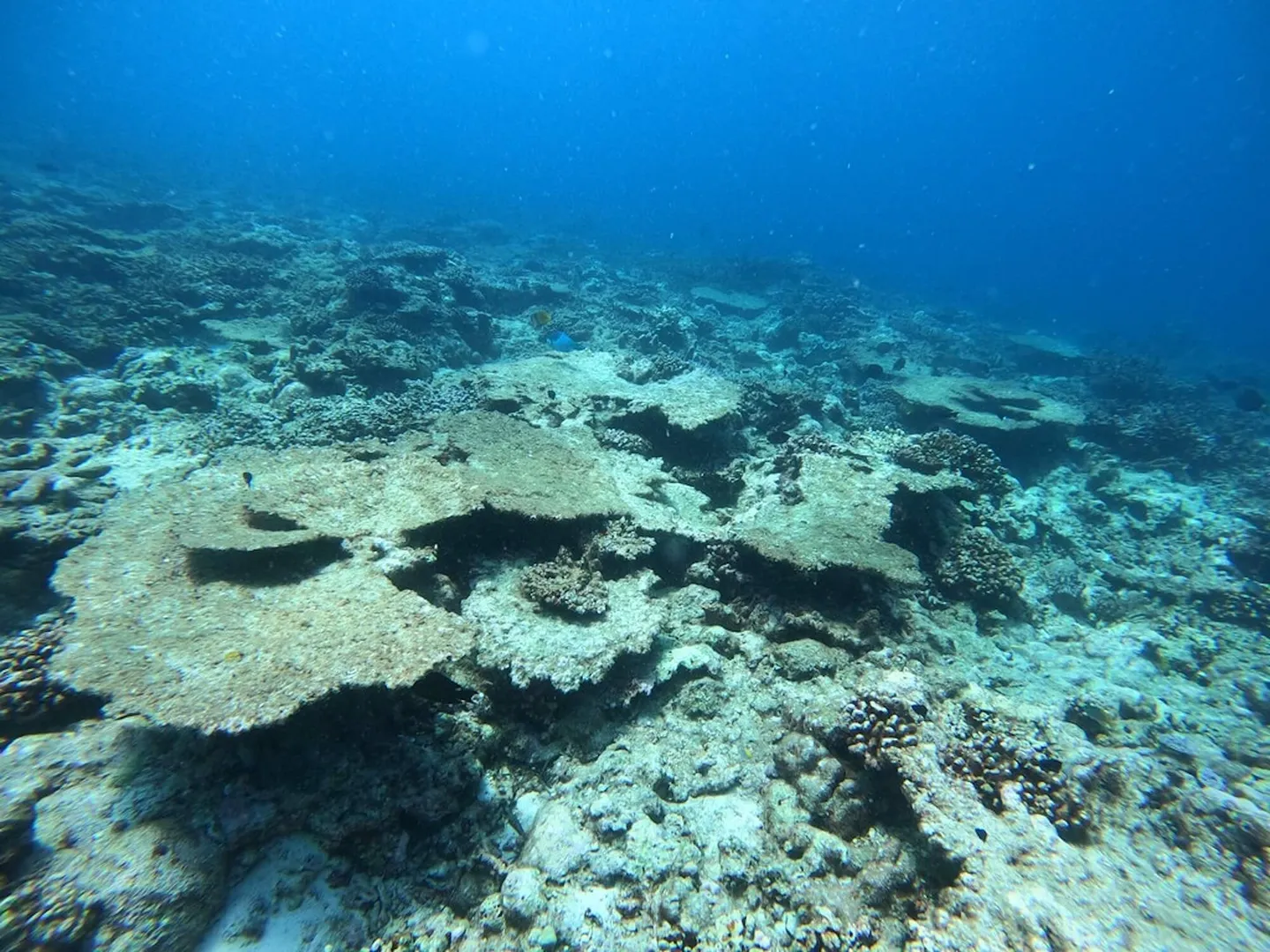
In the southwestern outer reef of Dongsha, hard coral from the shallows down to 20 m depth has been almost entirely killed, and reef fish are becoming increasingly scarce. Photo credit: Taiwan Coral Reef Society
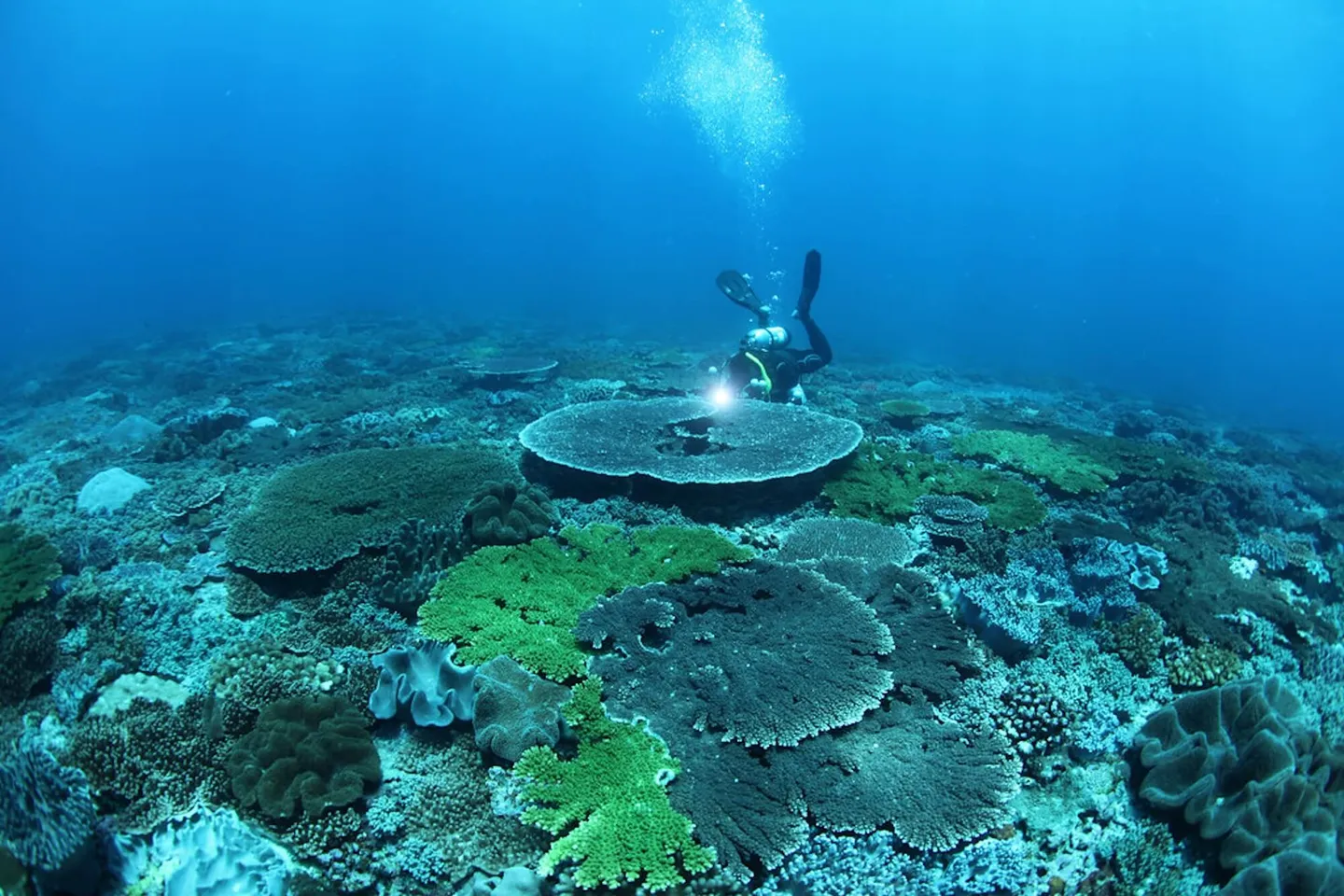
The seafloor of Dongsha's outer reef was once a vibrant and beautiful ecosystem. Photo credit: Taiwan Coral Reef Society
Further Reading
- Original article: Crown-of-Thorns Starfish "Locusts of the Sea" Sweep Through Dongsha — Experts Warn: All Hard Coral Could Be Devoured Within Two and a Half Years
- COTS Outbreak Kills 90% of Coral Reefs Around Itu Aba Island — Researcher: "I've Never Seen Such Devastation"
- A "Spiny" Visitor in Penghu Waters — The Crown-of-Thorns Starfish Packs a Dangerous Punch
- 25 Years of Academic Surveys — Cheng Ming-Shiou: Dongsha's Ecology Has Held On and Can Serve as an Ocean Germplasm Bank