The Editor says: Many people are asked by friends whether scuba diving is actually safe. The truth is, diving is a series of SOPs — as long as you follow the instructions, it is a very safe outdoor recreational activity. While we can't say foreign practices are always superior, by taking a closer look at the Lookout system that is taken so seriously in Australian diving operations, I believe we can greatly improve the safety of diving activities in Taiwan.
My last few articles have focused on dive travel and life in Australia, but this time I'd like to look at diving from a different angle.
I remember when I was taking my Open Water Diver course, watching videos of foreign divers with clear, well-enunciated narration. One segment reminded us to give an OK signal when entering or exiting the water, so the crew on board would know we were alright. Back in class I dutifully followed along, but most of my subsequent diving was in Malaysia on small boats. After a while, I started to feel like nobody was really watching anyway, and I gradually stopped making that little gesture — until I started working on a boat in Australia and discovered just how important that signal really is.
When working on the boat, one crew member is assigned as the Lookout and stands watch from the upper deck. In the beginning, during the Australian winter, I thought being the Lookout was easy work — no need to brave the cold getting in and out of the water, just keep an eye on everyone and wait for the divers to return. That meant no filling tanks, no chatting with passengers, and no responsibility for leading dives. But after the captain explained the importance of the Lookout role to us, my entire perception of the position changed completely.
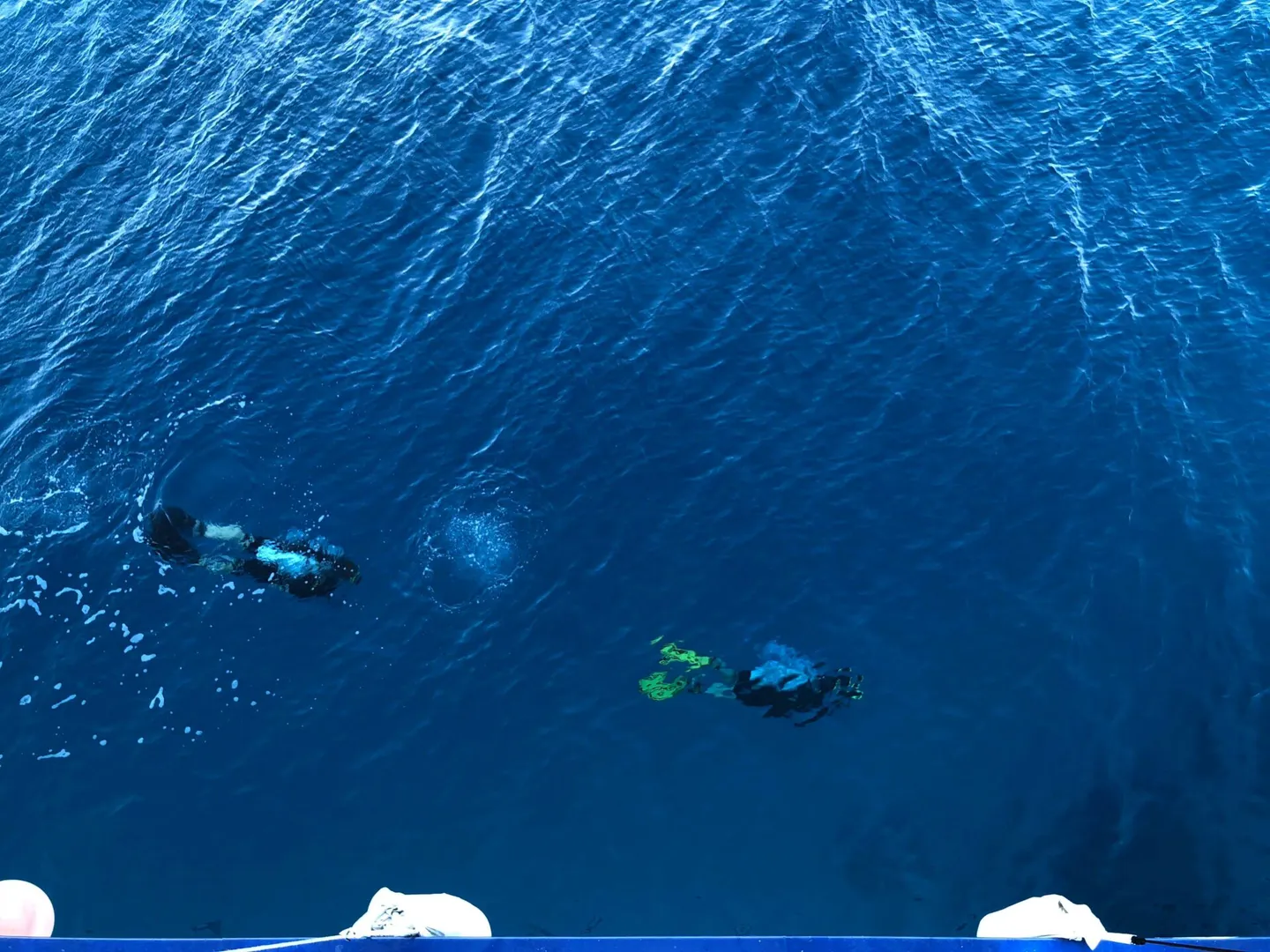
On a clear day, you can see the divers' silhouettes distinctly beneath the surface
Once while I was on watch, I struck up a conversation with a passenger who hadn't gone diving. After about two minutes, the captain spotted me and sternly told me to stop chatting, and asked the passenger not to talk to me anymore.
On this boat, the most important person is not me, nor is it any supervisor on board — it is the Lookout. The Lookout is the first line of defence for diver safety. If something happens to a diver, the Lookout is the first person to be held responsible, before even the captain.
That was what the captain told me, very seriously, and he instructed me to do a full circuit of the boat every minute or so to check on the divers. After the dive was over, the captain pulled me aside again to talk about how seriously he takes the Lookout role. "I've had a diver get into trouble right under a Lookout's nose and we didn't get them back. That leaves a huge psychological scar on the person who was on watch. So whenever a new crew member comes on board, if they can't do the Lookout job properly — no matter how talented they are — I'd rather not have them on my boat. Because if a diving accident happens, it causes tremendous harm to both the diver and the Lookout."
What Is a Lookout?
While on watch, the Lookout must wear sunglasses, a high-visibility vest, and sun-protective or warm clothing, and carry a pair of binoculars, a radio, and a whistle at all times. Every minute or so, a full lap around the boat is required — even the side farther from the reef must be watched, because divers can surface in the most unexpected places.
If a lost diver is spotted, the first step is to use the whistle to get the diver's attention and check on their condition. If the diver does not signal OK, or if after five minutes of observation they are clearly not swimming back — showing signs of exhaustion or being overcome by the current — the Lookout radios the crew at the equipment station so a crew member can take the tender to retrieve them.
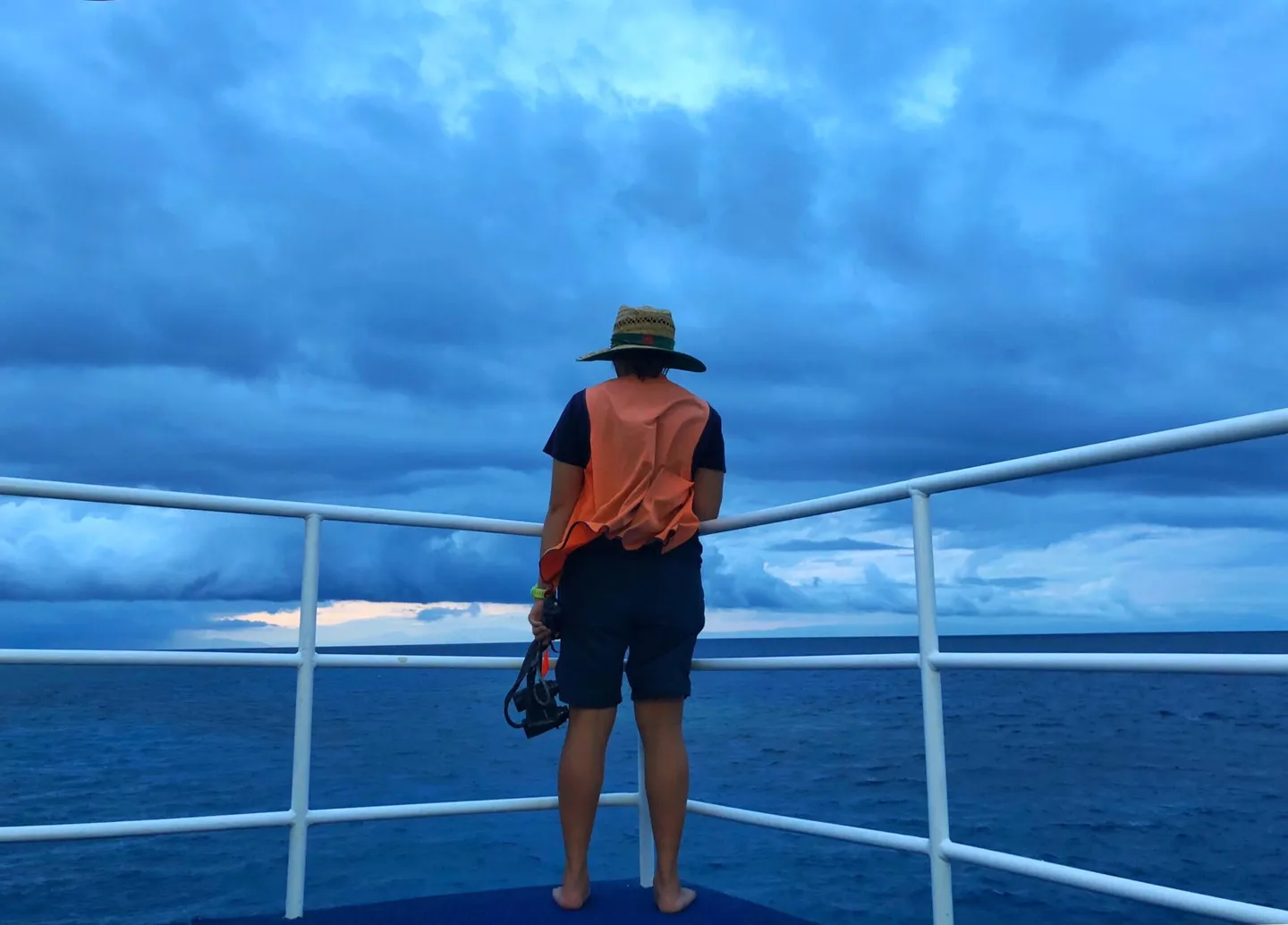
Standard gear for a professional Lookout
During my internship I took part in several drills. Among them, the separated dive buddy drill and the unconscious-diver-at-the-surface drill were most directly related to the Lookout's role.


The Lookout Internship Experience
Normally, a diver who loses their buddy will spend no more than one minute searching underwater before ascending to the surface to reunite. What many people don't know, however, is the correct procedure if their buddy isn't on the surface either. If a diver surfaces and their buddy is nowhere to be seen, they should immediately inform the Lookout. The Lookout then radios the crew, and once a supervisor issues a search-and-rescue order, all crew members begin preparing for the rescue and readying first aid equipment.
When a separated buddy situation arises, the Lookout must focus even more intensely on locating the missing diver. While volunteering with Mike Ball, I happened to be on board during one of their separated buddy drills. The captain played the role of the lost diver — he and one of the instructors went diving, and then without warning the instructor surfaced and told the crew the captain had gone missing. The supervisor immediately dispatched one crew member for an underwater search (the instructor held a solo diving certification), one crew member for a snorkeling search, and one tender operator. The rest of the crew on the boat helped the Lookout scan for the missing diver's bubbles. In the end, we found the mischievous captain not far from the boat.
One of the most memorable drills I did during my internship was the unconscious-diver-at-the-surface exercise. The captain told us a drill would be conducted that day but didn't tell us during which dive it would happen (on a liveaboard, there are typically five dives a day). I was doing my usual watch on the upper deck. About halfway through one dive, I spotted a diver lying motionless at the bow. I immediately realised this was the drill, and reached for my radio to notify the instructors at the equipment station — only to find my radio had switched itself off. I quickly restarted it and successfully continued through the unconscious-surface-diver rescue procedure. From the upper deck, I had to guide the tender operator toward the unconscious diver, report the rescue situation to the supervisors and the captain, and — because the dive session had not yet ended — simultaneously keep watch over all the other divers still in the water. After the drill, the captain reviewed it with us and pointed out that I had taken too long (over 2 minutes) to radio the equipment station about the unconscious diver. That experience really drove home just how critical the Lookout role is.
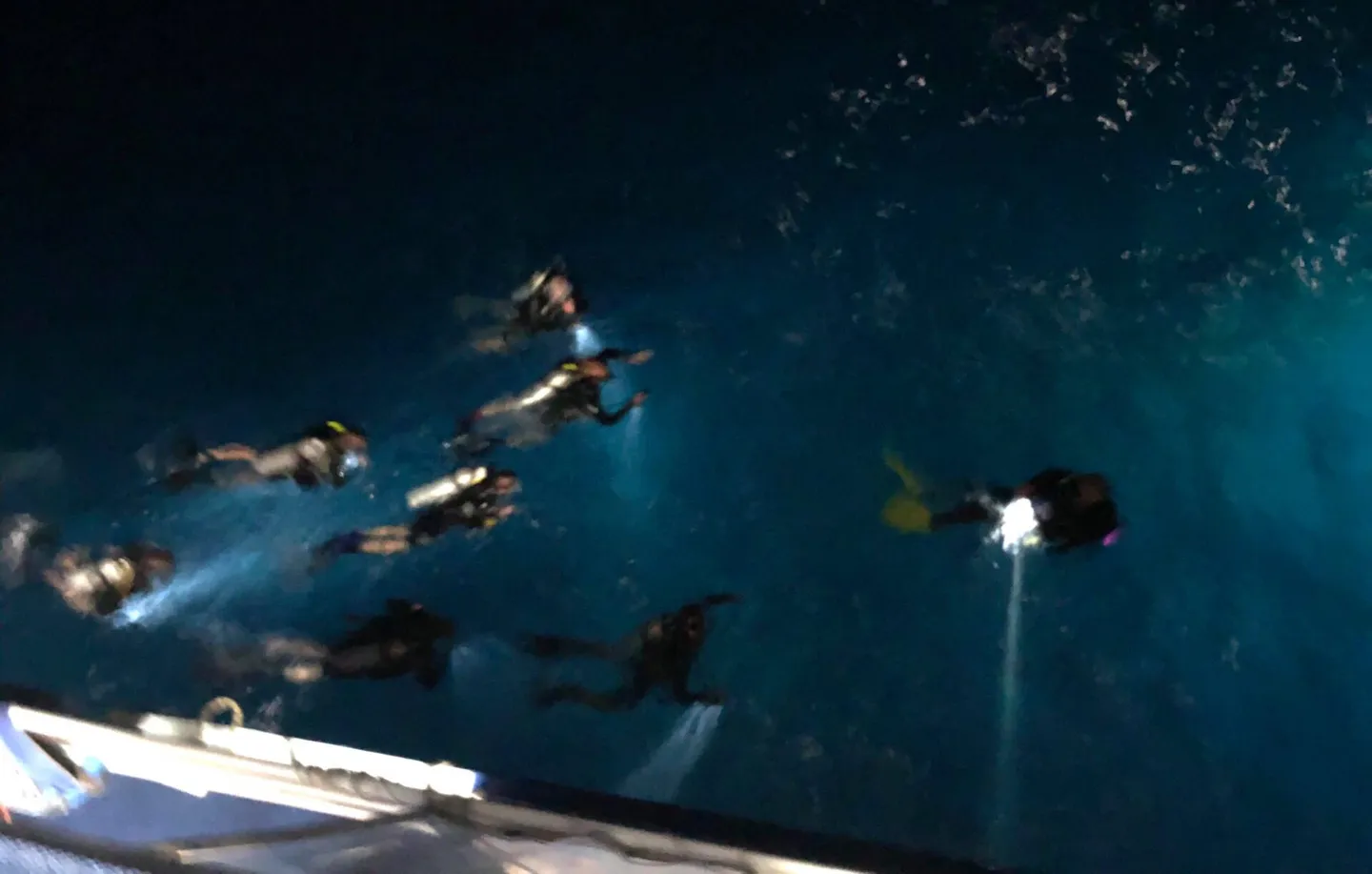
During night diving, the Lookout can track the position of every group of divers and has a clear sense of what may be happening underwater. A diver's torch beam passes through the water and creates a glow on the surface; viewed from the upper deck looking down, it looks like peering at an oil painting. If you see a torch light spinning wildly, you know "uh-oh, someone can't find their buddy." If you see a blue UV light and a regular night-dive torch converging together, you know "ah, someone didn't follow the rules and wandered into the fluorescent night dive group." If the boat happens to be anchored at an unfamiliar dive site, the occasional diver will surface lost and need to be picked up. Night watch is generally easier because you can actually see where the divers are, and everyone tends to dive more conservatively — but when something does go wrong, the tension is that much greater.
The Lookout is also usually the first to see — or feel — changing weather conditions. A few weeks ago, the weather turned nasty as a tropical cyclone swept through the area near our boat. Before conditions deteriorated completely, the divers were allowed in the water, but midway through the dive wind speeds climbed to 30 knots. I stood watch in driving rain and gale-force gusts, barely keeping my footing, but I kept dutifully circling the boat. The captain, watching from the wheelhouse, was grinning broadly at the sight of me being blown around.
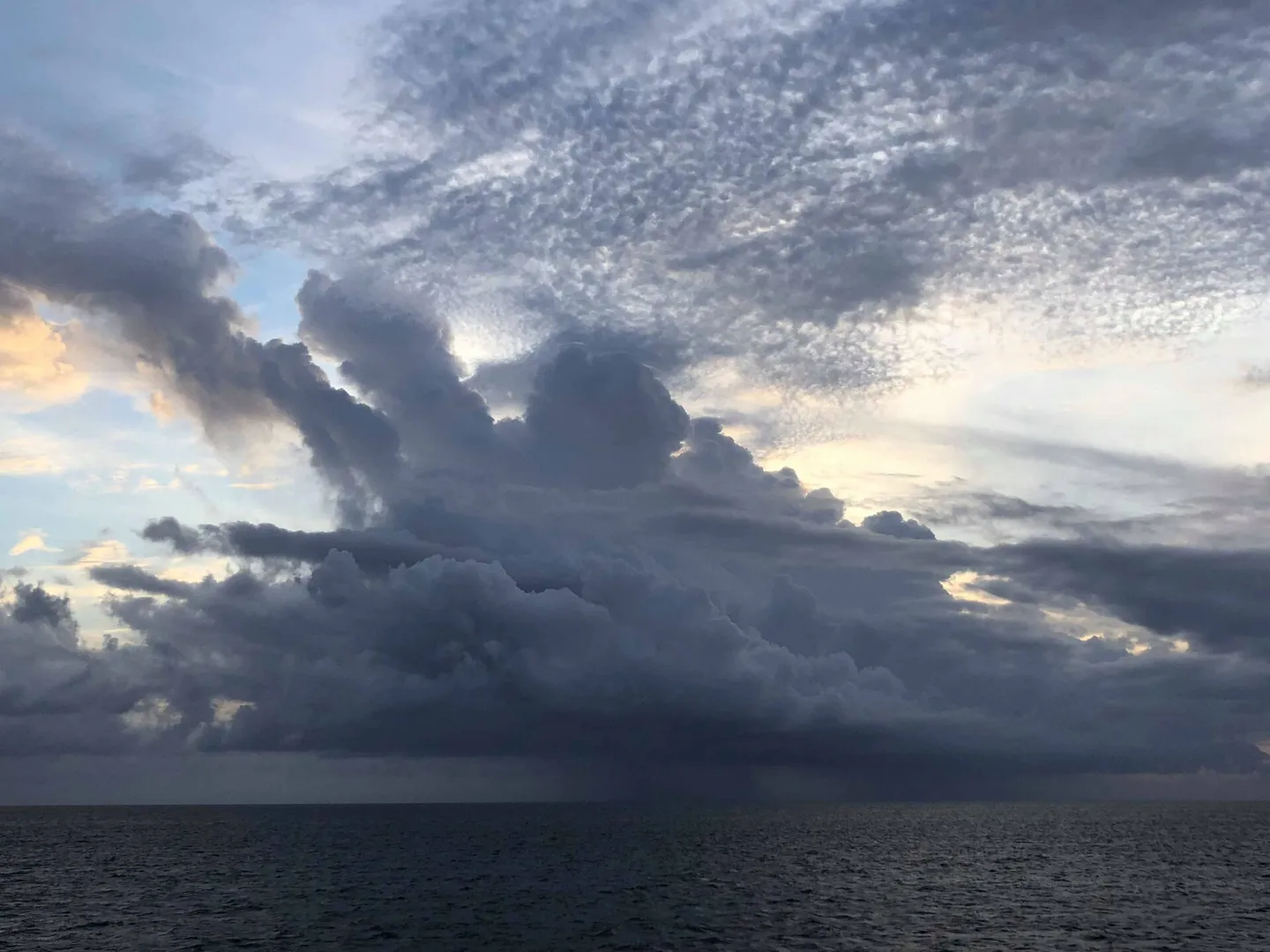
The storm bearing down on us
The Lookout's duties may seem simple, but the responsibility is enormous!
Next time you surface from a dive, remember to give a big OK to the Lookout who is watching over you.
Further reading:
Frequently Asked Questions
How is a BlueTrend dive trip different from an unknown, no-name dive group?
Choosing us means full peace-of-mind protection and a smooth experience from start to finish. Every trip we run holds to three things.
First, full legal protection and a professional dive leader: we strictly follow Taiwan's travel regulations and provide complete travel-agency liability insurance, travel insurance, trip-inconvenience insurance and dive insurance. Every group is accompanied by a certified, foreign-language dive leader who joins you on both the dives and the land itinerary, liaising seamlessly with local dive shops and operators on your behalf to keep things running smoothly — the person our travellers trust most.
Second, fully licensed with secure payments: every payment goes into a licensed travel agency's account, with multiple safe payment channels (bank transfer, credit card and more) and a legal collect-and-remit receipt, so every transaction is open, transparent and protected, avoiding the fraud and dispute risks of transferring money privately to an individual.
Third, hand-picked quality we vet in person: every trip, dive site and partner shop is scouted on the ground by our own team, from the guides' professionalism and safety standards to the food, lodging, environment and service details on land, all vetted by us so you don't get caught out.
I want to sign up for a dive trip. Are there certification-level or logged-dive requirements?
Each dive site is different, so the entry bar varies. 'Bali Tulamben', for instance, is relatively beginner-friendly. 'Malapascua in the Philippines' is also beginner-friendly, but since thresher sharks tend to cruise between 20 and 30 metres, we recommend AOW certification with 20+ logged dives to enjoy this trip comfortably. For 'the Maldives' or 'Palau', we suggest AOW with 50+ logged dives for a more relaxed experience. If you're not sure whether your experience fits the trip you want, message us and our dive editors will assess it and help you find the trip you'll feel safest on.
Can I join if I'm signing up alone? How are rooms arranged?
Plenty of our travellers sign up solo! For rooms and beds, we prioritise pairing you with a same-gender traveller, and if you'd rather have your own space you can pay the difference to upgrade to a single room. For the diving, our professional leader will pair you with a suitable buddy, and with the happy vibe on our trips you'll quickly make a great group of dive friends. Many people sign up alone, make new friends, and end up organising the next trip together!
Does the trip fee include dive insurance, gear rental, taxes and instructor tips?
It depends on the trip, the destination's regulations and the local operators. Every BlueTrend dive trip has a detailed web page with a clear 'included / not included' list, transparent and with no hidden charges. All payments are collected by a licensed travel agency, with a standard-form contract for your protection.
I'm a new diver / haven't dived in a long time — will I fall behind the group?
Before you complete your booking, our team assesses a suitable trip based on your certification level and experience. Before departure, we strongly recommend taking time to refresh in Taiwan with an instructor, or a fun dive to get your feel back. On the trip itself, our professional dive leader groups and pairs everyone by experience, keeps a close eye underwater on travellers who need extra care, and steps in to help right away.
Will the photos and videos taken during the trip be shared with us?
During the dives, 'safety' is always the leader's top priority, so whenever it's suitable and safe the leader will capture great shots and record the best moments. During or after the trip, we compile a cloud album for all travellers to download, so you go home loaded with memories!
Besides your scheduled trips, can you arrange a private group charter or independent travel for me and my friends?
Absolutely! Besides group trips, we also arrange private group charters and independent travel. We can communicate, enquire and coordinate services with local operators based on your needs, saving you time and effort and taking the language barrier off your plate, to tailor the smoothest, most reassuring dive trip just for you. Contact our LINE support and our editors will arrange it for you!