Contents(3)
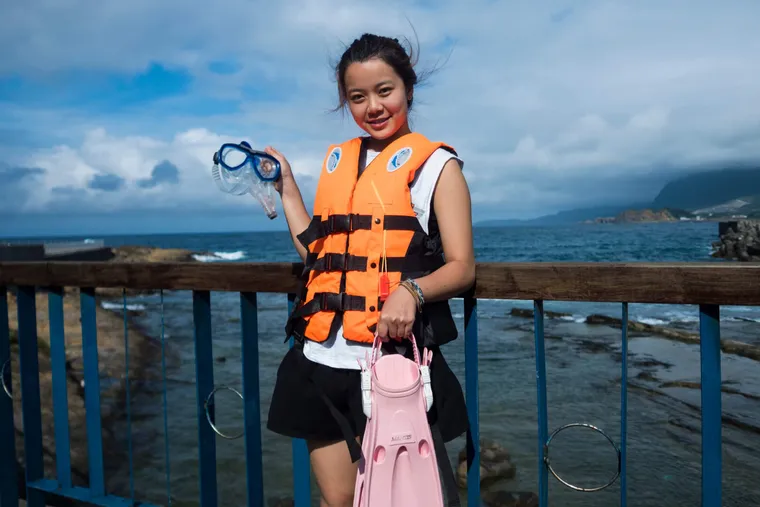
The Editor says: Did you know that Albee, our so-called "diving sweetheart," is actually terrified of the water? Without fins and unable to bring herself to jump into water she can't touch the bottom of, she's finally taking her first step toward becoming a sea creature this year — with an AIDA 1 freediving experience. If you've been curious about freediving but feel a little nervous about it, this article is sure to give you a huge boost of confidence. We can't wait to meet sea-cow Albee underwater!
If you've been following my blog carefully, you probably know that I finally earned my Advanced Open Water Diver (PADI cert) certification in September of this year.
With nearly a hundred dives under my belt, my scuba diving technique and stability have reached a decent level.
After getting my Advanced Open Water Diver (PADI cert) certification, I started wondering — what's the next chapter of my ocean-girl journey going to look like?
Then November arrived, and as autumn turned to winter, I still found myself missing the sea. The Northeast Coast winds swept in, and in the north it was already far too cold to dive. (Though there are plenty of hardcore divers who brave the chill and jump into 20°C water without a second thought — I have nothing but admiration for them~)
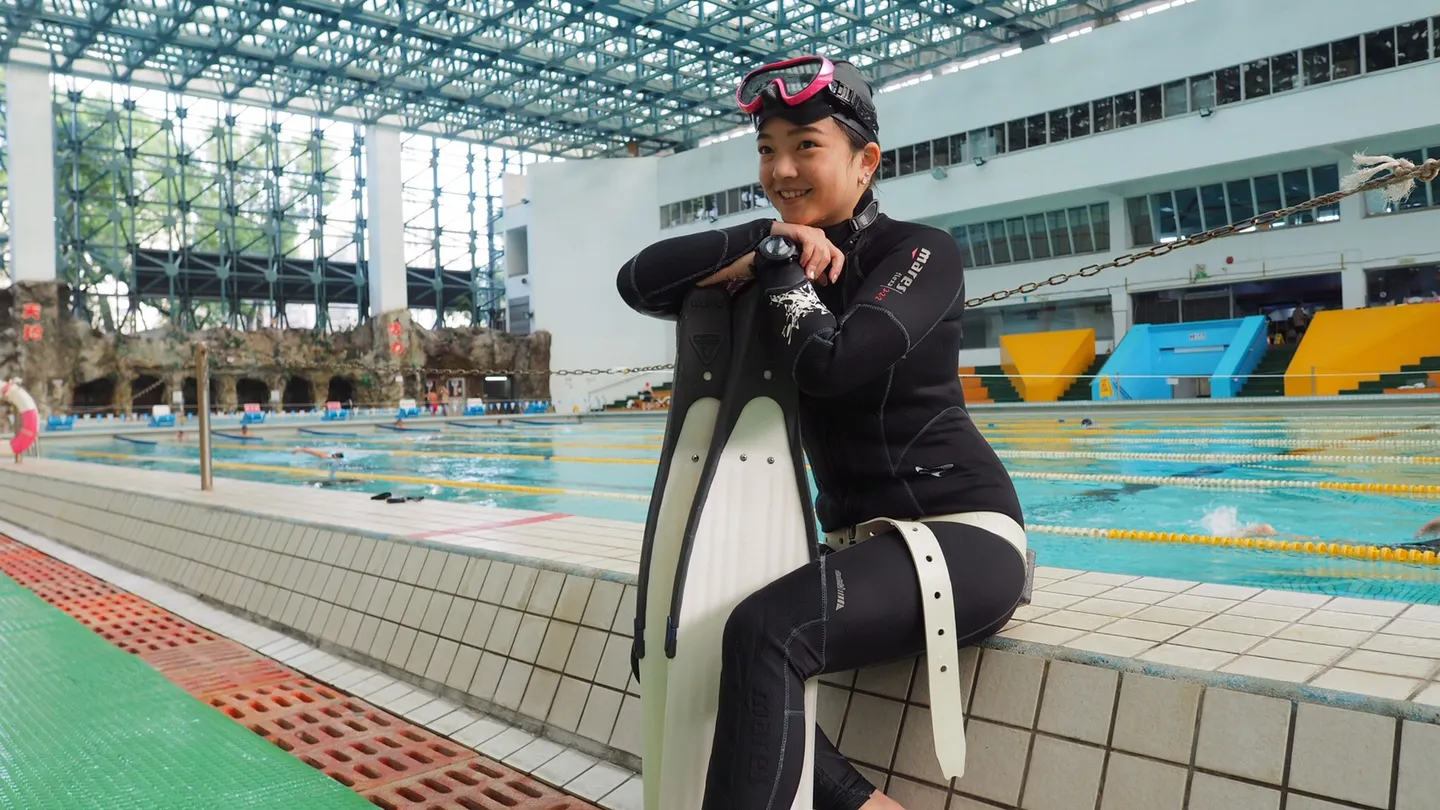
The Journey to Getting My AIDA1 Certification
I'll be honest — freediving was always something I was a bit resistant to.
I used to think: if there's an easy way to breathe underwater and explore the ocean, isn't scuba diving already simple enough?
Why put yourself through the torture of holding your breath just for the challenge of going down 10 or 20 meters?
A lot of people get drawn to freediving — and I'm pretty sure it's because of all those gorgeous photos circulating online.
Freedivers glide through the water effortlessly, as if they were born without the need to breathe,
every movement flowing with a gentle, graceful rhythm — wearing a tiny bikini, or showing off those golden six-pack abs,
their skin melting into the sea, as if they truly belong to the ocean, embraced and absorbed by it…
Willingly holding your breath for ages — all for one perfect shot
As a semi-influencer myself, I've always envied those stunning photos that require such incredible skill.
Yes. I just want to take gorgeous photos! (The most shallow of motivations, I know.)
P.S.: Compared to other freediving enthusiasts who start from a place of wanting to understand their own bodies, my motivation is admittedly shallow — but at least I'm honest about it.
So tell me — why do YOU want to learn freediving? XDD
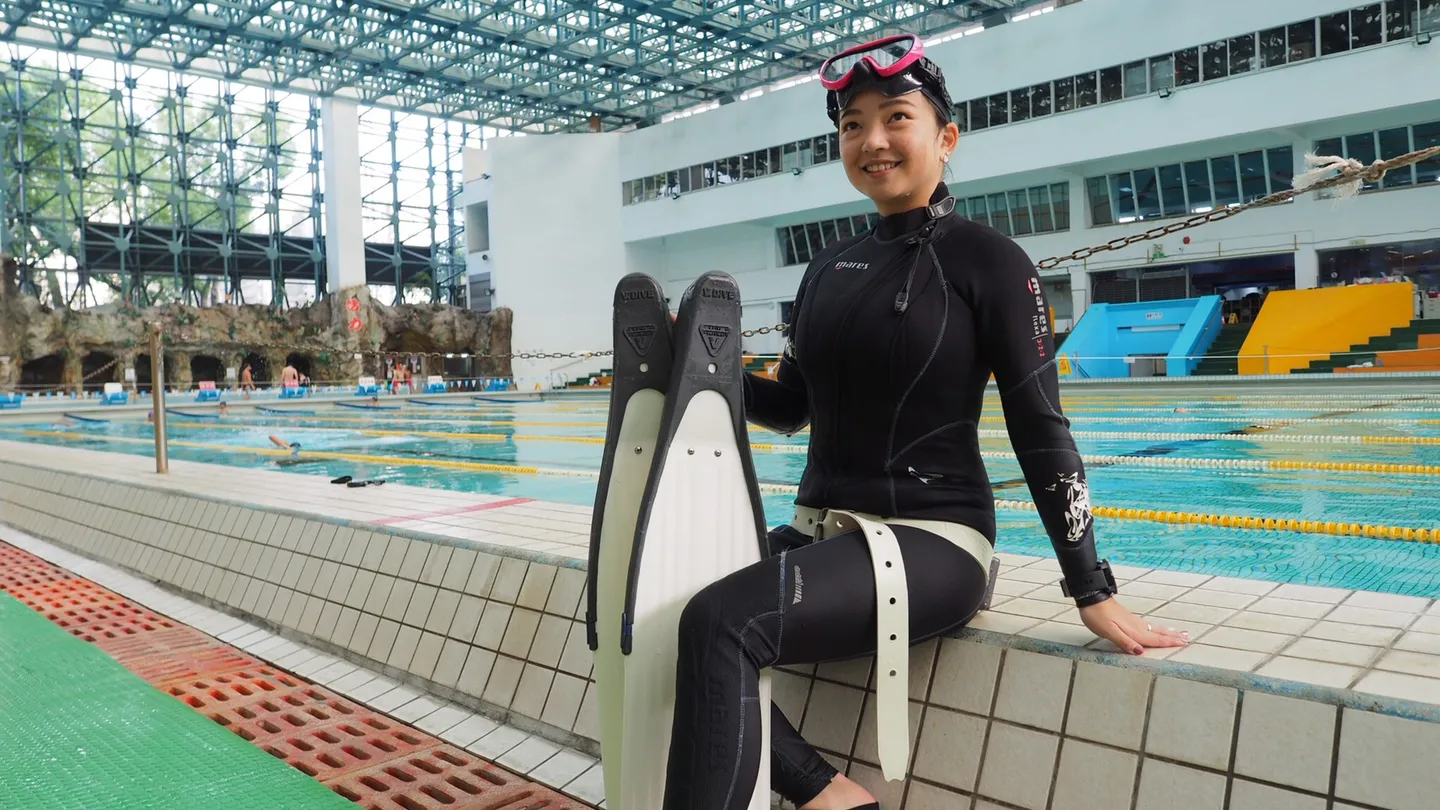
Let me first introduce freediving! (Actually, I'm pulling this directly from the AIDA (freediving agency) manual.)
We should first understand what scuba diving and freediving actually are —
so you don't end up thinking I'm still talking about scuba diving by the end of this.


Freediving 101
Scuba diving = using a breathing apparatus to supply the body with normal air
Scuba diving refers to diving where the diver carries their own underwater breathing system.
This includes both open-circuit and closed-circuit systems,
both of which use a regulator to convert compressed air from a scuba tank / cylinder into breathable pressure for the human body.
Freediving = holding your breath underwater
In some countries, such as Spain, France, Italy, and others,
freediving is also called "apnea."
It comes from the Greek word "apnoia," which literally translates to "without breathing."
If you'd like to learn more, check out this article: Your First Steps Toward the Ocean: Snorkeling, Scuba Diving, and Freediving Explained.
Q: Who can learn freediving?
A: Anyone can learn freediving! Holding your breath doesn't require superhuman ability — it's not a privilege reserved for a select few.
To freedive, you need to learn a set of skills such as relaxing your body and mind, making the most of your fins, and how to equalize your ears. The AIDA (freediving agency) freediving education system progressively teaches all freediving skills from beginner to professional levels.
Q: Are there any prerequisites for signing up?
A: You must be able to swim at least 100 meters continuously without a snorkel or fins in order to qualify.
(This is very important and a reasonably low bar — everyone needs to meet this requirement to learn freediving safely and comfortably.)
Q: What is AIDA (freediving agency)? Is it an acronym for freediving?
A: No, it is not an acronym for freediving!!!
Freediving is referred to as: 自潛, Free Diving, or Apnea.
AIDA (freediving agency) is an international freediving promotion organization.
AIDA (freediving agency) was founded in 1992, and its name comes from the French "Association Internationale pour le Développement de l'Apnée," meaning the International Association for the Development of Apnea. Originally established in France, AIDA (freediving agency) is now headquartered in Zurich, Switzerland. AIDA (freediving agency) is committed to going paperless within legal limits.
As such, the organization uses the website www.aidainternational.org as its primary communication platform. (So any training records and certification information can be looked up there.) So eco-friendly!!
Alright — if all of that sounds a bit overwhelming, let's get into the good stuff: my personal AIDA1 learning experience!
The instructor who guided us through this experience was Coach Gang from Liquid Vision 自由潛水合作社.
Their Facebook page actually covers the AIDA1 course outline in pretty good detail, but I'll share it here anyway for your reference~
AIDA1 Course Overview:
<Requirements>
• Minimum age: 18 years old
• Ability to swim 100 meters (any stroke, without stopping)
<Course Summary>
If you've never snorkeled before, or have never done any water activities in open water,
this course will introduce you to the fundamentals of freediving
and allow you to experience and understand basic freediving knowledge and skills in a safe environment.
<Course Content>
Theory Session
• Introduction to the AIDA1 course
• Freediving breathing techniques
• Introduction to equalization
• Basic freediving safety knowledge
• Freediving disciplines
• Freediving equipment
• Freediving planning / breathing session
• Static apnea (STA) (AIDA discipline) practice experience
• Introduction to the dive buddy system
• Experiencing various relaxation and breathing techniques
Confined Water Session (maximum depth of 10 meters)
• Introduction and demonstration of equipment use
• Introduction and demonstration of relaxation and breathing techniques
• Introduction and demonstration of snorkel use
• Introduction and demonstration of descent techniques and dive management
Course duration: One day (9:00–16:00)
The class was held at Qingnian Park~
They have a small studio where we completed the morning theory session, and in the afternoon we headed to the pool next door for practical training~
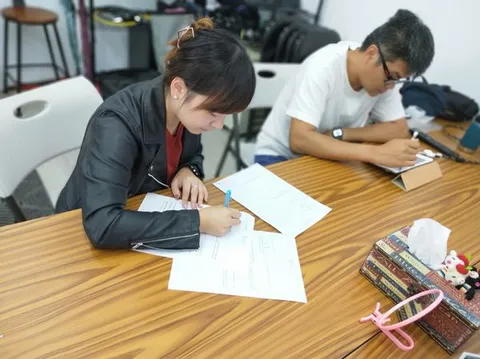
Before class, we filled out basic information and a health questionnaire to ensure a safer learning experience.
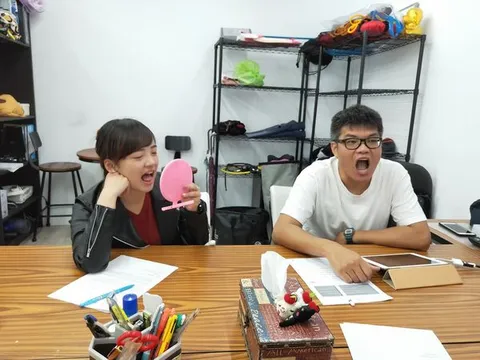
Learning equalization techniques — grab a small mirror and practice moving your tongue!
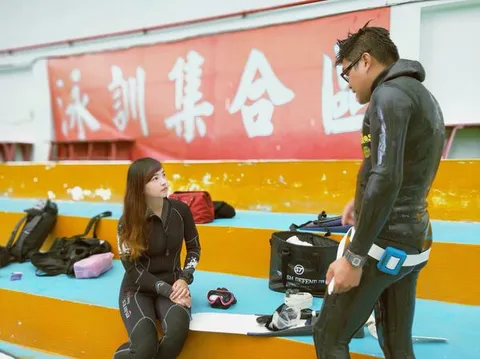
Afternoon pool training session~ No, I wasn't being scolded! I was just being very, very serious… XD
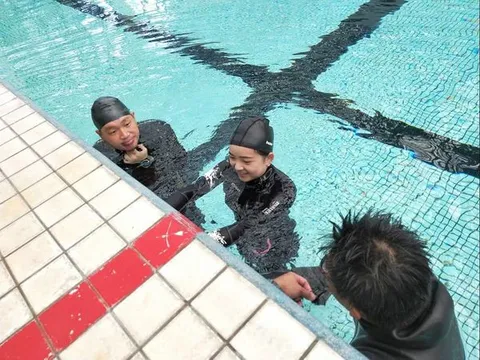
Pool training techniques
Before holding your breath, the relaxation phase is absolutely essential!!
Your mental state, muscles, and thoughts all affect how long you can hold your breath. The more relaxed your body and mind are, the calmer your breathing becomes. During the relaxation phase, diaphragmatic (belly) breathing is used throughout.
Each breath-hold consists of 4 stages: 1. Relaxation phase 2. Full inhalation 3. Breath-hold 4. Recovery breathing
During the breath-hold, the first attempt usually lasts about one minute.
On the second attempt, the instructor will encourage you to focus a little more, relax a little deeper, and push just a bit further — and you'll typically gain an extra 15–20 seconds.
Through repeated focused practice and learning to relax, you really can extend your breath-hold time~
Doing it for the first time made me realize just how chaotic my mind really is — it was incredibly hard to calm down >< (A woman with six restless senses)
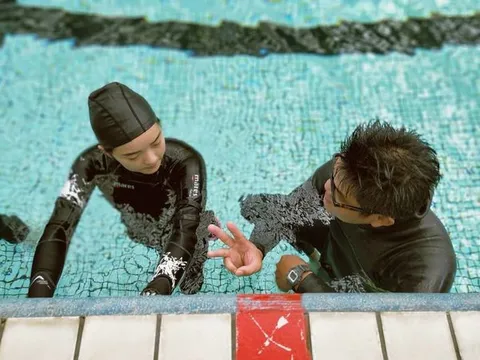
The instructor's patient and heartfelt teaching
The instructor emphasized again and again~
The dive buddy system is absolutely crucial in freediving~
Your dive buddy's role is to assist you in any situation and ensure freediving is carried out within safe limits.
Both of you need to develop great chemistry — you need to know what your buddy is going to do next in order to be prepared accordingly.
For this, effective and consistent communication must be established within the buddy team. (So choose your dive buddy wisely.)
Another key point: just as important as learning to breathe effectively and hold your breath is the recovery breathing process!!!
Recovery breathing must be fast and deep — take large gulps of air, as if you're taking a huge inhale while saying "hope."
Repeat this sequence of rapid deep inhalations and passive exhalations at least three times~
(The instructor will keep a close eye on you to make sure you're doing it properly!!)
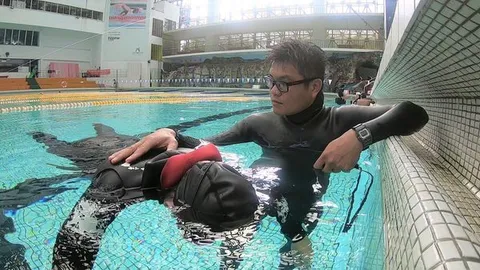
Practicing breath-holding — do not disturb~
Instructor tip: The dive buddy can place a hand on the freediver's back to help maintain balance and check their physical condition, and gently remind them to relax their shoulders, neck, and arms.
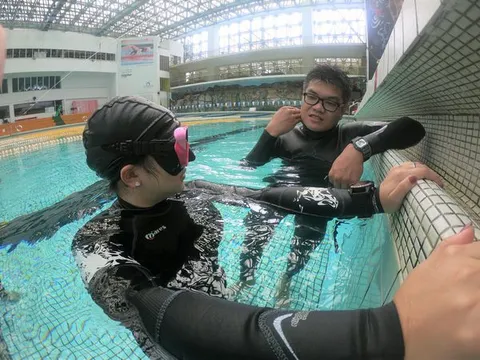
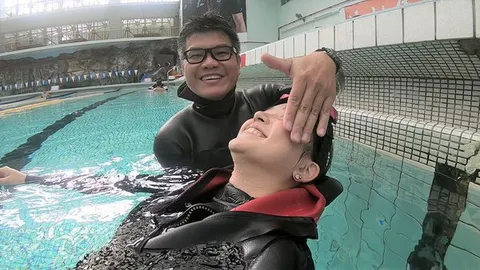
Emergency response training with my dive buddy — featuring some truly terrible acting. I couldn't help but laugh.
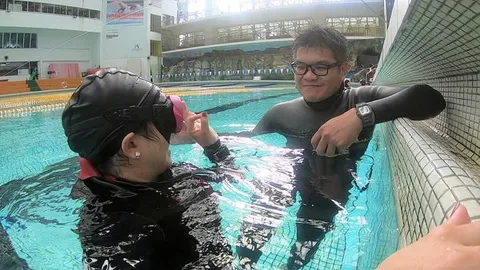
After recovery breathing, remember to give your dive buddy an OK signal!
After practicing the four stages of breath-holding, it was time to actually get in the water! Now we combined the breathing techniques we'd just learned with the actual descent movement.
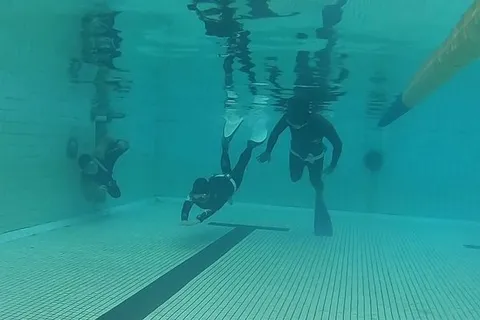
Kicking in long fins (freediving) felt so unnatural at first~~
But you can really feel the incredible propulsion — one kick and you shoot forward like a rocket XD
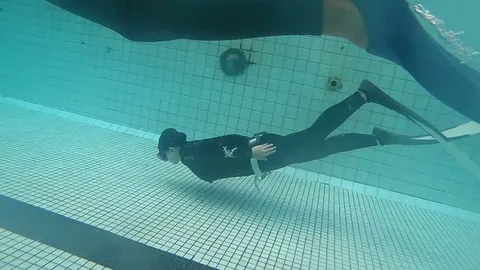
I kept instinctively sticking my butt up high~~~~ >////<
Mastering a clean duck dive and naturally flowing leg movement is genuinely difficult~~!!!!
And just like that, the class was over~~
I learned so many foundational freediving skills — none of which can be fully mastered in a single day~
Even after completing the AIDA1 course, you still need to get in the water regularly to practice, so that everything sticks and comes together naturally!
Throughout the entire learning process, the instructor was incredibly thoughtful about reminding me not to rush (yes, I am a very impatient person by nature).
Take a moment to check in with yourself before descending — no one is going to push you or pressure you~
The most important thing is learning to be with your own body in a comfortable and calm state!
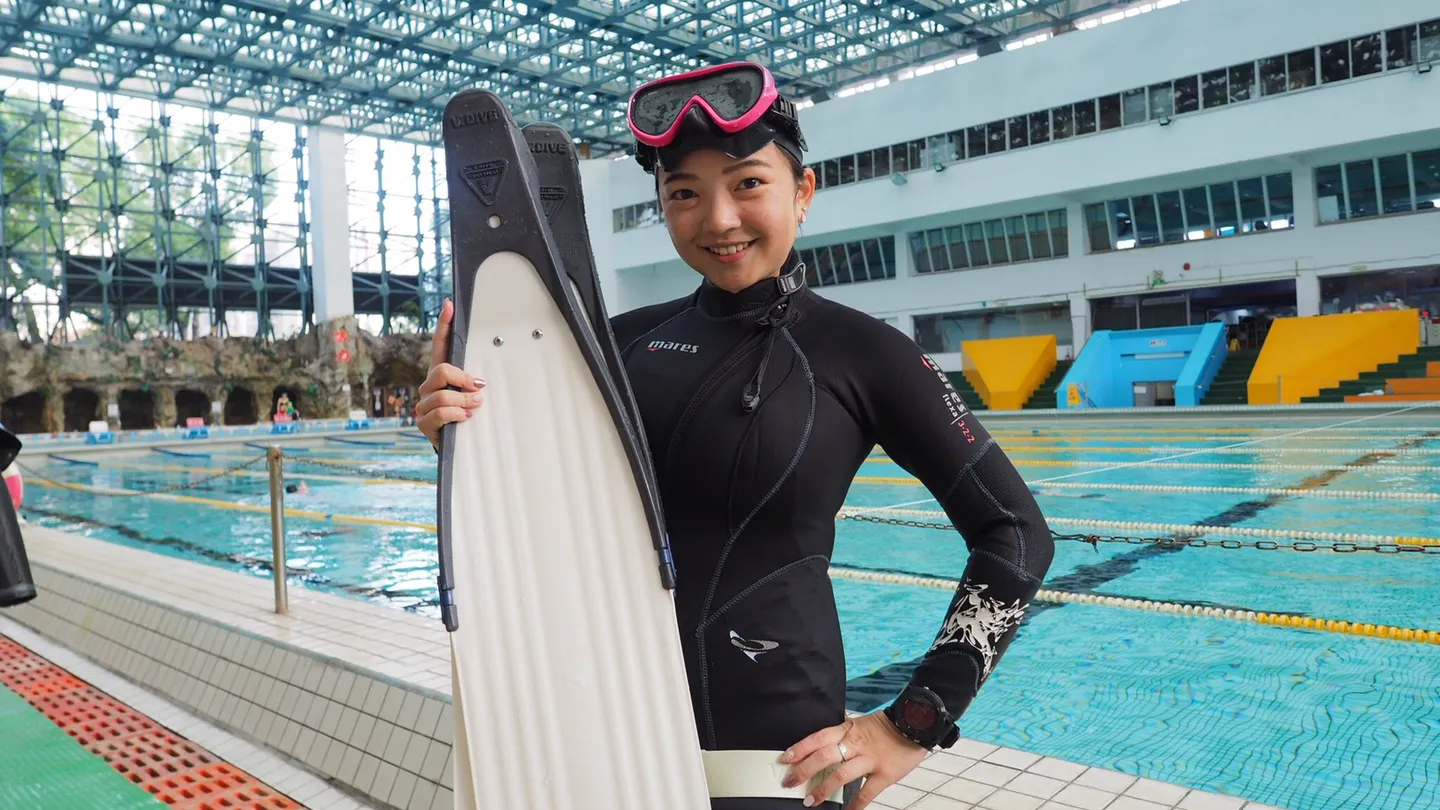
AIDA1 freediving course~~~ Successfully completed!!!
Stay tuned for sea-cow Albee's next freediving training adventure! Now that you've heard my very amateur take on the freediving experience, let's hear from the pro himself — Coach Gang shares his perspective on freediving:
Related links:

![[Desserts & Freediving] Your Burning Questions About Freediving – PinckyMommy](/_astro/IMG_0515_Z1VNCJ2.webp)