![Diving Abroad But Can't Speak Diving English? The Essential Diving English Guide Part 1 — [Nouns]](/_images/0f0361271621-1440w.webp)
Contents(5)
Actually, I've had the idea of writing a diving English article for a very long time — but I kept putting it off, and then I discovered that 水下三十米 had already launched their own diving English mini-series (I cried), which gave me even less reason to write one. Recently, though, quite a few friends have told me they feel their English isn't good enough and are wondering whether to go abroad to learn diving. Alternatively, dive instructors and Divemasters here in Taiwan who want to host foreign guests aren't sure how to give briefings. Then I happened to flip through my old notes from Australia — and just like that, t h i s a r t i c l e w a s b o r n.
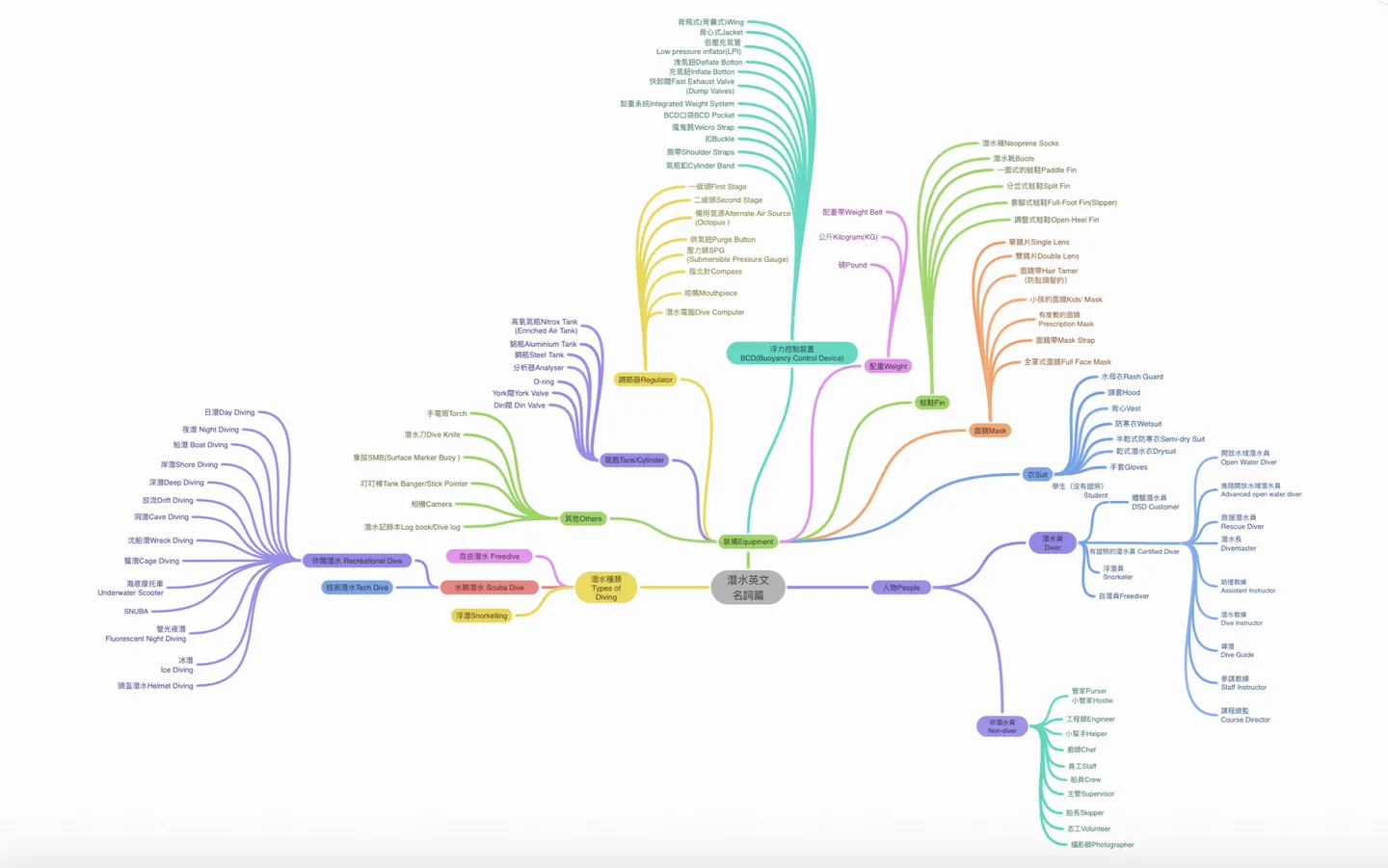
When I was learning myself, I was constantly confused and couldn't find any accurate, practical diving English resources. I hope this article comes close to what you'd consider genuinely useful. To avoid writing something that's just a bare list of English words, I'll add extra context and throw in some side-story tangents. That said, if you're only here to study English, I've also made a mind map — just scroll straight to the mind map to save time (the full nouns map is at the bottom)!
The article will focus mainly on recreational scuba diving (because freediving and technical diving are genuinely not my area of expertise — I'm afraid of saying something wrong, but if any instructor is willing to help me fill in the mind map, please reach out!). Part One covers practical English for everyday divers, simulating situations you might actually encounter so you can dive abroad without talking past your dive guide or struggle to flag up problems in the moment. Part Two is written for Divemasters and above, so you can properly host foreign guests in the future!
Part One: Diving English for All Divers
Nouns
People
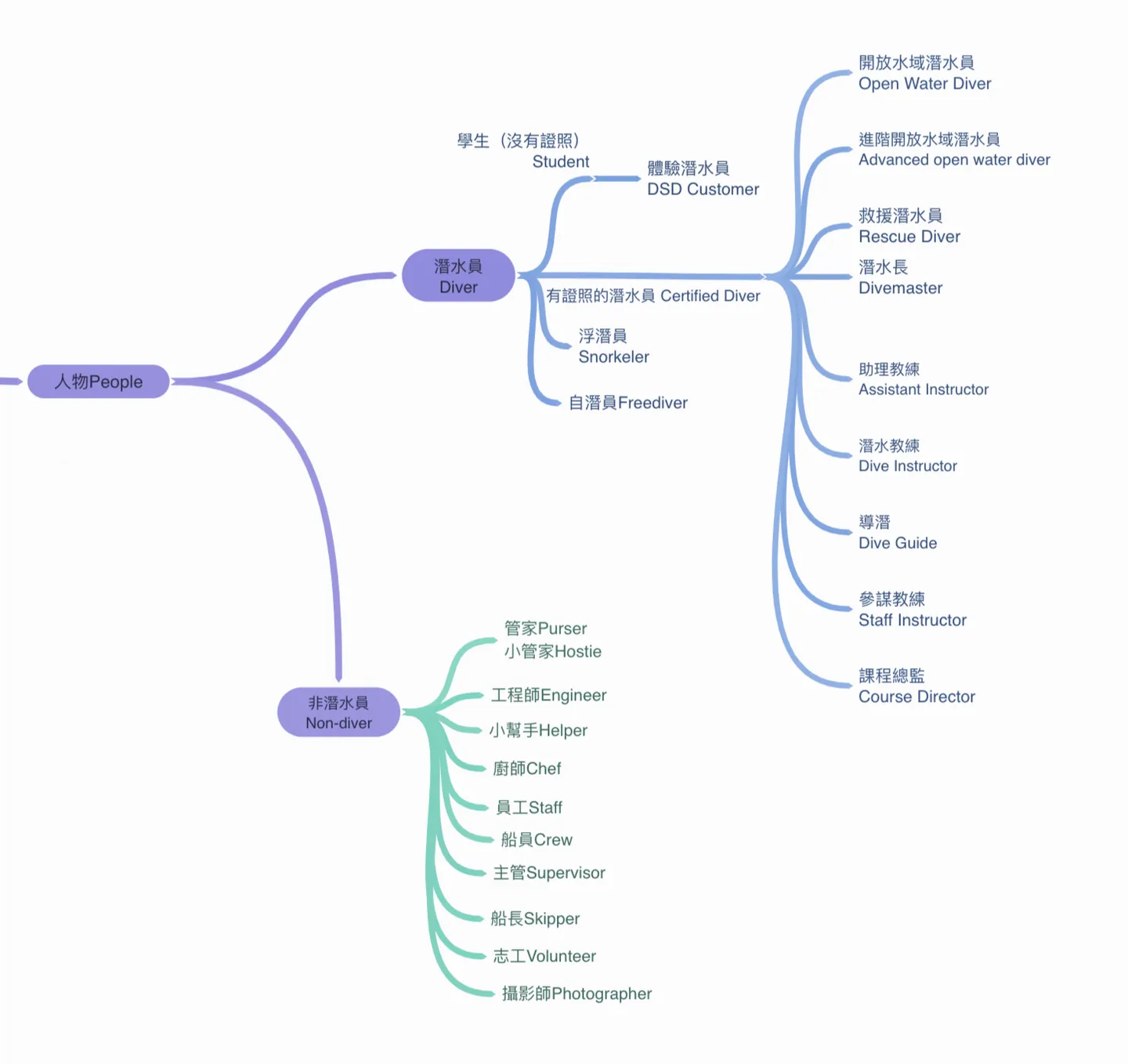
Diver
I've divided divers into a few categories: 1. Student or DSD Customer (Discover Scuba Diver):
Students typically refers to people who are working toward their certification — since they haven't passed yet, they're usually called Students. Personally, I don't like calling Discover Scuba Diving participants "divers," because these individuals haven't received diver training, so I think DSD Customer is a more accurate description.
If you're heading to another country just to "try diving," remember: if someone asks you 'Are you a diver?' — please be brave and say 'No!'
🐟 Side story: My buddy told me that once when I called in sick, there was no Mandarin-speaking instructor on the boat — and of course, a group of Chinese-speaking tourists showed up that day. When dive time came around, my friend picked up the log sheet and prepared to record everyone going in the water, then asked the group 'Are you a diver?' Seeing that they were already geared up, the group nodded and started hopping toward the water's edge ready to jump in. Luckily my buddy was sharp enough to pull them aside. As it turned out, these were Discover Scuba Diving customers who had simply watched the other divers gear up and joined the queue — copying them step for step. I hope nobody else ends up in a mix-up quite this dangerous.
- Certified Diver (using PADI as the reference):
This essentially describes divers at every stage: Open Water Diver (OWD), Advanced Open Water Diver (AOWD), Rescue Diver, Divemaster, Dive Instructor, and Dive Guide.
A dive guide is typically someone of Divemaster level or above who leads guests underwater. Also worth noting: if you come across a Master Scuba Diver (PADI rating), that means the person has completed at least five specialty courses — but it does not mean they are a professional, guest-leading Divemaster. In practice, the highest training level for a Master Scuba Diver is still only Rescue Diver. So when you finish your Rescue Diver course abroad, a dive shop may pitch you either the Master Scuba Diver rating or the Divemaster course — make sure you understand the difference!
One more thing: in some Asian countries, Open Water is often shortened to OW — which locally gets pronounced something like "Oh-dah-boo" or "Oh-wa." If your instructor or dive guide overseas is a foreigner, they might not understand these abbreviations, but simply saying "Open Water Diver" will do the trick. This situation is becoming less and less common as the Chinese-speaking market keeps growing — but you may still run into it occasionally. Beyond that, Staff Instructor and Course Director are roles that most everyday divers won't encounter; but if you do, they're essentially your instructor's instructor — people qualified to assist with or teach instructor-level courses. Think of them as the grandmaster level.
Speaking of the hard-working instructors and Divemasters — especially dive guides — who look after everyone's safety while hunting down cool critters: when you're diving in a country where tipping (tips) is customary, please don't be shy about leaving a tip. It really means a lot to them.
🐟 Side story: After one trip ended, a guest handed me a US$50 tip. I was genuinely moved — my stumbling, uncertain life as a Divemaster suddenly felt like it had received an enormous vote of confidence. Money isn't everything, but for a dive guide, it's also a form of recognition.
For more detailed information on what each certification level involves, visit the major agencies directly — for example PADI, SDI/TDI, SSI, or CMAS.
- Snorkeler — usually refers to tourists who go snorkeling:
Freediver — that's all of you talented breath-hold diving folks!


Non-Diver
Why list non-divers too? Because when you're visiting somewhere new, you'll meet crew members with various titles beyond just "diver," so it's worth covering them all.
Purser and Hostie: These were both words I only learned in Australia — I hadn't come across these specific roles while diving elsewhere. The Purser generally handles accounting and accommodation-related matters, while the Hostie is more like a general helper. In Australia, some of these Hosties are Volunteers, and positions offering work-for-certification arrangements or unpaid internship experience are also often called Volunteer roles — so if you're searching for that kind of opportunity, try adjusting your search keywords.
Then there's the Chef — if you have any special food requirements, such as food allergies, being Vegan, Ovo-Lacto Vegetarian, Lactose intolerant, or following a Keto diet, you can let the chef know in advance and ask whether the menu can be adjusted. This of course assumes the liveaboard or resort you're visiting offers that kind of flexibility.
Other roles you might encounter on a dive trip include Staff, Crew, Supervisor, Photographer, Engineer, and Skipper (captain).
🐟 Side story: Some people might wonder why the captain isn't called a "Captain." I asked my colleagues the same thing, and they told me that the skipper of a smaller vessel is usually called a Skipper, while "Captain" tends to be reserved for warships, cruise liners, and similar large vessels. The boat I worked on felt quite large to me at the time (it had three decks), so I never quite worked out where the line is drawn — but either word will generally be understood.
[caption id="attachment_6144" align="aligncenter" width="1400"]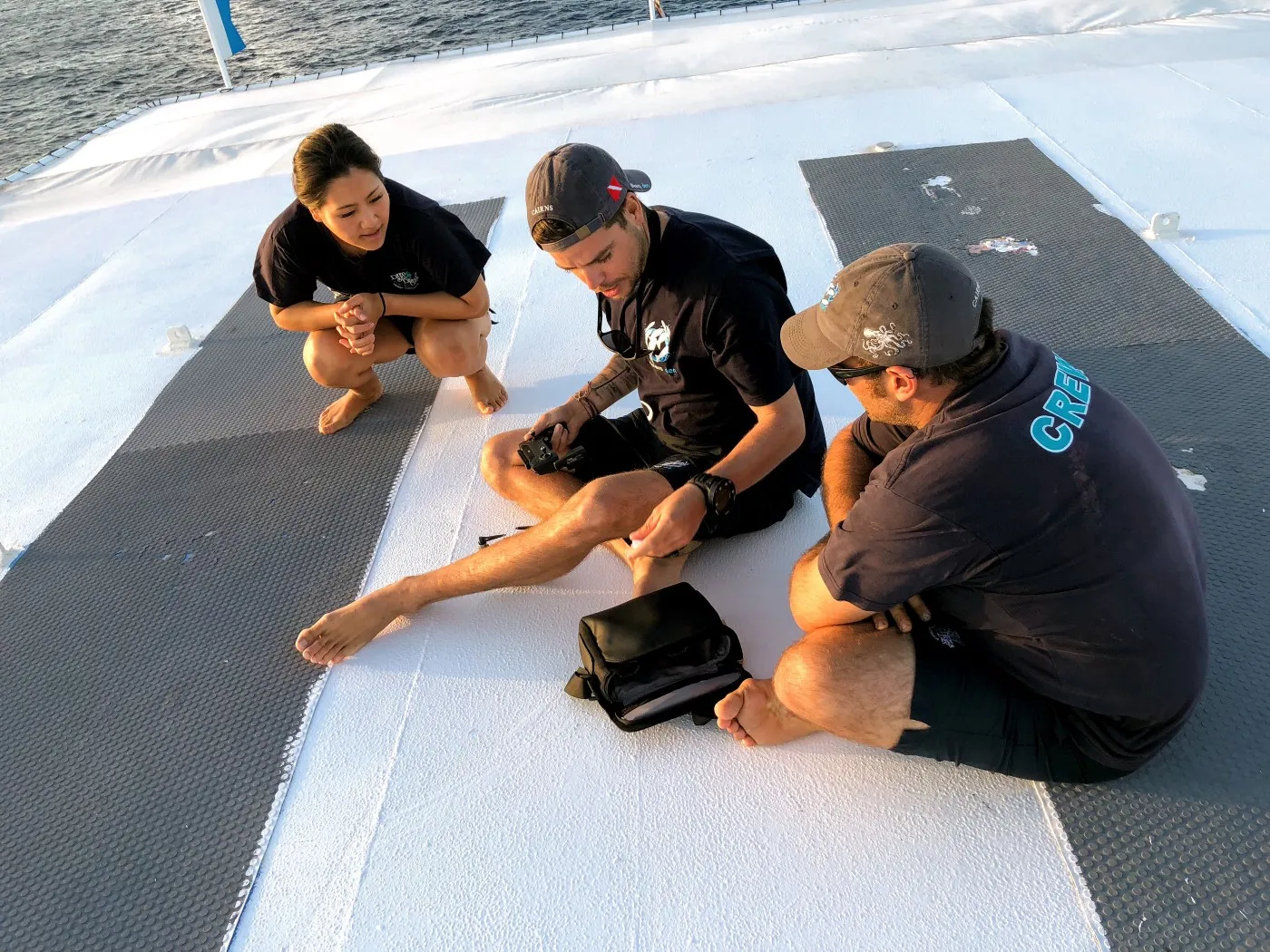 The person on the far right is our Skipper — that day we all went up to the top deck together to play with a drone[/caption]
Types of Diving
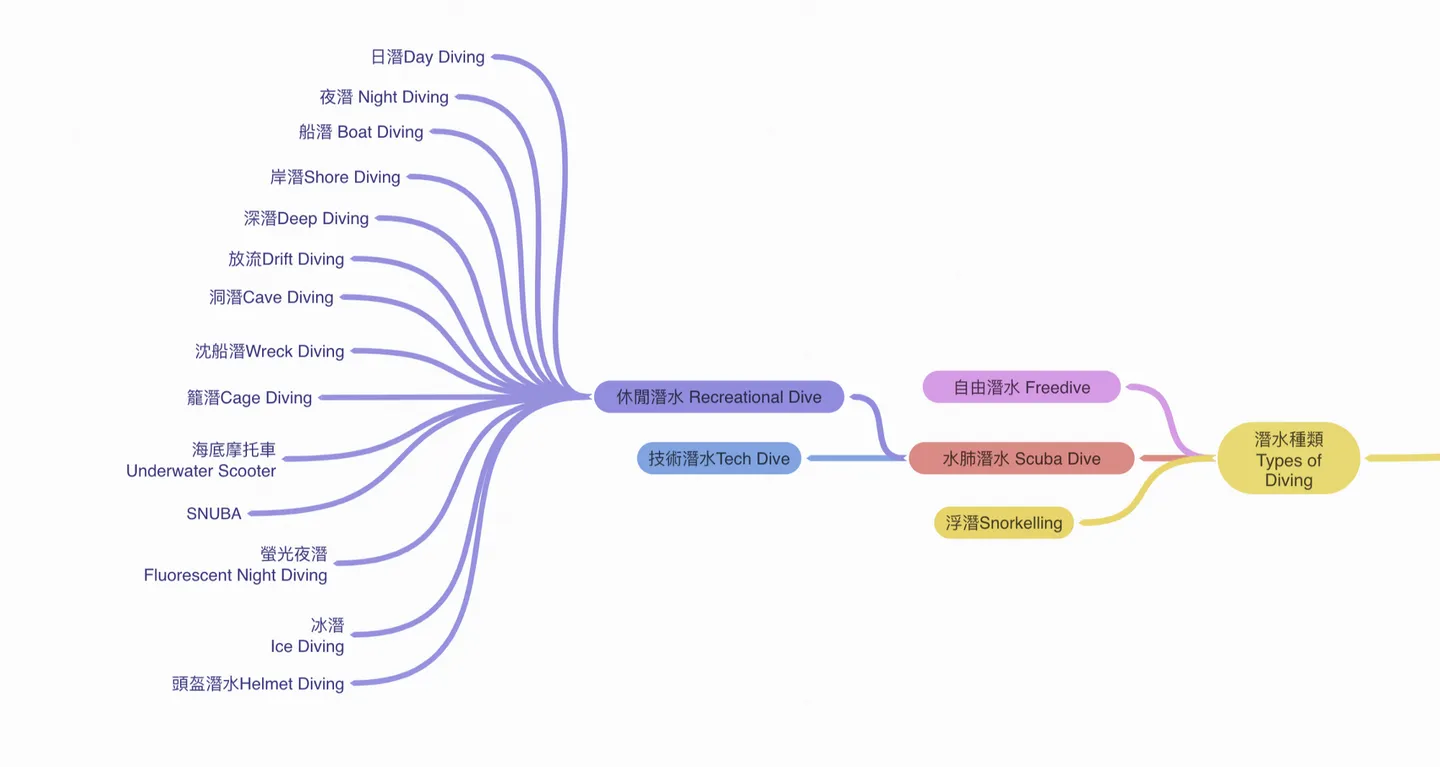
Here I'll focus mainly on recreational scuba diving!
There are truly many types of scuba diving — take a look at the mind map I made. Some of the more unusual ones, such as Fluorescent Night Diving, Cage Diving, Ice Diving, Underwater Scooter, and SNUBA, are relatively uncommon in Taiwan. I've selected some videos for each — click any underlined term in the text below to be taken directly to a video so you can get a better feel for these different types of diving.
Fluorescent Night Diving — I know of this offering from the Australian dive operation I worked for, and it apparently exists in Thailand too. Because the special blue-light torches required are quite unusual and individually very expensive, not every dive shop provides this experience. That said, I'd strongly recommend trying fluorescent night diving if you ever get the chance. You hold a special blue-light torch and wear a yellow-lens filter; as you dive, you'll find that healthy coral lights up and glows with fluorescence. Some researchers use whether coral fluoresces as one indicator of coral health.
🐟 Side story: Honestly, I was pretty scared during my first fluorescent night dive, because the torch isn't nearly as bright as a regular white-light torch — it's essentially pitch black once you're underwater. Participants also need to pay very careful attention to their Buoyancy and be very patient, because the entire dive is usually spent hovering over one very small section of reef, just observing.
Cage Diving — a fairly controversial form of diving in which divers are placed inside a large cage and lowered into the water to observe more aggressive species, such as Great White Sharks off Australia and Mexico. A few years ago there was an incident in which a Great White broke into a cage — and in truth, this kind of activity can cause significant harm to Great Whites.
Underwater Scooter — many countries offer underwater scooter experiences, usually targeted at guests who are hesitant about a regular Discover Scuba Diving experience. Honestly, I've always wanted to try one myself, though these experiences tend to be quite pricey.
SNUBA — SNUBA, which as far as I know has no established Chinese name, is actually a rather unique diving experience. The operator gives guests the same second stage regulator used in scuba diving, but the difference is that the hose is extremely long — stretching all the way from the surface down to about 3 metres underwater. This experience doesn't take guests very deep, and the advantage is that you don't have to carry a scuba tank / cylinder.
Equipment / Dive Gear
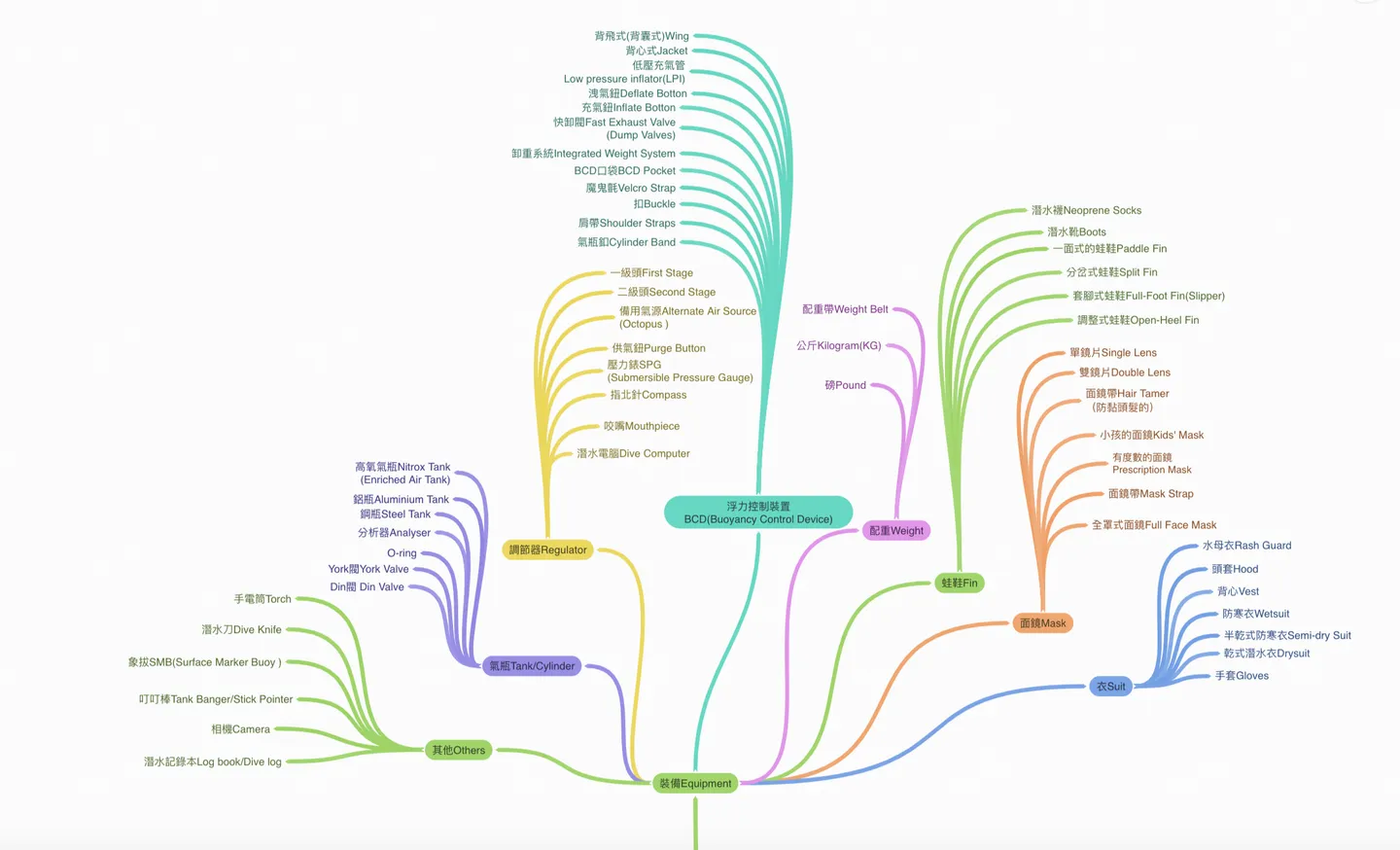
We finally get to the gear section (phew). I imagine most divers are already very familiar with equipment, so please refer directly to the mind map.
That said, let me highlight a few terms I think people don't use very often, but would be really frustrating not to know if something broke while you were travelling:
Mask:
- Mask Strap — the rubber or plastic band that holds the mask against your head. It can sometimes snap in two, and that's exactly when you'll need this word.
- Prescription Mask — if you're near-sighted and aren't comfortable wearing contact lenses while diving, ask the shop whether they have a Prescription Mask. Larger dive operations usually keep a selection of different prescriptions on hand.
BCD:
Wing BCD — if I remember correctly, some people say "Donut," but "Wing" is actually the proper term for a back-inflate BCD. "Donut" does get used to describe a wing BCD, but it's describing the shape of the bladder — if you just say "Donut" on its own, some foreigners may not understand what you mean.
Fast Exhaust Valve / Dump Valves — dump valves are genuinely very handy during a dive. As your experience grows and you need to dump air less and less, you start to realise that lifting your left hand to vent is actually pretty inefficient — and that's where dump valves shine.
🐟 Side story: Dump valves have a small cord attached to a triangular pull-tab. One day an American instructor turned to our supervisor and said, 'Do we have some spare dumplings?' Everyone was completely baffled. Then he added, 'Don't you think the stuff on the dump valve looks like a dumpling?' — and I suddenly realised that even native speakers don't always know the correct term for every piece of equipment. To this day, I still don't know what that pull-tab is officially called…
Integrated Weight System — some dive shops offer BCDs with the weight system built right in. These are the setups where you can give one smooth, dramatic pull forward to release the weights — that's called an Integrated Weight System. If you've never used one before, ask the shop to show you how it works.
Velcro Strap — it might seem odd to list this word, but personally I think it's one that only native speakers tend to know, because "Velcro" was originally the brand name of the company that invented hook-and-loop fastener. If the Velcro on your BCD isn't sticking very well, there's no need to panic — if you've chosen the right BCD size, there are still buckles to keep everything secure. If it really bothers you, just ask the shop to swap it out.
Regulator:
Regulator — while "regulator" technically refers to the entire regulator assembly, some instructors will say 'Regulator in!' before a descent to mean "put the second stage regulator in your mouth." In that context, "regulator" stands in for the second stage regulator. In all other situations, "regulator" refers to the complete assembly including the first stage, second stage, and pressure gauge (SPG), etc.
Purge Button — both the first stage and second stage have a button that releases air when pressed.
Mouthpiece — when using a rental regulator, give the mouthpiece a check. If you notice it's cracked or damaged, let the dive shop know and remind them to replace it.
Scuba tank / cylinder:
Nitrox Tank / Enriched Air Tank — both terms describe a cylinder filled with enriched air nitrox (EANx). If you receive a nitrox tank, you'll need to borrow an Analyser from the shop to check the oxygen concentration. Some shops will ask you to record the measured concentration — this varies by operator.
DIN / Yoke Valve (DIN / Yoke Valve) — I remember for a long time I couldn't keep the two straight and was always mixing them up. What finally worked for me was thinking "a DIN regulator looks like the letter D — you screw it in." I'd highly recommend this video: Scuba Tech Tips: DIN Regulators and Converters — S04E14, which explains DIN and yoke valves as well as the pressure ratings of different cylinder types like steel tanks and aluminum tanks — at a level that any beginner can follow.
Other:
Torch — the word for "flashlight" I learned back in school, but I hear divers use "Torch" far more often.
[caption id="attachment_6141" align="aligncenter" width="1400"]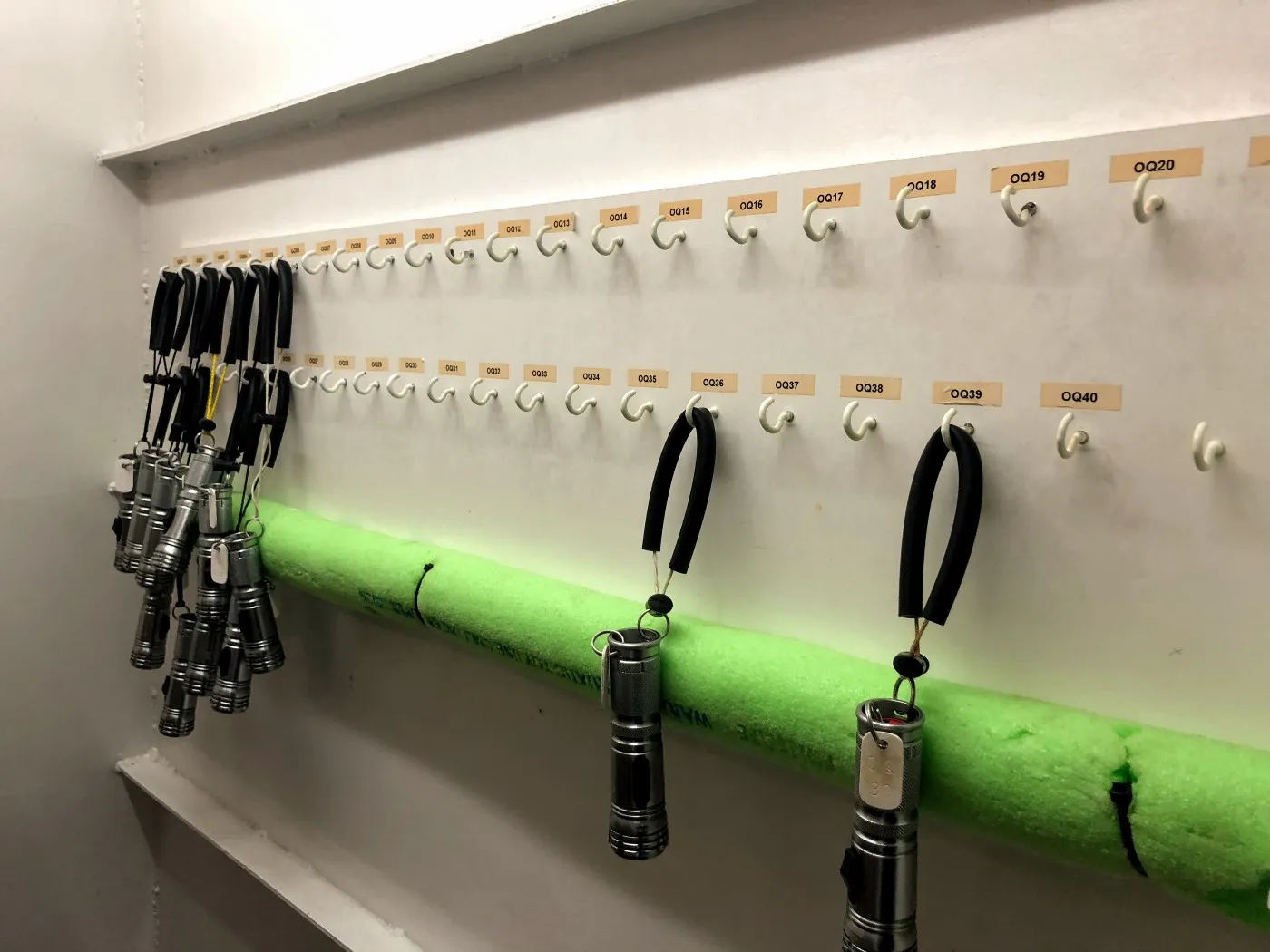 All the torches on the boat are hung up like this[/caption]
Tank Banger / Stick Pointer — as a dive guide, there is nothing worse than being underwater with a diver living in their own little bubble and not having a tank banger to get their attention.
🐟 Side story: I remember my tank banger got stolen back in Australia, and I had no idea what it was called in English. Eventually I managed to describe what it did, and my colleague said, 'Ah! Are you saying the tank banger?' Delighted to finally have the word, I went looking in other dive shops to see if any sold them — only to discover that a single tank banger in Australia costs between NT$600 and NT$800. I gave up.
That wraps up the Nouns section of diving English for all divers! I hope learning diving English doesn't feel too dry. The next instalment will cover practical sentences for real situations, and there will also be a practical briefing guide written for Divemasters and above.
Click here to view the zoomable mind map
Header image: Photo by Mael BALLAND on Unsplash
Related links:
- Diving Abroad But Can't Speak Diving English? The Essential Diving English Guide Part 2 — [Practical Phrases]
- 'If You Can't Think Like an Instructor, You Don't Belong Here' — The Journey from Divemaster to Dive Instructor
- Diving Safety Is Non-Negotiable — Meet the Diver's Guardian: the Lookout
- Tired of Diving the Great Barrier Reef? Head to Melbourne to Swim with pipefish and Seals
- Exploring Australia's Mysterious Shipwreck in Strong Currents — S.S. Yongala
- Travelling on a Backpacker Budget? The Complete Guide to Diving a Liveaboard in Australia for Almost Nothing!
- Looking for a Life Goal? Come Do an Unforgettable Dive Work-for-Certification in Australia!
- Encountering a Minke Whale on the Great Barrier Reef — Australia's Dream Voyage You Must Experience
- Jen's article series on Medium

![Can't Speak Diving English Abroad? The Essential Diving English Guide for Divers — Part 2 [Practical Conversation Edition]](/_astro/LRG_DSC00874_7dl44.webp)
![Diving Abroad But Can't Speak Diving English? The Essential English Guide for Divers Part 3 — [Divemaster / Instructor Edition]](/_astro/mael-balland-4HGHduVeCNs-unsplash_2gDACr.webp)