![[Blu's Marine Classroom] The World's #1 Most Toxic Crab! Besides the Mosaic Reef Crab, Meet Two More Deadly Poisonous Crabs!](/_images/acb1d5a12b09-1440w.webp)
Contents(8)
- Basic Introduction to the Mosaic Reef Crab
- The Toxins Found on the Mosaic Reef Crab
- How Much Toxin Does One Mosaic Reef Crab Contain?
- Other Commonly Found Highly Toxic Crabs
- Smooth Egg Crab (Atergatis integerrimus)
- Reef Crab (Zosimus aeneus)
- What Should You Do If You Encounter One in the Wild?
- Want to Learn More Fun Facts About Marine Life?
The Editor says: The ornately patterned mosaic reef crab — said to be the most toxic crab in the world — carries enough venom inside its body to kill hundreds of adults! But as long as you "don't eat it," you'll be perfectly fine, and you can still observe it up close! What other toxic crabs are commonly found in Taiwan? Follow the Editor to find out!
Basic Introduction to the Mosaic Reef Crab
The mosaic reef crab's carapace typically measures 10–12 cm across. It has a round, fan-shaped body that is mostly brownish, reddish-brown to dark reddish-brown, with a beautiful network of white, yellow, and red markings on the carapace. It has a pair of thick, powerful chelipeds with black-tipped claws, while its four pairs of walking legs are comparatively short and slender. It can be found all around Taiwan, though it is more commonly spotted in northern coastal waters and the Penghu archipelago. These crabs move slowly and mainly hide in the dark recesses of rocky reefs during the day, typically becoming active and foraging only after sundown.
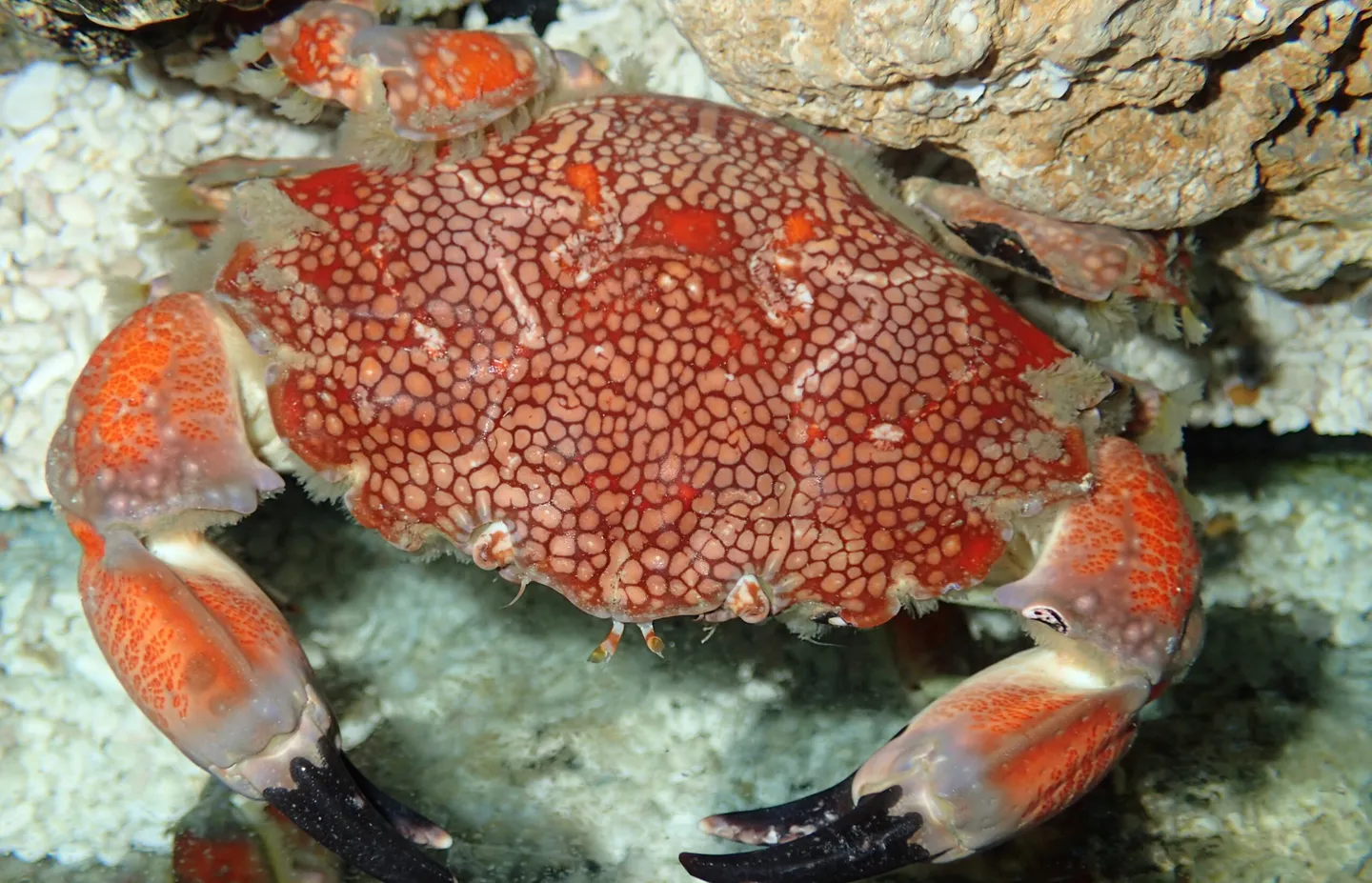
Mosaic Reef Crab (Lophozozymus pictor)


The Toxins Found on the Mosaic Reef Crab
The mosaic reef crab, reputed to be the most toxic crab in the world, actually acquires most of its internal toxins from its diet — including polychaete worms, mollusks, and decaying organisms. These food sources often carry bacteria, dinoflagellates, and various microorganisms. Through bioaccumulation up the food chain, the crab transforms these into lethal toxins within its body, such as paralytic shellfish poisons (PSP), saxitoxin (STX), and tetrodotoxin (TTX), which serve as its chemical defence. These types of toxins do not break down with cooking or heat, so the crab must never be consumed — whether raw or cooked!
How Much Toxin Does One Mosaic Reef Crab Contain?
Never underestimate a small mosaic reef crab. According to research studies, the flesh of a single 10 cm mosaic reef crab contains enough toxin to kill approximately 45,000 mice — and when scaled by body weight, it could potentially kill hundreds of adults. It has already been identified by current research as the most toxic crab in the world.
Other Commonly Found Highly Toxic Crabs
Smooth Egg Crab (Atergatis integerrimus)
Also a member of the family Xanthidae, the smooth egg crab (Atergatis integerrimus) is another commonly encountered toxic crab, appearing most frequently along the coasts of northern Taiwan and Penghu. Juveniles are reddish-brown with a white-edged carapace, somewhat resembling a burnt steamed bun. Adults are bright red, broad, and flat with large black-tipped claws. Some people mistake them for Dungeness-type edible crabs and consume them accidentally — so keep your eyes wide open! <For more details, see Marine Encyclopedia: Northern Taiwan>
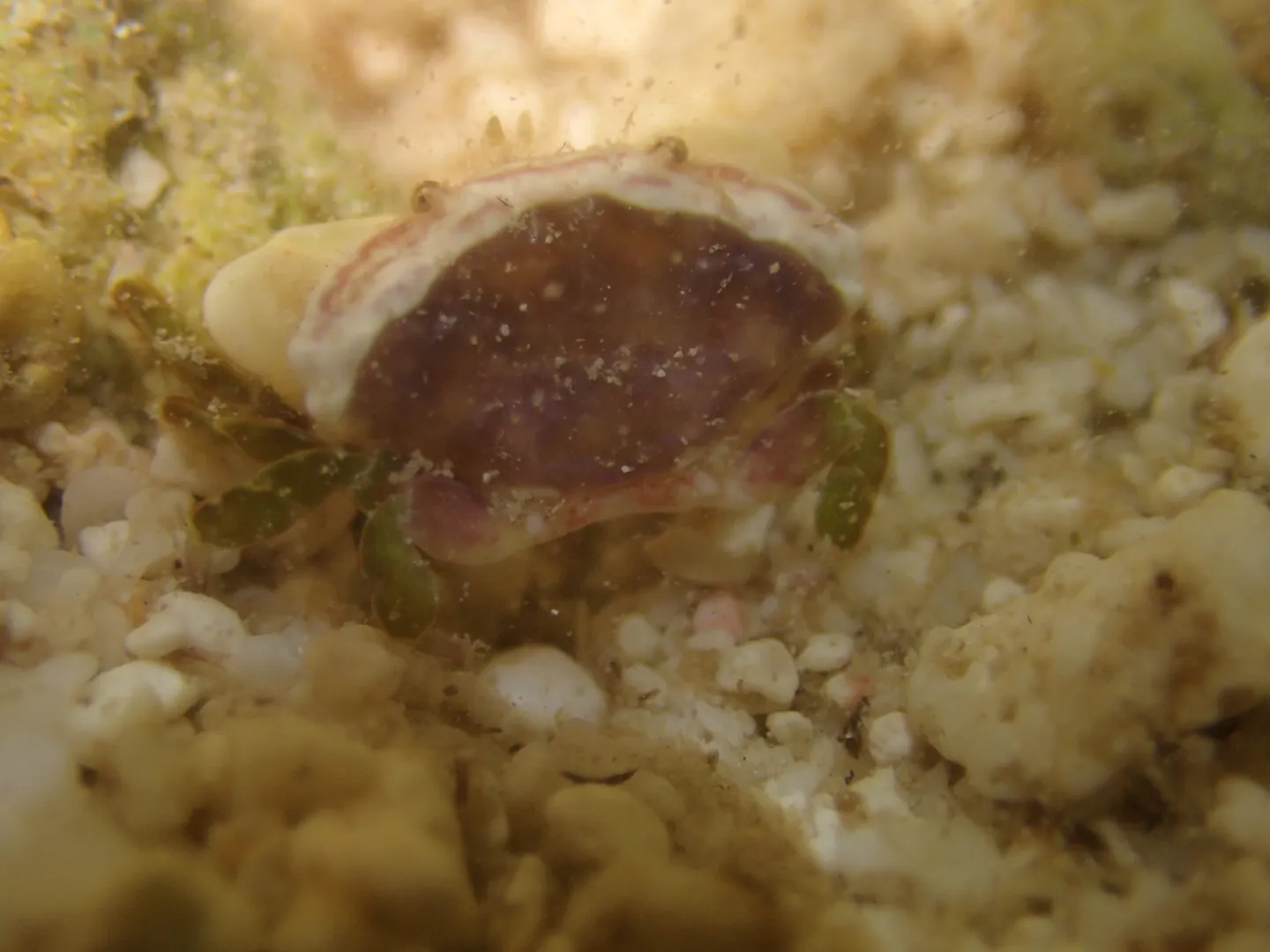
A juvenile smooth egg crab — doesn't this tiny little thing look just like a burnt steamed bun! Photo credit: Li Cheng-Lu
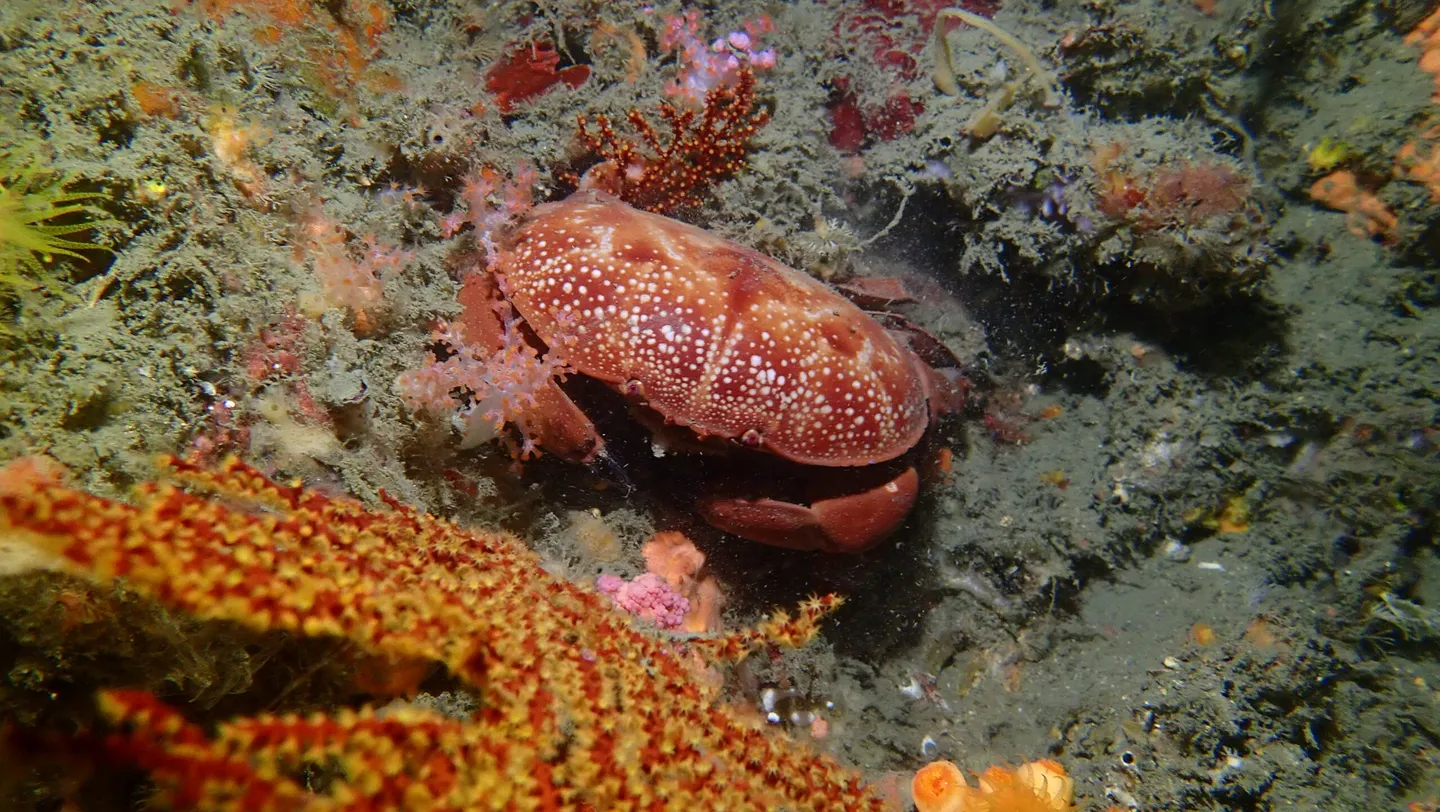
An adult smooth egg crab. Photo credit: Lin Yu-Ping
Reef Crab (Zosimus aeneus)
The reef crab (Zosimus aeneus) is covered in an intricate pattern of interweaving blue-purple and reddish-brown markings, somewhat resembling a bronze casting. These crabs prefer to inhabit shallow tropical seas rich in coral reefs, though they can sometimes be found in tidal pools along the intertidal zone. Because most of their natural predators fear the toxins on their bodies, the reef crab has become completely fearless — growing ever slower in its movements — earning it the nickname "the sluggish crab." < For more details, see Marine Encyclopedia 2: Nearshore Coral Reefs >
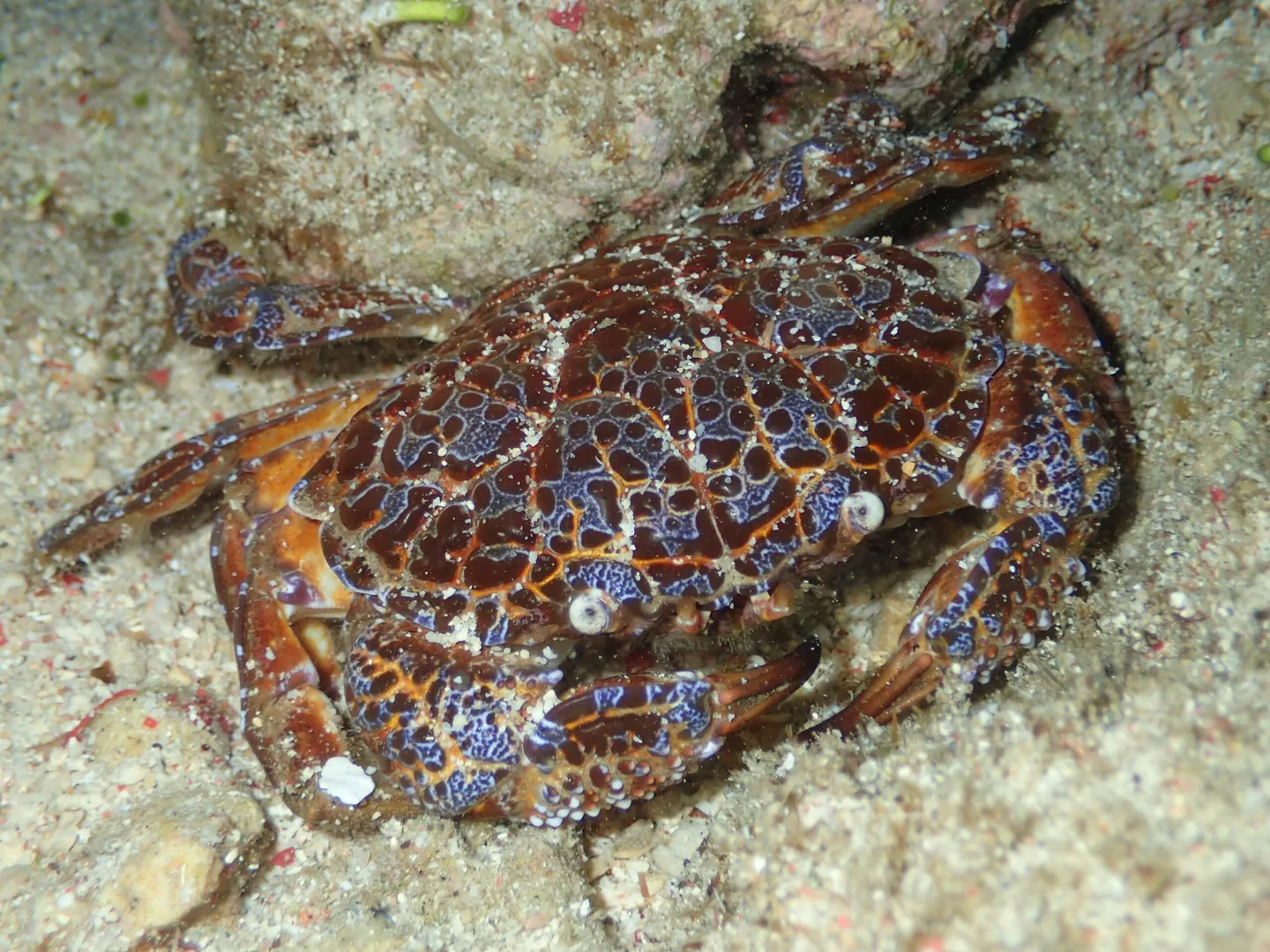
The patterns on the carapace really do look like a bronze casting — a little intimidating up close! Photo credit: Li Cheng-Lu
What Should You Do If You Encounter One in the Wild?
Hearing about the world's most toxic crab might give you a fright — but actually coming across one won't hurt you at all! Their shells do not release toxins, so as long as you don't eat them, you can safely get close and observe them! Of course, the most important thing to do is take a photo and upload it to a biodiversity database, so that more people can learn about the appearance and distribution of these toxic crabs!
Want to Learn More Fun Facts About Marine Life?
Marine Encyclopedia — Northern Taiwan
Marine Encyclopedia — Nearshore Coral Reefs
Further Reading:

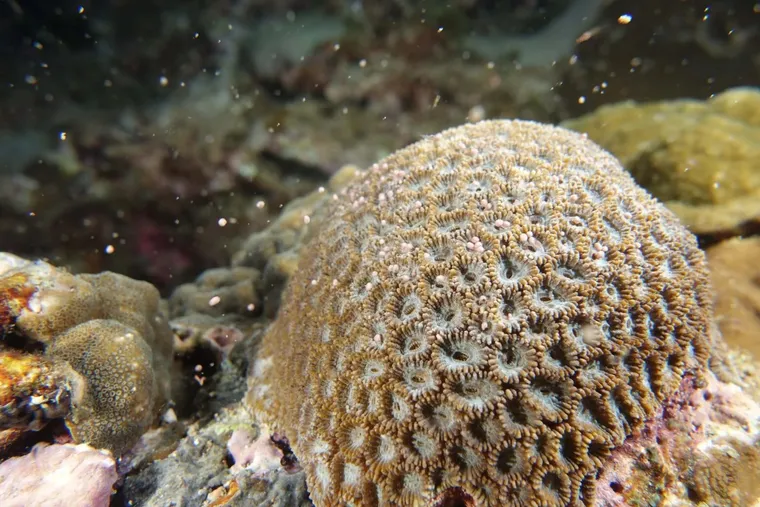
![[BlueTrend Mini Classroom] The Star Killer & Most Venomous Shrimp: The Devoted Harlequin Shrimp](/_astro/002_vivipic_2vdzYS.webp)