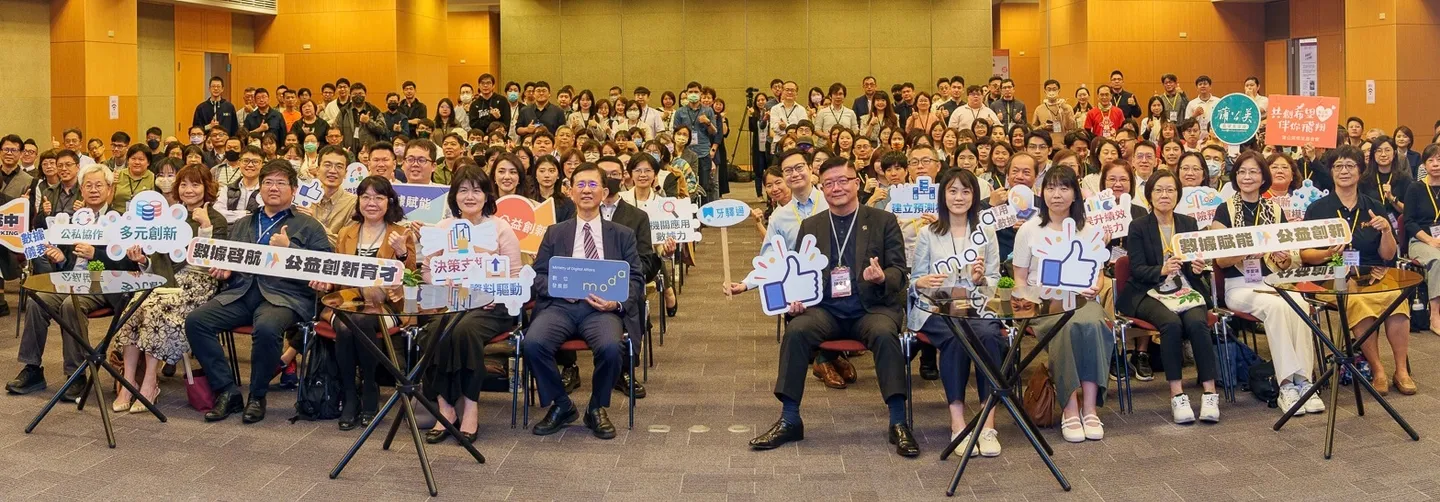


In an effort to advance the integration of public welfare and digital technology, the Ministry of Digital Affairs (MODA) held the "Data Empowerment, Public Innovation" Annual Results Sharing and Exchange Forum today (the 26th), showcasing the data transformation achievements of over one thousand nonprofit partners and more than 300 organizations. The event invited 10 nonprofit organizations (NPOs), social innovation organizations (NGOs), and 5 government agencies to share innovative applications and success stories from their transformation journeys.
Among the highlights, the Angel Heart Foundation and the Faith, Hope & Love Foundation demonstrated how data analytics can deliver more targeted respite services for families with children with disabilities. By introducing a flexible database system, social workers were freed from the burden of repeatedly entering case records. The AI Ocean database drew considerable attention at the venue by combining ocean exploration with sustainable tourism. Government agencies also actively applied AI tools to enhance operational efficiency and reduce waiting times for citizens accessing public services.

Minister Huang Yan-nan of MODA delivers opening remarks
MODA Minister Huang Yan-nan stated that the "Data Empowerment, Public Innovation" initiative has yielded rich results, having previously received the Social Impact Project Award at the 2024 IT Matters Awards. To continue expanding its influence, MODA will keep providing new avenues and new tools to broaden the reach of data-driven public good. The three themes of the day — "Data Illuminates Love," "Digital Transformative Power," and "Data Navigation" — revealed to all sectors that making good use of data can not only overcome existing challenges but also drive cultural innovation.
Institutions from various fields also shared concrete transformation outcomes. The Angel Heart Family Social Welfare Foundation and the Children's Welfare League Foundation used "data discovery" to organize membership databases and activity surveys, analyzing the needs of children with disabilities and vulnerable families, and using the findings to provide more refined respite services that left parents deeply touched. The Lixin Charity Foundation successfully reduced the time social workers spend drawing family genograms by 58 hours through the establishment of a unified data management platform. The Faith, Hope & Love Foundation used digitized, standardized, and visualized management methods to build a Ragic system architecture for managing ISPs (Individualized Support Plans), cutting paperwork processing time per case by 3.5 hours and making organizational management more real-time and comprehensive.
Director Zhuang Ming-fen of the Data Innovation Division added that this year marked the first time social innovation organizations participated in the mentorship program, with co-creation and co-sharing outcomes from ocean data on display. Shades of Blue Inc. combined ocean data with generative AI to link marine tourism and biodiversity databases, constructing a complete picture of Taiwan's ocean data — an effort of significant environmental diplomacy value. Yikang Biomedical Company worked with coaches to implement process automation using a variety of digital tools, dramatically reducing paperwork by 75%. Government agencies also actively explored AI applications: the Taitung County Fire Bureau used AI to assist in reviewing fire safety inspection drawings, cutting review time by 90%; and the Ministry of Finance's Taxation Administration used web scraping, automation tools, and generative AI to collect and cross-reference regulatory data, achieving automation of tax regulation and report proofreading tasks, saving an average of 60% in manual labor hours and improving both efficiency and accuracy.
To connect the data innovation ecosystem, the forum also invited more than 20 public welfare organizations and IT service providers to set up booths and facilitate resource matchmaking. Fu Jen Catholic University and National Pingtung University of Science and Technology, both partners of MODA, designed public interest innovation talent development programs that were publicly unveiled for the first time, showcasing the fusion of interdisciplinary approaches with the creativity of digital natives and the needs of local organizations. Médecins Sans Frontières and World Vision also shared their data transformation journeys at the forum, blending Taiwan-specific characteristics with an international perspective.
MODA stated that it will continue working hand-in-hand with NGO/NPO partners to realize the vision of co-prosperity and co-creation in a new digital society, ensuring that every act of goodwill and creativity can, empowered by data, reach its destination with precision.
News reprinted from the official MODA website
Further Links