Contents(3)
The Editor says: Think there's nothing living in the deep sea? Scientists have discovered 20,000 lavender-hued Pearl Octopuses 3,200 metres below the surface off California — a sight that looks just like an underwater garden. Research suggests the octopuses choose this spot because nearby hydrothermal vents raise the water temperature, accelerating egg development, shortening incubation time, and boosting the survival rate of hatchlings. But why aren't the eggs cooked by the vents? Follow along with Blu to find out! <Full article reprinted from the Taiwan Environmental Information Center, compiled by Mingshan Xie, reviewed by Zuling Xu>
Octopuses are usually solitary creatures, yet a colony of lavender-coloured Pearl Octopuses (Pearl Octopuses, scientific name: Muusoctopus robustus) — each roughly the size of a grapefruit — has gathered about 3,200 metres beneath the ocean surface off the California coast, forming an "octopus garden" covering approximately 333 hectares.
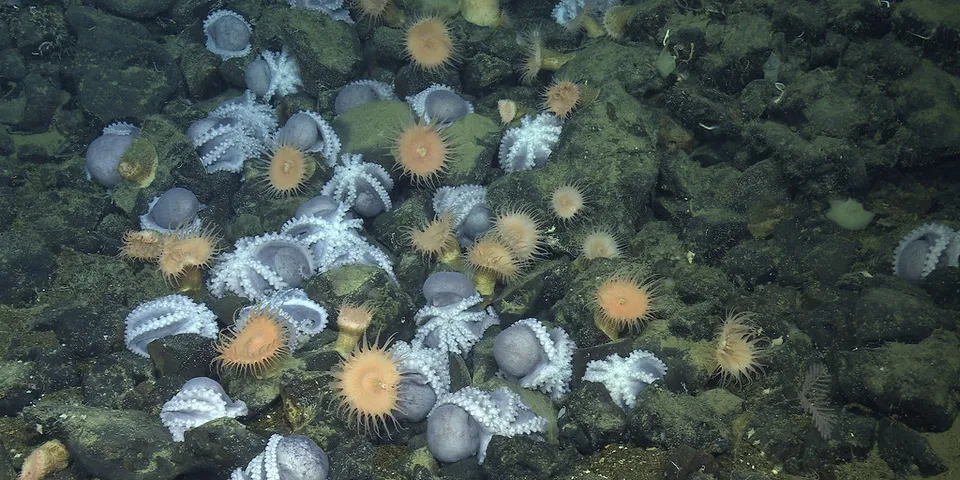
More than 20,000 Pearl Octopuses have congregated approximately 3,200 metres beneath the ocean surface off California, forming an "octopus garden" spanning 333 hectares. Image credit: MBARI
Warm Hydrothermal Vents on the Seafloor: A Prime Nesting Ground for Pearl Octopuses
According to The Guardian, the octopus garden was discovered in 2018 by a research team from the Monterey Bay Aquarium Research Institute (MBARI). Their initial hypothesis was that nearby underwater volcanic vents produce warmer water, which accelerates egg incubation — attracting Pearl Octopuses to congregate there.
The research team spent more than three years sending deep-sea remotely operated vehicles (ROVs) to the site over a dozen times, ultimately confirming this hypothesis. Each female Pearl Octopus lays around 60 eggs, attaching them to exposed rock. The mothers stand guard tirelessly over their eggs throughout the entire incubation period.
There are at least four known deep-sea octopus aggregation sites worldwide. MBARI scientists estimate the total number of octopuses at this site to be as high as 20,000, making it the largest known congregation of its kind.
According to Scientific American, in waters at 1.6℃, octopus eggs incubate very slowly — taking a minimum of five years and in some cases up to 13 years. The colder the water, the slower the incubation. In the area where the octopuses gather, water temperatures range from 5 to 10℃, allowing hatchlings to emerge in under two years.
Octopuses and their eggs are vulnerable to predation, infection, and other threats throughout the incubation period. A shorter incubation time dramatically increases the survival rate of the hatchlings.
Deep-sea hydrothermal vents expel superheated fluids in smoky plumes, classified as "black smokers" or "white smokers" based on the colour of the discharge. MBARI benthic ecologist James Barry explains that the water in this area is not as hot as that in black smoker zones, so it does not cook the octopus eggs.
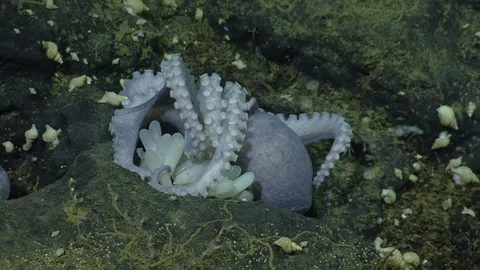
A female Pearl Octopus, no bigger than a grapefruit and tinged lavender, will lay around 60 eggs and attach them to exposed rock. Image credit: MBARI


The Octopus Garden Creates an Underwater Oasis
The research team found that the octopus garden also creates an oasis for other marine life. Male Pearl Octopuses die shortly after mating. Once the eggs hatch, the mothers also perish. Other deep-sea creatures — including fish, shrimp, sea stars, and snails — feed on the octopus carcasses, giving rise to a thriving ecosystem.
The deep sea holds vast riches: not only metals such as copper, cobalt, nickel, and manganese, but reportedly rare earth elements including yttrium, along with substantial deposits of gold, silver, and platinum — all of immense strategic value. Many nations are eyeing the enormous potential profits of deep-sea mining. Although this particular octopus garden lies within the Monterey Bay National Marine Sanctuary and is relatively protected, Barry warns that many other undiscovered octopus breeding grounds are under threat from trawl fishing and deep-sea mining. We must cherish these ocean treasures and not allow the seabed to be so carelessly stripped away.
Editor in charge: Jenny Tsai
References
- The Guardian (23 August 2023), Discovered in the deep: an octopus's garden in the shade
- Scientific American (23 August 2023), The Hot Secret behind a Deep-Sea 'Octopus Garden'
- MBARI (23 August 2023), Scientists solve mystery of why thousands of octopus migrate to deep-sea thermal springs
Reprinted with permission from the Taiwan Environmental Information Center. Original title: Scientists Discover a Deep-Sea "Octopus Garden" off California — Over 20,000 Octopuses Congregate Around Hydrothermal Vents to Create an Underwater Oasis

![[BlueTrend Mini-Class] Chameleons of the Sea? Coral's Best Ally – The Gender-Switching Parrotfish](/_astro/003_vivipic_Z1h2loq.webp)
![[BlueTrend Classroom] The Most Beautiful Sea Cucumber — The Sea Apple Is Actually a Hidden Underwater Bomb?](/_astro/004_%E5%B8%83%E9%AD%AF%E5%B0%8F%E6%95%99%E5%AE%A4_vivipic_Z1c6nxu.webp)