Contents(4)
Marine Industry Development Act
The Marine Industry Development Act — one of the three long-awaited ocean laws — finally passed its third reading in the Legislative Yuan on May 26, 2023 (ROC Year 112), making it the first of the three ocean laws to complete the full legislative process.
Given the composite nature of the marine industry, with relevant regulations scattered across multiple laws and difficult to consolidate, the passage of this Act is expected to achieve policy integration and operational coordination, helping to foster a thriving marine industry and, under the premise of sustainable development, build a sound environment for marine industry growth.


Contents of the Act
The Marine Industry Development Act was first drafted in 2019 (ROC Year 108) and completed through the collective efforts of industry, government, academia, research institutions, and various civic organizations.

The Act comprises 16 articles covering the definition of the marine industry's scope, the establishment of a marine database to integrate ocean monitoring and survey data, confirmation that the government must allocate budgets to promote the marine industry, and assistance for the private sector in securing funding to participate in marine industry ventures.
The Act also mandates that competent authorities and the central government work together to strengthen public awareness of the ocean — encouraging people to approach, understand, and cherish the sea — while promoting active citizen participation in marine activities, cultivating more marine industry talent, and providing guidance, assistance, incentives, or subsidies for marine enterprises. It also encourages universities to pursue industry-government-academia collaboration.
In addition, the Act empowers the central competent authority to assist in establishing marine industry parks or special zones in accordance with the law, and allows dedicated legal entities to handle relevant operations to enhance and promote marine industry development.
Balancing Traditional Rights and Economic Development
The Legislative Yuan's plenary session also passed a supplementary resolution requiring that, while promoting marine industry development and establishing marine industry parks or special zones, the needs of Indigenous peoples' survival, traditional rights, and economic development must be taken into account to avoid adverse impacts on Indigenous communities.
Furthermore, under the premise of not affecting the marine ecological environment, the rights of existing sea area users must be protected, and in cases involving the traditional sea territories of Indigenous peoples, their traditional gathering, fishing, and ceremonial activities must be safeguarded.
The Importance of Ocean Citizen Scientists
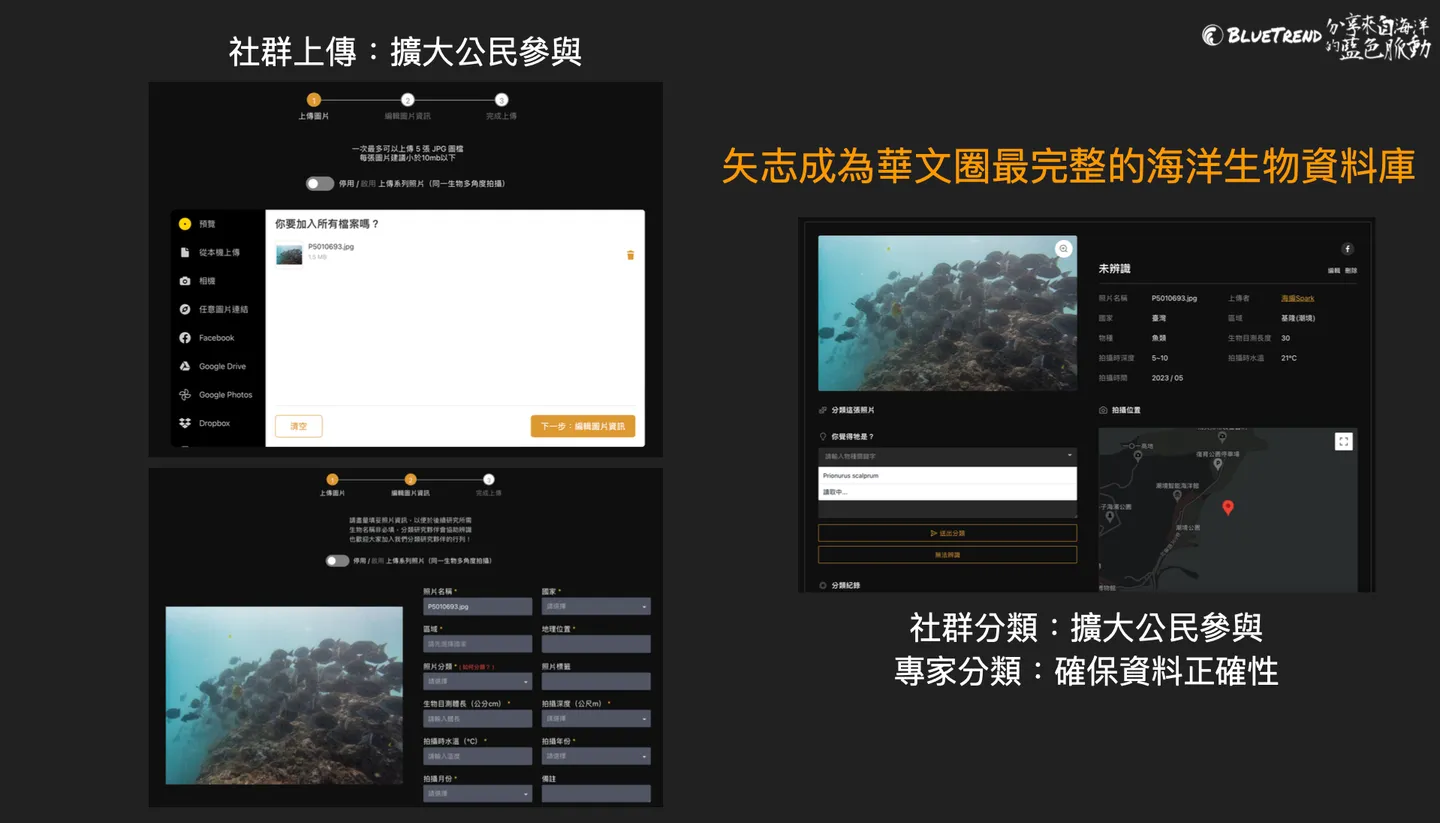
Article 5 of the Act specifically states that the central competent authority should coordinate with relevant agencies to establish a national marine information system and sharing platform, broadly collecting and integrating ocean monitoring and survey data — including hydrological, ecological, seabed substrate, and soundscape survey or monitoring data. These invaluable marine data come not only from the results of related research projects, but also from the growing contributions of ocean citizen scientists in recent years, which have generated an enormous accumulation of records.

BlueTrend has also responded to this major government policy direction. Since 2021, BlueTrend has been building an ocean citizen science biodiversity database, and continues to develop citizen scientist biodiversity databases for the Keelung Chaojing Resource Conservation Area and the Taoyuan coastline. To date, 3,708 citizen scientists have contributed, allowing everyone who loves the ocean to make a difference through photographs — gradually completing the baseline ecological data for the waters surrounding Taiwan.
The passage of the Marine Industry Development Act marks a turning point for marine conservation and sustainable development. We look forward to the successive completion of the Marine Conservation Act and the Ocean Space Management Act, which would complete the full suite of three ocean laws and contribute to Taiwan's long-term ocean sustainability.
Further Reading:
- Chub mackerel and horse mackerel are shrinking, and pomfret are only 6 cm! Fearing ecological imbalance, environmental groups urge faster passage of the Marine Conservation Act
- The wildest, most heroic marine conservation warrior in history — Paul Watson goes head-to-head with hunting fleets, using his own body to block ships in perilous waters!
- 【Are marine protected areas the best answer for ocean sustainability?】 Oceanpedia takes you on a fresh look at MPAs — Part 1
- 【No matter how many protected areas are designated, they're worthless without enforcement!】 Oceanpedia takes you on a fresh look at MPAs — Part 2