The Editor says: Cephalopods are the creatures we commonly know as cuttlefish, bigfin reef squid, octopus, and more. Not only do divers encounter them regularly underwater, they are also a staple at fishing harbors and on dinner tables. Research on cephalopods in Taiwan, however, remains quite rare — yet Taiwan, situated along the Pacific island chain, has already documented 102 identified cephalopod species. This time, we'll first pull back the veil of mystery on cephalopods through a documentary on a mother octopus filmed by Hong Yu-ting, and then pair it with the book 臺灣產頭足類動物圖鑑(精裝) to deepen our understanding of cephalopods!
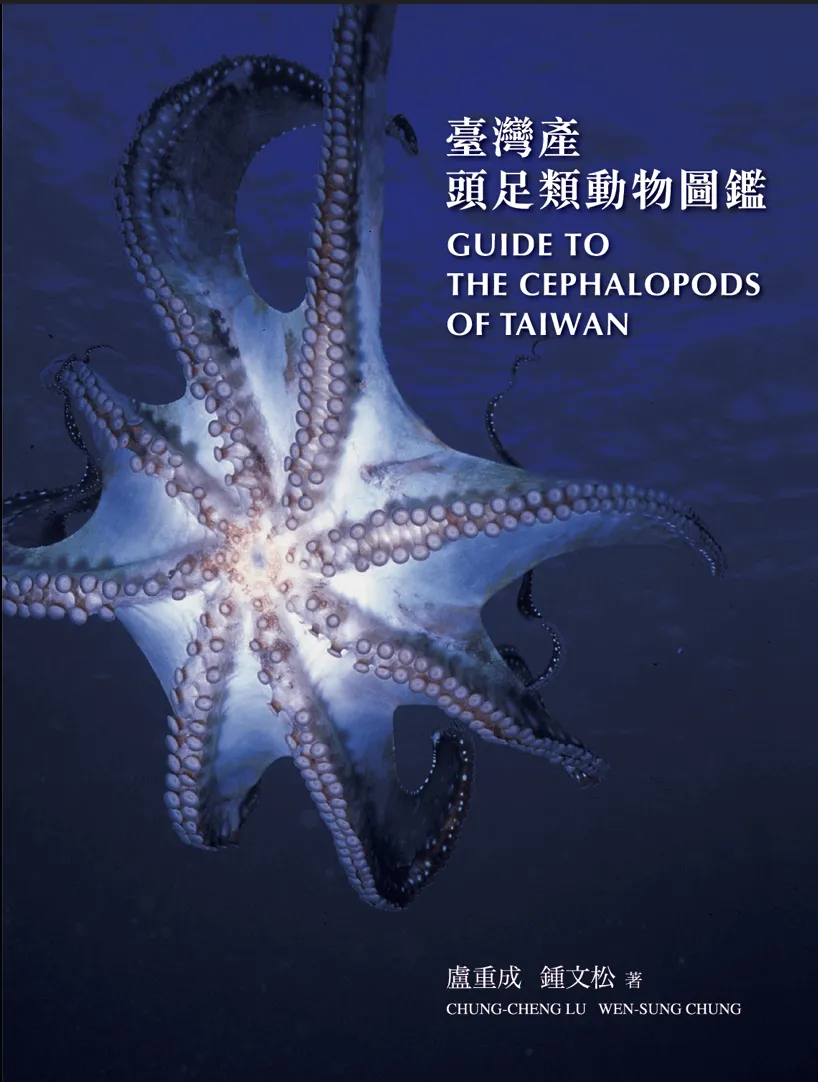
Taiwan lies along the western Pacific island chain. Except for the Penghu Channel, which reaches depths of up to 200 m along the western coast, most waters there are no deeper than 100 m — yet within just 5 km of the eastern shoreline, depths plunge to 1,000 m. This diverse topography nurtures a wide variety of species. As introduced in 臺灣產頭足類動物圖鑑(精裝), coverage at this stage can only focus on species commonly found in fish markets or those that are relatively easy to distinguish. As research advances, we can expect even more cephalopod species to be identified in the future.
What Are Cephalopods?
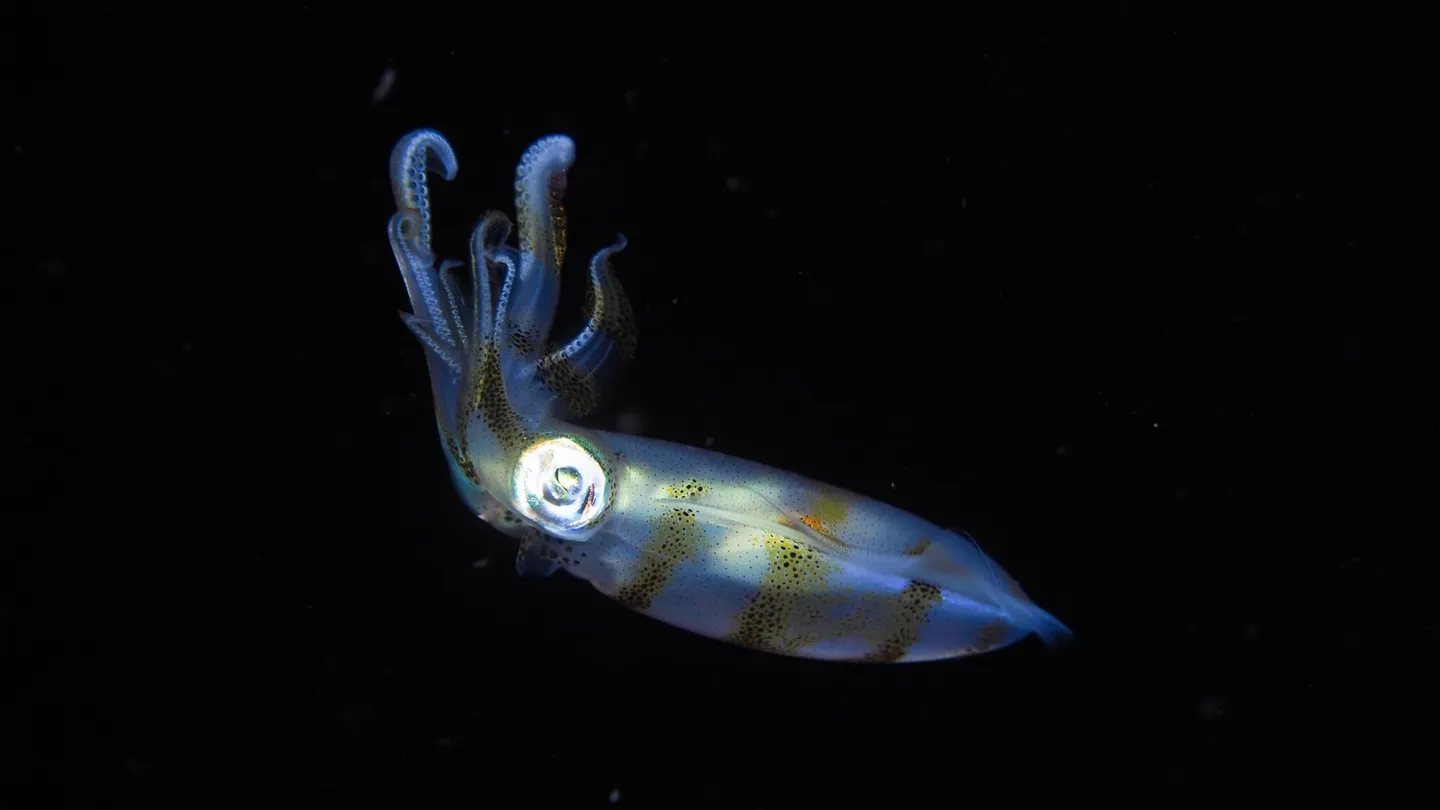
There are over 800 species of cephalopods worldwide. They are ancient creatures that have existed on Earth since the Cambrian period. The Greek-derived scientific name Cephalopoda literally means "head-footed animals," which tells us that their distinctive body plan has captured human imagination since time immemorial. They are found throughout the world's oceans — from polar, temperate, and subtropical to tropical regions, and from surface waters to lightless depths thousands of metres below. Their rapid growth rate has made them a major food source in Asia and an important fishery resource.
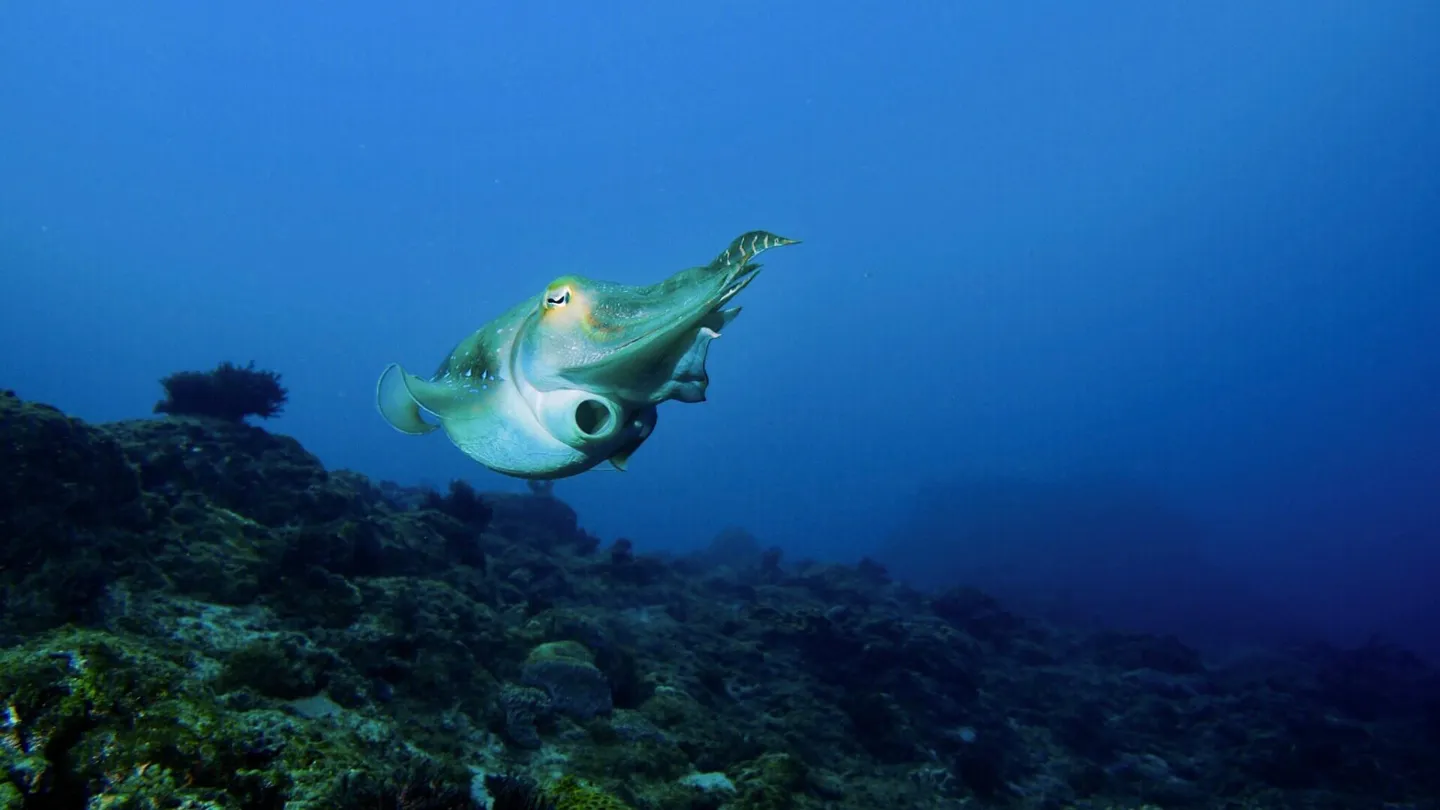
Over a long evolutionary history, cephalopods abandoned their hard, cumbersome shells, reshaping their bodies into streamlined, low-drag forms. By using jet propulsion, they became the fastest-moving invertebrates in the water. Equipped with keen eyesight and powerful arms, cephalopods have evolved into highly efficient underwater predators.


The Superpowers of Cephalopods
The hunting strategies of squid and octopus differ considerably. Cuttlefish and squid rely on vision to locate prey, waiting until it enters striking range before rapidly extending their tentacles to snatch it. Octopuses, however, rely not only on vision but also on the suckers along their arms: as they crawl across the seafloor, they sense prey hiding in rock crevices and coral reef ledges before making their move.
Cephalopods are not just formidable predators — they also possess remarkable escape strategies, including rapid flight from danger, ink ejection to distract predators, and lightning-fast changes in body patterning. Beyond color-matching camouflage that mimics surrounding environments almost instantly, they can also raise textured bumps across their skin and sway their arms like swaying seagrass. Some octopuses can even secrete chemical venom from their salivary glands — the blue-ringed octopus, which many people have heard of, uses exactly this method to warn enemies that it is not to be trifled with. With all of these advantages, it's no wonder cephalopods reign supreme in the water!
In addition to detailed coverage of cephalopod ecology and classification, 臺灣產頭足類動物圖鑑(精裝) also vividly describes the remarkable courtship behavior of cephalopods — for example, the stunning display-color-changing show performed by pharaoh cuttlefish during mating, which can be observed every May at Chaoching, Keelung (the video below was filmed by Kyoutaro at Chaoching Park, Keelung). The book also uses photographs to illustrate the differences between the eggs of octopuses, cuttlefish, and squid, making it an extremely practical reference for anyone who wants a thorough understanding of the cephalopod life cycle.
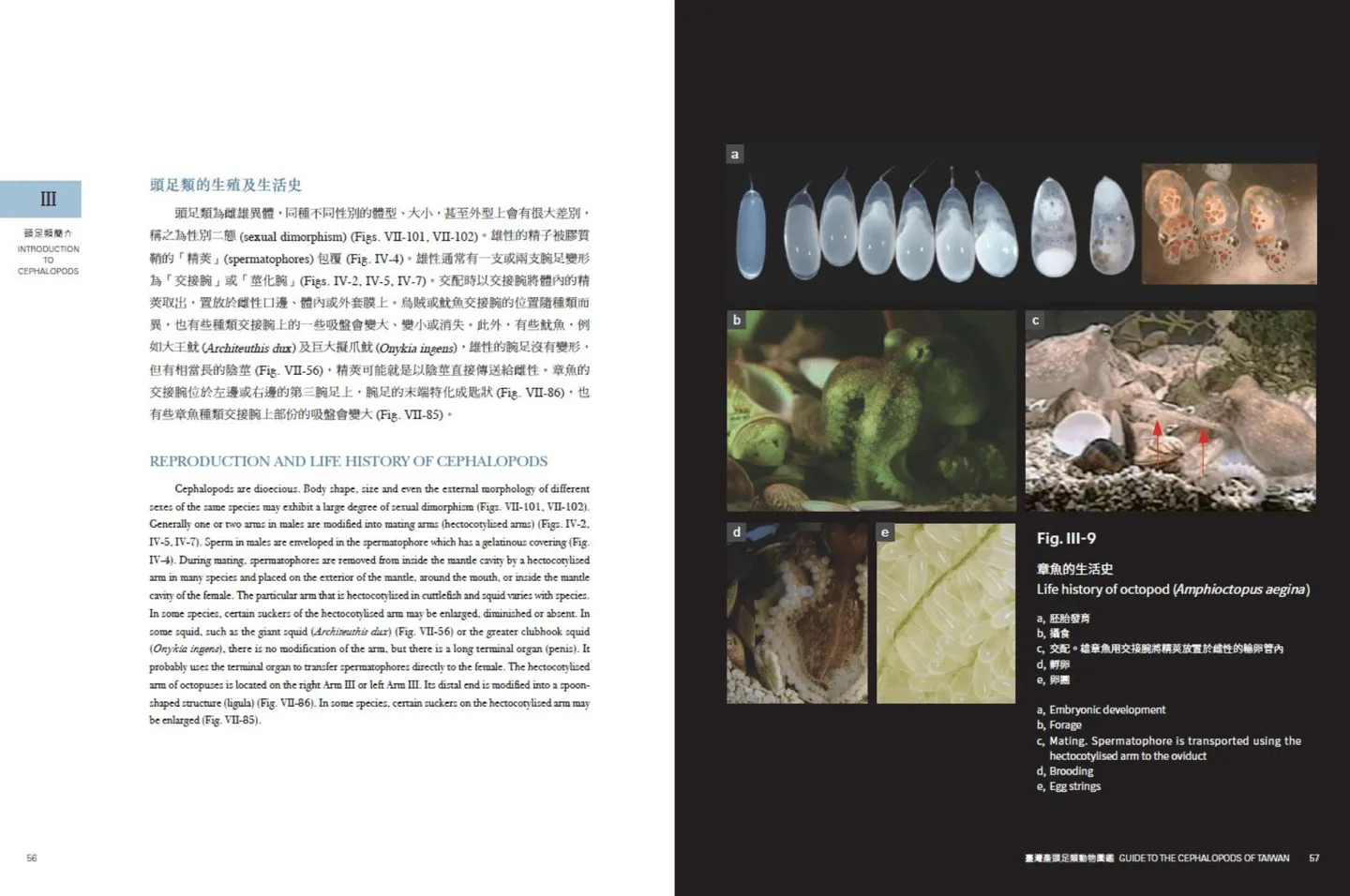
Most cephalopods live for only one year. They grow rapidly, but males die shortly after mating, and females follow suit after spawning. You can enjoy the documentary below, in which Hong Yu-ting spent numerous dives throughout 2018 to capture footage of a mother octopus laying her eggs.
Based on the field guide, the octopus filmed by Hong Yu-ting "appears to be" Octopus sinensis d'Orbigny, 1841 — known in Chinese as the zhonghua octopus, or simply octopus as it is commonly called. Its mantle can reach 250 mm in length, and it can weigh over 2.5 kg. It is a nearshore, bottom-dwelling species frequently seen in fish markets, carries high commercial fishery value, and is widely distributed across both the eastern and western coasts of Taiwan.
Like other cephalopods, octopuses have evolved complex brain regions that integrate sensory and motor systems. Some studies even suggest cephalopods are capable of learning and memory — for instance, octopuses can figure out how to extract food from jars through repeated trial and error, and can also learn new techniques through observation.
Although this 臺灣產頭足類動物圖鑑(精裝) is priced on the higher end, we believe that after reading it carefully, you'll be fully equipped to confidently tell apart bigfin reef squid, cuttlefish, cuttlefish (花枝), squid, mitre squid, and octopus — whether at the fish market or underwater!
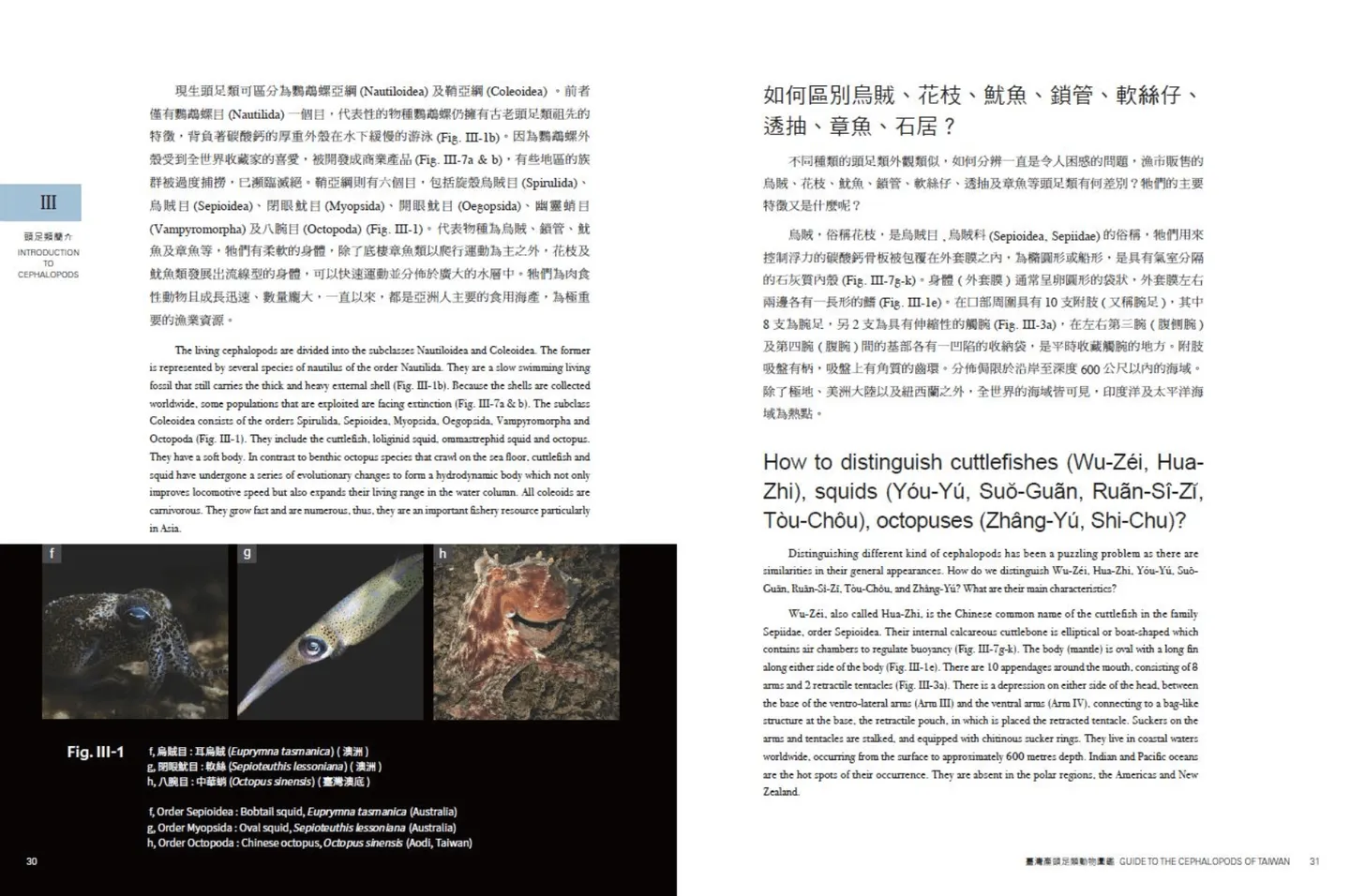
(The content of this article is excerpted from《臺灣產頭足類動物圖鑑(精裝)》, published by the National Museum of Natural Science, and reproduced with permission by BlueTrend. Videos reproduced with permission from Hong Yu-ting and Kyoutaro.)
Further Reading:

![[Editor on the Go] Sea Turtle's Life, Mermaid Ocean, and Lovelife Stone — Three Ocean Artisans Share Their Stories](/_astro/PC090193_1W50By.webp)