Contents(11)
- Key Amendments to the Regulations Governing Water Recreation Activities at a Glance
- Draft Amendment — Article 16 of the Regulations Governing Water Recreation Activities
- Draft Amendment — Article 17 of the Regulations Governing Water Recreation Activities
- Draft Amendment — Article 18 of the Regulations Governing Water Recreation Activities
- Draft Amendment — Article 19 of the Regulations Governing Water Recreation Activities
- A Deeper Look at Incorporating Freediving into the Regulations Governing Water Recreation Activities
- How Should Freediving Be Defined?
- What Constitutes an Accepted "Competency Certificate"?
- What Does "Familiar with the Dive Site" Mean?
- Differing Views on the "Dive Buddy" System
- What Are Your Thoughts on the Draft Amendment to the Regulations Governing Water Recreation Activities?
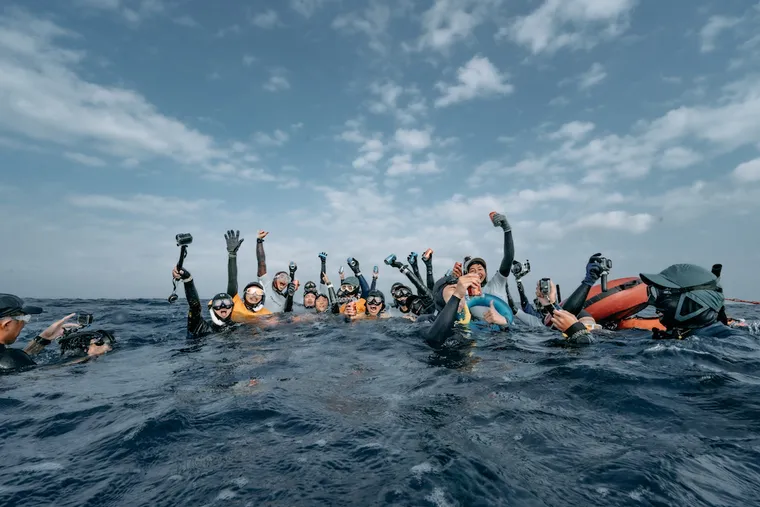
On January 4, 2024, the Ministry of Transportation and Communications announced a draft partial amendment to the "Regulations Governing Water Recreation Activities." The primary consideration is the growing popularity of freediving in recent years; the amendment proposes adding "freediving" to the relevant provisions along with additional related rules. The BlueTrend team has mixed feelings about this: seeing a government agency take action and propose legislative amendments at least signals that ocean and water activities are receiving increasing attention. However, when divers read the fine print, they found what appears to be a number of grey areas in the wording. In this article, BlueTrend and the Editor walk you through each of the additions in the draft amendment — let's take a closer look.
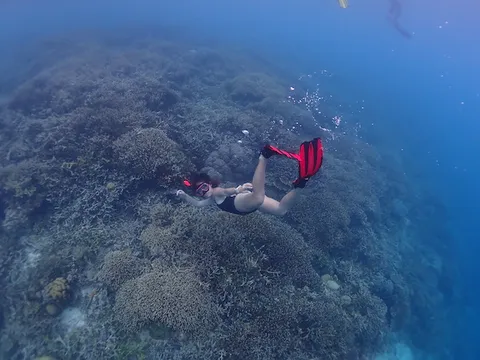
photo credit:Giam Teo
Key Amendments to the Regulations Governing Water Recreation Activities at a Glance
If you would like to read the full details of the amendment, please visit the Public Policy Online Participation Platform. BlueTrend and the Editor have summarised the key amendments below:
Draft Amendment — Article 16 of the Regulations Governing Water Recreation Activities
"Freediving" is added to the category of diving activities, defined as diving "without carrying breathing apparatus" and "on a single breath-hold."
Draft Amendment — Article 17 of the Regulations Governing Water Recreation Activities
A new provision requires anyone engaging in "freediving" to hold a diving competency certificate issued by a domestic or overseas diving organisation.
Draft Amendment — Article 18 of the Regulations Governing Water Recreation Activities
A new provision requires anyone engaging in "freediving" to carry buoyancy equipment, with freediving buoys cited as an example; a further addition requires that "freediving" be conducted in the company of a person who is familiar with the dive site and meets the requirements of the preceding article.
Draft Amendment — Article 19 of the Regulations Governing Water Recreation Activities
A new provision requires anyone leading clients in "freediving" activities to hold a qualified dive instructor competency certificate issued by a domestic or overseas diving organisation; the instructor-to-student ratio is capped at four students per instructor per session, which may be increased to six if a qualified assistant instructor is present.


A Deeper Look at Incorporating Freediving into the Regulations Governing Water Recreation Activities
The draft announcement has sparked extensive discussion. BlueTrend and the Editor have gathered a wide range of perspectives to offer multiple viewpoints, and we invite the diving community to follow this legislative process closely.
For this article, in addition to consulting the Tourism Administration of the Ministry of Transportation and Communications (the competent authority), the team interviewed two freediving instructor trainers / dual-system instructors* — Coach Xiao Ming and Coach Wayne — to understand the views of some experienced freedivers. We also exchanged opinions with multiple freedivers to collect diverse perspectives; sat in on an online briefing hosted by the Pingtung County Diving Instructors' Professional Union to understand the views of some members of the diving industry; and invited the Taiwan Freediving Development Association for comment, though the association declined the interview and suggested deferring to the government's response. We also referred to the proceedings of the deliberation meetings and quoted certain statements, which are compiled in the content below.
*Note: Coach Xiao Ming is a Molchanovs Instructor Trainer, an AIDA (freediving agency) Instructor Trainer, and an AIDA International Judge, and has set an Asian record in the freediving Constant Weight Bi-Fins discipline.
Coach Wayne is a PADI (certification agency) Freediver Instructor Trainer, an AIDA (freediving agency) Instructor, and an AIDA International Judge.
How Should Freediving Be Defined?
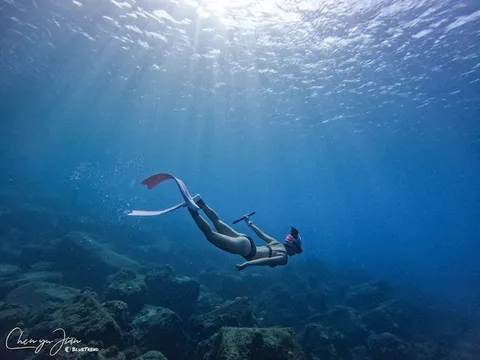
photo credit:簡晨宇
The draft amendment defines freediving as diving "without carrying breathing apparatus" and "on a single breath-hold." Coach Xiao Ming is concerned that this definition makes it difficult to distinguish freediving from snorkeling, and states plainly that even if freediving is defined this way, the related regulations will be hard to enforce in practice. Coach Wayne, on the other hand, feels the current definition is reasonable and broadly consistent with how major international freediving organisations define the activity.
During the open discussion session at the briefing hosted by the Pingtung County Diving Instructors' Professional Union, one participating instructor raised a concern: "For a typical fun freedive, you rarely go beyond ten metres — it's very hard to distinguish from snorkeling or ocean swimming." Union chairman Ryan Zhan Hao-yu responded that the union has also recommended using "depth" as part of the definition, suggesting that past freediving accident data could serve as a reference, and noting that the definition in the draft amendment is overly broad.
Response from the Tourism Administration's Scenic Area Development Division, Ministry of Transportation and Communications
Based on the deliberation meeting records, given that snorkeling, freediving, and scuba diving differ significantly in equipment and activity, it is considered that snorkeling and scuba diving can be intuitively and easily distinguished from each other in their current forms and require no adjustment; the review is therefore focused solely on defining and addressing freediving. As for whether to incorporate "depth" into the definition, since neither freediving nor snorkeling has a clearly defined depth threshold and this would be difficult for regulatory authorities to assess in practice, there are currently no plans to include "depth" in the provisions.
What Constitutes an Accepted "Competency Certificate"?
The draft amendment states that participants "shall hold a diving competency certificate issued by a domestic or overseas diving organisation." This raises the question of whether a course participation certificate — obtained without passing the assessment — qualifies as a "competency certificate."
Coach Xiao Ming finds this wording too vague, leaving too much room for varying interpretations. Intuitively, failing an assessment should mean a person does not hold a competency certificate; however, Coach Xiao Ming also poses the question: "If you can't enter the water without passing, and have no opportunity to practise, will you ever be able to learn?"
Coach Wayne says that instinctively he would interpret "competency certificate" as "a certificate obtained by passing a test," drawing an analogy to a driver's licence: "If you pass the practical driving test but fail the written test and don't get a licence, no one would consider you competent to drive on the road." He emphasises that a course participation record is only meant to document a student's learning progress, giving instructors a quick understanding of where the student is in their training. As for the wording of this provision, Wayne feels that "qualified certification" would be more precise than "competency certificate."
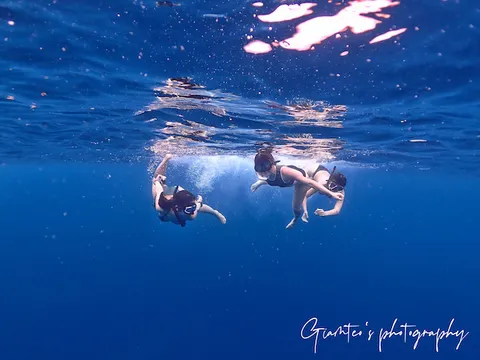
photo credit:Giam Teo
Ryan notes that obtaining a diving certification requires completing many sessions of training covering multiple skill areas; if a student fails even one skill assessment, they cannot receive their certification — "because even if there is just one thing you can't do, in certain situations you may not have the ability to handle what comes up, and that could be dangerous." He therefore believes that a course "participation record" cannot be treated as a competency certificate.
Response from the Tourism Administration's Scenic Area Development Division, Ministry of Transportation and Communications
The diving competency certificate referred to in this provision currently includes "course participation records," in accordance with the legislative notes to Article 16 (renumbered Article 17) of the Regulations Governing Water Recreation Activities: "The diving competency certificates referred to in these Regulations include diving certifications and course participation records."
What Does "Familiar with the Dive Site" Mean?
The draft amendment states that participants shall be accompanied by someone "familiar with the dive site." Coach Xiao Ming is puzzled by this: "What counts as familiar — having been there once, or ten times?" He considers it too vague to serve as a meaningful or enforceable standard, and also wonders: "If we really follow this, does that mean no new dive sites will ever be discovered?"
Coach Wayne shares his understanding of "familiar" — it should mean knowing the terrain, current direction, tidal patterns, and so on, so that when an unexpected situation arises, a quick evacuation plan can be formulated and executed. However, given the difficulty of establishing a consistent standard for "familiarity," Coach Wayne suggests that a certification mechanism could be developed in the future. For example, for popular dive sites such as the Dafu Fishing Harbour in Xiaoliuqiu, a defined area for teaching and diving could be established, with hydrological information, tidal data, and other details about that area put in writing and assessed through an exam-based certification process.
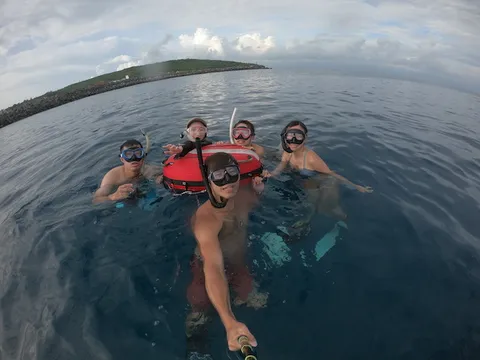
photo credit:Jenny Tsai
Ryan also criticised the lack of a clear definition of "familiar." Referring to the deliberation meeting records for the draft amendment, a representative from the Ocean Affairs Council similarly raised the point that "it is recommended to define more clearly whether an instructor is familiar with the dive site." At the same meeting, however, a representative from another group noted that, with reference to New Zealand's approach to recreational diving where no equivalent oversight exists, "familiarity with the dive site should be treated as a soft reminder rather than a hard requirement."
Response from the Tourism Administration's Scenic Area Development Division, Ministry of Transportation and Communications
The provision stating that participants shall be accompanied by someone "familiar with the dive site" who also meets the requirements of the preceding article is part of the existing framework of the Regulations Governing Water Recreation Activities. This amendment simply adds freediving as a new activity type to be included and regulated.
As for the ambiguity around the definition of "familiar with the dive site," based on the conclusions of the deliberation meeting, the Tourism Administration's Scenic Area Development Division will include this definitional issue in its review, and will simultaneously reference the Ocean Affairs Council's "Guidelines for Planning and Management of Marine Recreation Activities" to evaluate how to formulate relevant activity management guidelines for the reference of water recreation activity management authorities.
Differing Views on the "Dive Buddy" System
The draft amendment states that participants "shall be accompanied by a person who is familiar with the dive site and meets the requirements of the preceding article." The preceding article requires that participants "hold a diving competency certificate issued by a domestic or overseas diving organisation." This provision has therefore been interpreted as enshrining a "dive buddy" system. Both Coach Xiao Ming and Coach Wayne believe that the vast majority of people are aware of the concept of a dive buddy, but that the buddy system is not always effectively put into practice. They emphasise that investing more resources in education and promotion of the dive buddy safety system is more important than legislative amendments.
Coach Wayne also posed an interesting question: "When you go on a dive trip abroad, do you want a dive guide?" He says most people's answer is "yes" — yet when the setting shifts to diving locally in Taiwan, the answer might be different. But if you think about it calmly, "is it safer to have a dive guide or not?" — most people would naturally arrive at the answer.
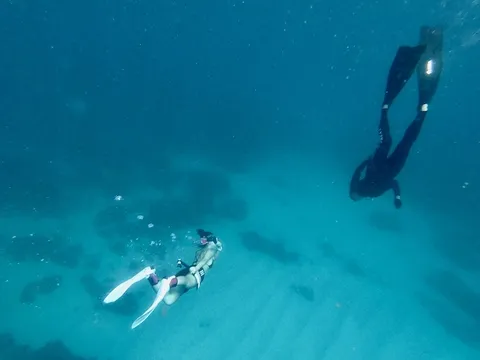
photo credit:Jenny Tsai
He noted that no one likes to hear "freedivers are so dangerous." From a safety perspective, he believes a dive guide system may be better than a buddy-only system; if a proper framework could be established to require guides to hold relevant certifications or pass assessments, "after all, it's their job — if something goes wrong, they lose their livelihood, so they're going to be far more professional and careful than an average recreational dive buddy." That said, he also acknowledged practical realities, including how a dive guide system would be recognised, whether instructors qualify as dive guides, and whether a separate dive guide qualification would be needed — all of which require much more discussion.
Ryan, meanwhile, pointed out that interactions between dive buddies fall outside the scope of water recreation activity liability insurance. He considers the "buddy-only system" a high-risk approach, and is also concerned that if an accident were to occur in the future, difficulty in determining liability could hinder the development of the industry.
Response from the Tourism Administration's Scenic Area Development Division, Ministry of Transportation and Communications
The requirement that participants be "accompanied by a person who meets the requirements of the preceding article" can be seen as embodying the spirit of a "dive buddy" system. This provision is also part of the existing framework of the Regulations Governing Water Recreation Activities, and is consistent with the basic diving safety principles established by major international diving certification organisations. The relevant regulations are considered to enhance the safety of participants in scuba diving and freediving activities.
What Are Your Thoughts on the Draft Amendment to the Regulations Governing Water Recreation Activities?
National Geographic once published a dedicated feature on the freediving boom in Taiwan, citing a 2020 report by AIDA (freediving agency) International which ranked Taiwan second globally in the number of freediving certifications issued.
As freediving continues to grow in popularity, its inclusion in legislation is now a work in progress. Although reaching consensus among the many stakeholders involved in the amendment is no easy task, vague wording in the provisions risks giving rise to varying interpretations and the potential for further disputes. We hope that through thorough discussion and open dialogue, the relevant regulations will be able to take effect more smoothly in the future.
Do you have any thoughts on this amendment? You're welcome to leave a comment or send a message on the BlueTrend community page to share your views and join the conversation. You can also leave your valuable feedback in the discussion section of the Public Policy Online Participation Platform.
>>Leave Your Valuable Feedback
Further Reading: