Contents(3)
the Editor says: Whether it's whales, sea turtles, or other marine life, countless precious lives have been lost to entanglement or accidental ingestion of debris. News like this inevitably makes us stop and reflect — could these tragedies be prevented? And what can we do about it? <Environmental Information Center, translated by: Xie Mingshan compiled>
In September 2022, scientists at an American aquarium discovered that "Snow Cone," a North Atlantic Right Whale, had been entangled in fishing gear for the fifth confirmed time — and the actual number could be even higher. She was dragging heavy fishing gear, in extremely poor condition: "moving very slowly, unable to dive, she is suffering and her chances of survival are very low."
The northeastern United States and eastern Canada are renowned lobster-producing regions, and they also lie along the migration route of the critically endangered North Atlantic Right Whale, of which fewer than 340 individuals remain. Entanglement in fishing rope — like what Snow Cone experienced — is far from an isolated incident. It is estimated that 86% of right whales have been entangled, making it the second leading cause of death. Measures taken by both governments and civil society have failed to effectively reduce mortality. Companies are now actively developing ropeless fishing gear, but lobster fishers, worried about the impact on their livelihoods, have responded with skepticism.
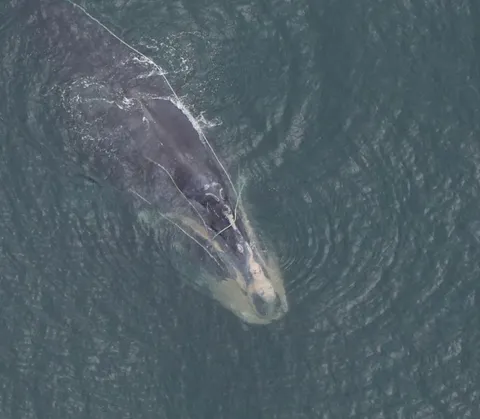
On September 21, 2022, North Atlantic Right Whale "Snow Cone" was found dragging heavy fishing gear, in extremely poor health. Image source: New England Aquarium
Entanglement: The Second Leading Cause of Death for a Critically Endangered Whale — Government and Civil Society Efforts Fall Short
Lobster traps are placed on the seafloor. To retrieve them, fishers deploy buoys on the surface connected to the traps by ropes hanging vertically through the water column — ropes that migrating right whales can become accidentally tangled in. Research suggests that along right whale migration routes, there are nearly one million such vertical ropes in the water. The New England Aquarium has found that 86% of right whales have been entangled, with some entangled as many as eight times.
According to Reuters, to address this problem, both the U.S. and Canadian governments have introduced regulatory measures — such as requiring breakaway ropes that snap if a whale makes contact, using color-coded ropes for tracking, or banning fishing during whale migration periods.
Civil society organizations have also taken action. In 2022, Seafood Watch added lobsters caught off Maine and in Canadian waters to the "red" list of its sustainable seafood guide, recommending that consumers avoid purchasing them. Whole Foods Market, the largest organic grocery chain in the United States, joined the response.
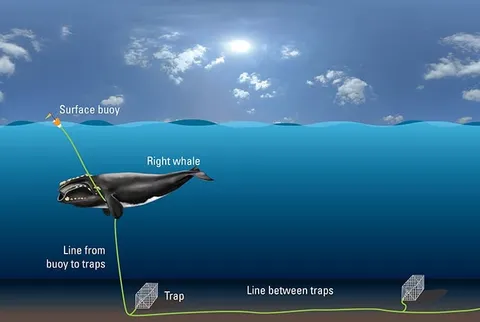
An illustration of a North Atlantic Right Whale entangled in fishing ropes; some whales drag gear for years. Image source: Woods Hole Oceanographic Institution
Yet these approaches appear insufficient to solve the problem. Official records show that at least four right whale entanglement incidents have occurred this year alone. One whale was found off North Carolina, and it is believed the animal may have been entangled as far away as Nova Scotia, Canada, traveling more than 1,000 km southward while dragging the trap.


Ropeless, On-Demand Fishing Gear Offers Hope for Reducing Whale Entanglements and Ghost Nets
In hopes of allowing whales and the lobster industry to coexist, several developers are working on new "ropeless" fishing gear. Unlike traditional buoy systems, these devices only bring the buoy to the surface when it is time to retrieve the trap — meaning the rope and buoy spend the vast majority of time resting on the seafloor.
The Global Seafood Alliance cites the product of EdgeTech, a company based in Massachusetts, as an example. The system includes two-way signaling between the vessel and the seafloor. The deck unit is installed on the boat and can receive signals from below, while the subsea unit contains built-in sensors and communication equipment, is connected to the fishing gear, and can release the buoy via acoustic commands.
Canadian company Ashored Innovations is also developing submersible, trackable buoys. The buoy dives down with the lobster trap and is only released to the surface when needed. The system also records the position of the trap or fishing gear.
EdgeTech has stated that its technology is nearing completion, with only final fine-tuning remaining, and the company expects to be able to produce 100 units per month in the near future.
NOAA Fisheries is conducting ropeless gear trial programs in Massachusetts and South Island, with 12 fishing vessels taking part in testing. However, most industry players appear unconvinced. Fishers told Reuters that the approach is too costly, and that if a technical failure occurs, lobster traps worth tens of thousands of dollars could be permanently lost on the seafloor.
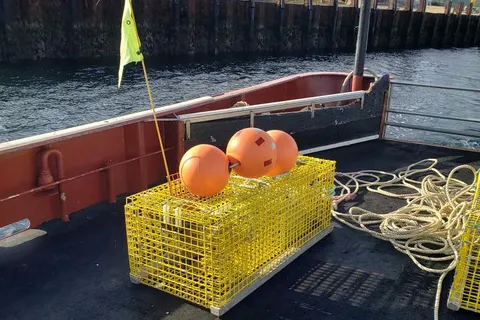
NOAA Fisheries conducting trial programs for ropeless lobster traps. Image source: NOAA Fisheries
References
- Reuters (June 8, 2023), North American lobster industry confronts 'ropeless' traps after whale entanglements
- Global Seafood Alliance (February 21, 2022), Rethinking ropes: Can ropeless fishing gear end whale entanglements?
- NOAA Fisheries, 2023 Northeast Experimental On-Demand Gear System Trials Completed
- New England Aquarium (September 22, 2022), North Atlantic right whale "Snow Cone" sighted entangled in new fishing gear and in extremely poor health
Further reading:
- What Happens on World Oceans Day? Join a Beach and Ocean Cleanup at Waimushan!
- The Advancing Giant Pollution! Analyzing the Global Distribution of Marine Debris — Interview with Zheng Mingxiu
- Critically Endangered: Research Reveals the Climate Crisis Facing North Atlantic Right Whales — Moving North to Feed Only to Face a New Threat
This article is republished with permission from the Environmental Information Center. Original title: Entanglement — The Second Leading Cause of Whale Deaths — Drives U.S. Development of "Ropeless" Lobster Fishing Gear.