Contents(4)
The Editor says: No-Decompression Limit (NDL) is one of the technical terms we learn when we first get into diving. The numbers on our dive computers are always there to guide us toward safer dives — yet the Editor frequently encounters divers who are genuinely confused about the differences between a safety stop, a decompression stop, and related terms. That kind of information gap can quietly raise our diving risk. We'd like to thank PADI (certification agency) instructor Chen Zhengwei for helping us clarify some of these terms, and we hope everyone can dive more safely! Reprinted in full with the author's permission. Original source.
One of the things scuba divers care about most is how long they can stay underwater. After all the effort of travelling abroad to dive, with breathtaking scenery all around and marine life in every direction — who wouldn't want to stay down a little longer?
Yet every diver knows that recreational diving falls under the category of "No Decompression Diving." No matter how carefully you conserve your air, your bottom time must never exceed the No-Decompression Limit (NDL). When diving abroad — especially at deeper sites — it's common to hear dive guides emphasise "No Deco Dives" during the briefing, warning that they reserve the right to refuse to take divers underwater if this rule is violated. Clearly, staying within the NDL is critically important for safety.
So what exactly does the NDL mean? In the PADI (certification agency) Open Water Diver (PADI/SSI cert) course materials, there are several easily confused but extremely important terms: no-stop diving, no-decompression diving, and emergency decompression. Let's clarify each of these concepts one by one.
Why Do We Need a Safety Stop?
The main reason divers cannot stay on the seafloor indefinitely comes down to two factors: residual nitrogen and water pressure. When a diver enters the water with a scuba tank / cylinder and begins breathing compressed air, the body metabolises and consumes oxygen — but nitrogen accumulates in the blood and tissues. The human body is adapted to atmospheric pressure on land, so nitrogen in a normal breath stays at a fixed partial pressure. Underwater, however, as depth increases, so does water pressure, which "forces" nitrogen into the body, raising the saturation level of nitrogen in the blood and tissues. This is how residual nitrogen builds up, and the greater the nitrogen load the body carries, the greater the risk.
A 10-litre cylinder is typically filled to 200 bar (200 times the atmospheric pressure on land) of compressed air — in other words, a diver brings 2,000 litres of air into the water. Air is approximately 21% oxygen and 78% nitrogen. So if a diver uses 150 bar of air underwater, that equates to 1,500 litres of gas consumed — comprising 315 litres of oxygen and 1,170 litres of nitrogen. During the breathing process, the body metabolises the oxygen. Nitrogen, however, is not used by the body; while most of it is exhaled, a small portion enters the body through gas exchange. The greater the depth and the longer the dive, the more nitrogen water pressure forces into the blood and tissues — and the more residual nitrogen accumulates, the greater the danger.
As the body's nitrogen saturation rises, ascending rapidly to the surface becomes extremely dangerous. As depth decreases, water pressure drops and gas volume expands quickly. When water pressure can no longer "hold" the nitrogen inside the body, nitrogen is released rapidly and forms bubbles.


Decompression Sickness
At that point, the human body is like a shaken, pressurised can of fizzy drink opened all at once — bubbles rush out. These bubbles circulating through the body can lead to decompression sickness (DCS): mild cases may involve skin tingling, joint pain, or limb numbness, while severe cases can result in pulmonary emphysema, pulmonary embolism, or cerebral embolism.
To prevent decompression sickness (DCS), divers must ascend slowly — no faster than 18 m per minute (or no faster than the speed of their own exhaled bubbles). Because the recommended maximum depth for Open Water Diver (PADI/SSI cert) is 18 m, the ascent from maximum depth should take no less than one minute. For safety, most dive computers are more conservative, halving the ascent rate to approximately 9 m per minute; ascend any faster and the computer will sound an alarm.
Before returning to the surface, divers typically perform a safety stop — three minutes at 5 m. In seawater, pressure increases by 1 atmosphere for every 10 m of depth, so at 5 m there is still 1.5 atmospheres of pressure. At this pressure, nitrogen remains "held" in the body, yet can be released safely and relatively quickly within a tolerable range. The safety stop therefore significantly reduces the risk of decompression sickness (DCS). Of course, this requires the diver to maintain good neutral buoyancy in order to hold 5 m steadily without shooting up or sinking. If a diver cannot maintain depth, the dive computer will extend the safety stop time — commonly referred to as "penalty time." An insufficient safety stop increases the risk of decompression sickness (DCS); an overly long one may mean everyone else is already back on the surface while you're still waiting below. Holding depth stably is what allows you to complete the safety stop quickly and correctly.
If the dive is shallow enough or short enough that residual nitrogen won't accumulate to dangerous levels even without a safety stop, it is referred to as a no-stop dive (a dive that requires no safety stop). On the PADI (certification agency) Recreational Dive Planner (RDP), any entry not shaded grey represents a no-stop dive. At 10 m, for example, the no-stop time is 145 minutes; at 18 m it is 45 minutes. This means that after a single dive at 10 m, a diver can ascend directly to the surface (slowly, of course) without performing a safety stop.
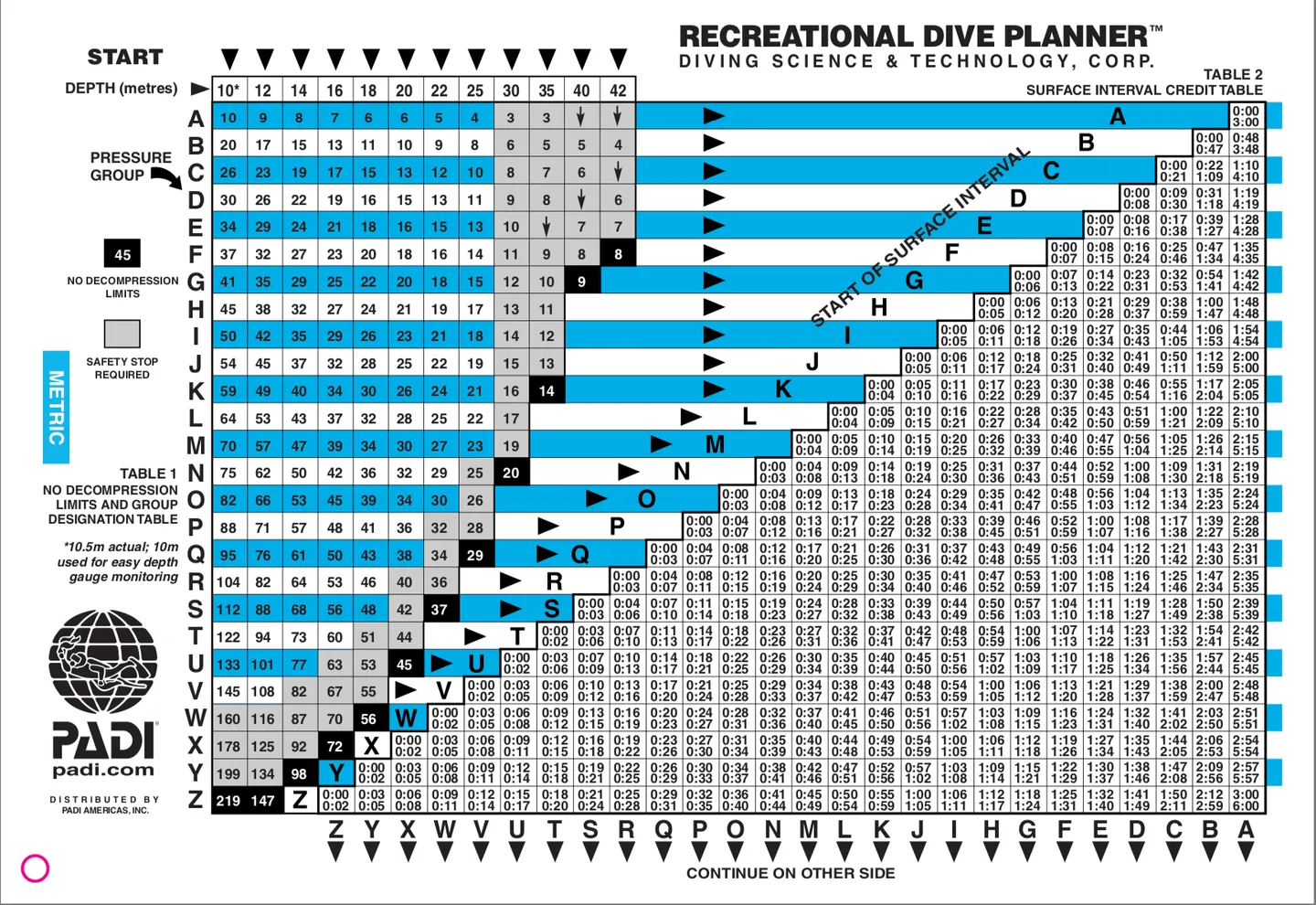
PADI RDP Table
Conditions for a "No-Decompression" Dive
The grey-shaded sections of the RDP represent no-decompression dives. This means that within these time ranges, performing a three-minute safety stop at 5 m is sufficient to significantly reduce the risk of decompression sickness (DCS) — no specific decompression procedures like those used in technical diving are required, and there is no need to enter a recompression chamber for decompression treatment after surfacing. Recreational diving is fundamentally no-decompression diving. For example, a single dive at 10 m lasting 160–199 minutes, or a single dive at 18 m lasting 51–55 minutes, both fall within the no-decompression range.
If a dive runs too long and too much nitrogen accumulates, even a three-minute safety stop at 5 m may not be sufficient to safely off-gas. To prevent residual nitrogen from exceeding what a safety stop can handle, recreational diving imposes a maximum allowable bottom time — this is the No-Decompression Limit (NDL), shown in solid black on the RDP.
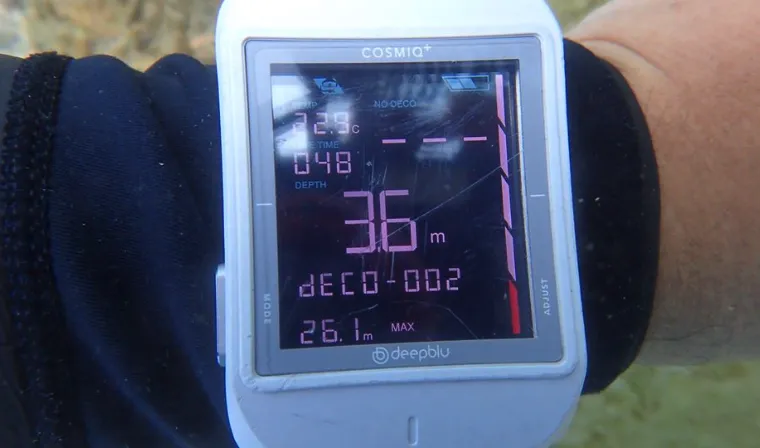
In short, the NDL is the maximum time a recreational diver may spend at a given depth. At 10 m, for instance, the NDL is 219 minutes; at 18 m it is 56 minutes. In other words, the longest single dive a recreational diver can make at 10 m is 219 minutes, and at 18 m it is 56 minutes. Because a typical diver on a single tank at 10 m can at most use air for 90–100 minutes — even with a sidemount double-tank setup it would be very difficult to exceed the NDL — dive computers usually display "–" at that depth, indicating that "you can dive until you run out of air and you'll still be safe."
Once the NDL is exceeded, the risk of decompression sickness (DCS) rises sharply. If the overage is brief, emergency decompression procedures apply: the diver must extend the safety stop to ensure safety. According to the RDP, if the NDL is exceeded by up to five minutes, the diver must perform an 8-minute decompression stop (rather than 3 minutes) at 5 m, and the surface interval after surfacing must be at least 6 hours. If the NDL is exceeded by more than 5 minutes, the diver must perform a 15-minute decompression stop at 5 m, and must wait 24 hours before diving again. If you are using a dive computer, the moment the no-decompression time is exceeded, the computer will adopt more conservative safety measures and instruct you to perform decompression stops at specific depths — follow the dive computer's instructions.
Understanding Enriched Air Nitrox (EANx) and Oxygen Toxicity
To extend the NDL and reduce residual nitrogen in the body, divers can opt to use enriched air nitrox (EANx) (also written as Nitrox, abbreviated EAN). Enriched air nitrox (EANx) is not pure oxygen — water pressure renders pure oxygen toxic. At just 4 m of depth, a diver breathing pure oxygen is already at risk of oxygen toxicity (1.4 bar atmospheric pressure × 100% oxygen concentration = 1.4 partial pressure of oxygen), and at 6 m oxygen toxicity is almost certain (1.6 bar × 100% = 1.6).
Enriched air nitrox (EANx) is a breathing-gas mixture with a higher-than-normal oxygen content, typically between 28% and 36%. A higher oxygen concentration means a lower nitrogen concentration, and therefore less residual nitrogen absorbed by the body after breathing. A 10-litre cylinder at 200 bar holds 2,000 litres of gas — standard air contains 1,560 litres of nitrogen; but with EAN x 30 (30% oxygen), the nitrogen content drops to 1,400 litres. With less nitrogen absorbed, the NDL is extended considerably.
Take 18 m as an example: the NDL for a single air dive is 56 minutes, but with EAN x 32 it extends to 95 minutes, and with EAN x 36 it reaches 125 minutes — truly making the most of every dive! Nitrox is designed to help divers stay down longer, not to dive deeper. In recreational diving, the depth limit is 40 m; regardless of certification level or gas mixture, this limit should not be exceeded for safety. Many divers therefore say that once you have your Advanced Open Water Diver (PADI cert) certification plus a nitrox certification, you're essentially set for recreational diving anywhere in the world!
Finally, the no-stop and no-decompression times on the RDP apply to single dives at a fixed depth. When divers make multiple dives or multi-level dives, the nitrogen load on the body becomes more complex. For planning repetitive dives, a dive computer makes things far simpler. A good dive computer not only provides a wealth of dive information — depth, temperature, dive time, NDL, and more — but also assists with the three-minute safety stop at 5 m and logs dive records. Some dive computers even feature a digital compass and a pressure gauge (SPG) readout for the scuba tank / cylinder (requiring a first stage regulator transmitter), giving divers a comprehensive picture of all relevant information. This is precisely why a dive computer is the first line of defence in dive safety — and why it is the first piece of equipment most divers purchase.
Cover photo by Marek Okon on Unsplash
Related links: