Contents(6)
- Synchronized Spawning Is Actually a Reproductive Strategy
- Around Mazu's Birthday Turns Out to Be Prime Time for Reproduction
- What You Should Know When Photographing Coral Spawning
- 1. Maintain neutral buoyancy — do not stand on or touch the coral
- 2. Coral spawning is everywhere — don't crowd and jostle
- 3. Keep an eye on your dive buddy — don't let solo diving become the norm
Every year on the 23rd day of the third lunar month — Mazu's birthday — another spectacular event unfolds beneath the waters off southern Taiwan. The sea surface and water column fill with a dreamlike vision of pink specks: this is coral spawning, one of the rarest and most awe-inspiring phenomena in nature. Some say the key trigger is light; others point to water temperature or tidal conditions — yet none of these theories has been conclusively confirmed by researchers, meaning the exact timing of spawning has never been reliably predicted.
What makes Kenting remarkable, however, is that this otherwise unpredictable underwater spectacle aligns almost perfectly with Mazu's birthday year after year. That reputation has drawn droves of divers to Kenting, all hoping to witness a massive coral spawning event and test their diving luck.
The third lunar month — Mazu's birthday — is the most important moment to witness coral spawning in Kenting, Taiwan
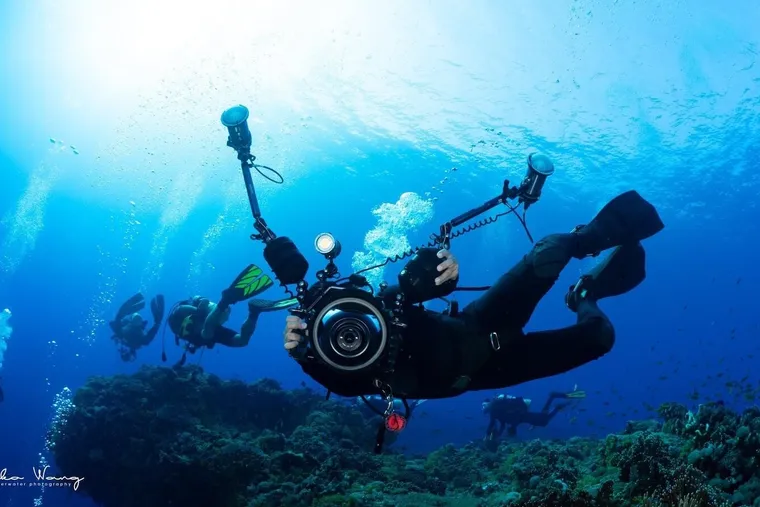
Acting on the advice of seasoned divers, we conducted three consecutive nights of night diving, entering the water at around 7:30 p.m., 8:00 p.m., and 9:00 p.m. on successive nights, timing each dive according to the tides. With the underwater world ablaze with light, the scene viewed from shore resembled the blue tears of Matsu — an equally surreal spectacle. At the surface before each descent, we could already see sheets of distinct pink coral eggs; coral releasing their gametes was visible from just 30 cm to 2 m below the surface.
During the annual coral spawning season, the outlet area at Kenting draws countless divers from across Taiwan — the surface shimmers with the reflections of hundreds of torches
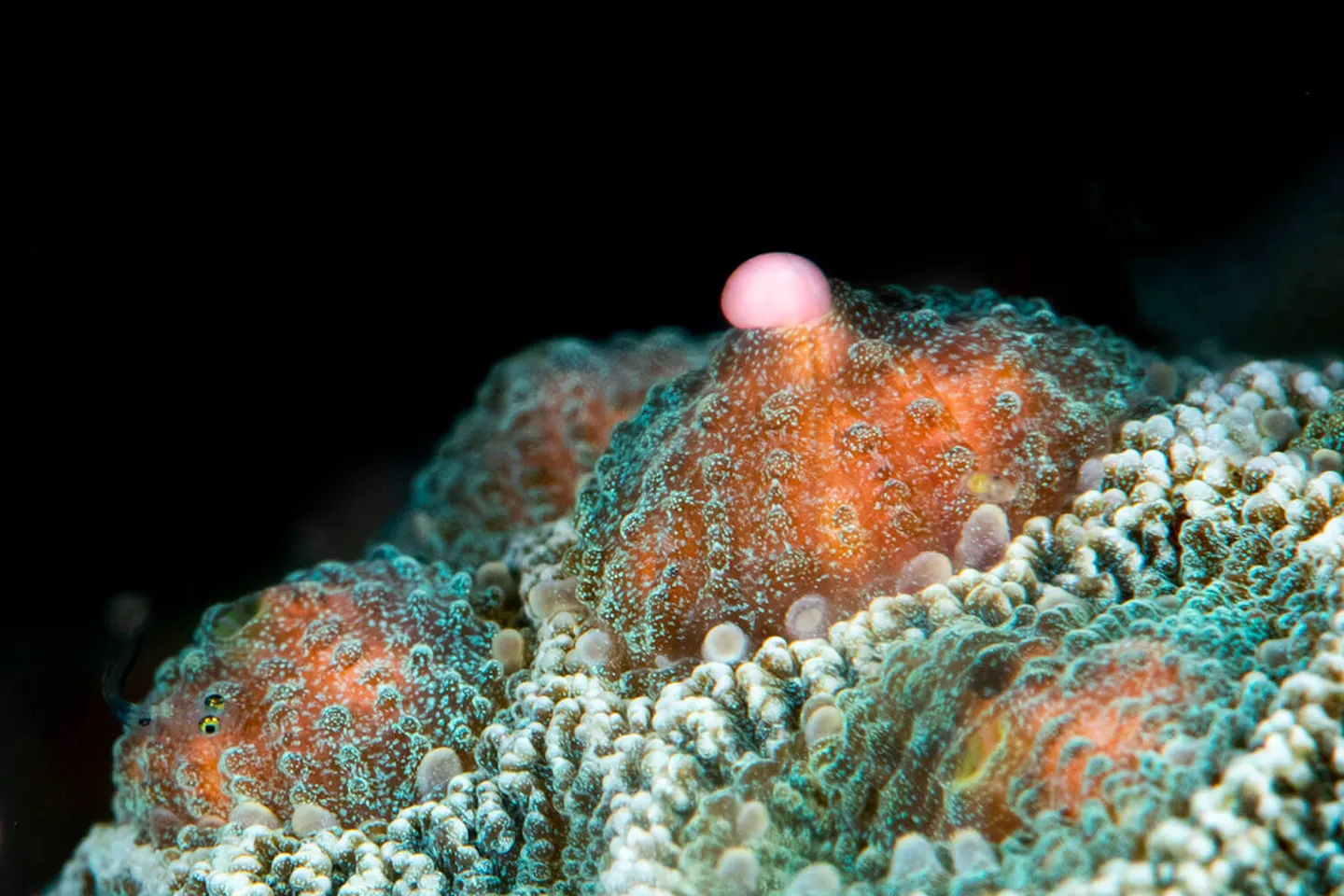
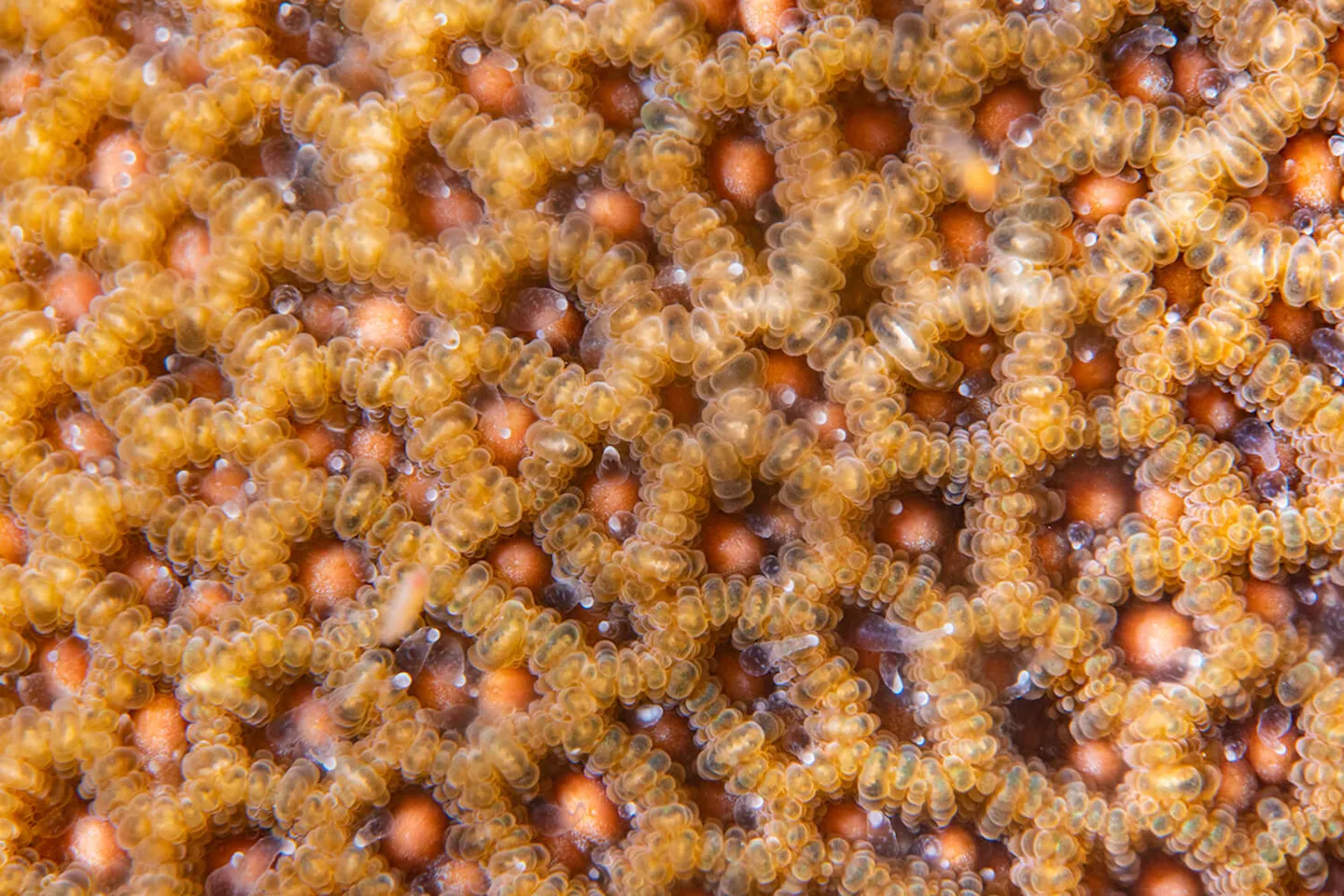
Coral eggs sit nestled inside coral polyp openings like pimples on the verge of erupting, waiting for the current to carry them away. For this reason, we recommend divers hire a dedicated dive guide from a local dive shop — not only for safety in unfamiliar nighttime terrain, but also because an experienced dive guide can help you identify which corals are about to release their eggs.
Synchronized Spawning Is Actually a Reproductive Strategy
Goniastrea favulus | Photo: Kyotaro
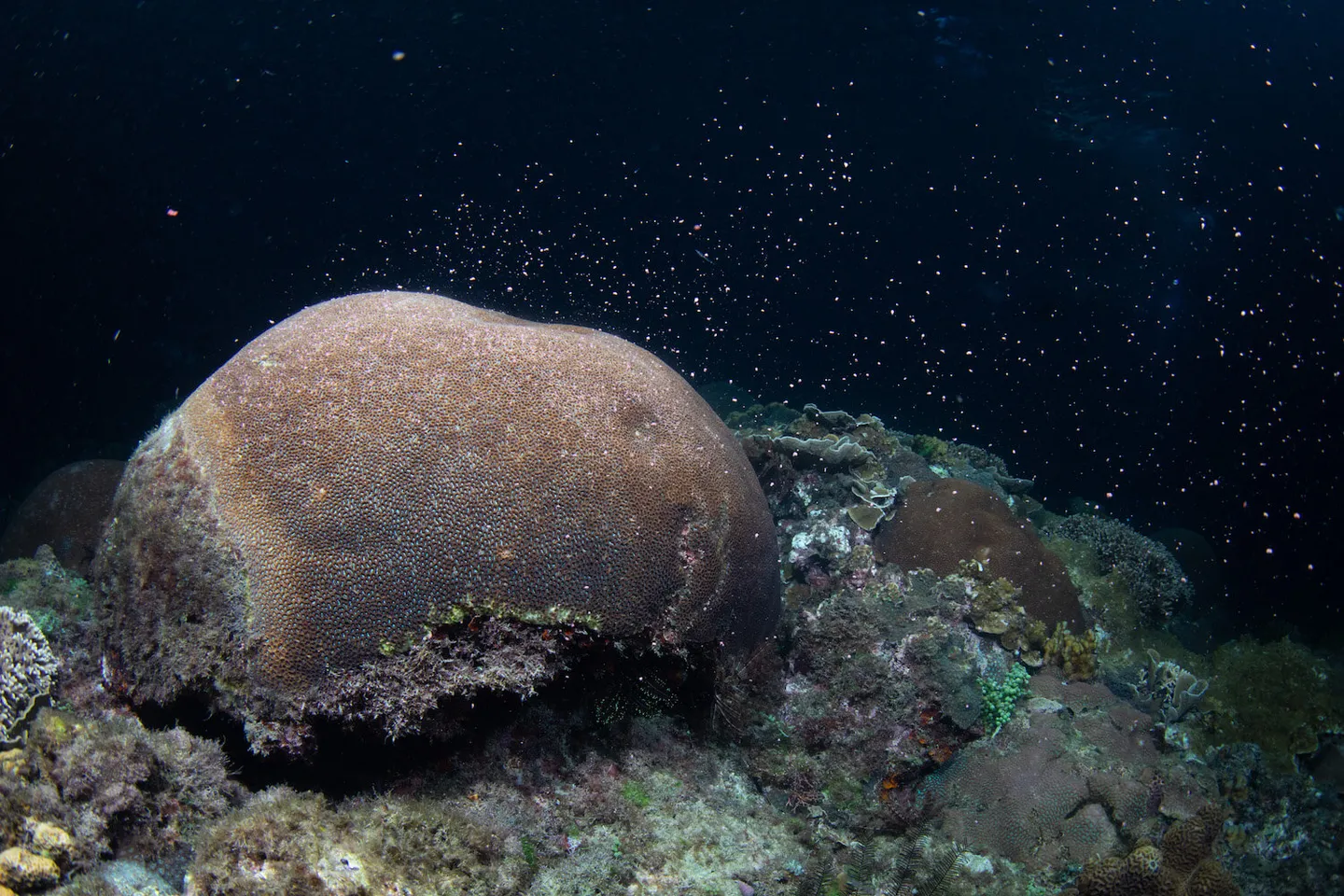
One theory suggests that coral spawning happens at night because the water is cooler than during the day and because moonlight plays a role; another holds that nighttime spawning takes advantage of sleeping fish, reducing the number of predators and thereby increasing the chances of successful fertilization. While a coral spawning event is essentially an all-you-can-eat buffet for predators, it is in fact a clever reproductive strategy designed to maximize fertilization success. Unable to move freely, corals coordinate with one another — as if by prior arrangement — and simultaneously release massive quantities of eggs and sperm into the water at a fixed time. The sheer volume overwhelms predators, leaving them dizzy and disoriented, and ultimately giving the gametes a much better chance of surviving to fertilize.
Merulinidae | Photo: Kyotaro
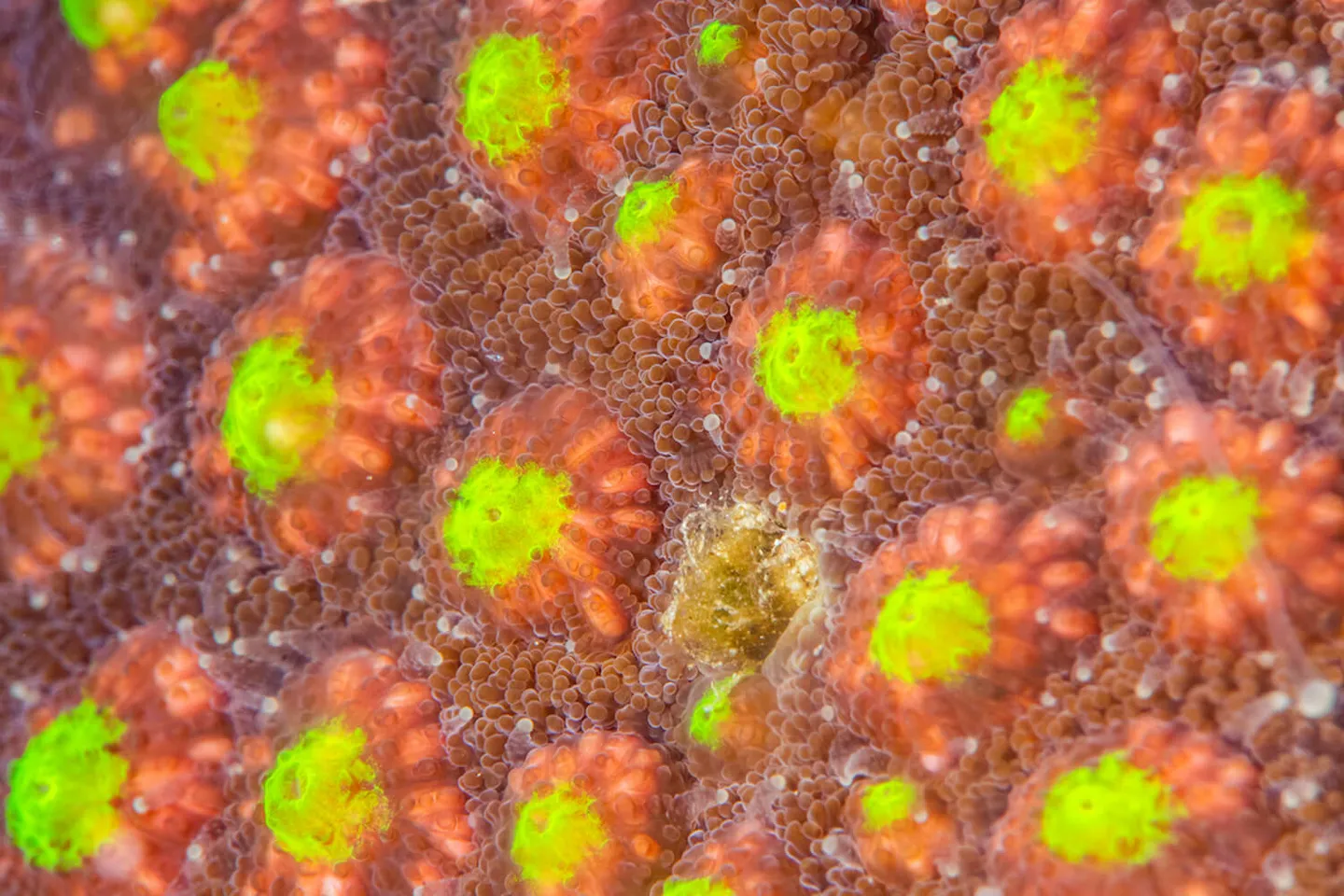
As a result, watching a coral spawn underwater can feel like a live feeding show — divers frequently witness entire shoals of priacanthids sweeping past at close range. This makes fish behavior a reliable indicator for underwater photographers trying to identify which coral is actively releasing gametes. Through macro photography, photographers can capture corals in a completely new light. Most of the coral spawning observed at the nuclear power plant No. 3 outlet in the Kenting National Park area involves corals of the family Merulinidae; however, identifying coral to species level is highly complex and requires photographs taken from multiple angles and in different states — a single image is never sufficient for an accurate identification.
'To identify coral species more accurately, start by photographing the entire colony, then take close-up shots of individual polyps and their openings. If tentacles or coenenchyme tissue are covering the coral surface, gently wave your hand nearby to encourage the tentacles to retract — this allows you to document external features more completely. If you have a scale bar handy, place it alongside the coral; this records the size of both the colony and the polyp openings, and will be of further help to whoever is making the identification.'
Cyphastrea sp | Photo: Marco


Around Mazu's Birthday Turns Out to Be Prime Time for Reproduction
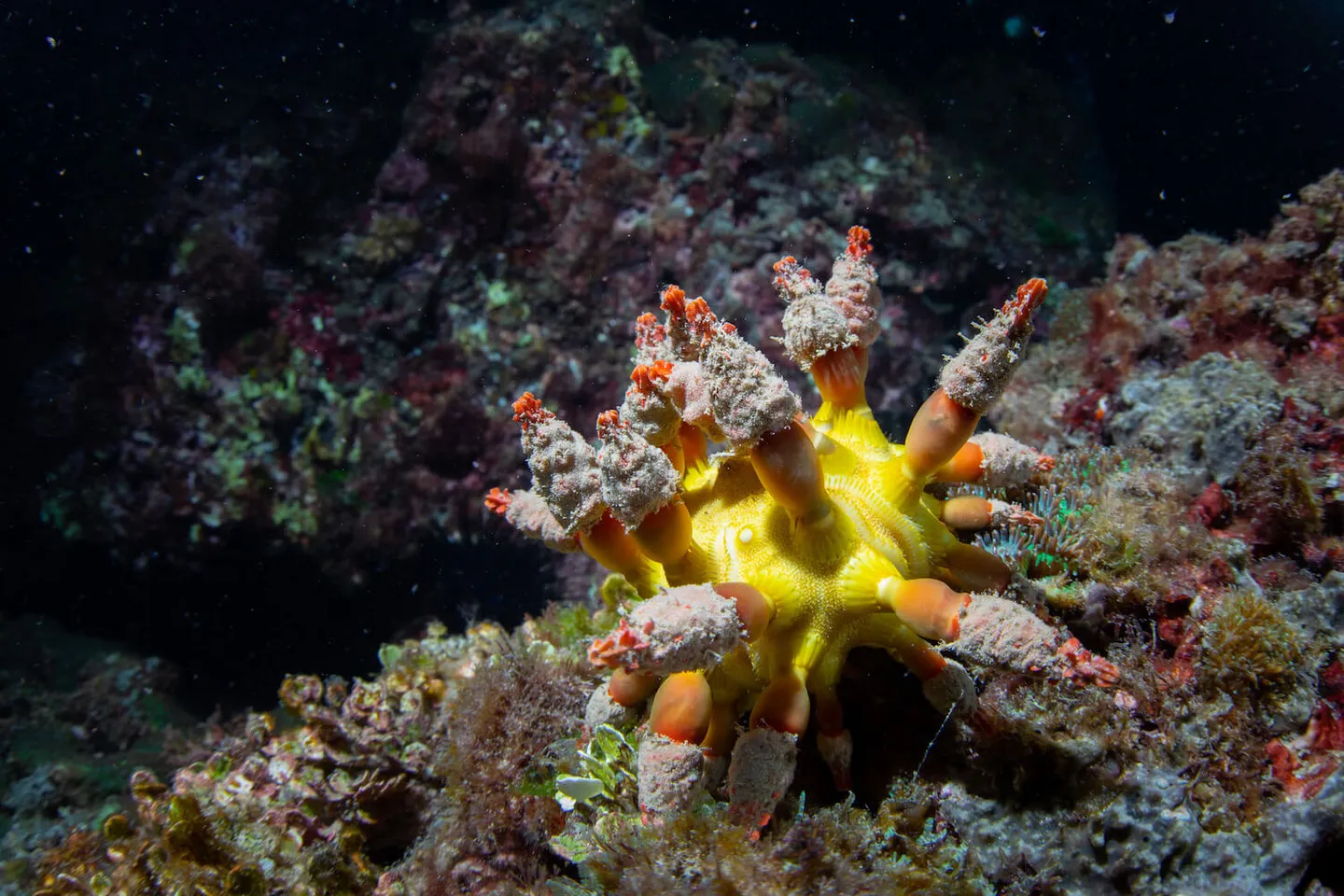
The underwater world of Kenting comes alive at the end of the third lunar month every year. Beyond the massive coral spawning event, many other marine creatures also choose this period to release their gametes into the sea. sea cucumbers preparing to spawn will raise half their body upright and emit white clouds of eggs and sperm. sea stars arch their five arms to lift the central disc off the substrate, allowing the current to carry their released gametes away from their own bodies. The delightfully whimsical-looking Chondrocidaris brevispina — with its vivid yellow spines — is another rare sight that emerges at this time in order to pass on its genes. Next time you go to watch coral spawning, take a moment to look around at the other strange and wonderful behaviors happening nearby.
Chondrocidaris brevispina | Photo: Kyotaro
Chondrocidaris brevispina looks strikingly like a strawberry-flavored popsicle from a traditional Taiwanese ice shop, which is why we affectionately call it the "popsicle sea urchin." These creatures normally hide deep within the reef and are extremely difficult to spot throughout the year — but during coral spawning season, they crawl up to the highest points of the reef and release their own gametes alongside the coral, maximizing their chances of fertilization. So after you've finished photographing the coral spawning, don't rush back to shore to sort through your images. Slow down, bow your head, and search carefully — you just might discover a rare and mysterious species hiding in plain sight!
Favites sp | Photo: Marco
What You Should Know When Photographing Coral Spawning
We are grateful to Chen Qi-en, Director of Courses at Taiwan Dive, for sharing what you should pay attention to when observing coral spawning! To observe coral spawning you will need to dive at night, which means night diving is an essential foundational skill. PADI (certification agency), SDI (certification agency), SSI (certification agency) and other agencies all offer professional night diving courses. These courses teach you how to use your Torch for navigation underwater, and — since verbal communication is impossible beneath the surface — how to combine hand signals with torch signals effectively.
Beyond night diving as the "baseline" skill for observing coral spawning, what other key points do you need to keep in mind?
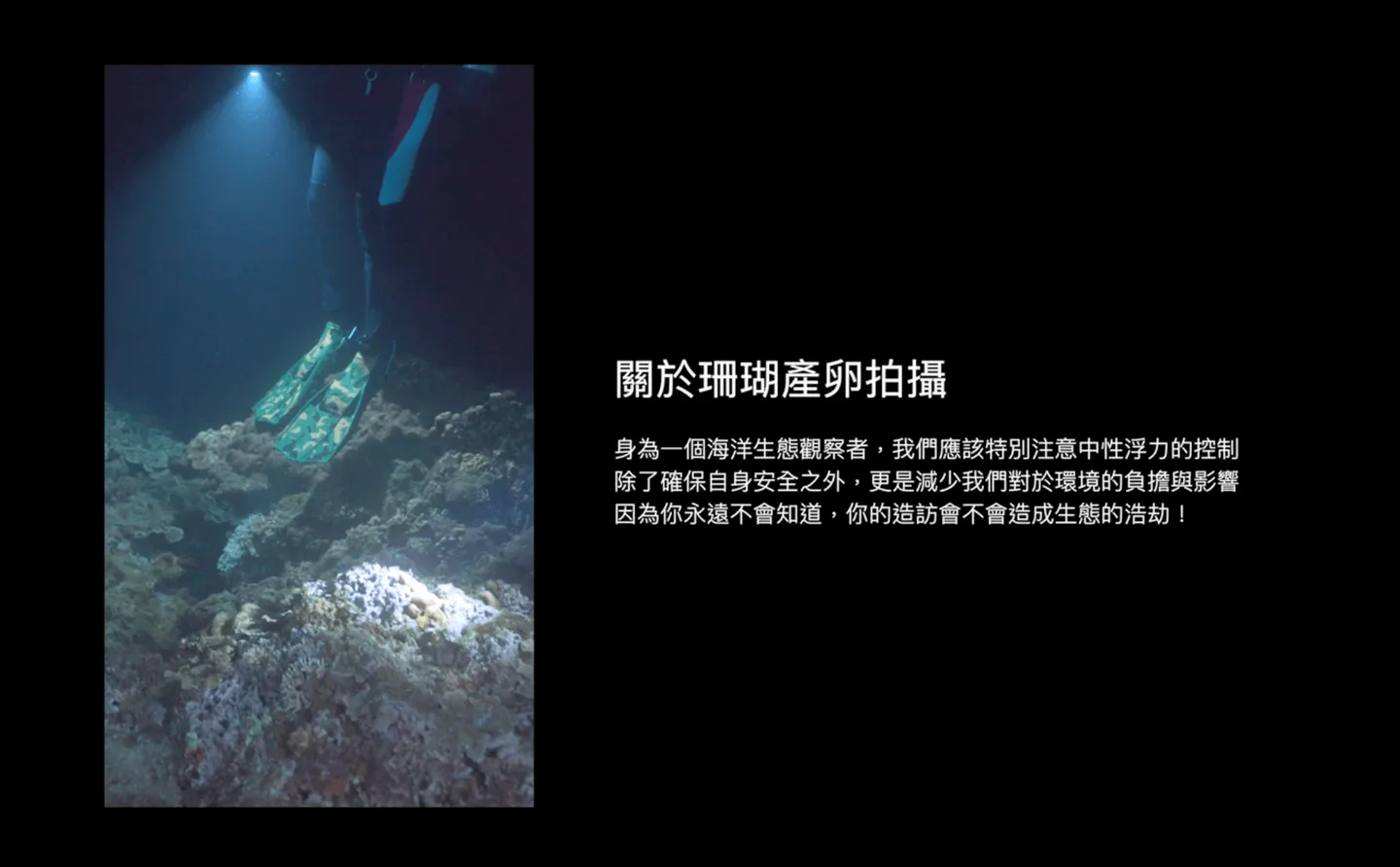
1. Maintain neutral buoyancy — do not stand on or touch the coral
Controlling your neutral buoyancy is a fundamental diving skill. Stop using "I'm a beginner" or "I'm a newbie" as an excuse to justify poor behavior! If you cannot maintain neutral buoyancy throughout your entire dive without touching the bottom, it means you need to revisit the skill with an instructor — let alone attempting to shoot with a camera, which adds risk for yourself and spells ecological disaster for the reef.
2. Coral spawning is everywhere — don't crowd and jostle
The coral spawning cycle around Mazu's birthday in Kenting is highly predictable. When you spot one coral colony beginning to release its gametes, there will almost certainly be other colonies spawning nearby at the same time. Crowding around a single coral makes for poor compositions, leads to pushing and friction between divers, and the concentrated glare of multiple torches may even interfere with normal spawning behavior.
3. Keep an eye on your dive buddy — don't let solo diving become the norm
We jokingly say that during the coral spawning weeks, the outlet area at Kenting transforms into a Kenting Night Market — the water is packed with torches lighting up the entire bay in a festive blaze. But when you're deep in concentration behind your camera, a single moment of inattention could mean you look up to find your dive buddy has disappeared, significantly increasing the risk of your dive.
Before entering the water, make sure you and your dive buddy have thoroughly discussed the lost-buddy procedure. If you do become separated, should you follow your training agency's protocol and surface to regroup, or should you attempt to move to a pre-agreed underwater meeting point and continue the dive from there? Clear communication before the dive goes a long way toward preventing incidents.
Cover image source: Marco Chang Underwater Photography.
Further reading: