Contents(10)
- What's Actually Clogging Okinawa's Waters? Operators Jump from 4 to 51, and the Whales Are Scared
- The Numbers Don't Lie: 4 Operators to 51, Tourists from 10,000 to 30,000
- What Whale Fear Actually Looks Like: A Mother's Energy Budget, Explained
- The Editor's Breakdown: Three Red Lines for Ocean-Friendly Travel
- Distance Management: Every Species Has Its Own Ruler
- Group Size Limits: Capping Numbers Isn't Killing Business
- Behavioral Rules: No Chasing, No Blocking, No Surrounding, No Touching
- Not Just Okinawa: Lessons from Xiaoliuqiu's Sea Turtles and International Guidelines
- From the Editor: Be a Diver the Ocean Wants to See Again
- Sources
Off the coast of Okinawa, things are getting crowded — not the kind of crowded you feel drifting through the crystalline blue of Kerama, but the kind where 5 or 6 boats circle a single humpback whale (written in Japanese as「座頭鯨/ザトウクジラ」; the Taiwan Cetacean Society uses the term "humpback whale") while everyone fights for the shot. On May 6, 2026, Japan's TV Asahi program Good! Morning aired a hard-hitting report on how Okinawa's whale-watching operators have ballooned from 4 to 51 in a decade, tourist numbers tripling from 10,000 to 30,000 — and how mother-calf pairs are now being driven into deep emergency dives by flotillas of tour boats. When the Editor finished watching, one thought was impossible to shake: this story is essentially a masterclass in what not to do as a sustainable diver. This piece starts with the incident itself, then lays out the three red lines every ocean-friendly traveler should know: distance, group size, and behavior. Read it, then ask yourself — the next time you head abroad for a swim-with, a whale watch, or a sea turtle encounter, are you standing on the right side of the line?
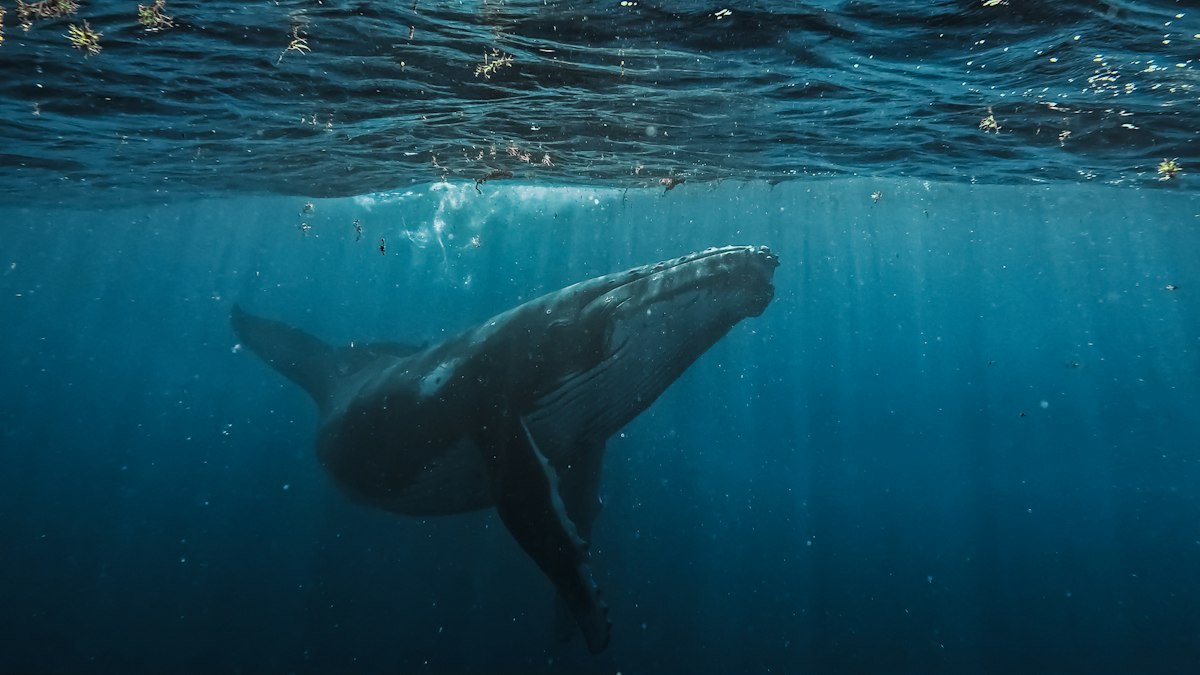
A humpback whale drifts slowly beneath the surface — a familiar sight off Okinawa in the transition from winter to spring. Photo by Oliver Tsappis on Unsplash
What's Actually Clogging Okinawa's Waters? Operators Jump from 4 to 51, and the Whales Are Scared
This all unfolded in the winter-to-spring transition of 2026. TV Asahi panned its camera across Naha Port — tourists lining up to board — then cut to five or six tour boats encircling a single humpback whale on the open ocean. The whale surfaced to breathe, was spooked within seconds, and dove deep. What the lens captured wasn't nature. It was a traffic jam.
The Numbers Don't Lie: 4 Operators to 51, Tourists from 10,000 to 30,000
The figures in the report are genuinely alarming. A decade ago, only 4 operators ran whale-watching tours in Okinawa. Today there are 51. Visitor numbers have climbed from roughly 10,000 to around 30,000. The boats multiplied twelvefold; the tourists tripled. The number of whales did not. On days when sightings are scarce, 5 to 6 boats descend on the same whale simultaneously — a scene the Editor can only describe as "a whale-edition limited-release ticket stampede."
Okinawa currently has four whale-watching associations that have drawn up voluntary guidelines. Tour boats are in principle required to maintain a distance of at least 100 meters from the whales; observation of mother-calf pairs must be limited to one hour; some operators in the northern part of the island have voluntarily suspended "swim-with-whale" programs. That all sounds responsible enough — but out of 51 operators, how many are actually complying? Who's enforcing it? Does parking 5 or 6 boats just outside 100 meters count as following the rules? After reading the report, the Editor's only question was this: if voluntary guidelines exist only as text on a website and there's no one on the water blowing the whistle, can they realistically hold back the pace of industry expansion?
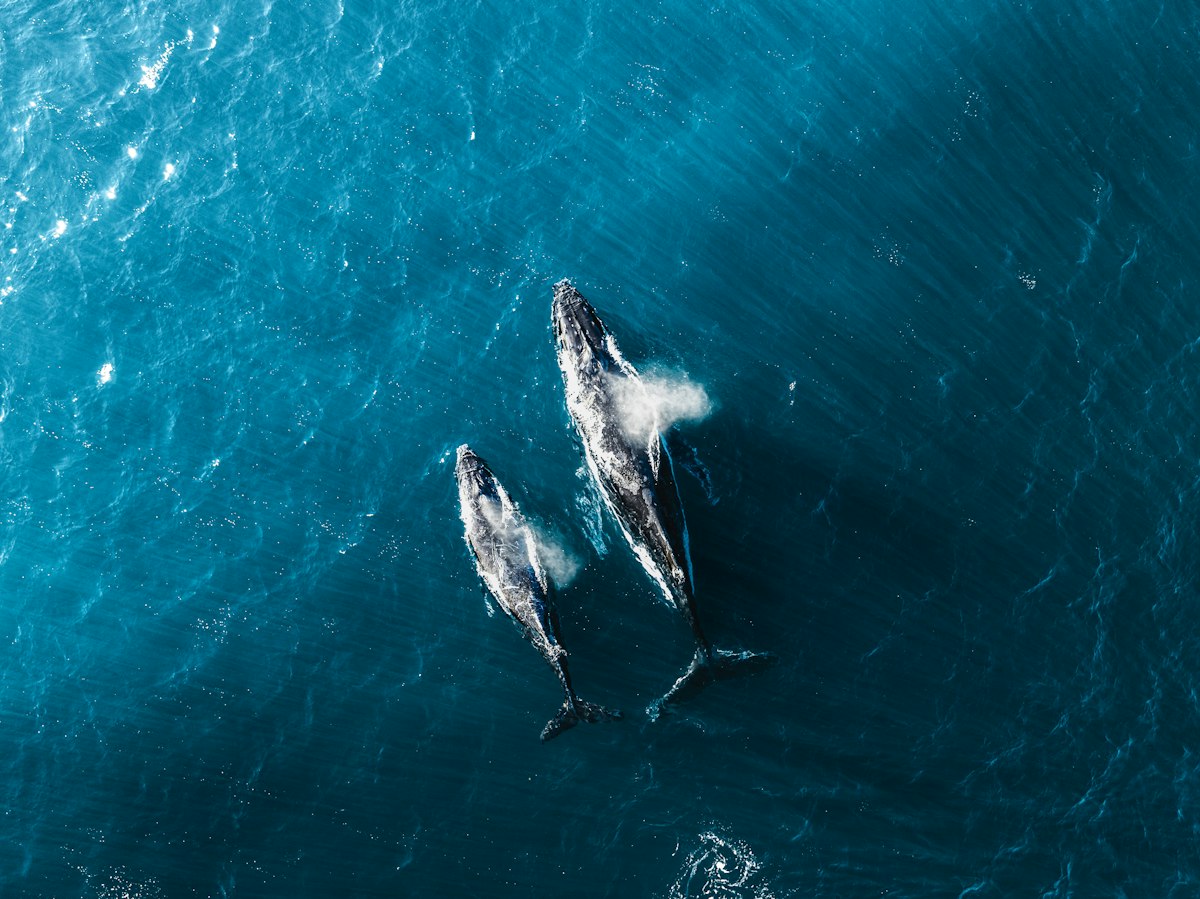
A mother humpback whale swims alongside her newborn calf. Every time a boat frightens her into a deep dive, it's energy deducted directly from her calf's milk supply. Photo by Jonathan Hsu on Unsplash
What Whale Fear Actually Looks Like: A Mother's Energy Budget, Explained
The moment that hit the Editor hardest in the report was when both the boat captains and researchers noted that the whales had started to "fear boats." The moment a vessel approached, the whales would dive deep — the languid, stationary surface rest that's their signature behavior replaced by rapid, evasive movement. For an animal 15 meters long, that picture is deeply wrong. Humpback whales rest motionless at the surface — that's their standard resting posture during their time in Okinawa. Drive a boat over and send them into a panic dive, and you've just yanked someone off the couch and made them sprint 100 meters. For you or me, maybe no big deal. For a mother whale who's just given birth, it's another matter entirely.
For the roughly three months humpback whales spend in Okinawa, they eat almost nothing. They survive on fat reserves built up eating through summer in Alaskan waters, gradually converting that stored energy into milk for their newborn calves. Every unnecessary deep dive, every panicked sprint during this period, comes directly out of the calf's milk ration. The report made a key point: whether a calf can successfully follow its mother back north to Alaska depends directly on how well-fed it is during those months in Okinawa. In other words, the moment your boat frightens that mother whale into fleeing — you may have just, without knowing it, altered the fate of the next generation of humpback whales.


The Editor's Breakdown: Three Red Lines for Ocean-Friendly Travel
Alright — incident documented. The Editor's point isn't "don't go whale-watching in Okinawa." It's about how to take this case of marine over-tourism and turn it into a checklist for the next time you book a dive trip or a swim-with experience. Ocean-friendly travel isn't a romantic slogan. It's three very concrete red lines.
Distance Management: Every Species Has Its Own Ruler
Different species have different comfort zones, and there's no one-size-fits-all measurement. Okinawa humpback whales: boats must stay 100 meters or more away. Xiaoliuqiu sea turtles: people must stay at least 5 meters away. Whale Shark swim-withs (Donsol in the Philippines and similar sites): minimum 3 meters from the head, 4 meters from the tail. manta rays (Manta Trust guidelines): 3 meters or more; observe cleaning stations from the outside perimeter.
Why such different numbers? Because body size, sensory systems, and threat responses vary enormously between species. Humpback whales are spooked by engine noise and propellers — they need a wide buffer. Sea turtles are stressed by being surrounded and cut off — 5 meters gives them enough of an escape route. Whale Sharks are large but slow-moving; 3 meters is enough clearance for the tail to sweep freely. The Editor's recommendation is simple: before entering any dive site, ask the local operator: what is the legally required or recommended distance for this species? If they can't answer, find another operator.
Group Size Limits: Capping Numbers Isn't Killing Business
The second red line is group size. The fundamental problem in Okinawa was too many boats in the same place at the same time. The Editor has seen some international operators limit in-water groups to just 6 people; some whale-watching boats out of Naha carry 40 to 60. Which side respects the whales more? The answer isn't really about boat size — it's about whether an operator is willing to wait. Willing to wait for the next whale to appear. Willing to give up a shot. Willing to cut the engine and drift. That's what capping group numbers is actually doing. If the operator you're booking with leads with "guaranteed whale sighting" or "fully booked departure," the Editor suggests you walk away and find someone else. Guarantees like that aren't a sign of an operator's skill. They're a sign of the price being paid — and right now, that price is being paid by the whales.
Behavioral Rules: No Chasing, No Blocking, No Surrounding, No Touching
The third red line is behavior. Taiwan's own Xiaoliuqiu actually offers an excellent template here: the Five No's — no chasing, no disturbing, no touching, no feeding, no harming. Internationally, the Green Fins code of conduct (co-founded by the United Nations Environment Programme UNEP and the Reef-World Foundation, with PADI as a global partner) explicitly requires: no chasing, no touching, no feeding, maintain distance and give space. It's the same principle as Xiaoliuqiu's Five No's — just without specifying exact distances, leaving that to individual species guidelines and local regulations.
One-line summary: let the animal decide whether it wants to approach you. You've entered its home. If it doesn't want to see you, you respect that. The problem in Okinawa was boats intercepting the whales' swimming paths — that's not observation anymore, that's containment. The Editor will say it plainly: encirclement-style whale watching is wrong. No matter what country. No matter what justification the operator offers.
Not Just Okinawa: Lessons from Xiaoliuqiu's Sea Turtles and International Guidelines
If you think this is purely a Japan problem, the Editor suggests looking closer to home. Ten years ago, Xiaoliuqiu was a word-of-mouth niche dive site. Today it's a tourist hotspot marketed on the promise of "guaranteed sea turtle sightings." The pace of that transformation looks a lot like Okinawa's. Once "guaranteed sighting" becomes a marketing tagline, operators start chasing volume — snorkeling groups enter the water one after another from morning to night, and sea turtles around Vase Rock and Lobster Cave get surrounded. The Editor has been there several times; the most visceral memory is a snorkeler's fins less than 2 meters from a sea turtle, someone reaching out to touch the shell, the operator shouting from shore — but sound doesn't travel underwater.
Taiwan actually has the regulations it needs. Pingtung County and civil society organizations jointly promote the 5-meter rule and the Five No's. Touching or harassing a sea turtle is a direct violation of Article 42 of the Wildlife Conservation Act, with fines ranging from NT$60,000 to NT$300,000 and/or up to one year of imprisonment. Marine citizens who witness violations on-site can photograph and report them. Taiwan doesn't lack the laws. What it lacks is whether anyone on the ground is willing to enforce them. The TV Asahi report is really a warning to Taiwan's operators: once "guaranteed sightings" become an expectation widely accepted by the market, the ecological pressure index rises exponentially — and the red lines get crossed one by one.
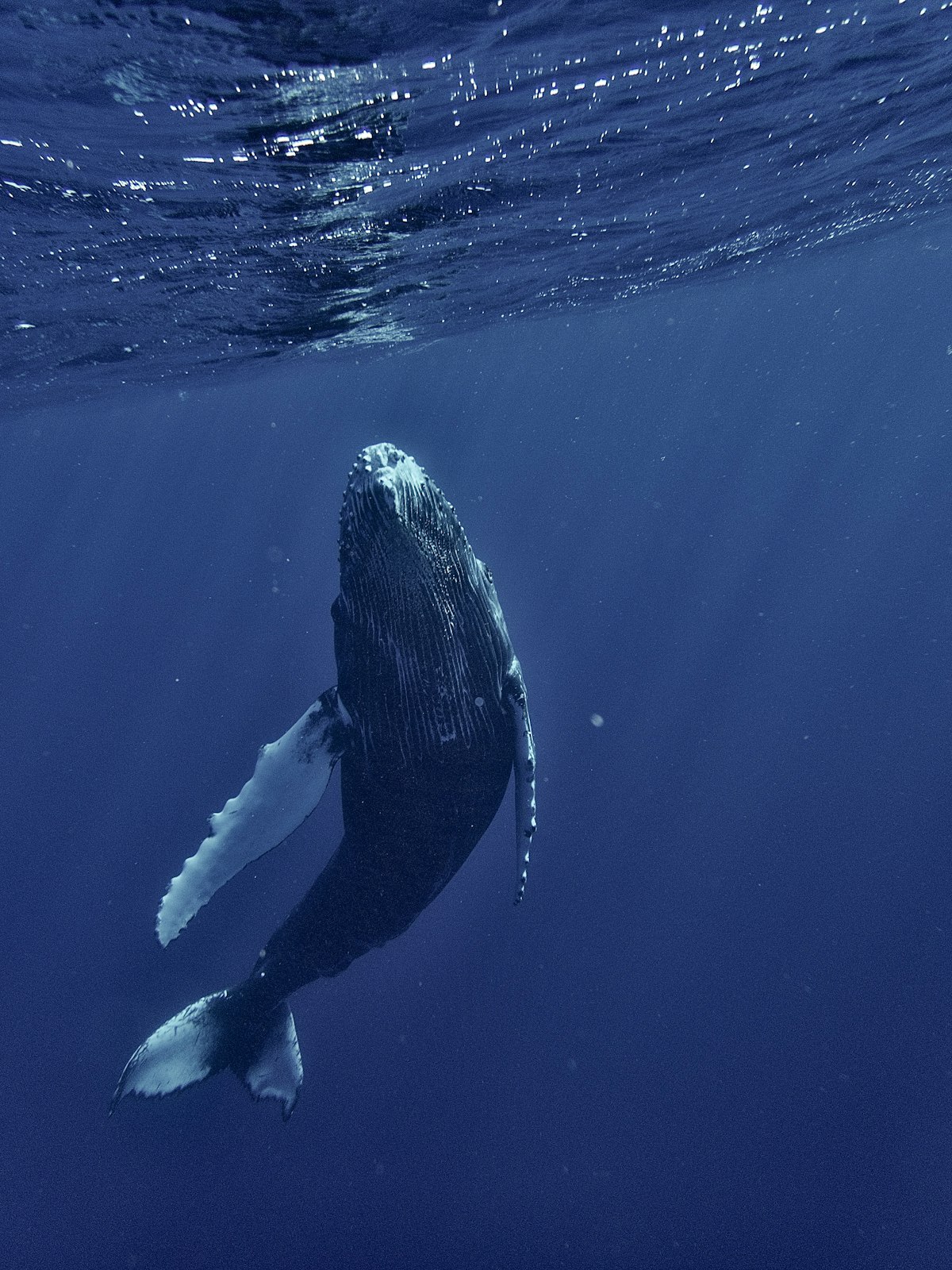
Let the animal decide whether to approach you — this is the shared spirit behind every international code of conduct. Photo by Chinh Le Duc on Unsplash
For divers who want to act responsibly, the Editor recommends keeping a few international guidelines in mind — something you can pull out when choosing a dive shop or booking a trip. Green Fins is a code of conduct for dive operators co-founded in 2004 by the United Nations Environment Programme (UNEP) and the UK's Reef-World Foundation; Reef-World now serves as the international coordinator, with PADI joining as a global partner in 2018. Its 15 Icon standards govern not just divers, but dive shops themselves: briefing content, waste handling, fuel spill management, and principles for interacting with marine life (no chasing, no touching, no feeding, give space — distances are not specified in meters). Next time you're choosing a dive shop, check whether it's a Green Fins Member — that's essentially checking whether it's willing to be scored against an international standard.
Whale Shark swim-withs: If you're planning to swim with Whale Sharks in Donsol in the Philippines or La Paz in Mexico, keep two numbers in mind: minimum 3 meters from the head, minimum 4 meters from the tail. No fins (to avoid kicking the Whale Shark), no flash photography, never block the animal's path. Donsol now has dive guides in the water who blow a whistle to stop violations.
manta ray swim-withs: Manta Trust has released a sustainable tourism guide at swimwithmantas.org, distilling responsible manta ray encounters into 10 steps — from how to enter the water, to maintaining a 3-meter distance, to observing cleaning stations from the outer perimeter, not approaching from above, and not chasing. The Editor wrote a full breakdown previously: How to Swim with Manta Rays Responsibly — Manta Trust's 10-Step Guidelines, All in One Place — recommended reading before your next swim-with trip abroad.
Taken together, all of these guidelines are saying one thing: keep the animals willing to return to that stretch of ocean, year after year. If you respect the distances, respect the limits, and respect the behavioral rules today, that ocean will still have something to show you next year.
From the Editor: Be a Diver the Ocean Wants to See Again
The Editor wants to be honest with you before signing off. Ocean-friendly travel sounds like a slogan for conservationists — but for us as divers, it's deeply practical. Whether we get to see that sea turtle again, that Whale Shark, that school of manta rays, depends entirely on how we treat them today. Among those 51 Okinawa operators, some will lose money, some will be pushed out of business — but the worse outcome is if the humpback whales decide this stretch of ocean is no longer a safe place to raise their young, and the entire industry disappears with them.
The joy of being a diver isn't in "what I saw." It's in "whether the ocean is still willing to show me." Before you book a liveaboard, sign up for a snorkeling tour, or reserve a spot on a swim-with, ask your operator three questions on the Editor's behalf: What are your distance guidelines? How many people per group? And if the animal wants to leave — will you let it? Only book when all three answers are right.
Sources
- TV Asahi Good! Morning, broadcast May 6, 2026. YouTube video link
- SSJP (速速日本) Chinese-language summary: Okinawa's Whale-Watching Boom Causes "Marine Over-Tourism" — Humpback Whale Behavior Shows Alarming Changes
- Green Fins / Reef-World Foundation (introduced via PADI Pros Blog): The Reef-World Foundation's Green Fins Code of Conduct
- Manta Trust "How to Swim with Mantas" 10-step guidelines: swimwithmantas.org
- Xiaoliuqiu sea turtle Five No's and Wildlife Conservation Act Article 42 regulatory summary (compiled from Pingtung County Government and civil society sources)