Contents(11)
- The Batfish Are Back at Green Island's Steel Reef: How Much Value Can One Artificial Reef Generate?
- Not Just Green Island: Over 200 Batfish Sighted in a Storm at the Keelung Steel Reef
- The Keelung Steel Reef Controversy: A Speargun on the Same Boat — "This Isn't a Protected Area, Catch Whatever You Want"?
- Legal Grey Area No. 1: Is Spearfishing with Scuba Gear Legal? There's No Nationwide Blanket Ban — But the Legal Space Has Been Squeezed to Almost Nothing
- Legal Grey Area No. 2: If You're Diving from a Recreational Fishing Vessel, What Fishing Methods Are Allowed? Just Three
- Legal Grey Area No. 3: What If I Take My Own Yacht Out with a Speargun? A Fine of NT$60,000 to NT$300,000 If Your Catch Qualifies as a Haul
- Legal Grey Area No. 4: Aren't Artificial Reefs Already No-Take Zones by Default? Mostly, Yes
- So Why Does the Coast Guard So Often Fail to Intervene? Here's an Awkward Regulatory Gap
- Beyond the Law: Artificial Reefs Are Nurseries, Not Hunting Grounds
- Practical Reference: Quick Legality Check for Spearfishing While Diving & How to Report It
- Conclusion: No Single Phrase Like "This Isn't a Protected Area" Can Override This Many Laws
How much is one batfish worth? Green Island's steel reef teira batfish population recently rebounded from just ten individuals to around forty. A living school of batfish can bring in hundreds of millions of NT dollars in tourism revenue for an entire island over a year — but shoot one with a speargun and it's worth nothing more than a single meal. The Editor opens with this calculation because something happened at the Keelung Steel Reef just a few days ago: dive instructor @vamos_diving reported on Threads that during a boat dive, someone on the same boat descended with a speargun to catch fish — and before anyone entered the water, the boat operator announced to everyone on deck: "This isn't a protected area, so whatever you catch down there has nothing to do with us." The Editor's bottom line: that statement is completely wrong. The vast majority of artificial reef zones are designated no-take areas officially gazetted by regulatory authorities under the Fisheries Act, and catching anything inside them is illegal. Even outside a no-take zone, using scuba gear to bring up a "catch quantity" of fish constitutes unlicensed commercial fishing. And the only fishing methods permitted on recreational fishing vessels are rod-and-line, handline, and trolling — spearguns are nowhere on the list. In this piece, the Editor has compiled all four key legal grey areas surrounding artificial reef no-take zones, their penalties, and the relevant references — all in one place.
The Batfish Are Back at Green Island's Steel Reef: How Much Value Can One Artificial Reef Generate?
First, some good news. The teira batfish at Green Island's steel reef are back.
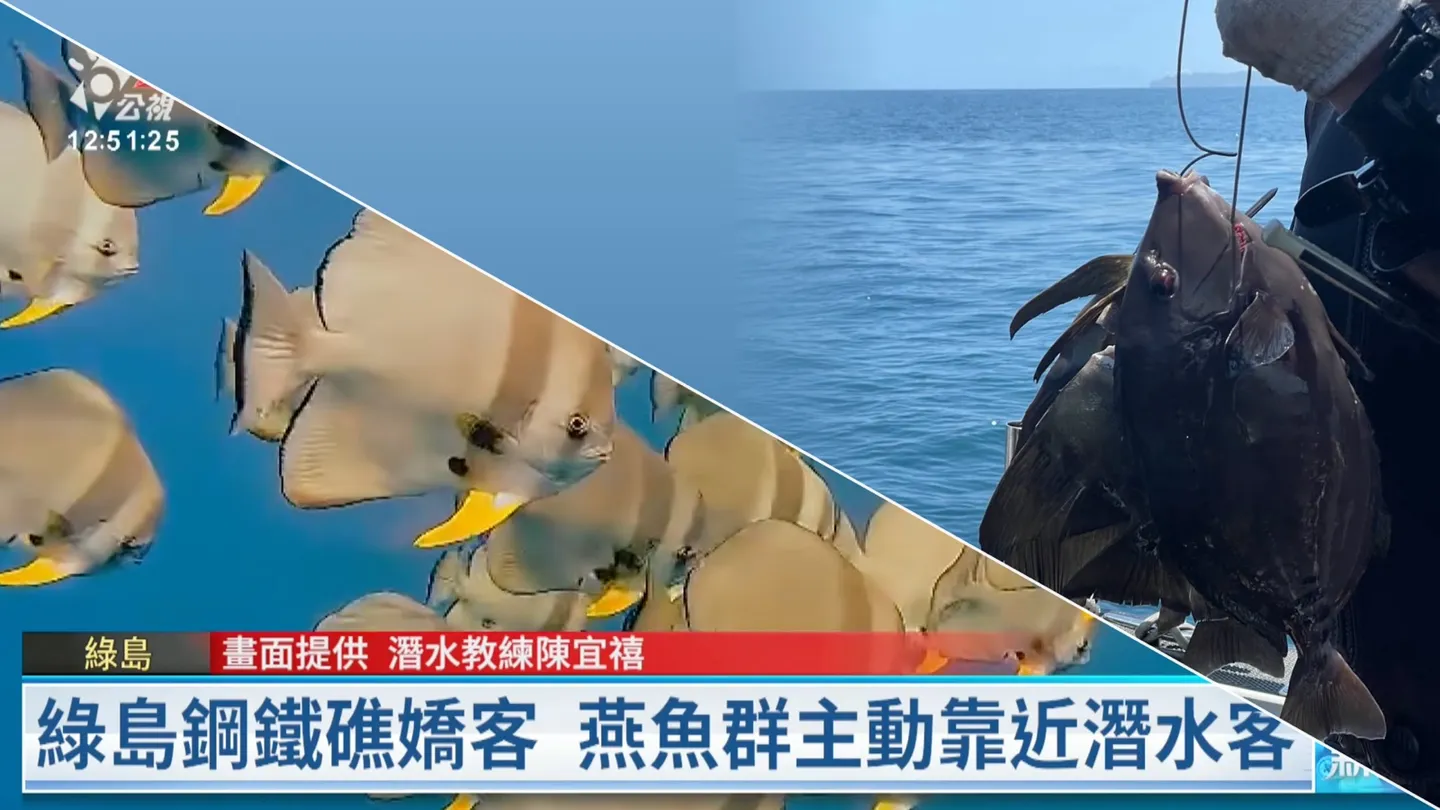
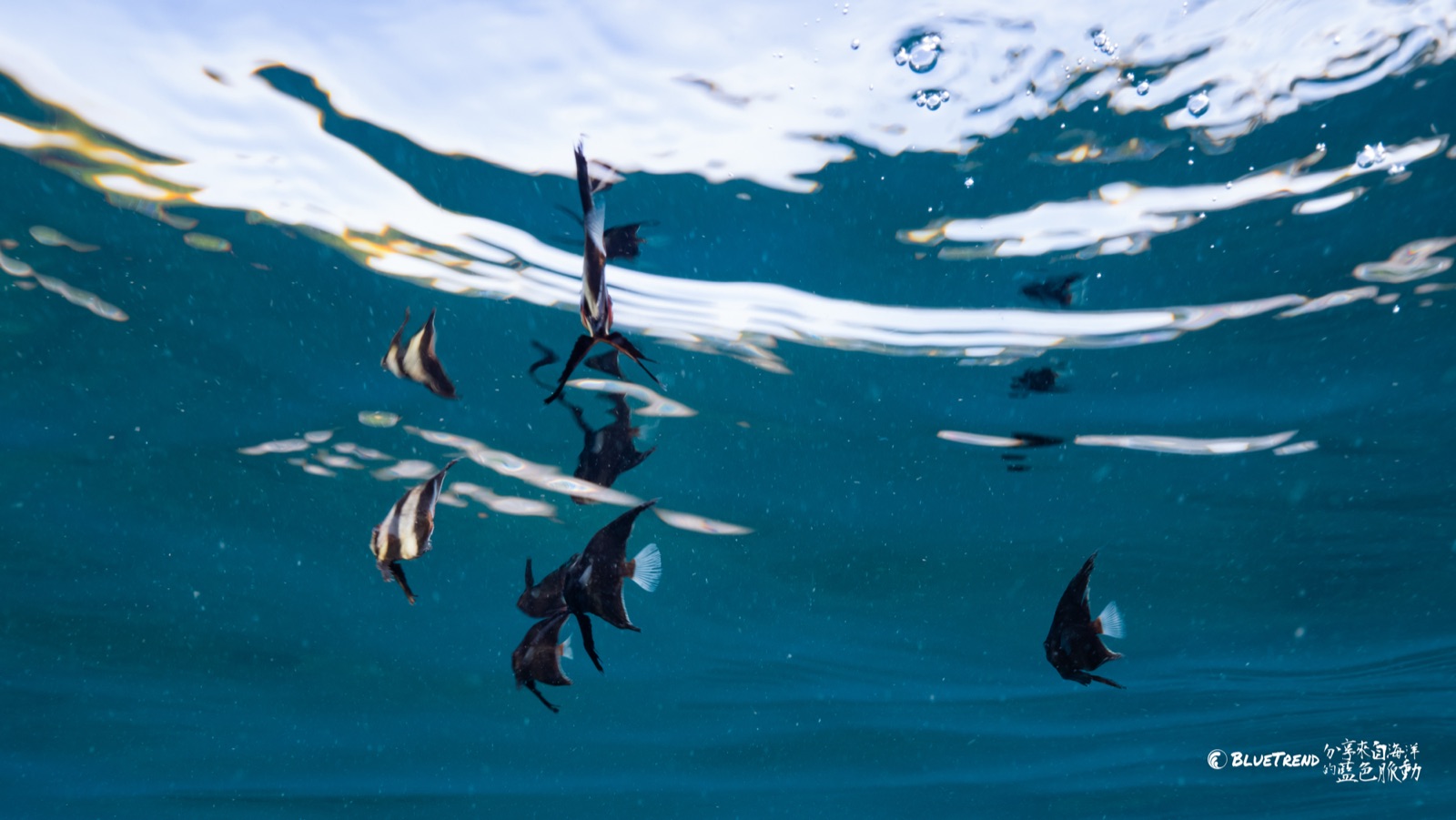
According to a PTS News report, this steel artificial reef — resting on a sandy seafloor at around 30 metres — was recorded late last month by divers hosting a school of approximately forty batfish that would actively swim up to people. That number might not sound impressive, but bear in mind: in 2025, only ten individuals remained here, and more than a decade ago the entire school vanished for unknown reasons. In the report, Huang You-xu, associate researcher at the Eastern Marine Biology Research Center of the Fisheries Research Institute, explains that teira batfish are not migratory — as long as they are left undisturbed, they will slowly rebuild their population in the same waters. Historical records show that more than a hundred individuals once lived here. (Wondering how to tell a teira batfish from a Platax orbicularis? The Editor previously wrote a guide on the four major batfish species — one read and you'll have it sorted.)
The Editor wants to ask you a question: how much are those forty batfish worth?
If someone shoots one with a speargun, it becomes a single meal on a table — worth a few hundred NT dollars — and the reef loses one more icon. But if they stay in the water, Green Island sees roughly six thousand visitors per day at the summer peak, a large proportion of whom come specifically to dive, and the steel reef is practically a must-visit site for advanced divers on any trip to the island. That same school of batfish, photographed by thousands of divers each year and shared across countless social media posts, continuously generates income for guesthouses, boat operators, instructors, and restaurants across the whole island. That is the point of an artificial reef: it is meant to let fish recover into a wild population — a goose that lays golden eggs — not to serve as a one-time hunting ground.
This gap in value has been quantified clearly by research overseas. A widely cited study from Palau (Vianna et al., 2011) calculated that a single living reef shark, through dive tourism, generates a lifetime value of approximately US$1.9 million — around US$179,000 per year — while the same shark, if caught and sold, yields a one-time value of only about US$108. Alive versus harvested: a difference of nearly 20,000 times. The same logic applies to the iconic fish that inhabit artificial reefs. Working backwards to a rough estimate for Green Island: with six thousand visitors per day at the summer peak, even conservatively assuming only one-third have any connection to scuba diving or snorkeling, and each dive package running anywhere from NT$5,000 to over NT$10,000, stacked on top of accommodation, transport, and food and drink costs, the tourism cash flow from a single summer peak season alone runs into the hundreds of millions. And the batfish school at the steel reef is the living magnet that holds that draw together. The Editor should stress that this figure is a conservative back-of-envelope calculation, not an official statistic — but the direction is clear: leave the fish in the water and the revenue keeps coming in year after year; shoot them and you're left with the price of one meal.
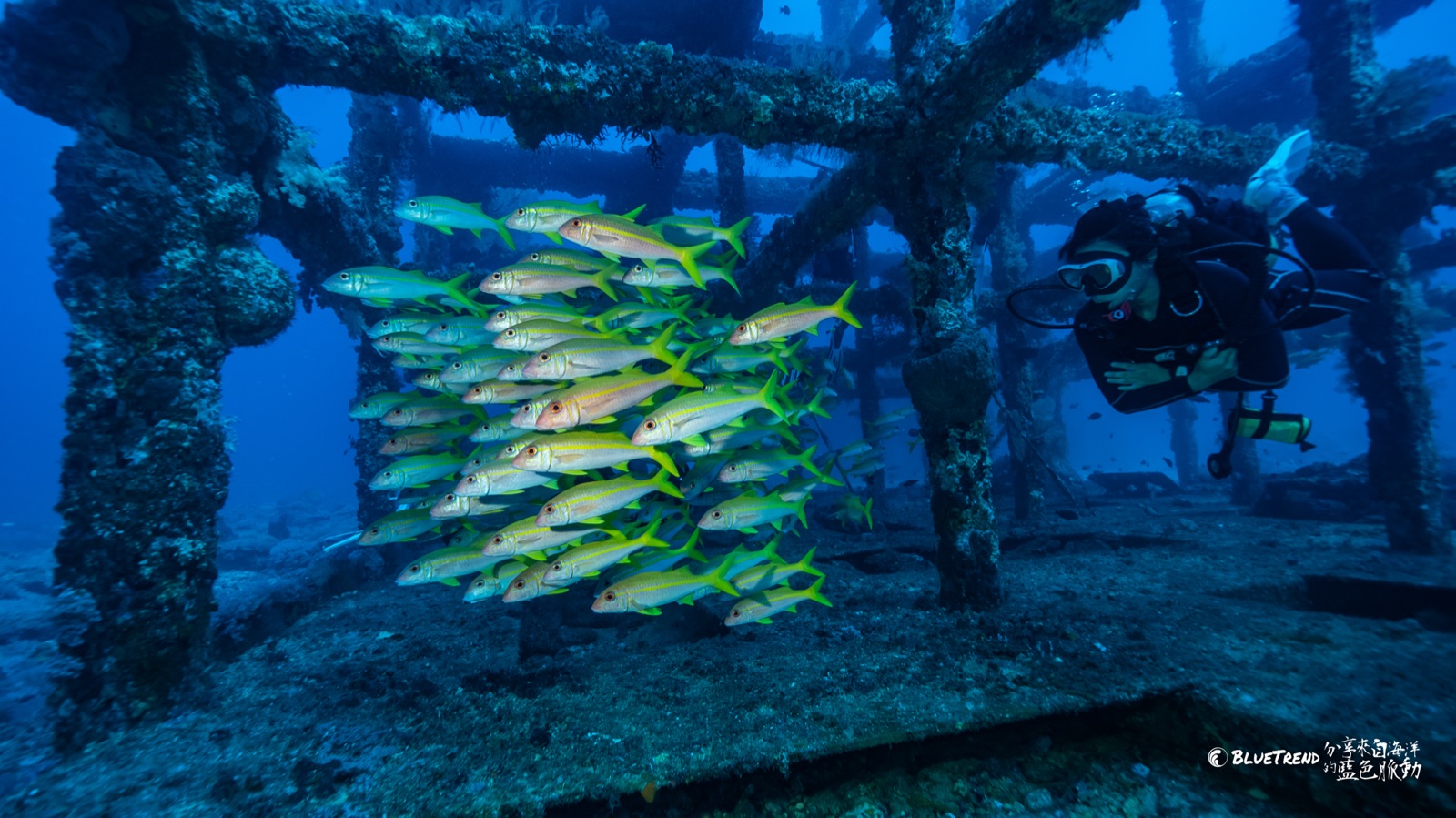
It took Green Island more than a decade of establishing conservation zones and sinking steel reefs to bring the batfish back one by one. And Green Island is not the only place where steel reefs have helped batfish recover — Keelung, in northern Taiwan, recently recorded an almost identical scene.


Not Just Green Island: Over 200 Batfish Sighted in a Storm at the Keelung Steel Reef
A batfish storm is not unique to Green Island. On 4 July 2026, dive instructor Beckham was leading a boat dive when the group encountered more than 200 teira batfish swimming together in formation at the Badouzi Steel Reef in Keelung — forming a spectacular batfish tornado described as a once-in-a-century sight in the Northeast Coast waters.
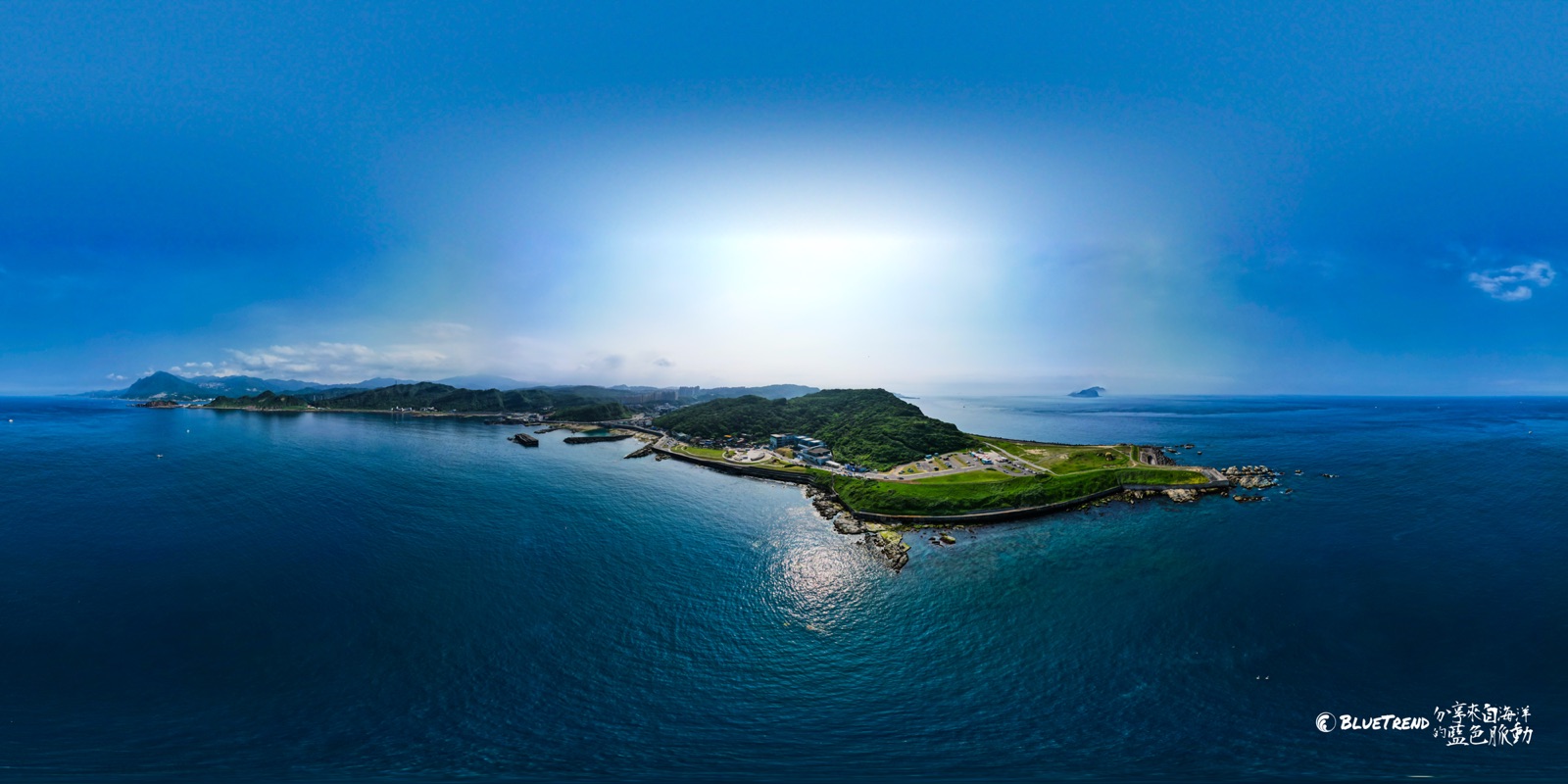
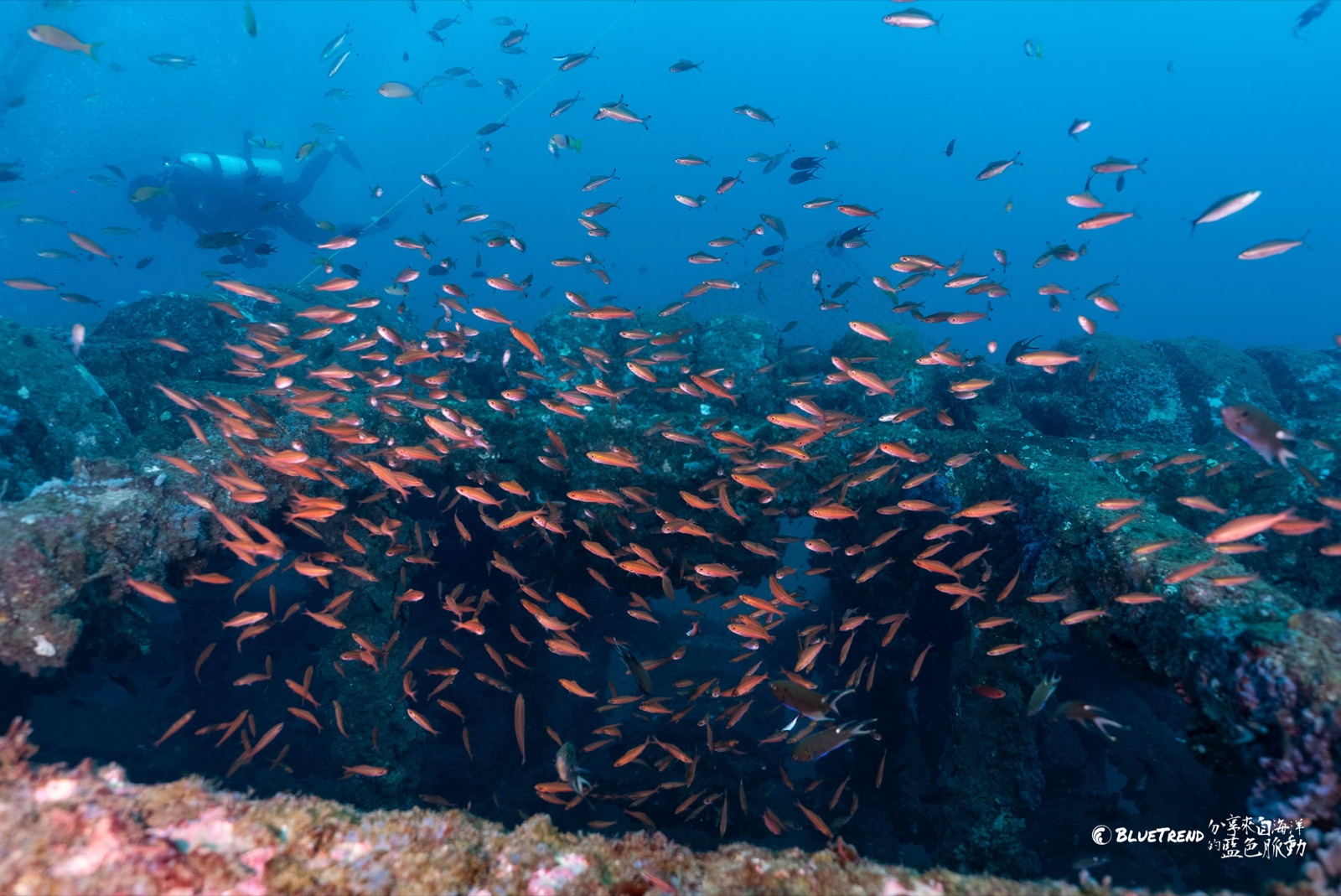
The Badouzi Steel Reef sits on the outer edge of the Keelung Wanghaijhang Chaojing Bay Aquatic Resources Conservation Area. It was sunk specifically to protect the marine ecosystem and increase fish populations, and is rated as an intermediate-to-advanced dive site. The massive steel structure is now blanketed in soft coral and gorgonian / sea fans, and has become a landmark artificial reef that draws fish year-round — the finest proof yet that conservation efforts in the area have paid off.
Ironically, just a few days after this batfish storm left the diving community awestruck, reports emerged that a diver had descended to the very same steel reef with scuba gear and a speargun — and fired on the school. On one hand, a breathtaking ecological spectacle that dive instructors were bringing groups to witness and that countless people were clamouring to see; on the other, someone shooting those fish one by one. Protection and predation, colliding head-on at the same reef. That is exactly why, the moment the Editor saw the spearfishing report, there was no choice but to lay all of this out clearly.
The Keelung Steel Reef Controversy: A Speargun on the Same Boat — "This Isn't a Protected Area, Catch Whatever You Want"?
Back to Keelung. The controversy originates from a firsthand account posted on Threads by dive instructor @vamos_diving, titled "Northeast Coast Ghost Story." Here is what happened: the first dive of the day at Keelung Islet came up empty for the spearfishers — fine. But before the second dive, at the steel reef, the boat operator delivered an unsolicited disclaimer to everyone on board:
"This isn't a protected area — whatever you bring up down there has nothing to do with us, okay?"
Put plainly: the operator and dive guide already knew that someone intended to go down with a speargun, and pre-emptively shielded themselves from any responsibility. What followed? Batfish that everyone had been watching in the water moments earlier were shot dead and hauled up on deck. Making it even more egregious: there were student divers on the same boat taking a course. Those students had been happily watching batfish underwater — and came back up to find a row of dead fish on deck. A spiny lobster (Thenus orientalis) that was also nearly taken was only spared because someone picked it up and noticed it was carrying eggs.
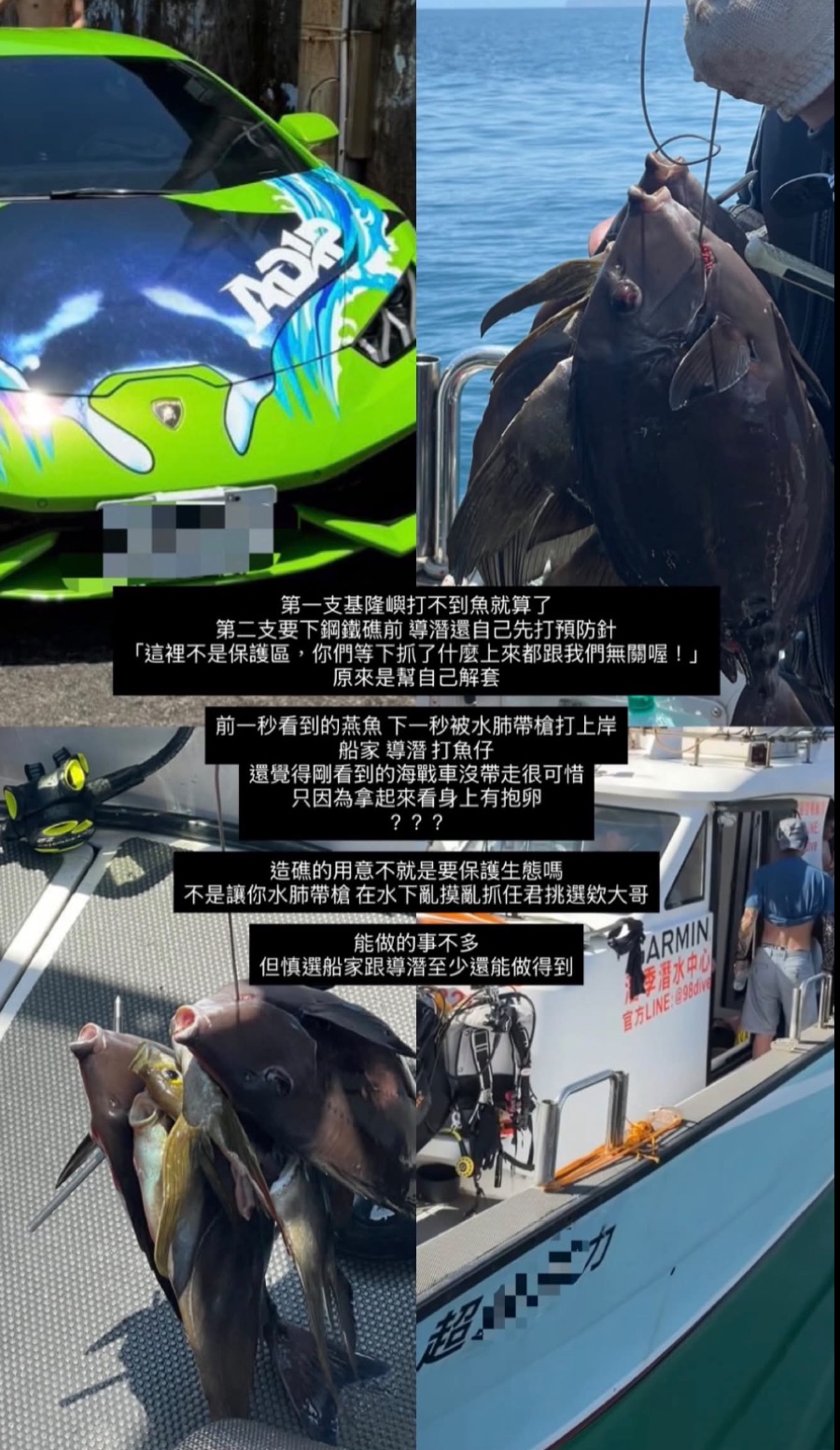
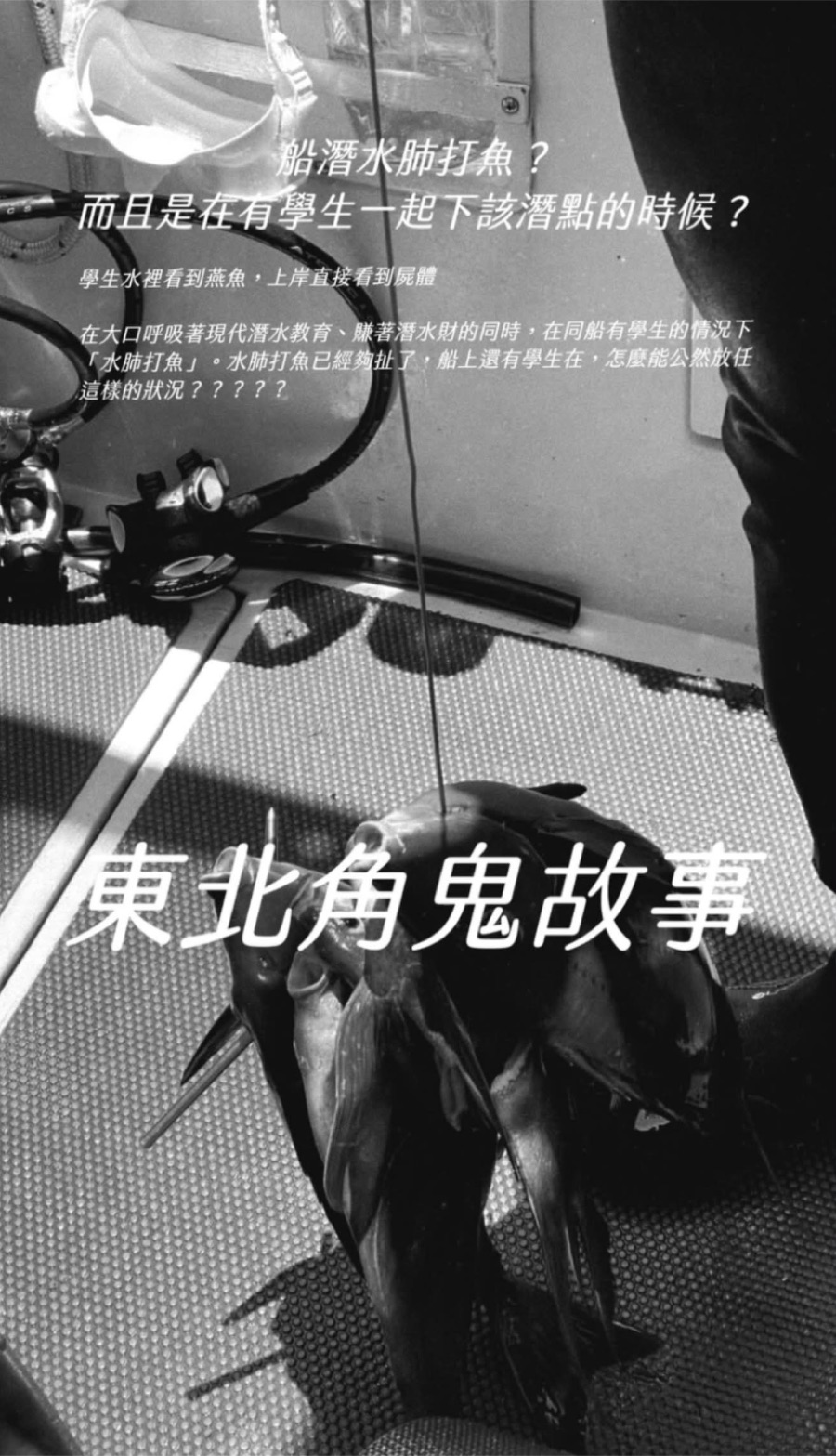
Images / Dive instructor @vamos_diving (Threads — "Northeast Coast Ghost Story")
The Editor's only comment is this: the idea that "if it's not a protected area, nothing applies" badly underestimates how Taiwan's marine law actually works. Regulating fishing in Taiwan has never been as simple as "inside a protected area" vs. "outside a protected area." What tool you use, what vessel you're on, whether you hold a licence, and how much you take — any single one of these factors can independently put you in violation.
Below, the Editor works through the four questions people ask most often, laying out the relevant statutes one by one.
Legal Grey Area No. 1: Is Spearfishing with Scuba Gear Legal? There's No Nationwide Blanket Ban — But the Legal Space Has Been Squeezed to Almost Nothing
Let's first debunk a common misconception. Many people believe Taiwan has a single ironclad rule that "completely prohibits spearfishing with scuba gear." Strictly speaking, no such nationwide blanket ban currently exists. In 2017 (ROC Year 106), the Fisheries Agency pre-announced two national draft regulations — "Control Measures for the Harvesting of Aquatic Animals and Plants Using Diving Equipment" and "Control Measures for No-Take Zones for Spearfishing" — that would have regulated the use of diving equipment and spearguns to harvest aquatic life within twelve nautical miles. However, following pushback from the recreational diving community, spearfishing enthusiasts, and indigenous communities with traditional fishing rights, a public hearing resulted in a request to "study the matter further," and neither measure has been enacted to this day.
No blanket ban does not mean anything goes. The legal space for spearfishing with scuba gear has, in practice, been squeezed to almost nothing by two existing rules.
The First Constraint: Scuba Fishing Licences Have Not Been Issued Since 1989
Taiwan stopped issuing "diving equipment fishery" licences in 1989 (ROC Year 78). More than thirty years later, not a single new licence has been issued — meaning no one can legally "operate a fishery" using scuba gear. The moment you strap on a tank, pick up a speargun, and descend to catch fish in a quantity deemed to constitute "actual fishing catch," you are operating a fishery without a licence. That is a direct violation of Article 6 of the Fisheries Act, subject to a fine of NT$60,000 to NT$300,000 — we'll cover the penalties in detail under Legal Grey Area No. 3.
In August 2025, authorities in Penghu caught a fishing vessel using a compressor and air hose — with divers breathing from the hose — to illegally harvest seafood. The haul included more than twenty kilograms of lobster and high-value fish. The case was prosecuted as an unlicensed diving equipment fishery: gear and catch were confiscated, and the offenders were referred for prosecution. Repeat offenders face enhanced penalties. So "nobody's watching" is an illusion — you will be caught; it's only a matter of when.
The Second Constraint: No-Take Zones Gazetted by Local Governments
The second — and most directly relevant — constraint in the Keelung steel reef case is the no-take notices issued by local governments for artificial reefs and conservation areas within their jurisdiction. Most artificial reefs off Keelung fall under exactly this kind of notice. Violations are penalised under Article 65 of the Fisheries Act: NT$30,000 to NT$150,000, plus confiscation of equipment and catch. The Editor will cover this in full under Legal Grey Area No. 4.
Legal Grey Area No. 2: If You're Diving from a Recreational Fishing Vessel, What Fishing Methods Are Allowed? Just Three
Many people assume that "as long as I'm on a properly licensed recreational fishing vessel, everything I do on board is legal." That is also a misconception.
Under Article 2, Paragraph 1, Subparagraph 1 of the Recreational Fisheries Management Regulations, one of the permitted activities on a recreational fishing vessel is "harvesting aquatic animals and plants." However, Paragraph 4 of the same article explicitly limits the fishing gear and methods for this activity to rod-and-line, handline, or trolling. As for carrying passengers on scuba diving trips, Paragraph 3 of the same article requires compliance with the Regulations for the Management of Water Recreation Activities and approval by the competent authority.
To be clear: rod-and-line, handline, trolling. All three involve a line and a hook — not a single one involves a speargun. In other words, even if you are on a legitimately licensed recreational fishing vessel, even if the operator claims "we do this all the time," using a speargun underwater is still a fishing method that exceeds what the law permits. An operator who turns a blind eye to this — or worse, provides the speargun — is dragging both themselves and their clients into legal jeopardy.
How Are Yachts, Small Boats, and Fishing Vessels Classified? No Recreational Fishing Licence Means No Passengers for Fishing
One more point that trips a lot of people up. Under the Ships Act, yachts, small vessels, and fishing vessels are all classified as ships; yachts and small vessels under 20 gross tons fall under the jurisdiction of navigation authorities. A fishing vessel without a "recreational fishery licence" may not carry passengers out to sea for recreational activities such as fishing.
To legally carry passengers, a fishing vessel must complete vessel inspections, purchase insurance, and file a departure report under the relevant recreational fishery regulations — only after all approvals are in place may it take passengers to sea. Anyone aboard should also hold the appropriate qualifications and relevant documentation. If a vessel owner takes you out to fish without following these requirements, the vessel itself may already be in violation of passenger-carrying regulations — meaning you've essentially boarded a boat that was already operating illegally.
Legal Grey Area No. 3: What If I Take My Own Yacht Out with a Speargun? A Fine of NT$60,000 to NT$300,000 If Your Catch Qualifies as a Haul
So what if you don't board someone else's vessel — you take your own recreational craft, bring scuba gear and a speargun, and dive?
The Fisheries Agency addressed this question long ago through an official interpretation. Per Fisheries Agency Interpretation Letter No. 88-Yu-Yi-Zi-8860612, dated 13 August 1999 (ROC Year 88): under Article 6 of the Fisheries Act, anyone wishing to operate a fishery in public waters or waters connected to public waters must obtain approval from the competent authority and hold a valid fishing licence. If a member of the public — without such permission or licence — uses a privately owned recreational vessel to bring scuba diving equipment and a speargun underwater to harvest aquatic animals or plants, and the quantity harvested is deemed to constitute "actual fishing catch from a fishing operation," that person is in violation of the law. The competent authority may impose a fine of NT$60,000 to NT$300,000 under Article 64, Paragraph 1 of the Fisheries Act.
In plain language: your own boat, your own speargun — if the quantity you shoot is judged to constitute "fishing" rather than purely recreational observation, you are still subject to a fine, and a heavier one than the Article 65 penalty at that.
Legal Grey Area No. 4: Aren't Artificial Reefs Already No-Take Zones by Default? Mostly, Yes
This brings us to the heart of the issue: artificial reef no-take zones.
The vast majority of Taiwan's coastal artificial reef zones and protection reef zones are formally gazetted by the Fisheries Agency. The purpose of the gazetting is to create habitat, aggregate fish populations, and restore marine resources — and harvesting aquatic animals or plants within these zones is, as a rule, prohibited. The legal basis for these no-take notices comes from Articles 44 and 45 of the Fisheries Act, under which the competent authority (either the Fisheries Agency or a local county or city government) may gazette "restrictions on or prohibitions of fishing in designated fishing areas." Violators are subject to a fine of NT$30,000 to NT$150,000 under Article 65, and catches and gear may be confiscated under Article 68. This is the provision most directly applicable to the Keelung steel reef case.
Taking Keelung as a specific example: the Keelung City Government has gazetted the "Keelung Wanghaijhang Chaojing Bay Aquatic Animals and Plants Breeding Conservation Area" under Articles 44 and 45 of the Fisheries Act. Within that area, harvesting any aquatic animals or plants other than hand-harvesting seaweed is prohibited. Similar local notices cover the artificial reefs and conservation areas throughout the waters off Keelung. The Fisheries Agency's official website maintains dedicated lists of "Artificial Reef Zone Notices" and "Protection Reef Zone Notices," catalogued zone by zone in full detail. The entire point of sinking an expensive steel structure to the seafloor is to create a nursery for fish populations — there is simply no way it was ever intended to allow spearfishing inside.
So when someone says "this isn't a protected area," the Editor's advice is to ask them to produce evidence: does this particular steel reef fall within a gazetted artificial reef zone or no-take zone? In most cases, the answer will be very uncomfortable for anyone who showed up with a speargun. And even if the reef genuinely falls outside any gazetted zone, the previous three constraints — scuba-gear harvesting rules, fishing method restrictions on recreational vessels, and unlicensed fishing provisions — have already made "catch whatever you want" legally impossible.
So Why Does the Coast Guard So Often Fail to Intervene? Here's an Awkward Regulatory Gap
After reading this far, you may be wondering: if so many laws apply, why can someone brazenly bring a speargun aboard a vessel in plain sight of the Coast Guard without being stopped?
The Editor will be honest — there is an awkward grey zone here. In 2016, when the Ministry of Transportation revised the Regulations for the Management of Water Recreation Activities, it removed the provision that had explicitly stated "divers may not carry a speargun." That deletion left a gap in the "carrying" stage. On top of that, the rubber-band and mechanical spearguns commonly available on the market are mostly not classified as regulated firearms under the Controlling Guns, Ammunition and Knives Act, so simply "possessing" or "carrying" a speargun does not, by itself, easily constitute a criminal offence.
The problem is that the legal violation hinges on "harvesting" and "catch quantity" — both of which must be caught in the act underwater, or established after the fact based on the catch. A Coast Guard officer watching from the side of a vessel who spots a speargun cannot immediately conclude that the person will definitely use it, or how much they will take. To put it bluntly: possessing or carrying a speargun is not in itself illegal, but going underwater to catch fish absolutely is — it's just that if the speargun is stowed and the catch is hidden by the time the boat returns to port, and there is no footage of what happened underwater, it becomes very difficult to issue a citation on the spot. This is an evidentiary and enforcement difficulty — it is not the law giving anyone a pass. So please do not mistake "not stopped in the moment" for "legal." Once someone is photographed, reported, or found with a catch at the dock, every single one of those penalties outlined above still applies. And precisely because the law can only catch so much — hide a speargun, hide a bag of fish, and you might escape the fine — this ultimately comes down to something the law cannot fully regulate: conscience. That is what the Editor wants to discuss next.
Beyond the Law: Artificial Reefs Are Nurseries, Not Hunting Grounds
With the hard legal facts out of the way, the Editor wants to talk about something the law cannot touch but that matters just as much: perception and ethics.
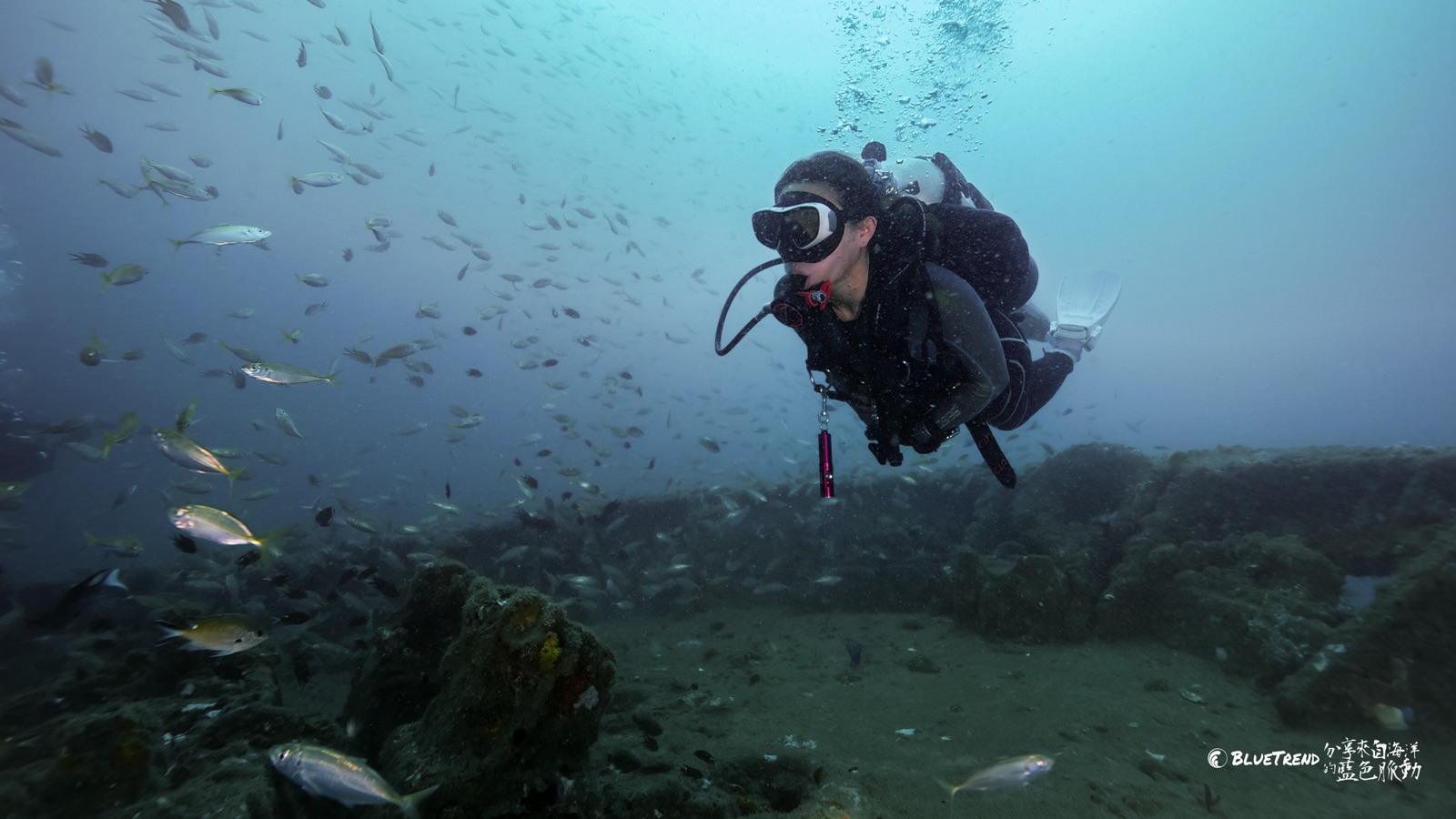
First: the entire purpose of an artificial reef is to let fish populations rest and recover, and to bring wild populations back. It took Green Island's steel reef over a decade to welcome the batfish back. A place like this is meant to be the ocean's nursery — not anyone's private fishing ground. To fire a speargun inside a nursery is to convert a resource that everyone has collectively nurtured into a one-time meal for one person. No matter how you do the maths, that is a terrible trade.
Second: the Editor knows someone will inevitably say — bottom trawling and purse seining do far more damage to the ocean; why are you singling out a few people spearfishing? The Editor agrees that large-scale industrial fishing has a far greater impact, and that is a separate, important issue that needs addressing. But "someone else is doing something worse" has never been a get-out-of-jail card for breaking the law. Illegal is illegal; two issues must be handled separately, and one cannot be used to shield the other.
Third, and most immediately: the other paying passengers on a boat dive came to see marine life — and when someone on the same boat uses a speargun to scatter the fish and strip a dive site, those divers have essentially wasted their money. Even within the freediving spearfishing community itself, there is growing self-reflection: "taking everything regardless of size, even inside protected areas" has depleted resources and tarred the entire community with a bad reputation. When there are recreational divers in the water nearby and someone is brandishing a speargun and taking aim, setting aside legality entirely — the risk of accidental injury and the safety implications alone are enough to make anyone's blood run cold.
Marine resources belong to everyone. Leave one more batfish at the steel reef today, and next year more people will make the boat trip to see it. That is how this ocean gets to still be worth something a decade from now.
Practical Reference: Quick Legality Check for Spearfishing While Diving & How to Report It
The Editor has condensed all of the above into a single table — save it and share it with anyone who needs it.
| Scenario | Legal? | Basis & Penalty |
|---|---|---|
| Using scuba gear to spearfish and reaching a "catch quantity" (unlicensed commercial fishing) | Illegal | Diving equipment fishery licences have not been issued since 1989. Violates Article 6 of the Fisheries Act; penalised under Article 64 with NT$60,000–NT$300,000; catch and gear confiscated under Article 68 |
| A nationwide blanket ban on scuba/speargun harvesting | Does not currently exist | The Fisheries Agency's 2017 draft national control measures were shelved after a public hearing and have not been enacted; management relies instead on local no-take zone notices and the unlicensed-fishing provisions |
| Using a speargun while diving from a recreational fishing vessel | Illegal | Article 2, Paragraph 4 of the Recreational Fisheries Management Regulations limits fishing gear/methods to rod-and-line, handline, and trolling |
| A fishing vessel carrying passengers for fishing without a recreational fishing licence | Illegal | Ships Act + recreational fishery regulations; a vessel without the required licence may not carry passengers for recreational fishing |
| Using a speargun from a private recreational craft and reaching a catch quantity | Illegal | Fisheries Agency Interpretation Letter No. 88-Yu-Yi-Zi-8860612; violates Article 6 of the Fisheries Act; penalised under Article 64 with NT$60,000–NT$300,000 |
| Harvesting aquatic life within a gazetted artificial reef zone / no-take zone | Illegal | Gazetted as no-take under Article 44 of the Fisheries Act; violators fined NT$30,000–NT$150,000 under Article 65; catch and gear confiscated under Article 68 |
Spotted someone spearfishing in a reef zone or conservation area? Here's what to do: Call the Coast Guard Administration's "118" hotline, or dial "1999" to report to the local competent authority. Note the vessel name, location, and time — video or photos make an even stronger case. A timely report from a member of the public is the single most practical thing anyone can do to protect these waters.
Conclusion: No Single Phrase Like "This Isn't a Protected Area" Can Override This Many Laws
Back to where we started: "This isn't a protected area — you can catch whatever you want." Now that you've read this far, you know exactly how hollow that claim is when held up against the laws governing artificial reef no-take zones. Scuba-gear harvesting rules, fishing method restrictions on recreational vessels, unlicensed fishing provisions, and gazetted reef zone prohibitions — any one of those four barriers can result in a fine for anyone who goes underwater with a speargun. Penalties range from NT$30,000 to NT$300,000, and both gear and catch can be confiscated on top of that.
Green Island spent over a decade bringing the batfish back — proof that when we let artificial reefs serve as nurseries, the ocean repays us generously. The Editor sincerely hopes that the Keelung Steel Reef, and every artificial reef around Taiwan, will see one fewer speargun — and one more school of fish that made it home. Have you ever encountered someone spearfishing on a boat dive? How did you handle it? Leave a comment and let the Editor know — together we can keep this conversation moving forward.
References & Legal Sources
- Firsthand account of spearfishing at the Northeast Coast Steel Reef / Dive instructor @vamos_diving (Threads — "Northeast Coast Ghost Story")
- PTS News: "Green Island Steel Reef Batfish Population Recovering"
- UDN: "Over 200 Teira Batfish Form a Storm at Badouzi Steel Reef — A Once-in-a-Century Sight on the Northeast Coast"
- Fisheries Act full text (including Articles 6, 44, 64, 65, 68) / Laws & Regulations Database of the Republic of China
- Recreational Fisheries Management Regulations, Article 2 (fishing gear/method restrictions for harvesting; approval required for passenger diving) / Laws & Regulations Database of the Republic of China
- Ships Act / Laws & Regulations Database of the Republic of China
- Fisheries Agency, Council of Agriculture: Artificial Reef and Protection Reef Zone Information (including Artificial Reef Zone Notices and Protection Reef Zone Notices)
- Keelung City Government Notice: "Keelung City Wanghaijhang Chaojing Bay Aquatic Animals and Plants Breeding Conservation Area and Related Restrictions" (pursuant to Articles 44 and 45 of the Fisheries Act)
- Fisheries Agency 2017 (ROC Year 106) pre-announced draft "Control Measures for the Harvesting of Aquatic Animals and Plants Using Diving Equipment" — shelved after public hearing / Public Policy Network Participation Platform
- Fisheries Agency, Ministry of Agriculture: Prohibited Activities and Penalties in Marine Protected Areas
- Fisheries Agency Interpretation Letter No. 88-Yu-Yi-Zi-8860612: Clarification on whether there is a legal basis to regulate the act of a member of the public using a privately owned recreational vessel to bring scuba diving equipment and a speargun underwater to harvest aquatic animals and plants
- Palau reef shark tourism value study (Vianna et al., 2011, AIMS / University of Western Australia, reported by Pew): lifetime tourism value of one reef shark approximately US$1.9 million vs. one-time fishing value of approximately US$108

![[BlueTrend Mini Classroom] Can't Tell *Platax orbicularis* from *Platax teira*? A Complete Guide to the 4 Batfish Species!](/_astro/216196384_4105065342874977_2449265796608541870_n_Z1z3sHf.webp)