Contents(6)
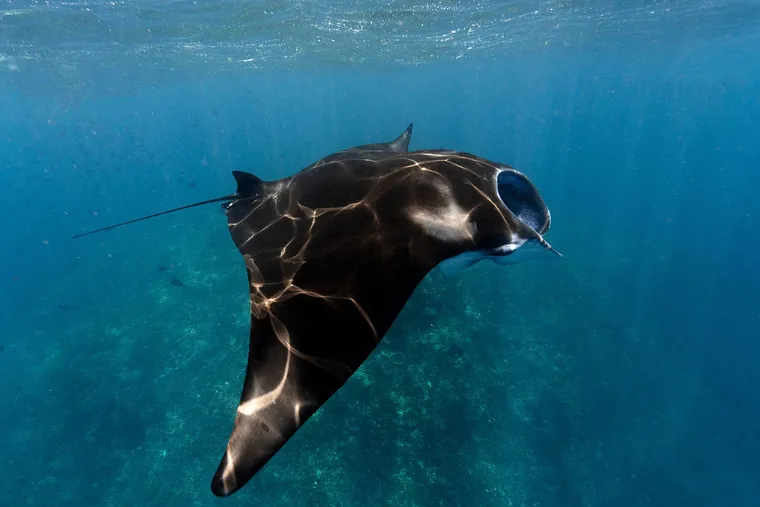
When a vast black pair of wings glides silently overhead underwater, most people's first instinct is to cry, "Wow, a manta ray!" But did you know that beneath those wings lies an entire family? The world's manta rays and their close relatives — the devil rays — total 10 species combined. The Editor used to think a manta ray was simply one type of large stingray, until reading the international marine conservation organisation Manta Trust's global field guide, Field Guide to Manta & Devil Rays of the World, and discovering that every member of this family looks alike yet has its own distinct identity.
Manta Trust is the world's most dedicated charitable organisation focused on manta ray research and conservation. In recent years, the Editor has covered their research calculating the economic value of Maldives manta rays (feel free to check the further reading at the end of this article). This time, the Editor has condensed their global field guide into a single article — each species comes with a dorsal identification illustration and Manta Trust's species spotlight video — so you can get to know all 10 family members at once, with notes on which species can be spotted in Taiwan and what threats they currently face.
First, Let's Get the Classification Straight
Manta rays belong to the order Myliobatiformes, a large family comprising around 370 species across 12 families. Today's subjects are all concentrated within the family Mobulidae, and the entire family contains just one genus: Mobula.
The 10 species within this genus can be divided into two simple groups:
- 3 species of "manta rays" (manta): The largest members, and the ones most commonly topping divers' bucket lists.
- 7 species of "devil rays": Smaller relatives whose horn-like cephalic fins — which actually funnel plankton into their mouths — give them their common name.
It's worth noting that all of them are gentle giants that survive by filter-feeding on plankton. That wide-open mouth may look intimidating, but they are completely harmless to humans.


The 3 True Manta Rays (Manta)
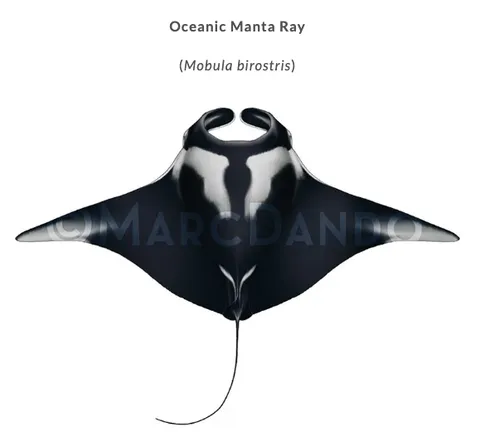
Oceanic Manta Ray (Mobula birostris, known in Taiwan as 雙吻前口蝠魟)
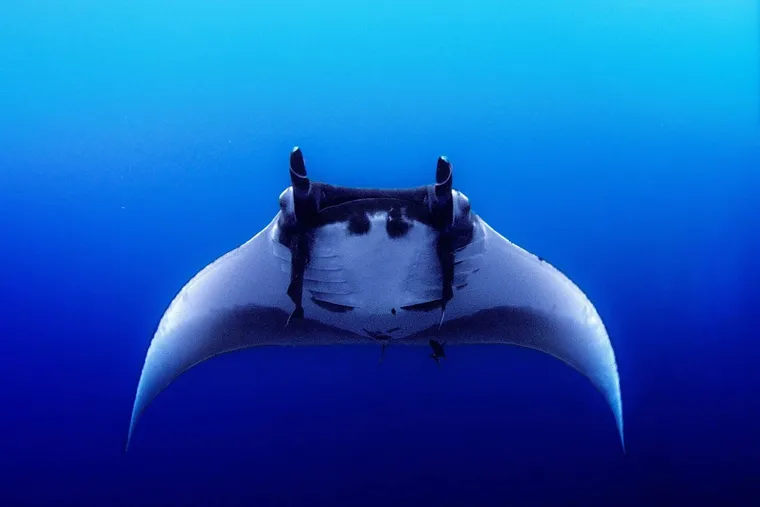
The giant of the family. Average disc width ranges from 4 to 5 metres, with the largest recorded individual reaching a staggering 6.8 metres and weighing up to 2,000 kg. The two white shoulder patches on its back form two symmetrical right triangles, leaving a black "T" shape in between — the easiest way to tell it apart from the Reef Manta Ray. The inside of its mouth and its cephalic fins are black, and there is a small bump at the base of the tail concealing a vestigial tail spine.
As the name suggests, it mostly inhabits the open ocean far from reefs, and will dive hundreds of metres deep in search of plankton feasts. Its lifespan is approximately 40 years, and it is listed as Endangered on the IUCN Red List.
In Taiwan: The Oceanic Manta Ray is not commonly encountered in Taiwan, but fishers occasionally bring one in as bycatch — there are past records from Hualien and Taitung, and this species is also the subject of the Editor's earlier series of reports on Taiwan's manta rays.
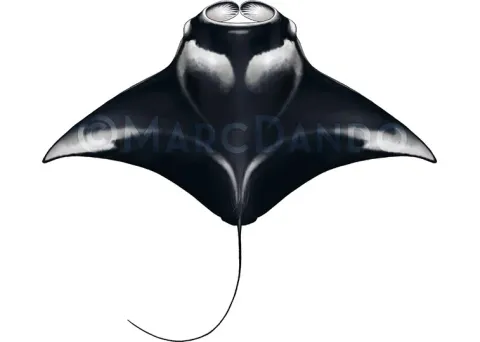
Reef Manta Ray (Mobula alfredi, known in Taiwan as 阿氏前口蝠魟)
This is the one divers encounter most often. Average disc width is 3 to 3.5 metres, with a maximum of around 4.3 metres and a weight of up to 844 kg — slightly more slender than the Oceanic Manta Ray. The black-and-white boundary on its back is more diffuse and blended, forming a black "V" shape across the shoulders (remember: the Oceanic has a T, the Reef has a V).
It prefers the relatively shallow coral reef waters around continental coasts and offshore islands, which is why divers are more likely to encounter it at cleaning stations or feeding hotspots. Its lifespan is similarly around 40 years, and it is listed as Vulnerable on the IUCN Red List.
In Taiwan: The Reef Manta Ray is actually the species that Taiwanese divers occasionally have a chance to meet in the water, and fishers sometimes take them in as bycatch.
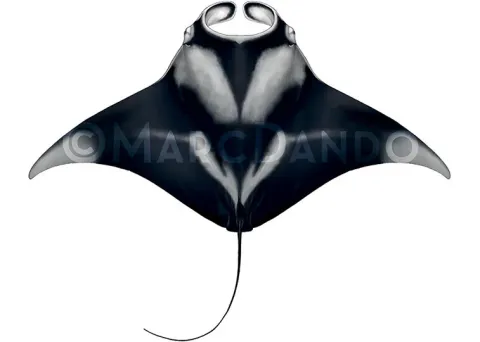
Atlantic Manta Ray (Mobula yarae)
The newest addition to the family. It was officially confirmed as a distinct species in July 2025 after 15 years of debate, with genetic analysis providing the conclusive evidence. Maximum disc width is approximately 4.8 metres, with a weight of up to around 1,077 kg. It also bears a black "T" shoulder patch on its back, but has large, rounded or oval dark blotches near the gill slits on its ventral surface.
Its range is limited to the Caribbean island chain and the Atlantic coastline stretching from Massachusetts, USA, southward to Brazil, and it plays an ecological role more similar to the Reef Manta Ray. Scientists believe it evolved from a population of Oceanic Manta Rays that "settled" into Caribbean reef environments long ago.
The 7 Devil Rays
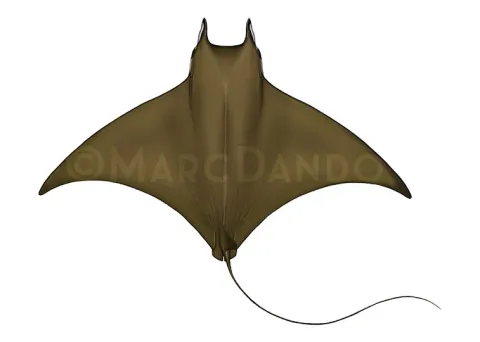
Sicklefin Devil Ray (Mobula tarapacana)
The largest of the devil rays, with a maximum disc width of 3.7 metres. Its back is an unusual olive-green or brown, the ventral surface has a jagged black-and-white boundary, and there is a distinct ridge running along the dorsal midline. It is the deepest-diving devil ray on record, having been documented diving to 2,000 metres where water temperatures drop below 4°C.
Its two-tone gill plates — white on the inside, dark on the outside — fetch the second-highest prices in the gill plate trade after those of manta rays, making it the third most heavily traded victim. It is widely distributed in warm Pacific waters including those around Taiwan, and is listed as Critically Endangered on the IUCN Red List.
Spinetail Devil Ray (Mobula mobular, known in Taiwan as 正蝠鱝)
Maximum disc width approximately 3.5 metres. Its most distinctive feature is a broad black band running across the top of the head from eye to eye. The back is slate-blue with a touch of grey and dark-edged fins, while the ventral surface is bright white; the tip of the dorsal fin is white, and the tail bears a spine that fishers often remove. It is found in tropical to temperate seas worldwide, including the Pacific waters around Taiwan, and is occasionally taken as bycatch by coastal fisheries. It is also one of the most frequently caught devil rays in global fisheries, causing a significant decline in population, and is listed as Critically Endangered on the IUCN Red List.
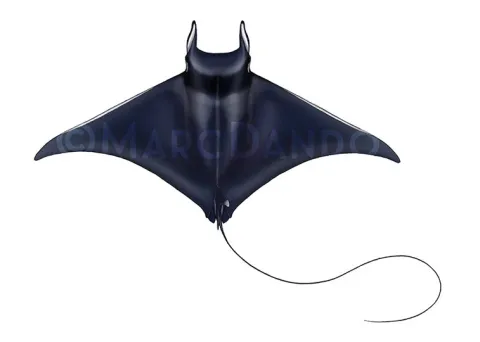
Bentfin Devil Ray (Mobula thurstoni)
Maximum disc width approximately 2 metres, with an average of just 1.35 metres. The back is deep purple to blue-grey, with the same broad black band across the head from eye to eye, while the ventral surface shimmers with an iridescent silver or gold sheen. Its signature feature is a distinct double bend along the front edge of the pectoral fins, and it has no tail spine. It typically travels alone, occasionally forming small groups of 2 to 6 individuals, and appears frequently in Southeast Asian fisheries catches. It is listed as Critically Endangered on the IUCN Red List.
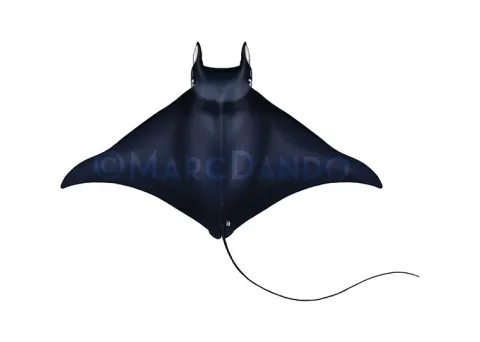
Shorthorned Pygmy Devil Ray (Mobula kuhlii)
Entering "pygmy" territory — maximum disc width just 1.34 metres, body weight only 25 kg. Back colour ranges from purple-grey to chocolate brown, with a dark crescent-shaped "collar" above the spiracles. A nimble coastal creature, it hunts mysid shrimp and juvenile fish in schools of 5 to 15 individuals (sometimes upward of 50). It is mainly found in the coastal waters of Pakistan, Bangladesh, and Mozambique, and is listed as Endangered on the IUCN Red List.
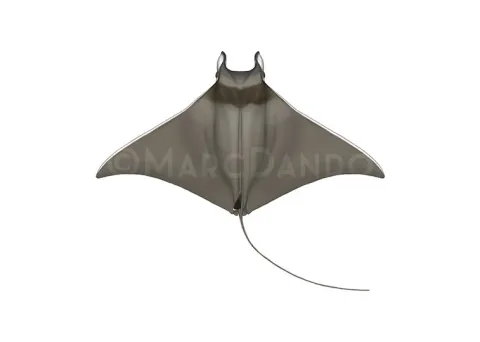
Longhorned Pygmy Devil Ray (Mobula eregoodoo)
Maximum disc width 1.3 metres, average 1.1 metres. Very similar to its Shorthorned cousin, but with a noticeably longer neck and more elongated cephalic fins — the key to telling them apart in fisheries. The back is brown with dark stripes along the front edge of the pectoral fins, and there is no tail spine. Found throughout the Indo-Pacific, it commonly appears in schools of around a dozen individuals, and is relatively frequently caught in Pakistani and Indonesian fisheries. It is listed as Endangered on the IUCN Red List.
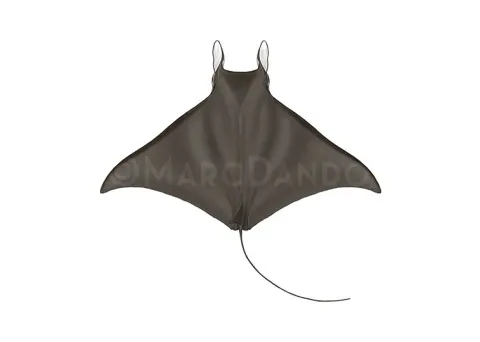
Munk's Pygmy Devil Ray (Mobula munkiana)
Maximum disc width 1.3 metres, with a purple-grey back and a deep black collar on the head. This species is best known for gathering in massive aggregations of tens of thousands of individuals in the Gulf of California, Mexico during certain seasons, where they collectively leap several metres out of the water like a rain of flying black droplets — a behaviour whose purpose remains a mystery. Its range is limited to the eastern Pacific coast, from the Gulf of California south to Peru. Precisely because of its tendency to school in large groups, it is particularly vulnerable to being wiped out in a single haul by gillnets and purse seines, and is listed as Vulnerable on the IUCN Red List.
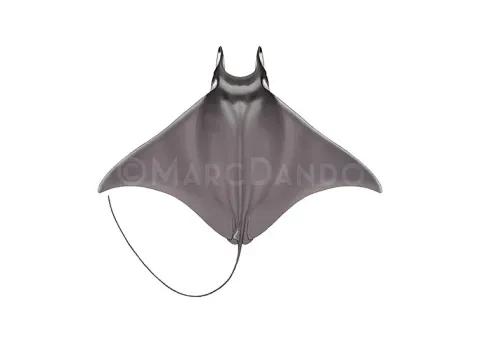
Atlantic Pygmy Devil Ray (Mobula hypostoma)
The last member of the family. Average disc width 1.1 metres, body weight approximately 24 kg. Back colour ranges from light brown and grey to black, with very small, nearly circular spiracles. It inhabits tropical to warm-temperate waters on both sides of the Atlantic, typically in groups of 2 to 10 individuals, with a recorded maximum of 40. Although not directly targeted by fisheries, it frequently ends up as bycatch in longlines and gillnets, and is estimated to have suffered a population decline of 50% to 79% over three generations. It is listed as Endangered on the IUCN Red List.
▶ Watch it in motion: Manta Trust species spotlight video (western Atlantic population)
Wait — What About the Spotted Eagle Ray? Why Isn't It on the List?
The Editor knows you're bound to ask: why doesn't the spotted eagle ray (the one with a back scattered in white spots, also called the ocellated eagle ray) appear among these 10 species? Many people confuse it with manta rays or even assume they belong to the same family — but they are actually distant relatives from an entirely different family.
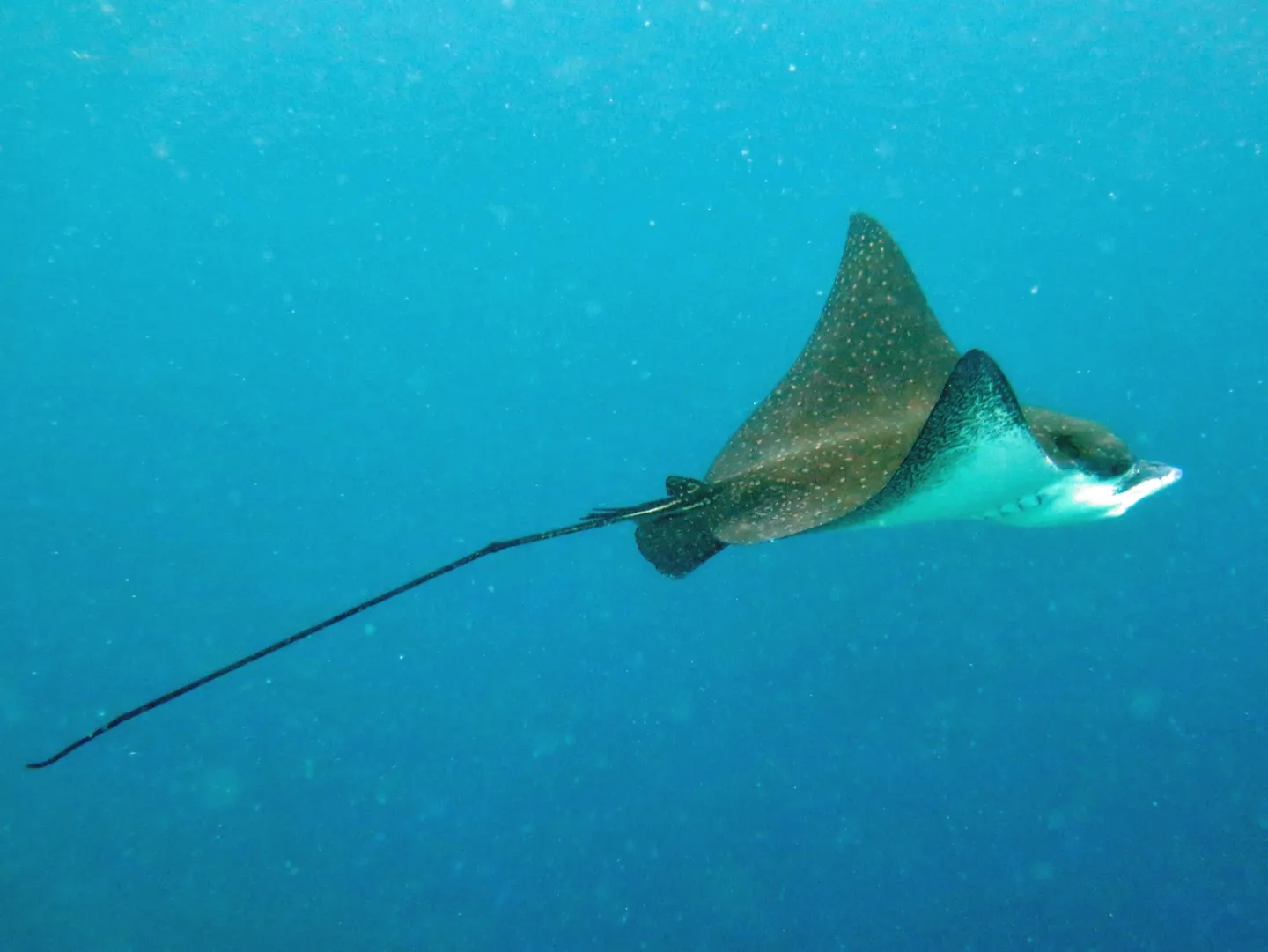
The spotted eagle ray's scientific name is Aetobatus ocellatus, and it belongs to the family Aetobatidae (formerly placed within Myliobatidae). Although it shares the same order — Myliobatiformes — with today's subjects, its family is entirely different, which is why it does not appear on the Mobulidae list. To tell them apart underwater at a glance, just keep these points in mind:
- Look at the head: Manta rays and devil rays have a mouth positioned at the very front of the body, with a pair of horn-like cephalic fins on either side; eagle rays have a protruding, duck-bill-shaped snout and lack those "horns." The presence or absence of that pair of "horns" is the fastest way to tell.
- Look at how they feed: Eagle rays are benthic predators that use their duck-bill snout to root through sand, then crush molluscs and crustaceans with their plate-like teeth; manta rays and devil rays are gentle giants that filter-feed on plankton with their wide-open mouths.
- Look at the patterning: The spotted eagle ray has a back scattered with white spots (hence the names "spotted" and "ocellated"); manta rays have two large white patches on the shoulders, while devil rays are mostly plain with a dark band across the head.
- Look at the tail: Eagle rays trail a whip-like tail that can be up to three times the disc width in length and bears venomous spines; the tails of the Mobulidae family are comparatively much shorter.
The spotted eagle ray is found in Taiwan and throughout the Indo-Pacific, and is a popular attraction in aquariums. It is also listed as Endangered on the IUCN Red List. So next time you encounter one underwater, check whether it has that pair of "horns" — and you'll never mix them up again.
Recognising Them Is the First Step Toward Conservation
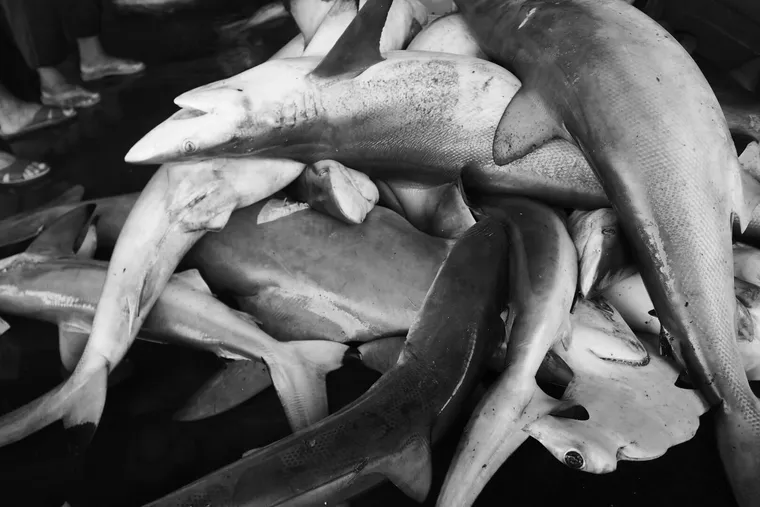
Laying out all 10 species side by side, the Editor feels a certain heaviness. Of the 10 species, 3 are Critically Endangered and 4 are Endangered — not a single one is doing well. Their shared greatest threat is the gill plates harvested for so-called "health supplements," compounded by their schooling behaviour that allows entire groups to be swept up in a single net haul. And several of these species are swimming right in the Pacific waters off Taiwan's doorstep.
This is precisely why being able to identify them matters so much. When you can distinguish an Oceanic from a Reef Manta underwater, or recognise which devil ray that eye-to-eye black band belongs to, each encounter becomes all the more precious. The Editor has always believed that conservation isn't a distant slogan — it starts with "I can see it clearly, and I care." Before your next dive, save this field guide. You might just need it one day.
Sources
This article is compiled from the global species field guide published by international marine conservation organisation Manta Trust. All species identification illustrations and "species spotlight" videos are credited to Manta Trust:
- Manta Trust species overview: Manta and Devil Ray Species
- Detailed species pages: Manta Trust
- Manta Trust species spotlight video series: Manta Trust YouTube
- Further reading: 《海洋博物誌3|離岸珊瑚礁》墾丁、台東、蘭嶼、綠島、龜山島、澎湖南方四島,936 種熱帶珊瑚礁生物辨識百科
The cover image for this article is the cover of the Manta Trust publication *Field Guide to Manta & Devil Rays of the World*. All species identification illustrations are © Marc Dando / Manta Trust.