Contents(5)
- What Is the Team Ocean Marine Conservation Sustainability Action Award?
- From Yilan's Rice Fields to the Seafloor of Penghu: What Each of the 5 Partners Does
- BlueTrend's Role: Underwater Monitoring, Citizen Science, and Communication
- Next Steps: Biodiversity Credit Technical Development and Bringing the Model to Malaysia
- Closing: This Award Belongs to the Entire Chain of Collaboration
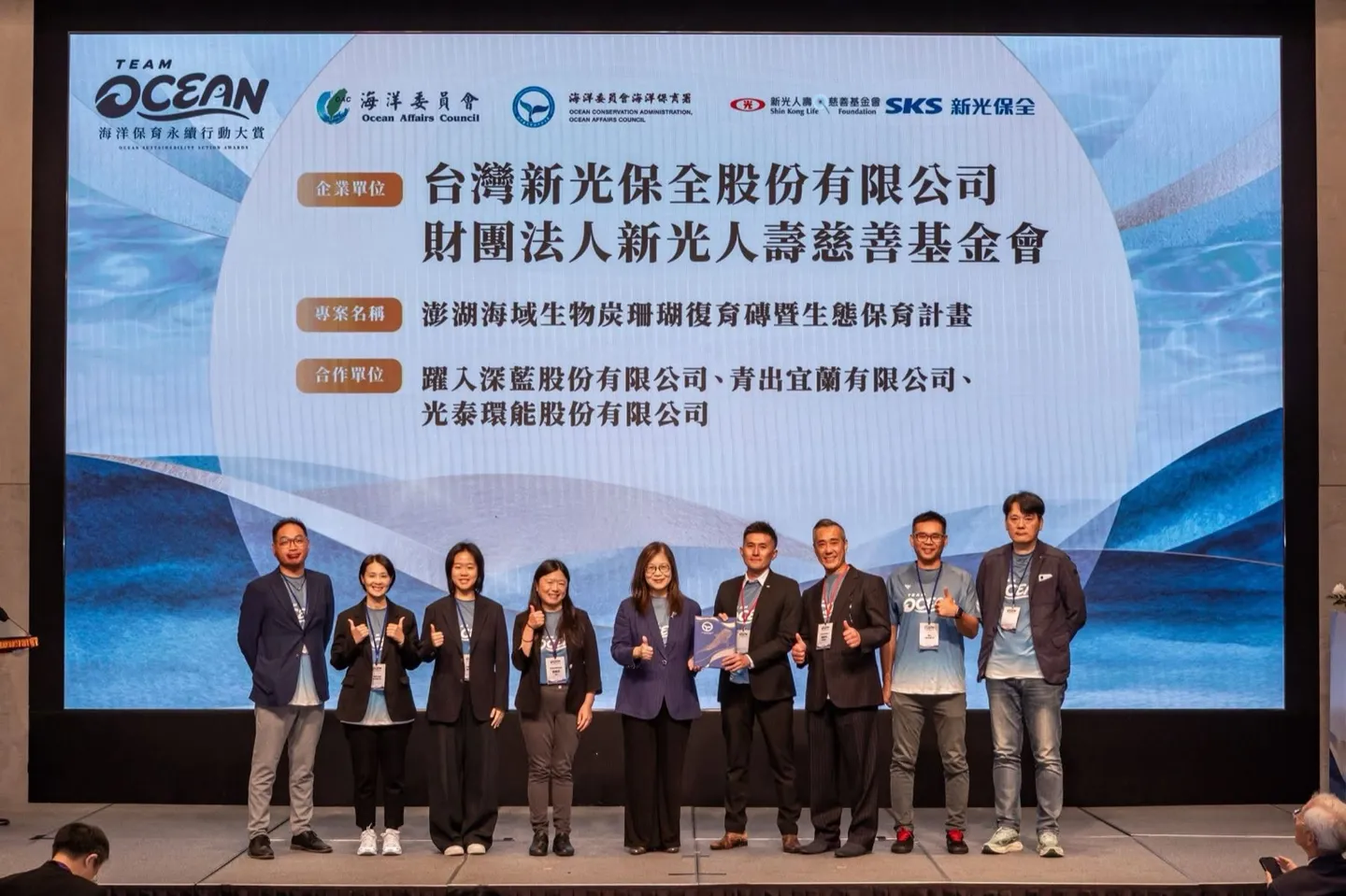
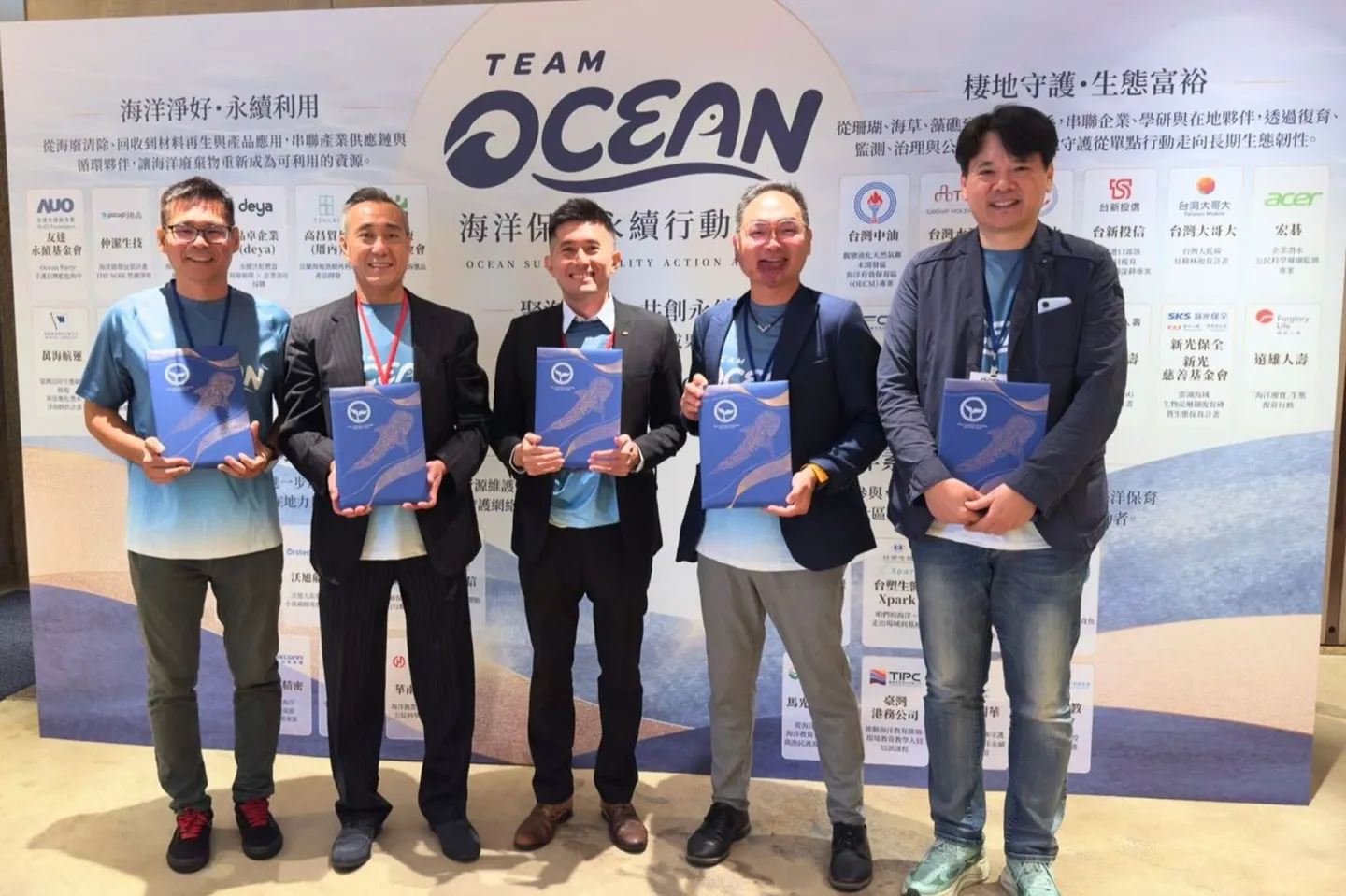
The Penghu Waters Biochar Coral Restoration Brick and Ecological Conservation Project was recognised on 11 November 2026 by the Ocean Conservation Administration's "Team Ocean Marine Conservation Sustainability Action Award." The project was spearheaded by Shin Kong Security and the Shin Kong Life Charitable Foundation, with BlueTrend (Yuè Rù Shēn Lán Co., Ltd.), Youth from Yilan, and TCHAR (光泰環能) joining the stage as partner organisations — tracing a path from Yilan's rice paddies all the way down to the seafloor of Penghu's Hang Bay.
The award recognises a very long chain: biochar is shaped into restoration bricks, the bricks go into the sea to host coral, and divers return tank by tank to document the results — with the next phase set to bring in rice husks left over from Yilan's farmlands. Each link in this chain is handled by a partner with a different area of expertise.
This article outlines the story behind the project, what BlueTrend has contributed, and the two steps we plan to take next: driving technical development of biodiversity credits, and exploring how to bring the entire model to Malaysia.
What Is the Team Ocean Marine Conservation Sustainability Action Award?
Team Ocean is a cross-sector collaboration framework that the Ocean Conservation Administration has been developing in recent years, designed to bring corporate expertise, academic and research institutions' scientific capabilities, and the grassroots strength of civil society groups to the same table — so that marine conservation is no longer the responsibility of any single organisation. The award ceremony held in Taipei on 11 November gathered the collective results of this period of action and made them visible to partners across all sectors.
The backdrop at the venue was divided into thematic sections. "Ocean Cleanup · Sustainable Use" focused on marine debris recovery and material recycling, while "Habitat Protection · Ecological Abundance" featured restoration and monitoring projects for habitats such as coral, seagrass, and algal reefs. The Penghu Biochar Coral Restoration Brick Project was listed under the latter.
The full name of the recognised project is "Penghu Waters Biochar Coral Restoration Brick and Ecological Conservation Project." The lead corporate entities are Shin Kong Security Co., Ltd. and the Shin Kong Life Charitable Foundation, with partner organisations including Yuè Rù Shēn Lán Co., Ltd. (BlueTrend), Youth from Yilan Co., Ltd., and TCHAR Co., Ltd.
This is not a single-track project funded by one company and executed by one team. It is five organisations each contributing their strongest segment of the chain — remove any single link, and the coral would never have grown on those bricks.


From Yilan's Rice Fields to the Seafloor of Penghu: What Each of the 5 Partners Does
The story begins on land. Shin Kong Security has long supported young people returning to their hometowns to practise environmentally friendly agriculture through its "Youth from Yilan" programme, with the organic rice harvest shared with vulnerable families across Taiwan. Shin Kong Security has also been building solitary bee habitats and applying biochar on the farmland itself, maintaining ecological biodiversity within the agricultural landscape.
After the rice is harvested, large quantities of rice husks remain. These agricultural by-products, which were often treated as waste in the past, will become the biochar feedstock for the next phase of restoration bricks.
TCHAR is responsible for converting biomass materials such as wood and rice husks into biochar through pyrolysis — a process of thermal decomposition under low-oxygen, high-temperature conditions. Biochar is a stable, carbon-rich solid that locks in the carbon plants absorbed from the atmosphere during their growth, keeping it sequestered over the long term.
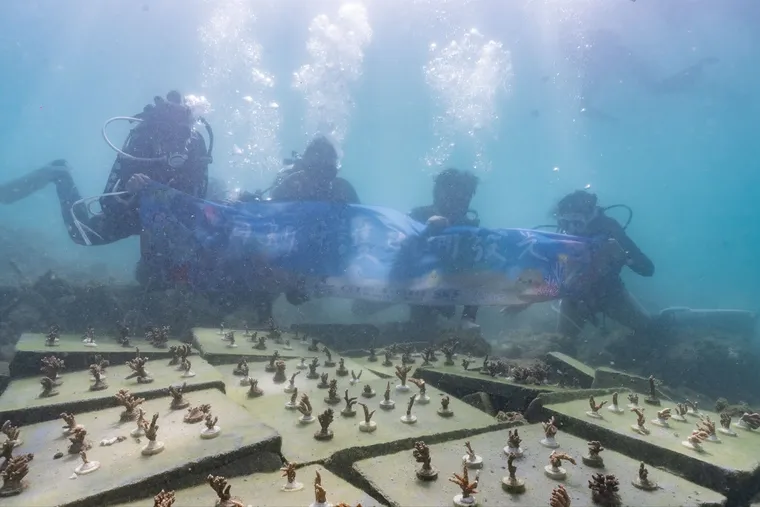
This batch of biochar meets the European Biochar Certificate (EBC) standard, and TCHAR is the first biochar manufacturer in Taiwan to obtain EBC certification. The biochar is combined with low-carbon cement to produce coral restoration bricks whose rough, porous surface is well-suited for coral attachment and growth.
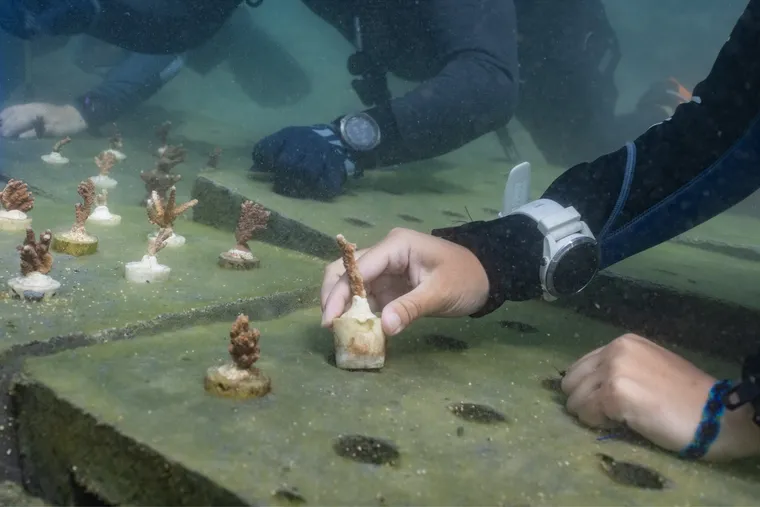
The Shin Kong Life Charitable Foundation began investing in beach cleanup in 2018, and over time expanded its activities to include ocean cleanup, coral observation, and habitat restoration. In 2025, the Foundation experimentally deployed 100 biochar coral restoration bricks in Penghu's Hang Bay, planting 552 coral fragments — using biochar derived from wood for this batch. The next phase of restoration bricks will switch to biochar made from the rice husks supplied by Youth from Yilan.
These restoration bricks have also been verified for carbon removal benefits through the international C-Sink mechanism, making this the world's first coral restoration case to receive international carbon removal certification. The methodology and verification process for calculating carbon sinks is relatively complex; a full explanation is available here.
BlueTrend's Role: Underwater Monitoring, Citizen Science, and Communication
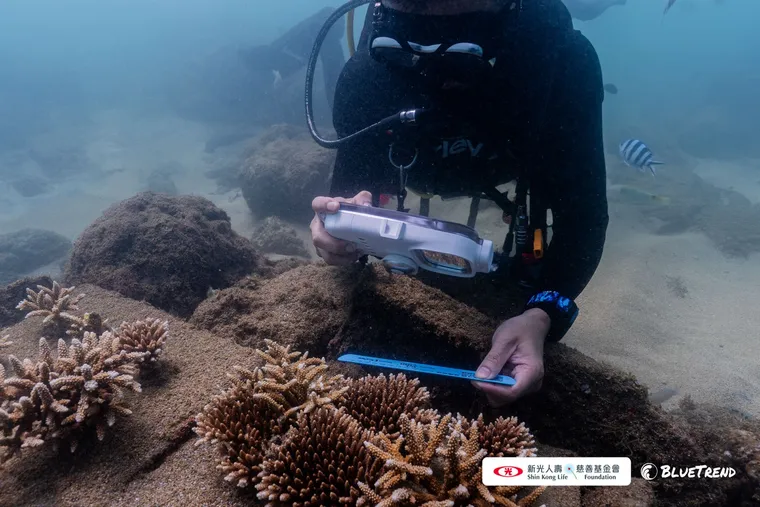
Once the coral is planted, the real investment of time begins — every year that follows. BlueTrend's role in the project covers the underwater professional component: conducting transect surveys and long-term monitoring, recording coral cover, species composition, and health status observation by observation.
During a survey in September 2025, hard coral cover in the Hang Bay study area reached 45.6%, and 46 species of stony coral were comprehensively identified for the first time. For the full details behind these numbers, see Penghu Biochar Coral Restoration Brick Field Record. Strong data from a single year does not equal a successful restoration — coral reefs must withstand bleaching events and typhoons, and long-term monitoring is the only reliable basis for evaluating outcomes.
Monitoring carried out solely by a research team is inherently limited in both frequency and spatial coverage. That is why we partnered with National Kaohsiung University of Science and Technology to develop a coral observer training programme, working with local dive shops in Penghu to let ordinary dive tourists contribute during a single tank: using a scale bar, they photograph the same coral from three distances — far, mid, and close — to document growth form.
The full workflow for this approach is described in Coral Monitoring in Penghu Hang Bay. For divers, it transforms a recreational dive into a trip that makes a tangible contribution to the reef — an approach that also aligns with the United Nations' designation of 2027 as the International Year of Sustainable and Resilient Tourism.
As an ocean media platform, BlueTrend's other role is to translate what is happening underwater for a general audience. How the restoration bricks are made, how the carbon is calculated, how divers can participate — if this information stays confined to technical reports, it becomes very difficult to inspire broader public involvement. Conservation requires science, and it also requires someone who can explain that science clearly.
Next Steps: Biodiversity Credit Technical Development and Bringing the Model to Malaysia
Carbon removal certification measures "carbon" — but the true value of a coral reef lies in how many species it sustains. The fish populations that return to settle, the new coral species that take hold: these ecological benefits are currently very difficult to quantify, which makes it equally difficult to secure long-term corporate investment.
Biodiversity Credits are a mechanism being developed internationally to fill precisely this gap. BlueTrend has joined the Biodiversity Credit Alliance (BCA) as a member organisation. However, the international rules governing this mechanism are still being established, and we ourselves are still in the stage of collecting monitoring data and building methodological foundations — there is still some distance to go before credits can be issued.
What we plan to do next is to introduce technical development related to biodiversity credits, so that the coral imagery and ecological records gathered through citizen science can be progressively transformed into measurable, verifiable data. Data quality is the prerequisite for all of this, so the current priority is to make each monitoring record as rigorous as possible.
Having taken this Penghu project through a full cycle, we have come to see that its value extends well beyond Penghu. From turning agricultural residues into biochar, to fabricating restoration bricks, to deploying them underwater for restoration, to handing long-term monitoring over to divers — this is a process that can be broken down and replicated.
We chose Malaysia because the first link of the chain is already being established there: TCHAR this year partnered with Malaysian counterparts to plan the establishment of a local biochar manufacturing base, with operations expected to commence in 2027 (ESG Times). With the ability to produce raw materials locally, combined with rich coral reef resources and a mature dive travel industry, Malaysia has become the first overseas candidate for replicating this model. BlueTrend is currently in talks with local partners, and we will share updates as concrete progress is made.
Closing: This Award Belongs to the Entire Chain of Collaboration
From biochar to the coral now growing on the seafloor of Penghu, to the Yilan rice husks soon to join the chain — every pair of hands along the way is part of this award. Our deepest thanks go to Shin Kong Security, the Shin Kong Life Charitable Foundation, Youth from Yilan, and TCHAR, and to every diver who went underwater to help document the coral.
The Penghu Biochar Coral Restoration Brick is only a beginning. BlueTrend will continue to record progress here on the biodiversity credit work and the Malaysia project as they develop. If you would like to join a coral monitoring trip in Penghu, we welcome you to follow BlueTrend's official LINE account or our social media channels for the latest registration information.
This article was written by BlueTrend. BlueTrend is one of the partner organisations of the "Penghu Waters Biochar Coral Restoration Brick and Ecological Conservation Project."