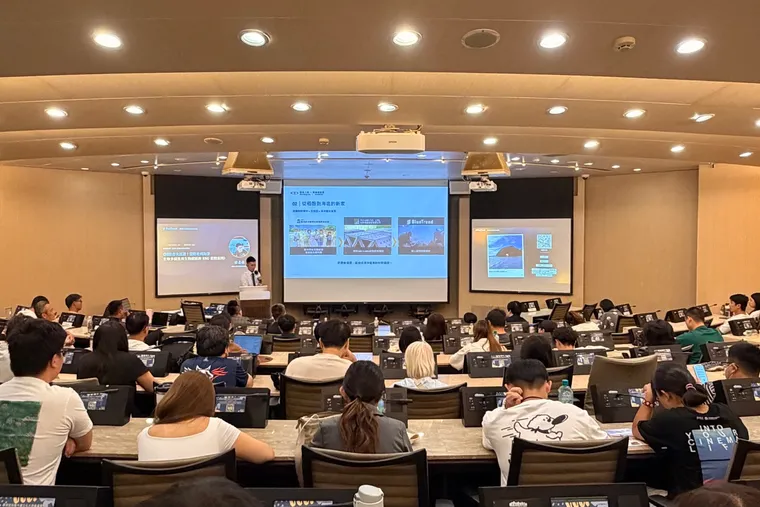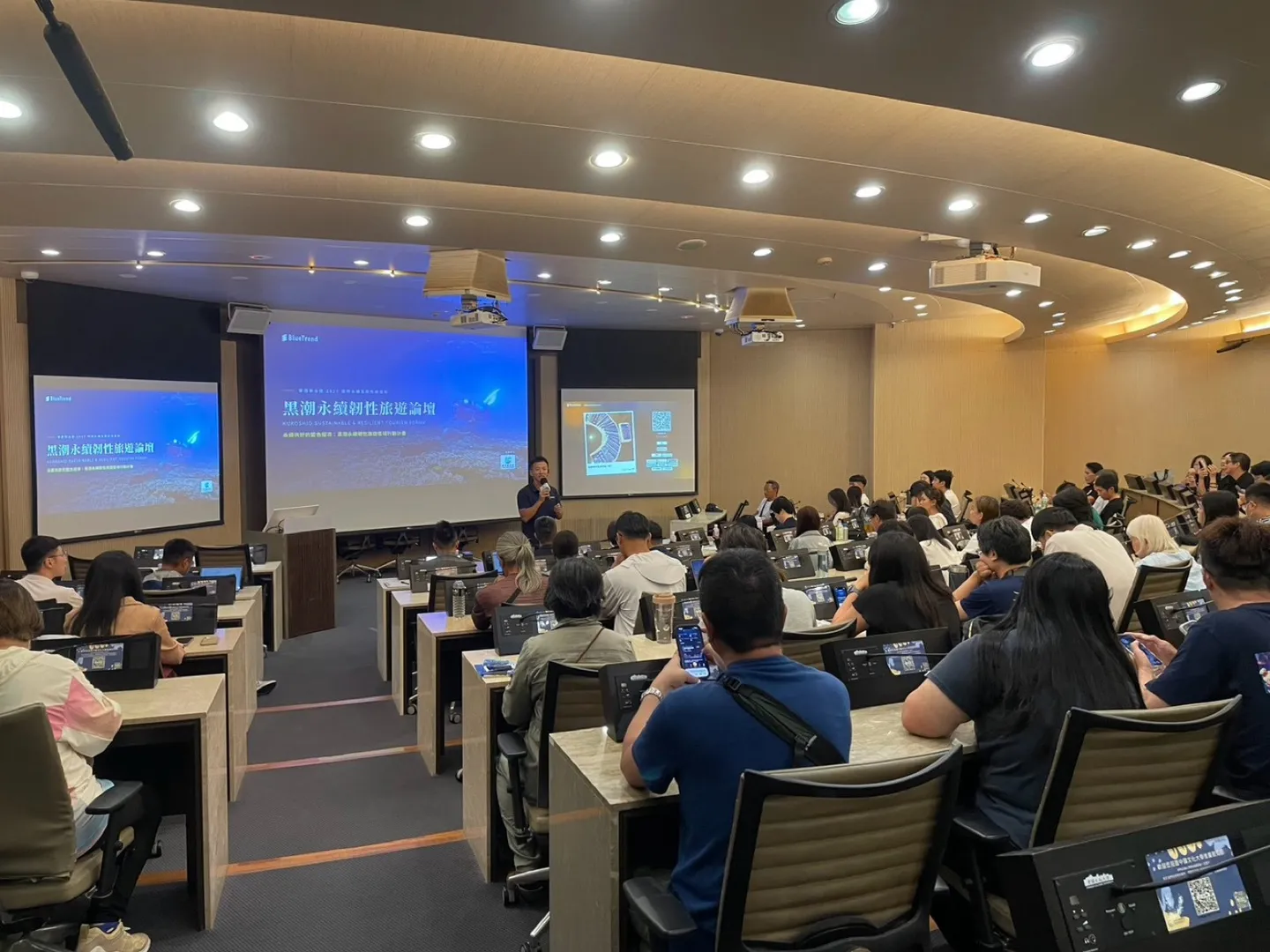
Contents(9)
- What Is Sustainable Resilient Tourism? The Dual Meaning of Industry Resilience and Ecological Resilience
- Ocean Affairs Council International Affairs Division: International Cooperation Along the Kuroshio
- International Sustainable Tourism Trends: 5 Directions from Hawaii, Okinawa, and Boracay
- Tateyama, Chiba, Japan: A Fishing Port Transformed by Sharks, Attracting International Divers
- Malaysia: Sipadan's Journey from Closing Its Resorts to a 50-Diver-Per-Site Brand
- Taiwan Diving: Industry Resilience Through Diversification from a Single Customer Source
- Cross-Domain Panel Discussion and TaiwanBlue: Taking Resilience from Individual Operators to the Whole Industry
- A Summary for Operators and Travelers: How Tourism Can Add Value to Existing Industries
- Conclusion: The Resilience of the Blue Economy Comes from Diversification and People Who Live with the Sea
For the blue economy to stand the test of time, the key lies not only in how many visitors are attracted, but in whether the industries that depend on the sea have the capacity for diversified development — avoiding over-reliance on a single customer base or a single product. At the "Kuroshio Sustainable Resilience Tourism Forum" held by BlueTrend on October 18, 2026, the first session centered on this very issue, inviting representatives from the Ocean Affairs Council's International Affairs Division, NextT Asia (Asia's travel innovation accelerator), the Tateyama City Office in Chiba Prefecture, Japan, the Tourism Malaysia Taipei Office, and Taiwan Diving to share how different regions are building industry resilience in marine tourism through diversification.
This article summarizes 3 key takeaways from the first session. First, global resilient tourism trends are shifting from measuring "numbers" to measuring "value." Second, the cases of Tateyama, Chiba and Malaysia show that tourism can add value to existing fisheries and marine resources, allowing the same stretch of ocean to simultaneously support fishing, diving, dining, and accommodation. Third, Taiwan Diving drew on more than 20 years of operating experience to explain how dive businesses can achieve long-term sustainability by moving beyond reliance on a single customer segment — experience diving — toward education, family programs, and industry networking.
The forum was supported by the Ocean Affairs Council, and all 130 spots were filled during the registration period. The second session, themed "Data Ocean," focused on the ecological resilience of coral reefs. For details, see the second summary article.
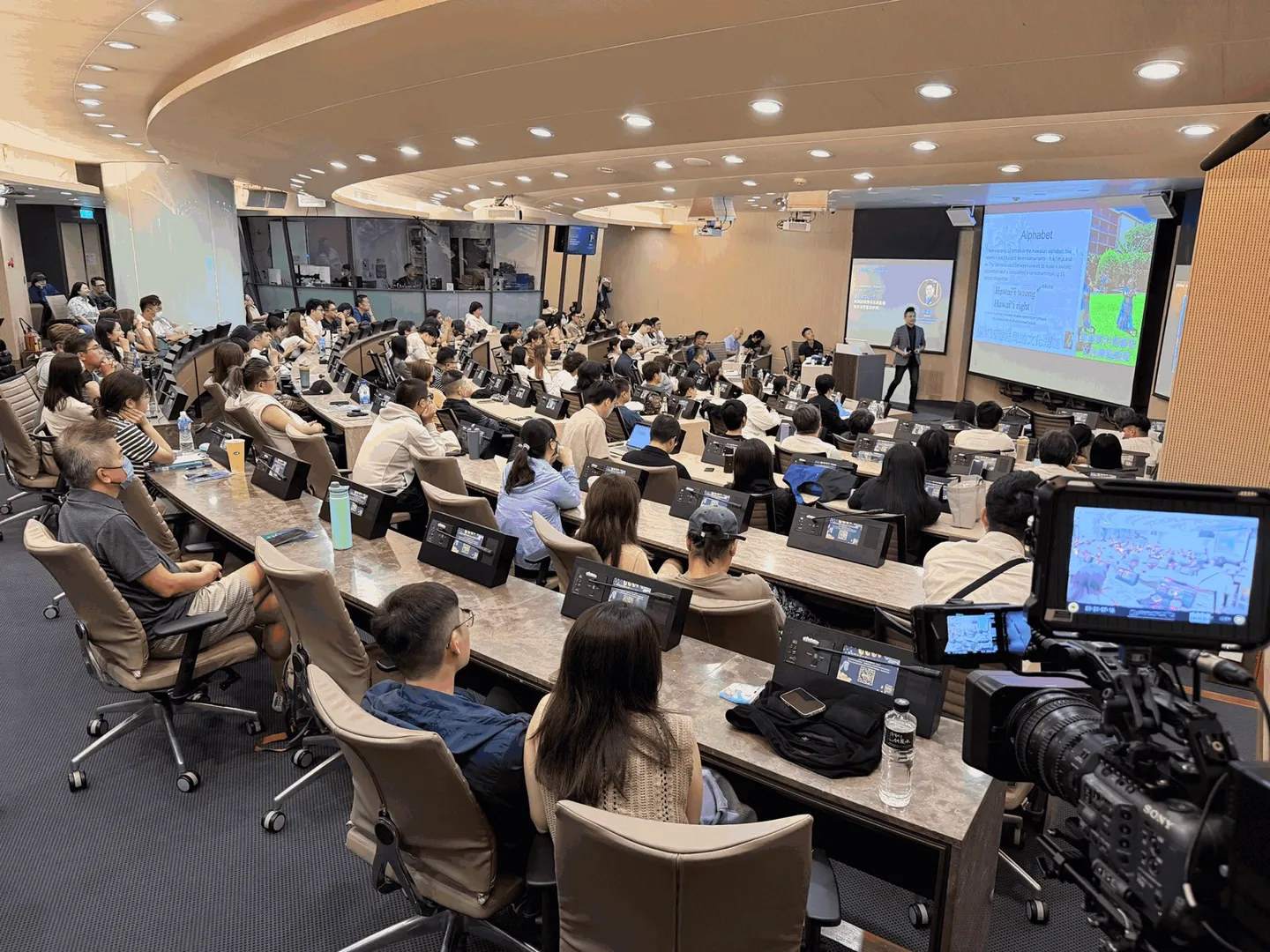
What Is Sustainable Resilient Tourism? The Dual Meaning of Industry Resilience and Ecological Resilience
"Resilient tourism" was a question many attendees had when they registered. Moderator Jerry explained at the opening that resilience carries two layers of meaning: industry resilience and ecological resilience. Taiwan is an island embraced by the Kuroshio Current, endowed with abundant marine resources. Finding the most appropriate blue economy model that balances marine conservation with economic development is the very core of promoting sustainable resilient tourism.
The forum also resonates with the United Nations' 2027 International Year of Sustainable and Resilient Tourism. The first session's theme was "Reshaping the Ocean: Linking Sustainable Tourism with the Blue Economy," with speakers responding from the perspectives of international trends, local government, national tourism branding, and private operators to the same question: when the tourism market faces disruption, how can sea-dependent industries keep going?
Looking across the first session's presentations, industry resilience is not simply a function of revenue scale. The key to ensuring that an industry does not disappear when a single market weakens is diversification — having more than one income stream, more than one customer segment, and a deep enough connection with local existing industries, residents, and the marine ecosystem.


Ocean Affairs Council International Affairs Division: International Cooperation Along the Kuroshio
Li Shan-Ying, Director of the Ocean Affairs Council's International Affairs Division, delivered opening remarks on behalf of the OAC and summed up the council's role in a single sentence: "Anything related to the sea is related to us." She noted that in the council's current international exchanges, two topics attract the most attention: the grey zones of maritime security, and ocean sustainability.

Director Li also mentioned the direct impact of climate change on marine tourism. She recently visited Palau, where the iconic Jellyfish Lake had almost no jellyfish to be seen before March of this year. If marine ecosystems are damaged, tourism brands built upon them will lose their foundation.
Countries Along the Kuroshio Must Act Together
Director Li responded to the significance of naming the forum after the Kuroshio. The Kuroshio flows from the Philippines through Taiwan and on to Japan — a corridor known in security discussions as the "First Island Chain," and in sustainability discussions as a marine biodiversity corridor.
Taiwan is an ocean nation. It's impossible for us to achieve much on sustainability by ourselves. It's not enough to just take care of our own surrounding waters — we all need to do this together.
She gave the example of a humpback whale cow recorded in Taiwan's eastern waters, which was later identified as having also appeared in Philippine waters. When marine life connects the waters of different nations, sustainability must be a shared regional concern — which is also why the forum invited speakers from Japan and Malaysia to present alongside Taiwanese counterparts.
International Sustainable Tourism Trends: 5 Directions from Hawaii, Okinawa, and Boracay
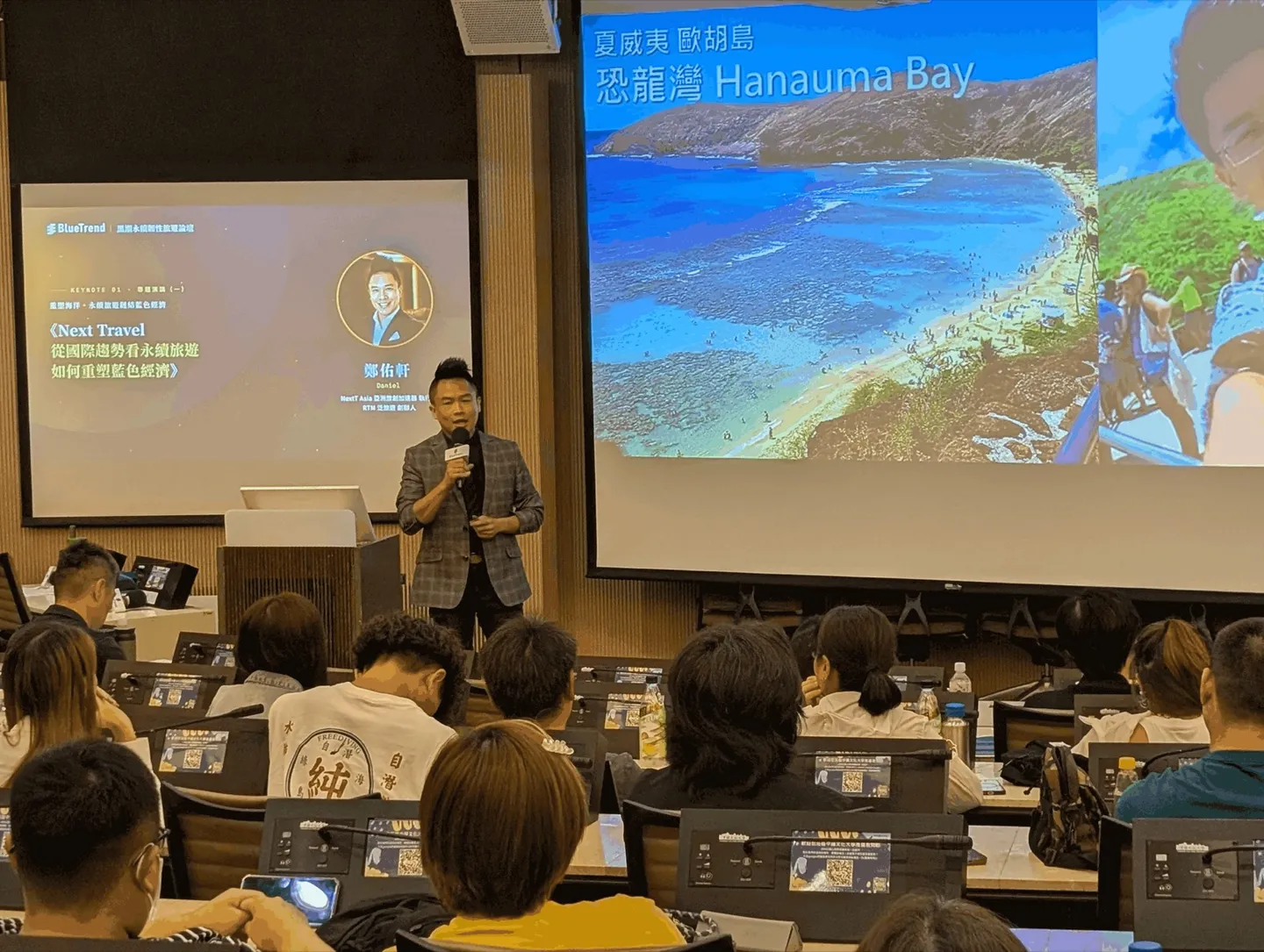
The first keynote speaker was Daniel Cheng (鄭佑軒), CEO of NextT Asia and founder of RTM Pan-Tourism. A former marketing representative for the Hawaii Tourism Authority's Taiwan office, Daniel makes four to five trips to Hawaii each year and drew on personal experience to outline 5 international trends in the blue tourism economy.
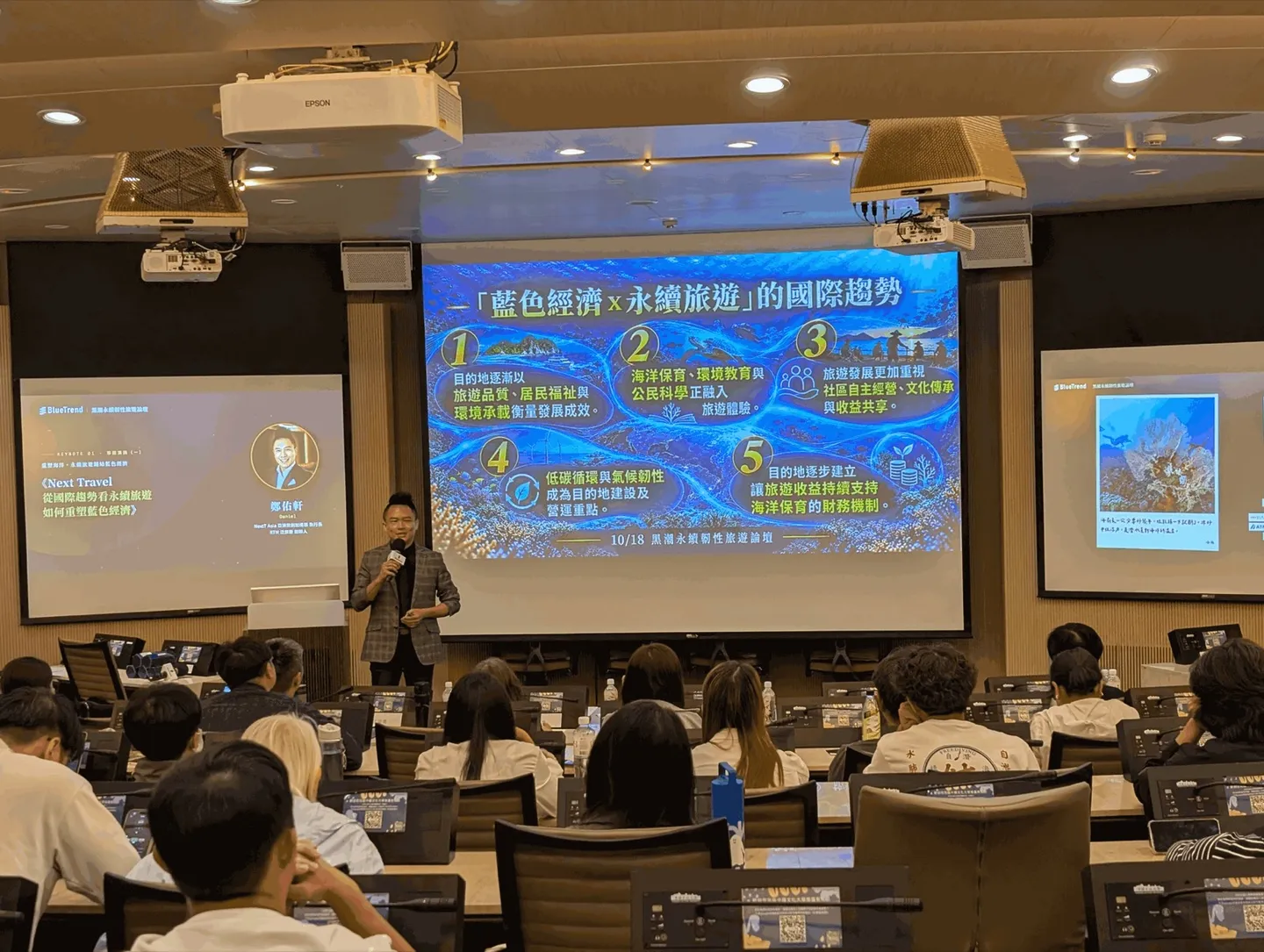
| Trend | Representative Case | Approach |
|---|---|---|
| From quantity to value | Hanauma Bay and Lanikai Beach, Hawaii | Visitor caps at attractions; some beaches ban tour operator promotion |
| Conservation integrated into tourism experiences | Okinawa land-based coral nursery | 900 JPY admission; coral restoration experience at 4,000 JPY, funded by corporate ESG programs |
| Cultural heritage and revenue sharing | Historic guesthouse in Ogimi Village, Okinawa | Elders serve as guides; revenue returned to the community |
| Climate resilience as a construction priority | Boracay and Maui | Island closure and remediation; rebuilt with disaster-resistant materials |
| Blue finance | Waikiki, Hawaii | Restricted hotel construction drives up room rates; tax revenue fed back into conservation |
From Quantity to Value: Recalling and Reprinting a Travel Book
Daniel shared a real-life experience. His team once invited bloggers on a two-week trip to Hawaii and published a travel book that featured Lanikai Beach on Oahu's northeast coast. After residents protested, local authorities ruled that tour operators and tour buses could not promote the beach, limiting access to individual visitors only. After the book was published, the Hawaii Tourism Authority pointed out the issue, and the team recalled every copy on the market and reprinted it — at an additional cost of NT$300,000.
This case demonstrates that restricting commercial activity is itself a policy tool for protecting local environments. For travel agencies, being unable to enter a full-capacity attraction creates operational headaches and forces operators to adjust itinerary timing — but this is precisely how policy sacrifices short-term commercial interests for environmental protection.
Climate Resilience and Blue Finance: Short-Term Pain, Long-Term Gain
Boracay was closed for six months in 2018 for comprehensive remediation. According to Daniel, the number of hotels on the island fell from over 700 to around 150, and the resident and working population dropped from roughly 70,000 to about 19,000. When it reopened, it transformed from a party island into a model of a sustainable destination. Maui suffered devastating wildfires in 2023 that caused severe damage to the historic town of Lahaina; reconstruction used materials more resistant to natural disasters, and visitor numbers have recovered to 83% of pre-disaster levels.
Daniel concluded that value is not the same as headcount and revenue, and that the importance of the environment takes priority over residents, whose rights in turn take priority over commercial interests.
Sacrificing commercial interests is actually short-term pain, long-term gain. On the day you open, you should already be thinking about 50 years of business.
Tateyama, Chiba, Japan: A Fishing Port Transformed by Sharks, Attracting International Divers
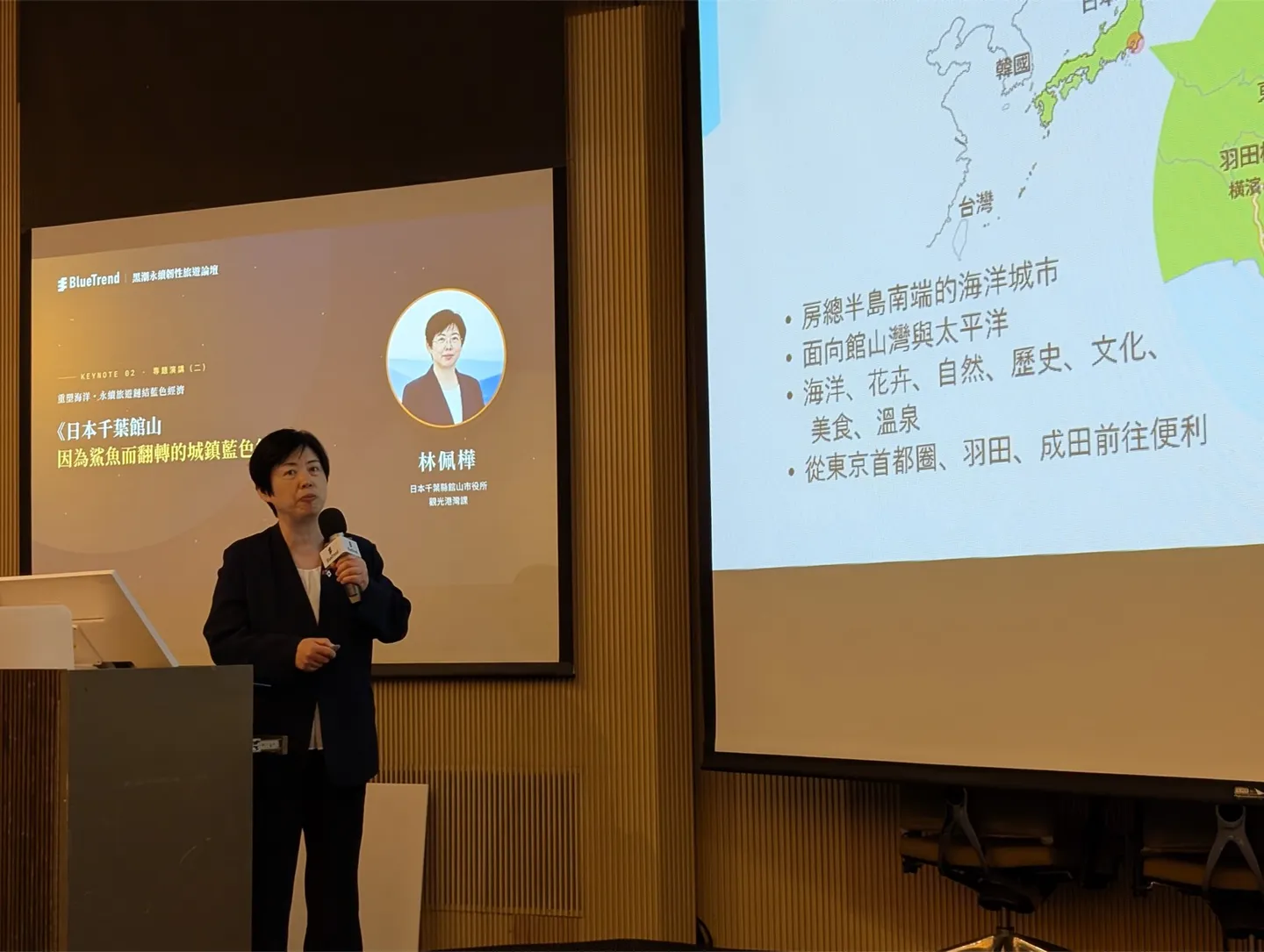
The second speaker was Lin Pei-Hua from the Tourism and Port Division of the Tateyama City Office in Chiba Prefecture, Japan — the only Taiwanese staff member in the division, responsible for tourism exchanges with Taiwan.
Tateyama City is located at the southernmost tip of the Boso Peninsula, facing Tateyama Bay and the Pacific Ocean, with a coastline stretching 34.3 km — right along the path of the Kuroshio Current. It is approximately a 2-hour drive from Narita or Haneda Airport. Lin Pei-Hua noted that the sea is not merely a tourism resource for Tateyama's residents; it is deeply intertwined with the fishing industry, food culture, and everyday life.
Dive Shops and Fishing Ports Overlap Almost Entirely on the Map
Lin Pei-Hua placed a map of Tateyama's fishing port locations side by side with a map of its dive shop locations — the two overlapped almost completely. She noted that in some parts of Taiwan, the diving industry and the fishing industry come into conflict over the use of marine waters. In Tateyama, however, dive operators must stay on top of weather, ocean currents, and fishing activity every single day, and over time this has built a close cooperative relationship with the fishing ports.
Here, we don't completely separate the fisherman's sea from the tourist's sea — everyone shares one ocean together.
The Shark Storm at Ito: From a Fishery Nuisance to an International Dive Site
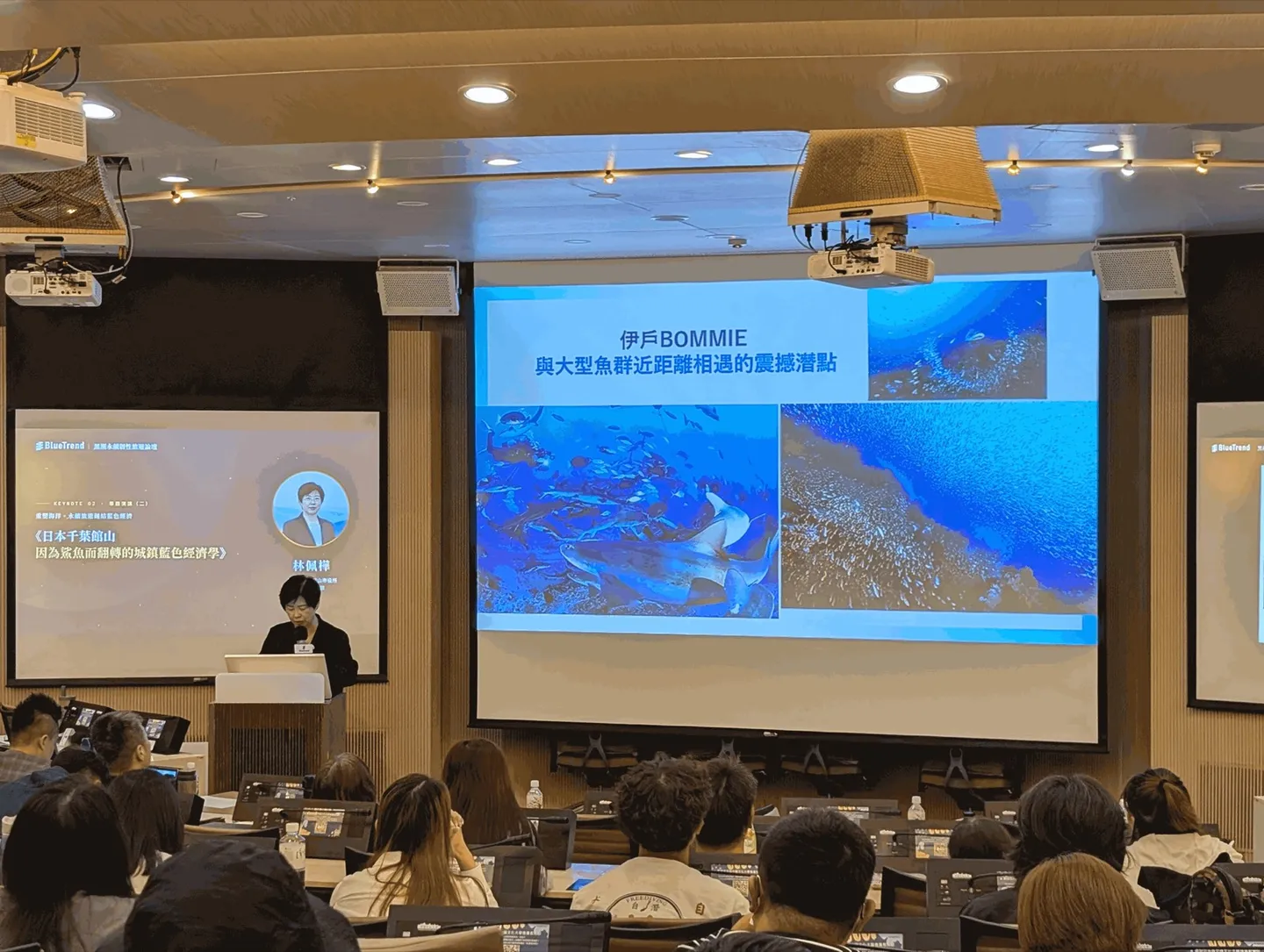
The most representative case is the dive shop BOMMIE in Ito. When the owner, Mr. Harada, opened the shop, he proactively consulted local fishermen and learned that banded houndsharks frequently entered the fixed set nets, injuring or killing the catch inside — a long-standing problem for the fishermen. Mr. Harada dove in himself to understand the situation, then began thinking about how to transform this fishery nuisance into a resource for diving tourism.
He subsequently began using small fish provided by fishermen — fish unsuitable for sale — as feed, gradually building an association between the banded houndsharks and diving activities. Today, the moment divers enter the water, the sharks gather, creating a "shark storm." Local operators report that at peak times, numbers can reach around 400. What was originally a predominantly fishing-focused stretch of ocean has thus become a destination drawing international divers.
The significance of this case is that tourism did not displace the fishing industry — it added value to it. Fish unsuitable for sale found a new use; sharks that had been a nuisance to fishermen became the reason international divers make special trips; and the fishing industry and the diving industry now share aligned interests. Lin Pei-Hua emphasized that the truly instructive element of this case is not the number of sharks, but the fact that the dive operator first communicated with the fishing community, working together to find a way to coexist.
Tateyama used this as a starting point to extend into natural scenery, historical culture, and culinary tourism. Lin Pei-Hua summarized Tateyama's approach to marine tourism in a single sentence:
Diving is not the destination of the journey — it's the starting point for getting to know Tateyama.
Divers dive in the morning, stroll along the coast in the afternoon, enjoy local seafood, watch the sunset in the evening, and soak in hot springs at night. Tateyama weaves together the ocean, nature, historical culture, and food, extending the spending that diving brings throughout the entire city — a model of diversification that spreads industry risk.
Malaysia: Sipadan's Journey from Closing Its Resorts to a 50-Diver-Per-Site Brand
The third speaker was Hafiz Hazin, Director of the Tourism Malaysia Taipei Office, who presented entirely in English. He opened by referencing the haze that had recently affected Malaysia and Singapore, noting that the impact of the natural environment does not stop at national borders — if a country fails to look after its own environment, neighboring countries suffer too. This view echoed Director Li's points about cooperation among Kuroshio Current nations.
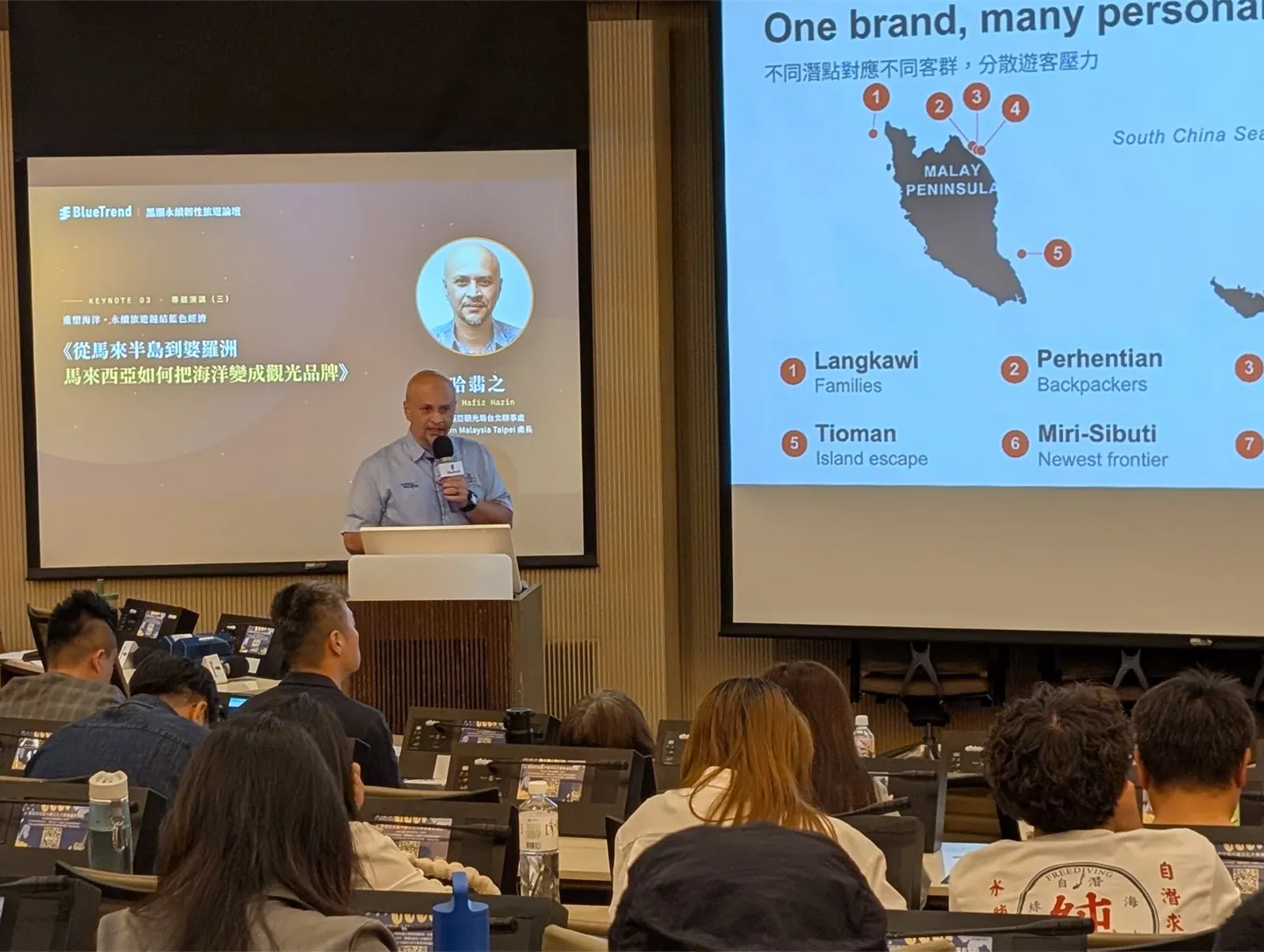
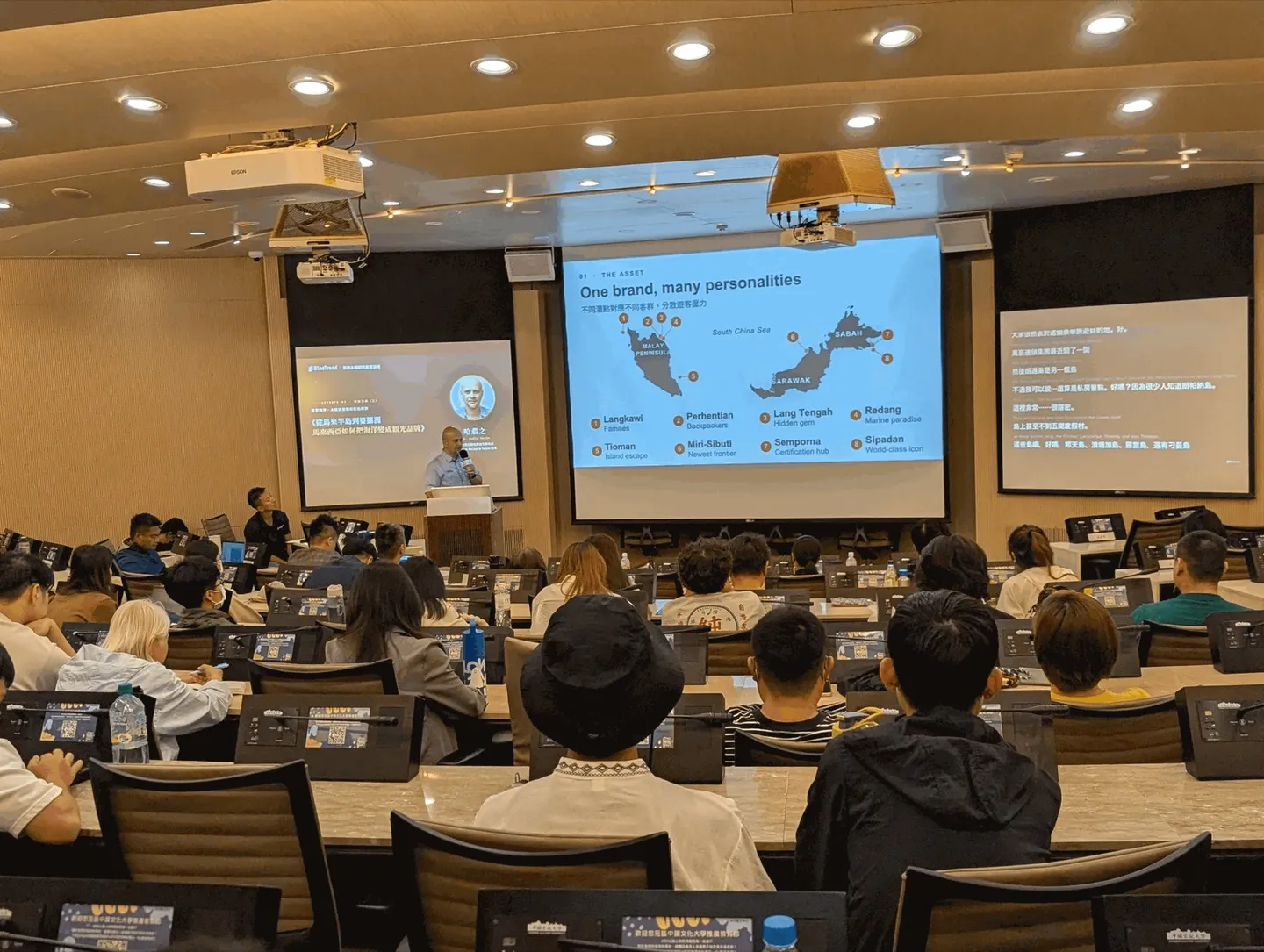
Malaysia comprises two land masses separated by the South China Sea and the Strait of Malacca. It is one of 6 countries in the Coral Triangle and is home to more than 40 Federal Marine Park islands. Hafiz explained that Malaysia's strategy is "one brand, many personalities": Langkawi suits families and first-time snorkelers; the Perhentian Islands are popular with backpackers and have recently attracted international chain hotels; Lang Tengah Island hosts fewer than 5 resorts, making it a relatively secluded choice. The east coast islands close each year from around late November to February due to monsoon season, giving operators time to refurbish facilities while allowing the natural environment to recover.
Sipadan's Turning Point: Making an Unpopular Decision First
Hafiz quoted marine explorer Jacques-Yves Cousteau's description of Sipadan as "an untouched piece of art." Diving operations began on Sipadan in 1993, and as its reputation grew, divers flooded in and the island's ecosystem began to feel the strain.
| Year | Management Measures at Sipadan |
|---|---|
| 1993 | Diving operations begin on the island |
| 2004 | Government orders all island resorts to cease operations |
| 2005–2006 | Daily diving permit system introduced |
| 2009–2015 | Island and surrounding reef areas designated as a protected zone |
| Present | Maximum 50 divers per dive site; no lights on the island at night |
We are not killing a destination — we are creating its scarcity.
Hafiz noted that demand actually increased after visitor numbers were limited, with more people wanting to understand why access was so restricted. Once numbers were controlled, pollution, coral bleaching, and vessel traffic were controlled as well. The no-lights-at-night policy allows marine life to return to its natural habitat undisturbed. In September 2025, Johor State also suspended diving, snorkeling, and visiting activities at 6 islands. He acknowledged candidly that island closures are unpopular with operators in the short term, but that in the long run they allow future generations to continue enjoying these waters.
Limit, Guide, Fund, and Share: 4 Management Mechanisms
Malaysia employs 4 mechanisms to manage high-value ecotourism. The first is limiting numbers, using carrying capacity studies and "Limits of Acceptable Change" as a basis — pre-defining acceptable ranges of change for coral condition, crowding, and water quality, and taking action when thresholds are reached. The second is guiding behavior through zoning, rules, and operating standards. Dive centers are evaluated annually under the Green Fins program, an environmental standard for the diving industry promoted by the United Nations Environment Programme and the Reef-World Foundation.
The third is funding conservation through tourism revenue — for example, the conservation fee at Tioman Island is approximately 30 Malaysian ringgit, roughly equivalent to NT$250. The fourth is sharing management responsibility with communities and NGOs.
Hafiz also noted that approximately 80,000 coastal residents depend on these waters for their livelihoods, which means that marine protected area planning must take community use and commercial fishing into account, and cannot be decided from a tourism perspective alone. The first lesson he drew from Malaysia's experience:
The reef is a product, not a backdrop.
The coral reef itself is the core product of marine tourism, not merely background scenery for an itinerary. Once a reef degrades, the tourism product disappears along with it — so protecting the coral reef is protecting the industry itself.
Taiwan Diving: Industry Resilience Through Diversification from a Single Customer Source
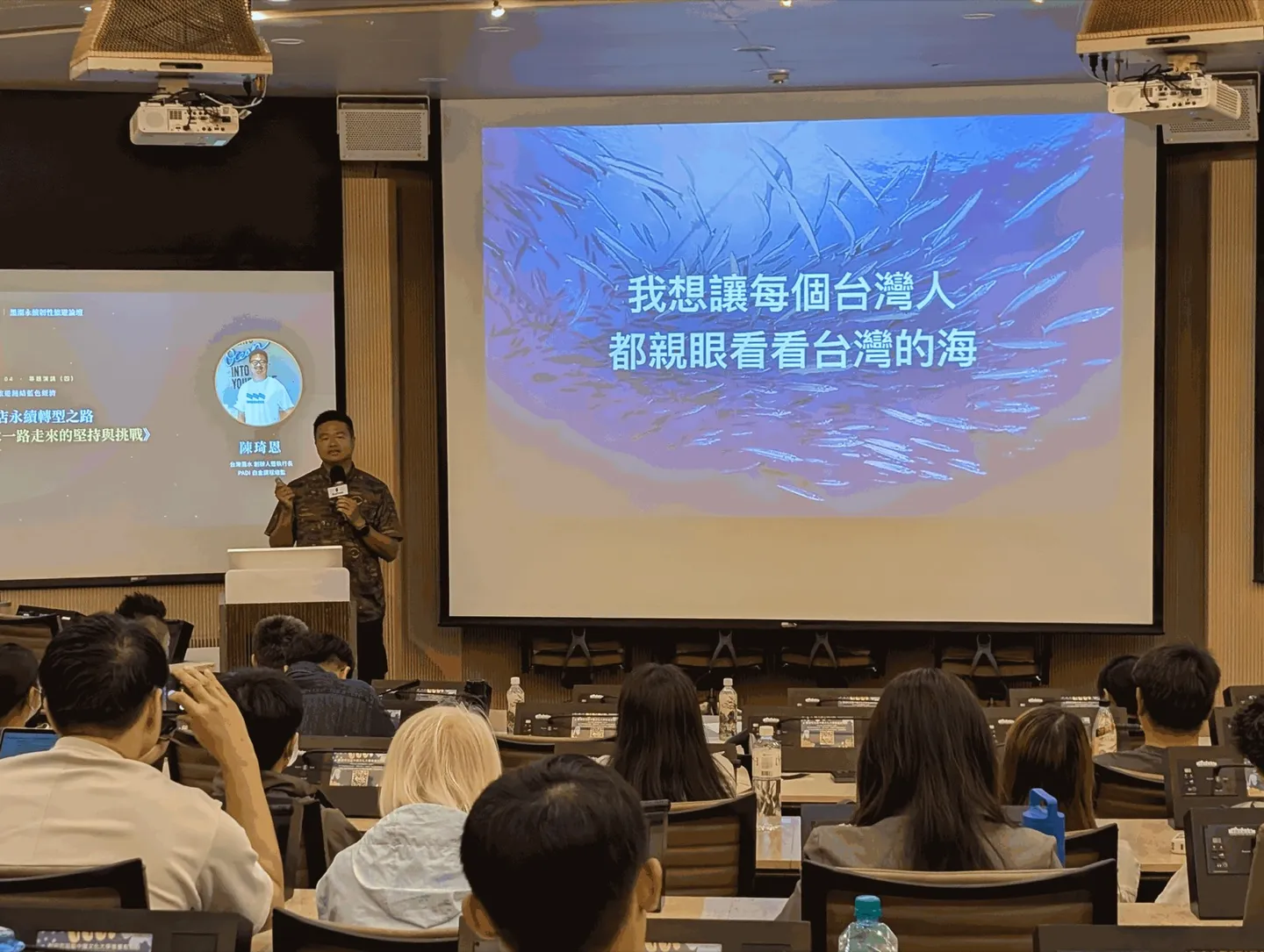
The final speaker of the first session was Chen Chi-En, founder and CEO of Taiwan Diving and a PADI Platinum Course Director. With more than 28 years of diving experience, he has trained over 500 dive instructors. He started the business with NT$50,000, from a corrugated iron shed in Kenting, and now operates locations in Kenting, Xiaoliuqiu, and Green Island.
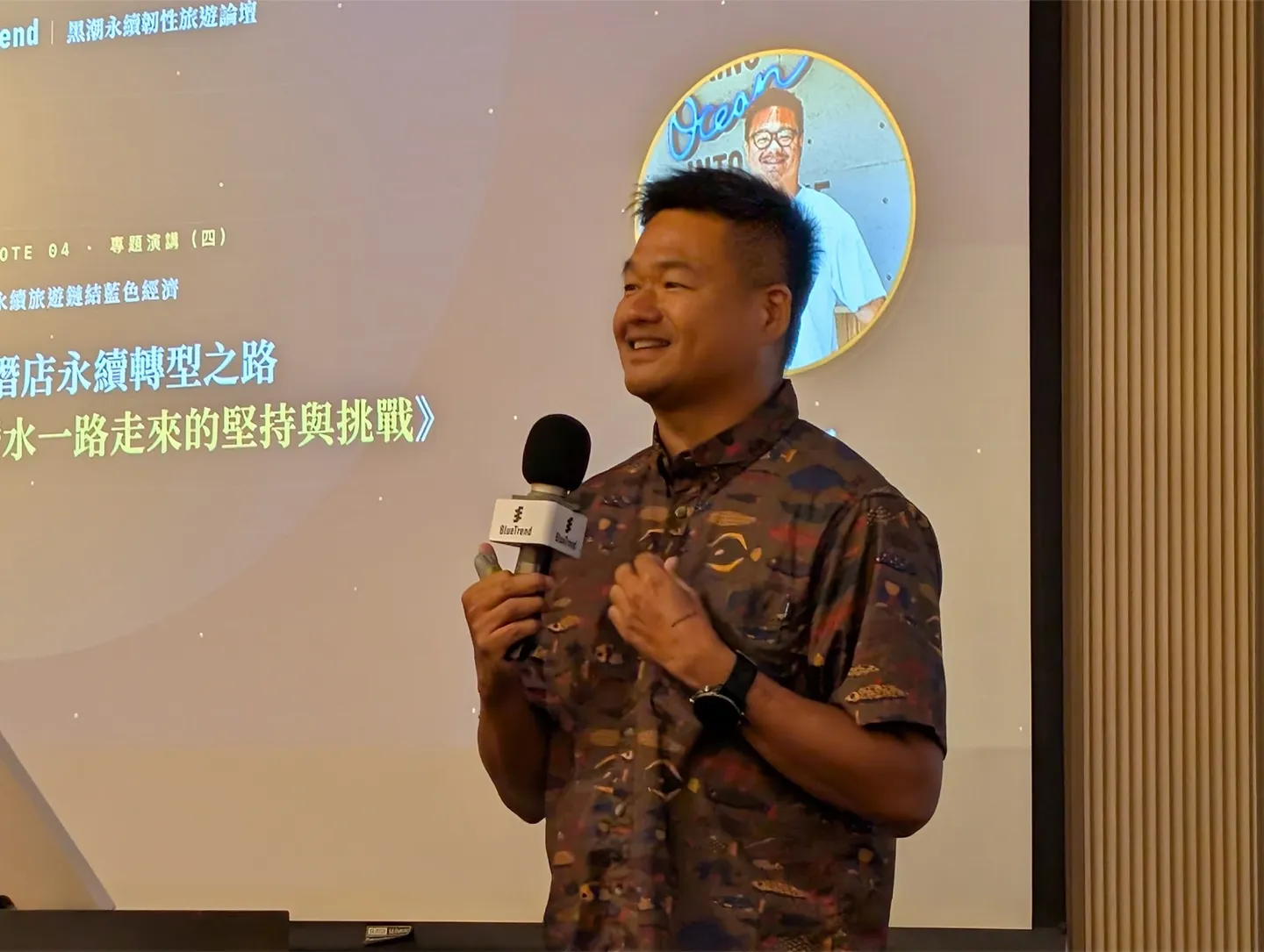
Chen Chi-En grew up in a family that made its living from the sea. At 17 in 1998, he joined his father in marine engineering work, and in his fourth year of university he obtained his dive instructor certification. In 2009 he went to Australia on a working holiday and worked for a cruise company with thousands of employees and hundreds of dive instructors — an experience that first made him think seriously about the scale to which the dive industry could grow.
Those Years of Standing in the Wind
Around 2015, a large wave of mainland Chinese tourists came to Taiwan. Taiwan Diving completed 7,860 experience dives in a single year at one location, with a peak of 150 divers in one day and 50 dive instructors on staff. Chen Chi-En described that period as "standing in the wind" — acknowledging honestly that it was a matter of timing.
Before, I spent every day studying ocean currents. Now I spend every day studying cash flow.
This experience directly illustrates the challenge of industry resilience: when income is heavily concentrated in a single customer source and a single product, any shift in the market delivers an immediate blow to operations. After the mainland Chinese market receded and the domestic tourism market also softened, Taiwan Diving relied on multiple locations in Kenting, Xiaoliuqiu, and Green Island to maintain operations, and still has 30 instructors permanently stationed there. However, the local community initially perceived them as "outsiders coming in to make money" — a remark that became an important turning point for Chen's later investment in the local community.
The Coral Squad: 100 Free Dives Over 5 Years
The turning point came after his son was born. Chen Chi-En began to think about what Taiwan's oceans would look like in 10 years, and whether his child would be able to see them. Taiwan Diving subsequently held a Marine Graduation Ceremony for Kenting Elementary School for 7 consecutive years, expanding from 1 school to 4, and bringing principals and teachers underwater alongside the students. Today, 70 to 80 percent of teachers at Kenting Elementary School hold dive certifications. The schools have also incorporated ocean curriculum into their school-based curricula, from wading in water in Grade 1 to snorkeling in Grade 2, all the way to learning scuba diving in Grade 6.
Taiwan Diving also established the "Coral Squad," offering 20 free dives per year to students from Grade 5 of elementary school through Grade 9 of junior high school — totaling 100 dives over 5 years, which just meets the threshold for applying to become a dive instructor. The costs are covered by revenue from paying customers, with the aim of helping young people believe that staying in Kenting to work as a dive instructor is a path to a good life. Only after more than 7 consecutive years of this effort did the local community truly recognize Taiwan Diving's commitment.
Resilience Means Stringing 50 People Together on One Line
Chen Chi-En's interpretation of resilience was the most grounded in industry reality of any offered during the first session. He used the Taiwanese word for "resilient" (韌) to describe the quality of being hard to knock down.
If my company is very large and all my partners are small businesses, and I fall — everyone falls with me. But if 50 of us are strung together on one line, we're much harder to knock down.
So his next step is not to expand Taiwan Diving, but to "make Taiwan Diving smaller and smaller." This year he established the Hengchun Peninsula Ocean Volunteer Corps, helping teachers obtain Rescue Diver certification, and is promoting the "Taiwan Ocean School" — connecting teams from Duoluman in Hualien, Heping Island in Keelung, and Penghu, and making materials such as fish ID cards and learning worksheets freely available to other dive operators.
Diversification: From Experience Diving to Education, Family Programs, and Digital Nomads
Looking across Taiwan Diving's more than 20 years of development, its product range has expanded well beyond basic experience diving to include Marine Graduation Ceremonies, the Coral Squad, ocean learning materials, volunteer training, and the cross-county Taiwan Ocean School. Chen Chi-En also raised another possibility for Kenting during the discussion: diving in the morning, having coffee at Nanwan, and working remotely on a laptop in the evening — a lifestyle that combines diving with digital nomadism.
This trajectory shows that industry resilience is not about taking a single product to maximum scale, but about developing multiple income streams and customer segments from the same stretch of ocean. When one market softens, the other parts keep running — and the industry survives.
Cross-Domain Panel Discussion and TaiwanBlue: Taking Resilience from Individual Operators to the Whole Industry

The first session closed with a cross-domain panel moderated by Daniel, with Lin Pei-Hua, Hafiz, and Chen Chi-En on stage. Daniel asked Chen Chi-En how things might have turned out differently if, a decade or so ago, there had been no market boom to ride. Chen replied honestly that he might not be standing where he is today. He looked back on the years between 2003 and 2010, when he made weekly trips between Kaohsiung and Kenting to guide customers, yet income was still barely enough to live on — and noted that newly opened dive shops today are unlikely to ever encounter a market environment of 8,000 experience dives in a single year.
This response underlines the importance of diversification. Market windfalls do not come twice; what operators can do is use opportunities when they arise to accumulate resources and convert them into capabilities that do not depend on a single customer source. Chen's concrete advice to operators in the audience was to invest in existing customers — rather than pouring large amounts into advertising budgets, put those resources into the people who are already with you. He also observed that the family market currently has the strongest purchasing power, and that developing diving combined with learning worksheets and ocean education materials into structured courses can help grow revenue.
When asked whether "good business" or "good life" comes first, all three panelists chose good life. Chen added that business is literally "the meaning of flourishing, unceasing life" (生生不息的意義) — customers will only choose to spend with you if they genuinely believe in what you stand for.
The TaiwanBlue Alliance: Legality and Professionalism You Can Look Up
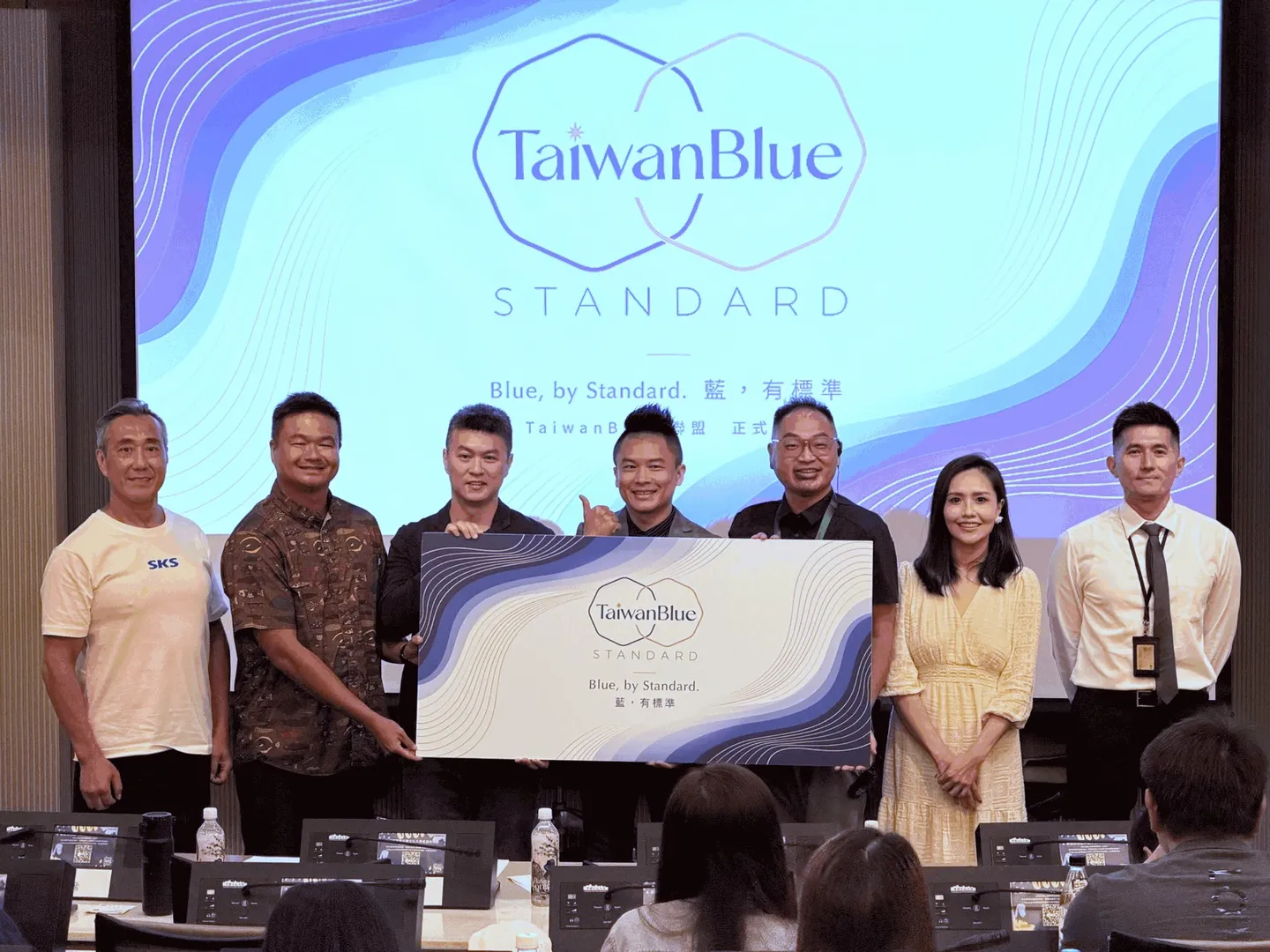
After the panel, the RTM Pan-Tourism Association announced the establishment of the TaiwanBlue Alliance, with co-founder AJ Wang (王烈賢) explaining its purpose. He outlined 4 challenges facing Taiwan's water activities industry. First, output value lacks statistical tracking, making it difficult to access government resources. Second, the market is subject to a race to the bottom, with consumers habitually using price as their primary selection criterion. Third, local, national, and international standards are inconsistent. Fourth, there is no unified brand to represent Taiwan's water activities sector to the outside world.
Our citizens are gambling when they go out on the water. Operators are running their businesses on conscience.
TaiwanBlue's goal is to establish Taiwan's first cross-discipline joint certification organization for water activities. In the future, certified operators will be featured in dedicated sections on travel agency platforms and online travel platforms, allowing domestic and international consumers to easily find operators who are legally compliant, insured, and professionally qualified. This aligns with the Green Fins standards mentioned by Hafiz, and represents the first step for Taiwan's water activities industry from individual operation toward collective resilience.
For the certification mark to take real effect in the field, it needs not only operator participation but also corporate support. We are grateful to Shin Kong Security and the Shin Kong Life Charity Foundation for joining TaiwanBlue. Shin Kong Security plans to collaborate with the TaiwanBlue Alliance around the themes of "water safety advocacy" and "smart safety services," combining safety education, site risk assessment, and technology applications — and linking these with existing marine conservation experience — to support sustainable tourism that embodies both industry resilience and ecological resilience.
A Summary for Operators and Travelers: How Tourism Can Add Value to Existing Industries
Looking across all 4 cases in the first session, the common thread of resilient tourism is not scale — it is diversification: tourism does not replace existing industries, but layers on top of them, allowing the same stretch of ocean to support multiple industries.
| Case | Existing Foundation | How Tourism Added Value | Source of Industry Resilience |
|---|---|---|---|
| Tateyama, Chiba, Japan | Fisheries and fishing ports | Banded houndsharks from set nets became a shark storm dive site | Diving and fishing share one ocean, creating aligned interests |
| Sipadan, Malaysia | Coral Triangle marine resources | Limited permits create scarcity and high value | Conservation fees fed back into management; livelihoods of 80,000 coastal residents protected |
| Hawaii | Island tourism | Restrictions on construction and visitor numbers; tax revenue returned to conservation | Using value to select visitors rather than chasing headcount |
| Taiwan Diving | Experience diving in Kenting | Ocean education, family programs, and local empowerment | Multiple locations, multiple products, and industry networking to spread risk |
For operators, the direction offered by the first session is clear: rather than chasing the next wave of customers, find the connections between your business and the local fishing industry, community, and marine ecosystem — and develop from those connections a range of products and customer segments that form a value proposition that is difficult for others to replicate. For travelers, choosing operators with deep local connections who are willing to respect carrying capacity limits is a concrete act of support for the sustainable operation of the marine industry.
For more on the diving environment in Tateyama, see the Tateyama Ito shark diving record. For diving information on Malaysia's east coast, see the Sabah Semporna travel guide.
Conclusion: The Resilience of the Blue Economy Comes from Diversification and People Who Live with the Sea
From the Ocean Affairs Council and international trends to Tateyama, Malaysia, and Kenting, the first session conveyed a single consistent message: the resilience of the blue economy does not rest on a single popular attraction or a single customer source — it is built on the diversified development and deep interconnection between tourism, fisheries, education, and community. Any market can weaken, but people and industries that live in step with the sea, as long as their income sources are varied and they are connected to one another, can keep going.
This is also why we took action at this forum: co-founding the TaiwanBlue Alliance with RTM Pan-Tourism Association, Taiwan Diving, and other partners — building a foundation of legal compliance so that operators' professionalism can be verified, consumers can choose with confidence, and government agencies have a clear point of contact. Diversification requires a shared starting point of mutual trust, and legal compliance is that starting point — and the most grounded first step toward advancing Taiwan's blue economy and resilient tourism.
The second session, themed "Data Ocean: The Fundamental Cornerstone of ESG Practice," featured the Shin Kong Life Charity Foundation and National Kaohsiung University of Science and Technology sharing data on coral reef ecological resilience and monitoring. For that content, please see Is a Higher Coral Cover Always Healthier? The Kuroshio Forum Examines Marine Ecological Resilience Through Penghu Coral Restoration. For any feedback on the forum content or the TaiwanBlue Alliance, please reach out to us via the BlueTrend LINE official account.
Further reading: Penghu Biochar Coral Restoration Brick Field Report: Sustainable Resilient Tourism You Can Dive Into
This article is compiled from the first session of the 2026 Kuroshio Sustainable Resilience Tourism Forum. The forum was organized by BlueTrend and supported by the Ocean Affairs Council.