Contents(5)
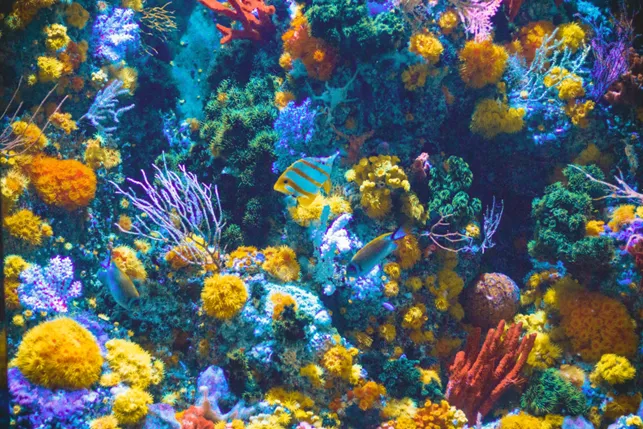
Beyond the colorful coral and fish that populate the shallows, a touch of green can also be found along the seafloor. These plants, growing at the boundary between land and sea, are seagrasses. They may seem unassuming within the marine ecosystem, yet they play an extraordinarily important role in carbon reduction, ocean ecology, and even our daily lives.
High Efficiency, Vast Coverage: Blue Carbon Emerges as a Key Carbon Sink
As the world moves toward net-zero emissions, natural "carbon storage reservoirs" that absorb and store carbon dioxide are indispensable. These reservoirs are broadly divided into three categories: green carbon, yellow carbon, and blue carbon. Green carbon refers to terrestrial plants such as forests and bamboo groves that absorb and store CO₂. Yellow carbon encompasses soils — farmland, black earth, permafrost, and the like. Blue carbon refers to riverine and marine organisms capable of storing carbon, exemplified by the so-called "three blue carbon treasures": mangroves, salt marshes, and seagrass beds. Blue carbon has attracted growing attention in recent years because its carbon sequestration efficiency surpasses that of both green and yellow carbon. Furthermore, since the majority of Earth's surface is covered by water and ocean, storing carbon sinks on the seabed offers greater stability. This article focuses on seagrass beds — one of the three blue carbon treasures — exploring their carbon sink benefits, ecological contributions, and the crises they now face.


The Indispensable "Meadows" of the Ocean
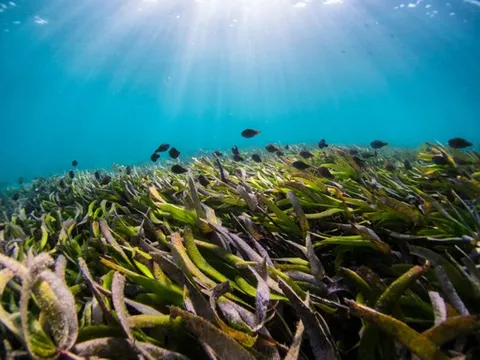
Seagrasses are flowering plants that live in shallow marine waters. Unlike the common algae that attach to rocks, seagrasses have roots, stems, and leaves. Their root systems anchor firmly in the substrate to absorb nutrients, and they carry out photosynthesis. Seagrasses play a vital role in coastal ecosystems: they serve as habitat for many marine organisms and as food for sea turtles, dugongs, and other marine life. Like "meadows" of the ocean, they underpin the shallow-water ecosystem.
Beyond providing critical habitat and nutrition for marine life, when seagrass beds reach a sufficient extent, they form a natural breakwater along the coast, reducing the height and intensity of waves and thereby preventing coastline erosion. The root systems of seagrasses stabilize sediments, making them an important front line in protecting coastal communities from the impacts of flooding.
Research has also found that seagrass beds deliver remarkably high carbon-reduction benefits. Their carbon sequestration efficiency is 40 times greater than that of terrestrial forest soils. The National Oceanic and Atmospheric Administration (NOAA) notes that seagrass beds store carbon at a rate 3 times higher than tropical rainforests and 10 times higher than terrestrial grasslands.
A 7% Annual Decline: Seagrasses Face a Disappearing Crisis
Although seagrasses are just a small part of the ocean, their significance to the sea, the climate, and society is immense. Yet in recent years, seagrasses have been confronting multiple crises. Research indicates that before 1940, seagrasses were disappearing at roughly 0.5% of their area per year; since 1990, however, that rate has accelerated to 7% per year — a severity comparable to that of tropical rainforest and coral reef loss. One key driver is rising sea temperatures caused by global warming. Between 2010 and 2011, a marine heatwave struck Shark Bay in Australia, causing the mass die-off of 1,000 square kilometers of seagrass beds and releasing 9 million tonnes of CO₂ into the atmosphere. Shortly thereafter, another heatwave in Western Australia killed seagrasses in that region, further depriving local dugongs of their food source.
Another threat to seagrass comes from human development and pollution. For example, Professor Lin Hsing-Juh, a distinguished professor in the Department of Life Sciences at National Chung Hsing University, has pointed out that Taiwan may have already lost one-third of its seagrass. Seagrasses are extremely sensitive to environmental change; turbid water conditions alone can prevent them from photosynthesizing, ultimately causing them to die. In many areas of Taiwan where seagrasses are found — such as Kenting and Penghu — harbor construction and coastal development have disturbed the seagrass environment, leading to further degradation. By contrast, the seagrass communities of Dongsha Atoll, having been subjected to relatively little human disturbance, maintain comparatively stable populations.
Seagrass Conservation and Its Challenges
In recent years, the importance of seagrasses has gained increasing recognition. For instance, in 2020, seagrass bed ecosystems were formally incorporated into the Global Biodiversity Framework and the Convention on Biological Diversity (CBD). Domestically, the Ocean Conservation Administration issued the Seagrass Restoration Guidelines last year. The restoration principles outlined in the guidelines include "prioritizing the protection of existing seagrass beds," "eliminating the factors causing seagrass decline," and "creating a favorable environment to support the recovery of seagrass beds," enabling governments and organizations to restore seagrass beds in ways tailored to local conditions. The Fisheries Research Institute of the Council of Agriculture has also made progress in seagrass restoration in Penghu through asexual propagation techniques.
Nevertheless, many technical challenges remain to be overcome. Professor Lin Hsing-Juh has noted that current knowledge of seagrasses is still insufficient, making it difficult to determine the precise sunlight, temperature, and other conditions required for their growth. Hsu Chia-Min, an assistant researcher at the Eastern Fisheries Research Center of the Fisheries Research Institute — the unit responsible for seagrass restoration on the main island — has also pointed out that the number of seedlings currently available in Taiwan is inadequate, and that continued coastal development and pollution could undermine the effectiveness of restoration efforts.
As the Seagrass Restoration Guidelines state: "Seagrass restoration should not be regarded as compensation for, or a substitute for, coastal development, and must not replace the protection of healthy habitat. Truly sustainable restoration should prioritize improving environmental conditions and addressing the root causes of decline, in order to facilitate the natural recovery and expansion of seagrass beds." The importance of seagrasses to ecosystems, the climate, and humanity reveals just how inseparably connected species are to one another. As environmental crises become an ongoing reality, we must rethink how humans can coexist with the natural environment in a healthier and more sustainable way.
References
- Mongabay, Why saving seagrass meadows could help save the world's coastlines
- NOAA, Understanding blue carbon
- PNAS, Accelerating loss of seagrasses across the globe threatens coastal ecosystems
- 中央社, AI淨零/台灣1/3海草床消失無性繁殖之外更待播種復育| 生活 | 中央社 CNA
- 海洋保育署, 海草復育指引
※ This article is reproduced from the Delta Electronics Foundation's Low-Carbon Living Blog: 〈Are the Ocean's "Meadows" Disappearing? Why Seagrass Beds Matter for the Climate?〉, co-produced with BlueTrend.