Contents(9)
- Full Six-and-a-Half-Hour Recording: Three Keynote Lectures and Panel Discussion
- "Completely No Data": Not Even Statistics Broken Down by Fishing Method
- Research Proposals Rejected: The Data Gap Is Institutionally Created
- "We Cannot Judge Friendliness by the Fishing Method"
- Tribal Experience: The Frontline of Community-Led Conservation Is the Fishers Themselves
- Observations from One of the Organisers: Six Dimensions
- Compared with the Current Draft: The Alliance's Three Calls to Action
- Appendix: Quotable Statements with Timestamps
- Notes and Sources
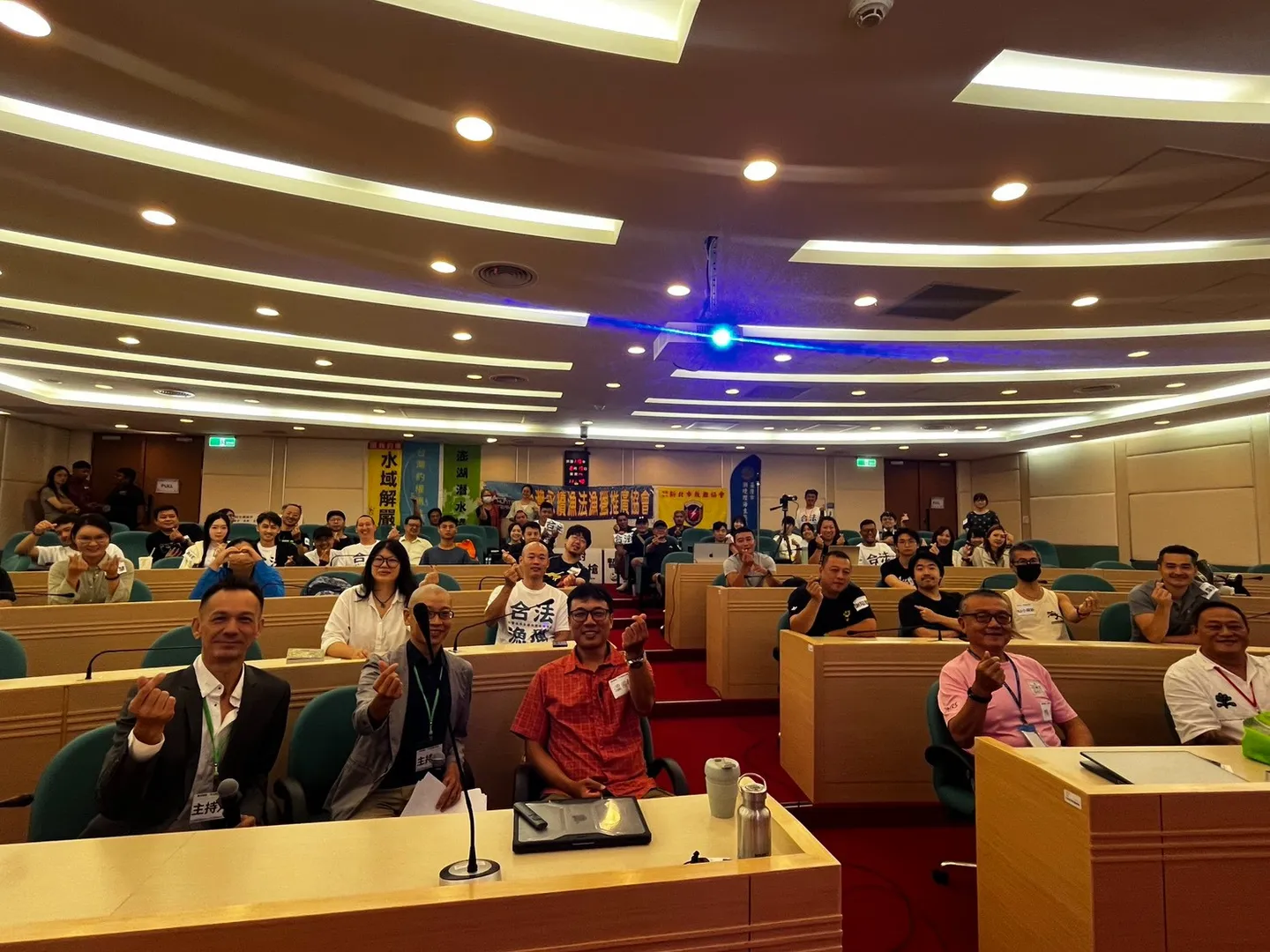
【Taipei】A seminar titled "Marine Conservation Is More Than Prohibition: Toward Good Governance and Sustainable Use in Taiwan's Coastal Ocean Management" was held on 15 August 2026 at Academia Sinica, co-organised by the Coral Reef Laboratory of the Biodiversity Research Center at Academia Sinica, the Center for General Education at Taipei Medical University, the Center for Marine Leisure Industry and Yacht Development at National Taiwan Ocean University, the Center for Ecology and Environmental Research at Tunghai University, the Taiwan Ocean Sustainable Leisure Harvest Alliance, and the Taiwan Freediving Development Association. Three scholars delivered keynote addresses examining ecological conservation, resource management, and local culture respectively, while Hsu Cheng-yu, founder of Yung Sheng Ocean, joined the panel discussion to explore how Taiwan's coastal waters might strike a balance between prohibition and openness.
The three lectures each stood independently, covering reef habitat ecology, fisheries resource management, and Indigenous ocean knowledge, while the panel discussion focused on enforcement and precautionary management. Key points from each speaker are summarised below.
A note on citations in this article: The three speakers were invited by the organising institutions to present their research and experience. All statements represent their individual professional opinions, do not reflect their position on any specific policy case, and do not constitute an endorsement of any group's claims. This article was compiled and published by the Taiwan Ocean Sustainable Leisure Harvest Alliance, one of the co-organisers; all excerpting and editorial arrangement was carried out by the Alliance, which takes full responsibility for the content. Please refer to the video recording for complete remarks.
Full Six-and-a-Half-Hour Recording: Three Keynote Lectures and Panel Discussion
The full recording runs 6 hours 27 minutes and includes all three keynote lectures and the panel discussion. The timestamps marked throughout this article can be used to jump directly to the relevant moments for verification — you need not rely solely on these excerpts.


"Completely No Data": Not Even Statistics Broken Down by Fishing Method
Professor Chen Chaolun, a research fellow at the Biodiversity Research Center of Academia Sinica, noted in his keynote that a thorough search of the fisheries yearbooks published by the fisheries authority turns up no statistical category for "coral reef fisheries" or "coastal reef-zone fisheries." Regarding the intensity of various harvesting methods — rod-and-line, nets, spearguns — his conclusion was that there is "completely no data whatsoever."
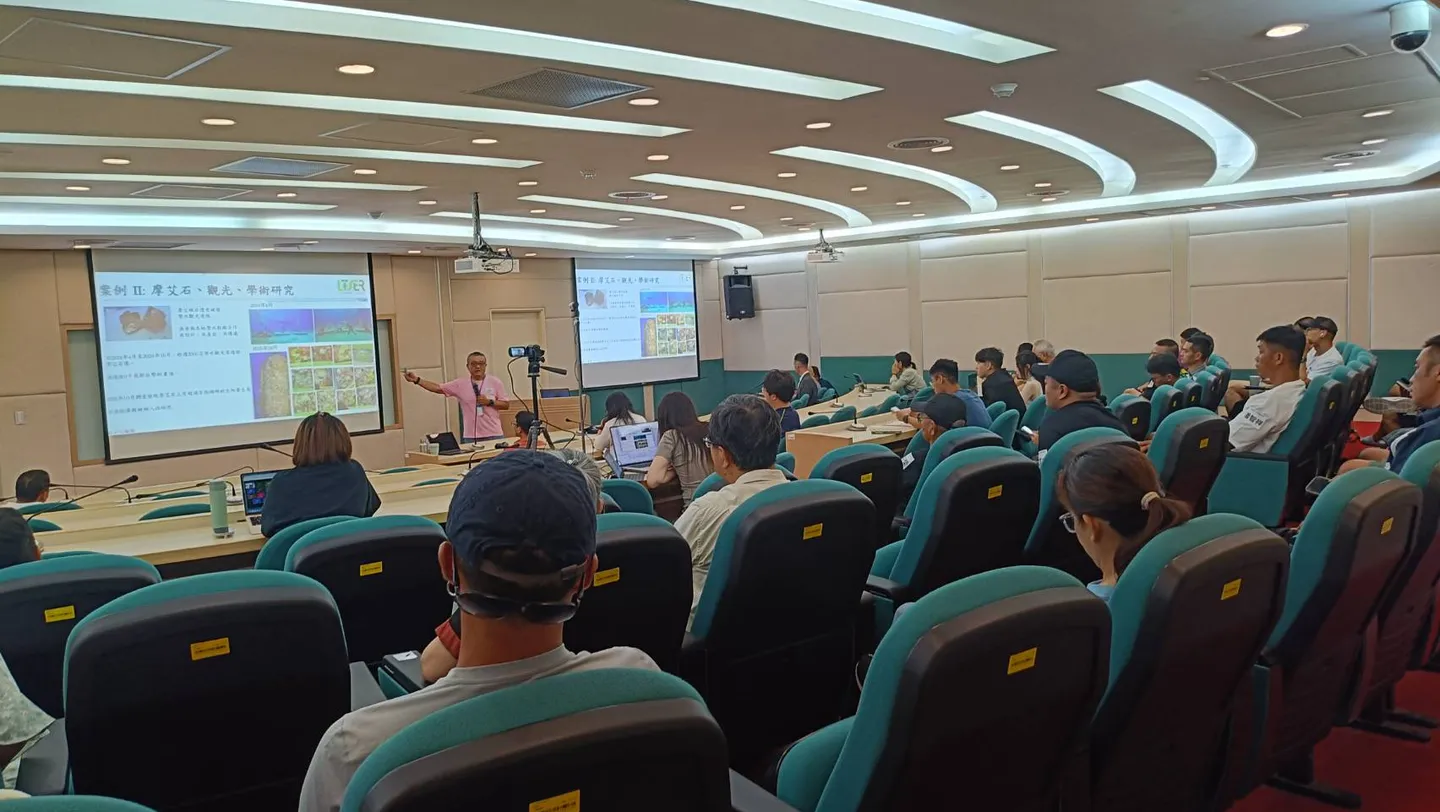
The lecture centred on the crises confronting Taiwan's rocky reef and coral reef habitats, identifying overfishing, habitat destruction, marine pollution, and climate change as four "historical collective failures." He used comparisons of catch sizes from the 1950s to the present across multiple countries to illustrate the widespread phenomenon of "big in the past, small today."
Chen also highlighted that the northern Taiwan and Northeast Coast regions feature "non-reefal coral communities" that are fundamentally different from the tropical coral reefs of Kenting, Green Island, and Orchid Island — characterised by fewer species but high biomass of individual species. The diversity generated by different ecological environments means that "the rules for resource management and use should essentially differ," and it would be inappropriate to transplant management models from other sea areas wholesale.
"We cannot expect the management rules for these rocky reef communities in northern Taiwan to be identical to those for Kenting, Green Island, Orchid Island, and Xiaoliuqiu. Entirely different management rules need to be established for them."
Research Proposals Rejected: The Data Gap Is Institutionally Created
Professor Wen Kuochang of the Department of Life Sciences at Tunghai University recounted that years ago he applied for a research project to survey the size distribution of coral reef fish, only to have reviewers conclude it "did not look like a scientific survey" and suggest it be handed to the Taiwan Fisheries Research Institute or the fisheries authority — which in turn deemed the commercial value of such fisheries too low, with research priorities directed toward pelagic species such as tuna and sailfish. The outcome: "over the past several years we truly have had absolutely no data."
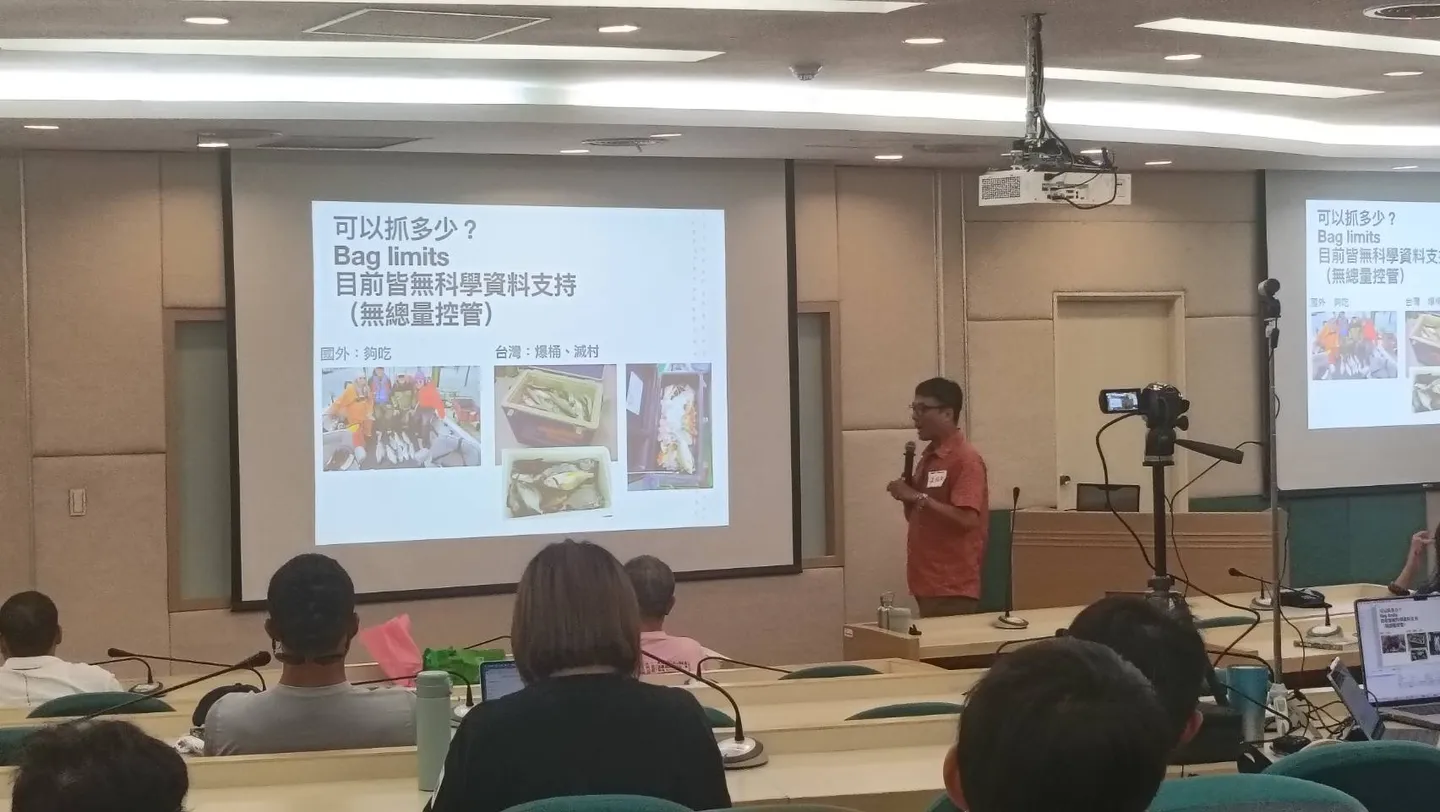
Wen stressed that he has long supported marine protected areas (MPAs), "but an MPA is not necessarily a blanket prohibition." Internationally, successful cases almost always involve zonal management developed through consultation with stakeholders.
He also laid out the scientific principles behind size-based management: the minimum size limit should ensure individuals have reproduced at least once before being harvested, while maximum size limits should protect large, highly fecund individuals. Using Grouper as an example, a 35 cm Grouper can produce approximately 7,000 eggs, whereas a 90 cm Grouper can produce up to 280,000. (The figures in this paragraph were corrected by Professor Wen Kuochang in a written communication after the event; for the Grouper example, these corrected figures supersede the approximate numbers stated verbally in the recording.)
During the panel discussion, Wen also stated that he does believe some individuals do illegally harvest undersized specimens, and he supports setting limits by specific species, location, and quantity. He also argued that current penalties are too low and should be raised. On the choice of regulatory tools, he offered the following observation:
"I genuinely do not know of any jurisdiction that bans only spearguns, or any country that bans only spearguns while allowing recreational fishing and diving harvest."
"We Cannot Judge Friendliness by the Fishing Method"
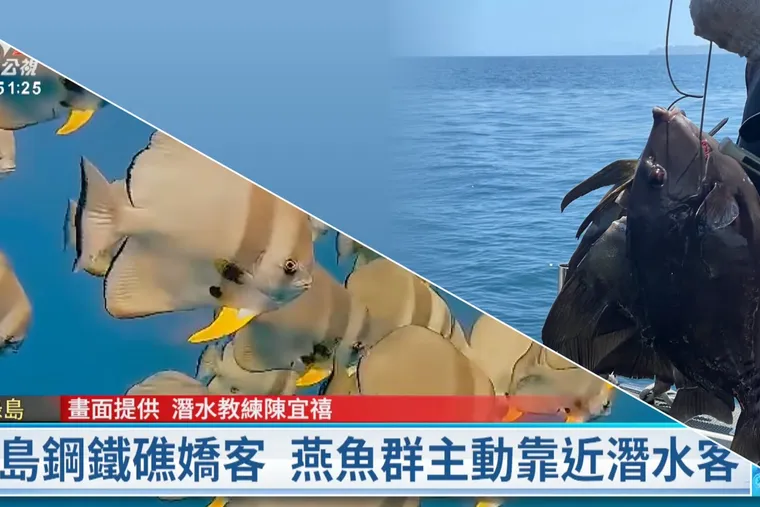
Hsu Cheng-yu, founder of Yung Sheng Ocean, who joined as a panel discussant, offered a different perspective from the standpoint of commercial fisheries management. He noted that every fishing method exists for a reason and serves a purpose, and that "spearguns are a fishing method just like nets and lines." He cited harpoon sailfish fishing as an example: it also operates on the principle of a spear, yet has long been regarded as one of the most eco-friendly fishing methods.
"What is the biggest speargun? The one called the most eco-friendly fishing method — harpoon sailfish fishing. Does that count as a speargun? We cannot judge the friendliness of a method by the tool used. That is not a scientific approach."
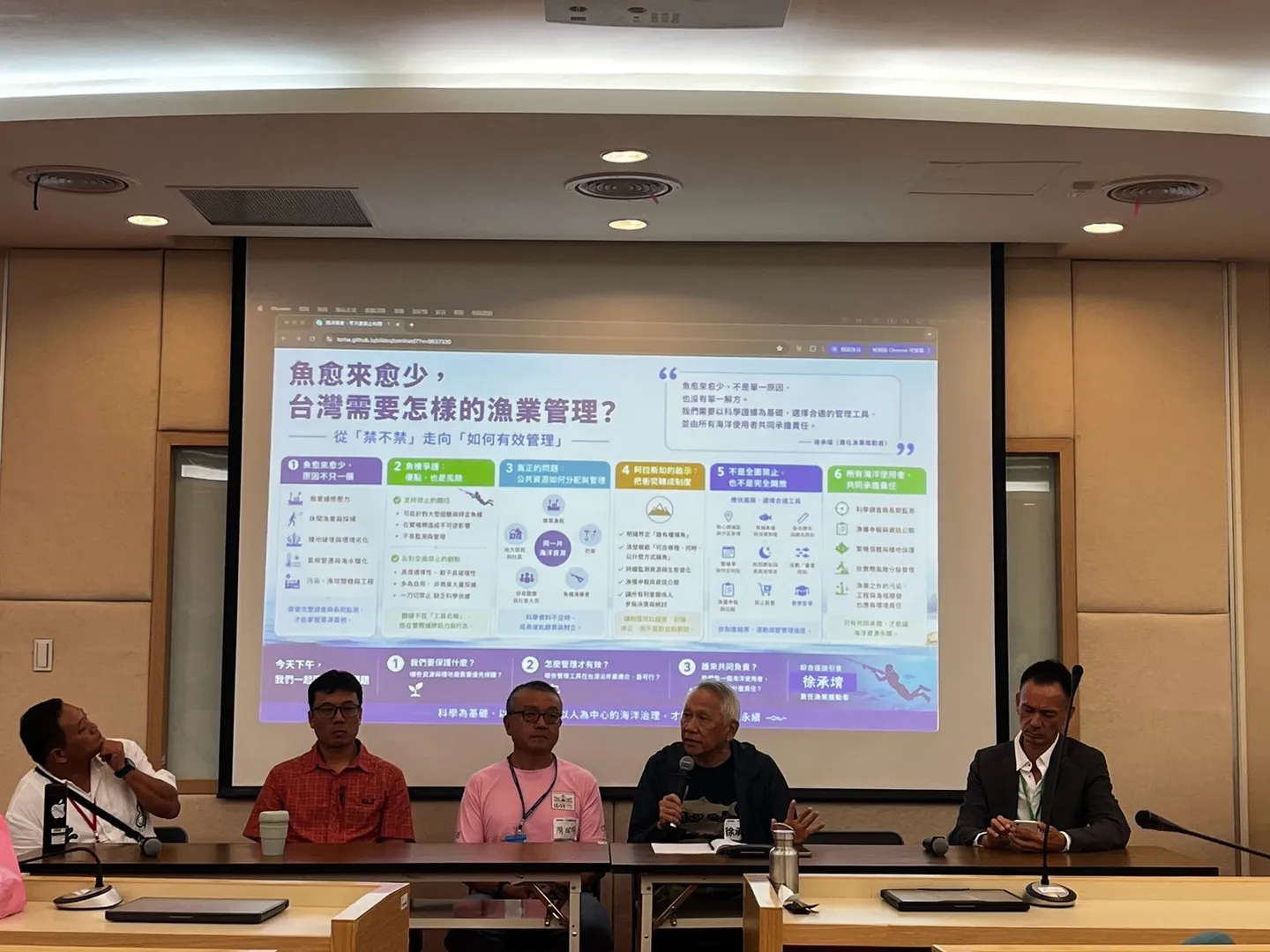
Hsu also identified funding as the fundamental bottleneck in enforcement. Resource surveys, regulation drafting, and actual enforcement all require resources; he advocated for a user-pays mechanism that would directly link management funding to use.
Notably, Hsu expressed positive views on the current draft regulations, saying he is "very, very much in favour" of the proposal because it "opens up a conversation in which everyone can discuss and come to understand the industry we are dealing with." At the same time, he observed that the draft "places a very high degree of focus specifically on spearguns." He also stated plainly that the long-term repeat offenders "are just a handful of the same people," and that without addressing them, it will be difficult to hold other users to account.
Tribal Experience: The Frontline of Community-Led Conservation Is the Fishers Themselves
Tsai Chengliang, professor in the doctoral programme in Austronesian Studies at National Taitung University and director of the National Museum of Prehistory, shared the community-led conservation journey of the Dulan tribe in Taitung. Since 2016, the Dulan tribe's age-grade organisations have established their own rules, including a nighttime ban on harvesting parrotfish (daytime harvesting is not banned, as it already requires considerable skill), and in recent years the tribe has promoted catching lobster by hand to avoid accidentally injuring egg-bearing individuals with spears or spearguns. The tribe has also established a marine conservation patrol team that conducts coral reef ecological surveys using freediving — since 2023, it has accumulated 162 participant-sessions across 9 surveys.
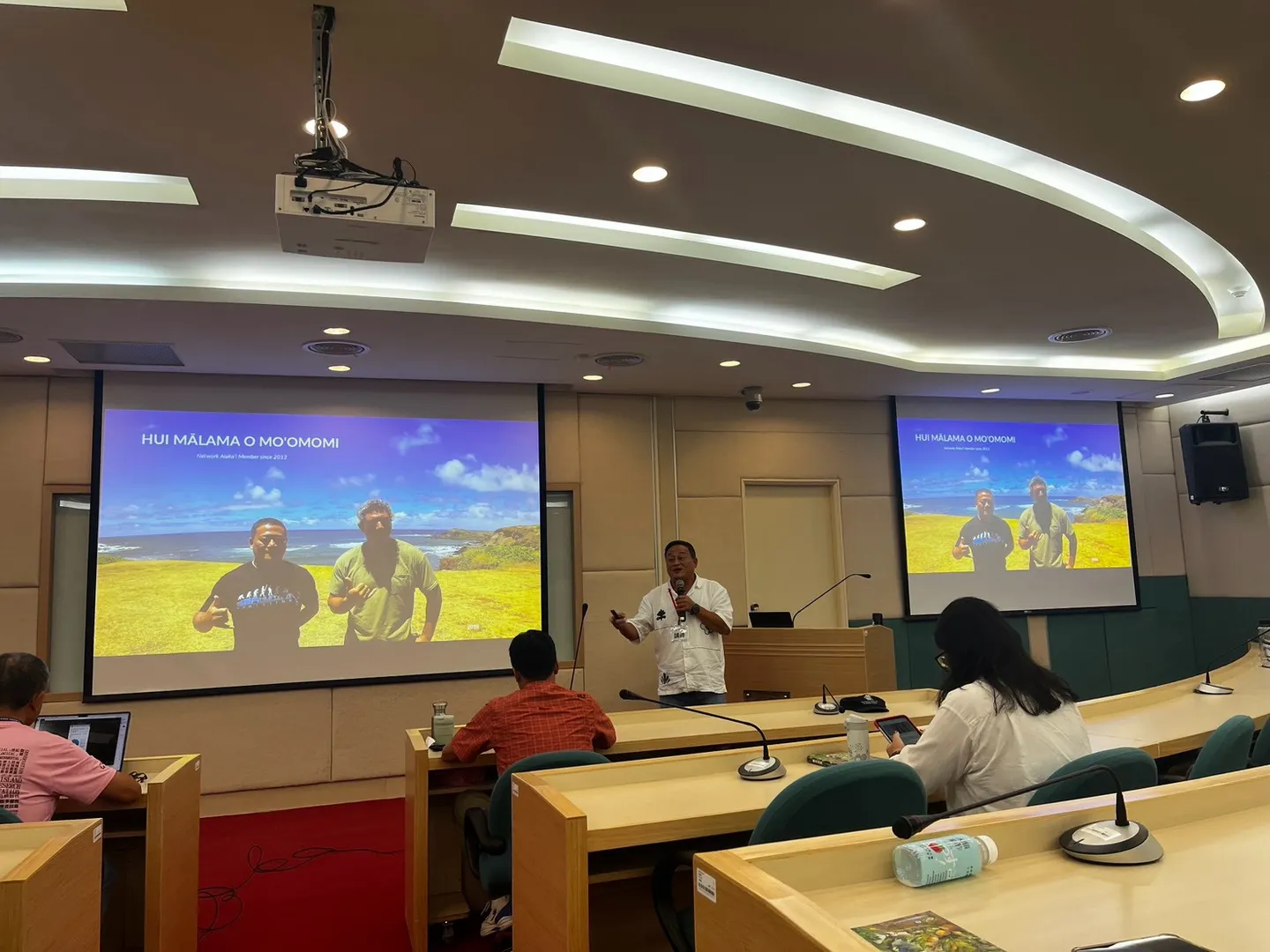
"Doing marine conservation — it didn't come from government agencies, nor from any civic group making demands. It was the tribe's own people who decided they wanted to do this. And who are the driving force? The driving force is entirely the fishers."
Tsai also discussed international examples: the Ra'ui system of the Cook Islands allows elders to judge when a given area should be closed and when it should be reopened — it functions as a "rotational rest" rather than a permanent ban. In Hawaiʻi, he noted, legislation establishing Community-Based Subsistence Fishing Areas (CBSFAs) was enacted around 1996, allowing communities to propose the protection of their own waters, with law explicitly defining the obligations of both government and civic groups and requiring public hearings to be convened.
Observations from One of the Organisers: Six Dimensions
The Taiwan Ocean Sustainable Leisure Harvest Alliance stated that, drawing on all three lectures and the panel discussion, six dimensions can be identified:
- The data gap is structural: the competent authority has long failed to invest in baseline surveys for coastal reef zones and recreational harvest.
- A protected area does not equal a total ban: the international mainstream approach involves zonal, species-specific, and size-based management, developed with stakeholders through consultation.
- Different sea areas should have different rules: the temperate coral ecosystems of the north and the tropical coral reefs of the south are fundamentally different, and rules should not be transplanted directly from one to the other.
- Regulation should be based on harm, not on tools: distinguishing eco-friendliness by the name of a fishing method lacks scientific grounding.
- The laws exist; the capacity to enforce them does not: the problem lies in funding, personnel, and incentive structures.
- Community self-management is viable: the empirical experience of the Dulan tribe demonstrates that user communities can be the main force in conservation.
The above summary represents the Alliance's own synthesis of the conference proceedings and does not constitute a joint opinion or collective statement by the speakers. Each speaker's words are authoritative only as reflected in the verbatim transcript and video recording.
Compared with the Current Draft: The Alliance's Three Calls to Action
The following represents the position of the Taiwan Ocean Sustainable Leisure Harvest Alliance, not the views of the speakers.
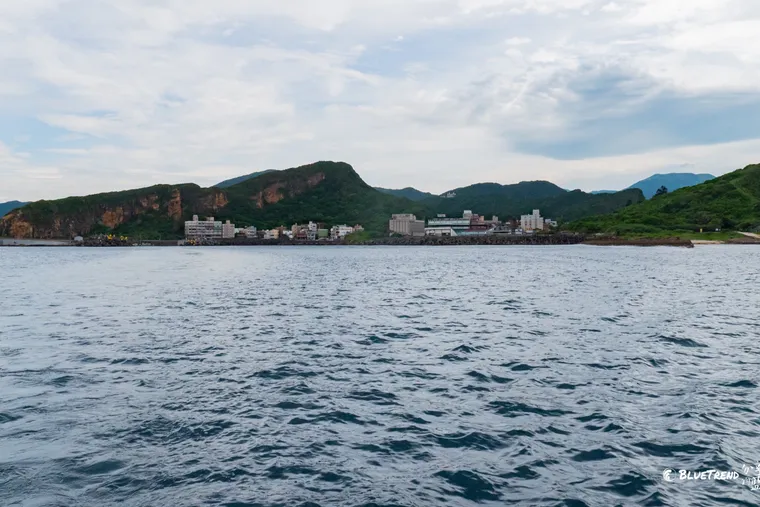
The issues discussed at this seminar correspond directly to a draft regulation currently open for public comment by the New Taipei City Government: the "Gongliao, Wanli, and Ruifang Aquatic Plant and Animal Breeding Conservation Zone and Related Restrictions." The draft prohibits the use of spearguns and diving equipment for harvest within "resource sustainable-use conservation zones," while other fishing gear and methods remain unrestricted. The draft content and arguments from both sides can be found in BlueTrend's earlier summary: New Taipei Marine Protected Area Expands Speargun Ban, Sparking Debate and Enforcement Questions in Gongliao, Wanli, and Ruifang.
The Taiwan Ocean Sustainable Leisure Harvest Alliance stated that it supports marine conservation and supports strict penalties for illegal overharvesting and unlawful commercial sale. Based on the discussions at this seminar, the Alliance puts forward three calls to action:
- Disclose the scientific data underlying the proposed regulations. If a regulation seeks to restrict a specific fishing method, it should explain the data basis and assessment methodology.
- Use actual behaviour and real harm — not tool names — as the regulatory standard. Behaviours such as selling catch commercially, harvesting egg-bearing individuals, and violating size limits should apply uniformly regardless of the gear used. Distinguishing by tool type alone lacks scientific grounding.
- Include enforcement capacity as part of the package. Inspection manpower, funding, and cross-agency coordination mechanisms must be planned alongside the regulatory content; otherwise, the rules will remain unenforceable in practice.
Appendix: Quotable Statements with Timestamps
The excerpts below were selected by the publishing organisation for reporting purposes and do not represent the full scope of any speaker's remarks. For complete context of each passage, please refer to the video recording. Timestamps are keyed to the Facebook livestream archive audio track; when searching in the YouTube version, allow a margin of several minutes.
- "If you go through the entire Fisheries Agency yearbook, there is not a single entry called 'coral reef fisheries' or 'coastal reef-zone fisheries.' As for fishing methods — rod-and-line, nets, and even the spearguns we are concerned with today — how intensive they are, there is completely no data whatsoever." (Chen Chaolun, 01:51:15)
- "We cannot expect the management rules for these rocky reef communities in northern Taiwan to be identical to those for Kenting, Green Island, Orchid Island, and Xiaoliuqiu. Entirely different management rules need to be established for them." (Chen Chaolun, 01:31:08)
- "Basically, my research has always supported marine protected areas, but an MPA is not necessarily a blanket prohibition." (Wen Kuochang, 02:08:29)
- "I genuinely do not know of any jurisdiction that bans only spearguns, or any country that bans only spearguns while allowing recreational fishing and diving harvest." (Wen Kuochang, 05:47:01)
- "What is the biggest speargun? The one called the most eco-friendly fishing method — harpoon sailfish fishing. Does that count as a speargun? We cannot judge the friendliness of a method by the tool used. That is not a scientific approach." (Hsu Cheng-yu, 05:48:04)
- "The laws are all already there. The problem is having laws but no capacity. More new laws, even more laws, really make very little difference." (Chen Chaolun, 05:36:31)
- "Doing marine conservation — it didn't come from government agencies; it was the tribe's own people who decided they wanted to do this. And who are the driving force? The driving force is entirely the fishers." (Tsai Chengliang, 04:46:11)
Notes and Sources
All statements cited in this article were made at a public seminar, and timestamps in the video allow them to be traced and verified. Text has been compiled from the video audio track; please cross-check against the recording before formal citation. Professor Chen Chaolun stated in his lecture that the views expressed are his personal opinions and do not represent the position of his affiliated institution. All three speakers and the panel discussant expressed opinions based on their research and experience; they did not take a position on any specific policy case and did not endorse the claims of any group. The Grouper spawning figures in the article have been corrected per a written communication from Professor Wen Kuochang. The figures on speargun numbers and angler population estimates cited by Hsu Cheng-yu during the panel were based on his own inquiries; readers are advised to verify the sources independently before citing.
- Original press release: Marine Conservation Is More Than Prohibition — Academia Sinica Seminar on Taiwan's Coastal Ocean Governance (published by the Taiwan Ocean Sustainable Leisure Harvest Alliance)
- Seminar record (agenda, speakers, key summaries, on-site photos): ocean-petition-tw.github.io/seminar-record.html
- Full recording on YouTube: youtube.com/live/5XTjSMcEKYo
- Full recording on Facebook: facebook.com/watch/live/?v=1537377560928447
On-site photos in this article are taken from the seminar record page listed above.